To avoid these ads, REGISTER NOW!

Buckling 14x20 slab

ticks_are_fun

Member
Joined
May 1, 2026
Messages
8
I’ve stalked the Journal for quite some time as I’ve tried to find the right approach to fix my 1926 14x20 garage, and now I join the fun.

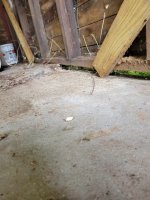
For some background, I live in Flint, MI, where 34% of the population lives in poverty. A lot of garages in the area, even in my nicer neighborhood, need repairs due to the plight we’ve all faced and the lack of maintenance. Mine’s cut from the same cloth. 2 owners ago, someone installed fresh bracing to keep the thing sturdy, and I’ve since installed 2x6s on opposite walls with a come-along and tow strap between them just in case something moves; the slack hasn’t changed in the last year. The pics of the gap beneath the plate are of the right-hand side and are the worst of the damage. The slab has, obviously, sunk on the left, but not to that degree.

To get it out of the way, yes, I’ve thought about demoing the thing. Freeing it of its curse. However, Flint created setback rules of 5’ from property lines, and this guy is 2’ away, but grandfathered in. Grandfathered unless I do a rebuild, and then I lose 3’ of my already small backyard. I’d like to avoid that; otherwise, I’d build a new one in a heartbeat. I’d like to use the garage at all, because fixing my cars in the driveway in the cold isn’t something I enjoy.

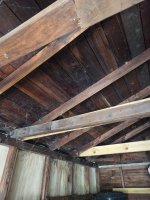
Basically... Where do I start with this? Or, what do I do? The top and bottom plates are toast, and the roof needs a complete rebuild, save for a few rafters and some of the hardwood used back in the day. Some of the lumber needs to be replaced all around, but one step at a time. I can handle that. But the foundation needs a miracle. I’ve thought about polyjacking, or having a contractor come and look, but I think nobody would take the job, or charge far more than I can afford. Or the inspector visits me, and I’m screwed either way. (I looked into getting a variance, but that’s $1700, and my reasoning of not wanting to lose yard space won’t fly.) I plan to reuse as much as possible, as long as the pieces are structurally sound, but it needs a lot. I looked at fresh slabs and metal buildings, but the property setback is what bothers me the most.

My thoughts are to replace the perimeter foundation in segments, as I don’t trust the waterlogged lumber. I would tear the roof off completely, rafters and all, and install kickers and bracing. Then, I’d drop one of the load-bearing walls, replace the plates and any studs needing love, and then pour a proper 1’ footer after cutting the slab, anchor bolts and all. Place a wall, brace, do the one on the opposite side, and pretty it up with rafter ties. The front and back walls aren’t in as poor shape, and the header looks perfect. Replace those parts of the foundation, and then cut new rafters, sheath, and slap on shingles. One day, I’ll tear out the rest of the buckled slab on the interior, but I’m trying not to bite off more than I can chew. I need to figure out a way to keep the weather out, but there’s still time.

For people far more intelligent and skilled at this than I’ll ever be... is this feasible? My qualifications are that I’m semi-competent at most things I do, because I learn as much as possible before attempting a fix outside my field. (I write novels for a living, and my woodworking experience involves trim, chairs, and some interior bracing. I fix my cars and everything around the house.) I have a younger brother who’s taking construction classes at his school, and he’s great at math and loves anything to do with framing. He's already rebuilt our father's porch.

Originally, I wanted to expand to a 16x20, but an expansion and the state of the garage would require a tear-down through the permitting office. I just want a spot to work on my cars and have a welder out there.

Thanks in advance to anyone who throws in their advice or laughs. This garage has been screwed sideways more than twice.
 

Attachments

  • garage_1.jpg
    garage_1.jpg
    527.4 KB · Views: 226
  • garage_2.jpg
    garage_2.jpg
    363 KB · Views: 222
  • garage_3.jpg
    garage_3.jpg
    520.9 KB · Views: 216
  • garage_4.jpg
    garage_4.jpg
    398.3 KB · Views: 208
  • garage_5.jpg
    garage_5.jpg
    248 KB · Views: 220
To avoid these ads, REGISTER NOW!

PWC Repair

Well-known member
Joined
Dec 27, 2012
Messages
3,169
Location
Arkansas
OK, so it looks like the slab was just poured on the dirt with NO gravel base OR compaction, OR rebar. And it seems you have new rules that will sort of screw you with any major work. SO, I would do 'repairs' to the structure instead. Do them in stages, a little at a time to avoid any bellyaching from the permit writers. Saw cut the concrete around the perimeter so you can pour a new footer and take care of the base plate and/or studs. Form it with a step down for your new slab OR to where you could 'repair' the base plates ON TOP of the new footer. After that you could jackhammer the slab, leave all the rubble, compact it, bring in some gravel, compact it, then pour a new slab WITH proper rebar. Then you could 'repair' other framing issues a bit at a time...............BUT, I'm a barefooted, backwood hillbilly so don't take MY word for it.
 

zak77

Well-known member
Joined
Sep 18, 2014
Messages
1,351
Location
Monson, MA
I'd go talk to the Building Dept and explain the situation to see what their opinion is. They may see it as being toast and allow you to rebuild everything on the existing footprint but if they say no to that, ask about what if you left 1 wall alone and everything else went. I see that happen alot where a small portion of the old structure is kept and 99% new is built around it. Doesnt hurt to ask.
 

JuncleJohn

Well-known member
Joined
Dec 27, 2025
Messages
194
Location
Omaha, Nebraska
No way that I’d call the building department. Unless you want to risk opening a major can of worms. They could deem your garage unsafe and condemn it.

I suggest you consult several reputable companies that specialize basement/foundation repair. They can at least give you options.

I’m a serious DIY guy, so I would fix it myself.

If it were my garage under the same circumstances, I’d consider sawing out and replacing (center section) concrete floor. Then I would jack up one side at a time and replace the footer with thicker concrete that would be tied with rebar to the new center floor.

Also, replace the wood bottom sill plate if needed.

John
 

zendriver

Well-known member
Joined
Dec 10, 2014
Messages
29,752
Location
Indiana
I've seen worse (on my own properties) Based on the images alone, I might just bust out that bad floor section and repour level.

Won't be perfect, but nothing will be in that old garage.

Regarding rotten wood. Hack out the old replace with new.
 

tarbellb

Well-known member
Joined
Apr 17, 2011
Messages
5,737
Location
Oregon
Dig deep into what constitutes a "rebuild"

I know in my area if you keep just ONE original wall its not considered a rebuild, there are plenty of 95% new homes with one original wall in my town now...

If you dont mind taking your time, support each wall with temp structures, pour new stemwall or base, then pour inner area.
 
Last edited:

strutaeng

Well-known member
Joined
Dec 12, 2011
Messages
2,249
Location
Dallas, TX
Isn't that from frost heave?

We get to deal with similar heaving around here, but from seasonal moisture variations because some areas have really expansive soil properties.
 

Dig Doug

Well-known member
Joined
Apr 16, 2018
Messages
1,091
There are a few ways to attack that

lift it up
or
shift it to the side

Is what Im thinking ! Not sure about exterior conditions

either option will need a new foundation !

lift it up-

meaning raise the structure

reinforce the structure w/ wood bracing so it remains as square as possible
‘you’ll need some temporary wood blocks cribbing 4x4, 4x6’s to hold up the structure say all corners & mid wall
then dig out in between the cribbing and pour a new footing/ stem wall in sections
set the structure back down on new footings
dig out the sections that held the cribbing on the 1st pour epoxy dowel rebar to connect each footing
I would add a new bottom/ sill plate and then wedge anchor to the footings


shift it to the side-

off set the structure to a new location after digging and pouring a new foundation
raise up structure to set on cribbing

reinforce structure to keep it square
dig new footings say 2 feet to the side and across the back once down shift / slide the structure over onto the new footings

either one of these is a time consuming process

but
can be done fairly easy IF you have the room to shift or raise

NOTE -
main thing is to support the existing structure and square it up and add racing from top plate to bottom /sill plate on a diagonal attach at each stud add X. support across the door garage door a little movement at a time

shifting to the side would be better / easier if you have the room - you can pour the footing at one time

I hope you understand my gibberish
 

DaveAndStuff

Well-known member
Joined
Feb 3, 2026
Messages
280
I would not contact any government agency, unless you want to demo and rebuild.

A "new" big thing here, is PU foam injection under the slab to level it up.

If you can get the slab leveled up, as others have said, you can jack up the walls a bit and replace the sills and I think you'd be in not bad shape. Once it's flat and plumb, a lot of problems may go away.

You could also just replace the sills, jack it up and block it level 4" above the existing, dig the footing around the outside and pour a new slab over the existing.

If you demo and rebuild, you can put roll-up in the back of the shop that opens to the back yard.

I would not put a lot of time and money into the existing.

I would buy a decent laser-lever first thing.
 

fourjeepin

Well-known member
Joined
Feb 12, 2011
Messages
3,653
Location
Atlanta, GA
I don’t recall the details, but there have been threads here with rescues of garages in similar and even worse shape. If you want to put in the effort, you can make this happen.

Based on those threads, I would jack the existing garage, pour new foundation and pad. Someone mentioned 4 ft. raise. That might be a good number for room to work under. i don’t recall seeing the ceiling height mentioned, but because no garage is ever big or tall enough, I would then consider building down to the new foundation vs. lowering the structure. Or maybe lower it some, but raise it a foot or 2. Once it is on the new foundation and side walls (either block or formed), then replace the rotten boards, roof, etc.
 

larry4406

Well-known member
Joined
Jan 27, 2006
Messages
19,057
Location
Northern Virginia
Linked thread showed how a guy raised his garage substantially and installed a new foundation. Might give the OP some ideas how to "repair" his foundation on his non-forming but grandfathered garage.
 

andyvh1959

Well-known member
Joined
Feb 15, 2020
Messages
2,590
Location
Green Bay WI
I agree with the others. That slab was just poured in place with no substrate prep.So I would not bother trying to repair/level what is there because it will never be good. I lve in a similar climate (Green Bay WI) and I built my 24x28 shop on a locled edge slab back in the wet fall of 2019. Not even one minor settling crack to show after five winters. So base/substrate prep os critical to get it level and reliable.

I would do as little contact with the city as possible. Make them think nothing in your garage has changed and yet you can make it so much better, in place as if nothing moved and the end result is a better looking more sustainable structure.
 
Last edited:

larry4406

Well-known member
Joined
Jan 27, 2006
Messages
19,057
Location
Northern Virginia
At what point do the smallest of repairs require a permit? Nosey neighbor turns you in for making noise and dust...

Clearly, the foundation and slab needs to be replaced. Then framing addressed. In my area, these would likely trigger a permit.

My area, structures below 256 SF are exempt from a building permit but Zoning permits are required if 200SF or more.
 

Cane

Well-known member
Joined
Feb 8, 2022
Messages
339
Looks like my 30x40 shop before I redid it. It was originally just a barn storage area. Had two grainerys in it. The concrete was all busted up. Where I added the door in the side that I work out of most the concrete was all busted up and sunk. I actually filled it with sand over the broken concrete to level it up and nailed tongue and groove plywood over the bad area. It was like that for a long time. Was great to mount tires on. I first did it to run a cherry picker on to pull the head on my semi.

About ten years ago I took a wet saw and cut all the concrete four inches from the wall and tore out all the inside concrete with my skid loaders. Dug it out and compacted roadstone in it then when we poured it we ran it a inch higher which covered that four inches left along the walls. Just put a chalk line on the sill board and floated it to that. I cut a relief cut around the floor where we over lapped that four inches on the old concrete. I also had a couple places with gaps under the sill board. I just put a board on the outside and we floated the concrete under the sill.

It came out great and haven't had any issues with it. There is one hairline crack in a area I poured it four inches that is my parts storage and furnace area. Most the rest is ten inches thick where I run the semi on it. The rest is six inches where the machines are.

Not the most ideal way to do it but I'm cheap and only have around 10k in it including new siding and metal roof. Now I roll out a old carpet remnant to change tires on.
 
To avoid these ads, REGISTER NOW!

andyvh1959

Well-known member
Joined
Feb 15, 2020
Messages
2,590
Location
Green Bay WI
Aside from getting involved with the city and permits, it sounds like whatever you do is an improvement to the questionable construction of the structure to begin with. Just improving it means you should not have to adjust its position to meet current setback requirements, the grandfather aspect of the structure. If you get a permit than current city codes might decide what you can't do, and a permit means eventual inspections.

I'm not against following protocol and permits, but ti sounds like you'd end up spending more to get less result for what you have to work with.
 
OP
T

ticks_are_fun

Member
Joined
May 1, 2026
Messages
8
Far more replies than I expected, and I apologize for not getting back at all. (Been spending my past few weeks rebuilding my DD’s engine, and catching up on a plethora of projects at the MILs.) Here we go. I’ll bundle a few things up together to hopefully keep ’em as organized as possible! Forgive my etiquette.

Regarding permits, code enforcement, and rules:
And it seems you have new rules that will sort of screw you with any major work.
They may see it as being toast and allow you to rebuild everything on the existing footprint but if they say no to that, ask about what if you left 1 wall alone and everything else went. I see that happen alot where a small portion of the old structure is kept and 99% new is built around it.
Dig deep into what constitutes a "rebuild"

I know in my area if you keep just ONE original wall its not considered a rebuild, there are plenty of 95% new homes with one original wall in my town now...
At what point do the smallest of repairs require a permit?
If you get a permit than current city codes might decide what you can't do, and a permit means eventual inspections.

City of Flint requires a permit for any repair/replacement/modification of a load-bearing wall. They’ll ding ya if you replace too much decking if you’re replacing a roof. But specifically for my hellhole structure, “Substantial improvement - any repair, reconstruction or improvement of a structure, the cost of which equals or exceeds 50% of the market value of the structure... requires city approval." Those are two separate documents mashed together — because the permitting office is underfunded, understaffed, and unsuccessful at retaining inspectors — but my garage doesn’t win against that rule. Scanning through more legalese told me that any city person involved pays a set price for materials and labor, so I can’t win with that. Foundation work is excluded, thankfully.

Pretty sure the wiring in the garage would vomit red flags, too. The wire is from the ’70s, and whatever guy did it made some interesting choices. Questionable, one might say. If I did everything by the book, that wiring would no longer exist because the previous owner “removed it.”

I'm not against following protocol and permits, but it sounds like you'd end up spending more to get less result for what you have to work with.

Andy hit it right on the head, to no surprise. As I mentioned in my post, getting the ball rolling with the permitting office alone would run me $1,700, and the city would set a hearing for me to plead my case to not push the garage several feet further into my small plot; my reasoning isn’t enough. I don’t win in anything I can do with the city. You can’t fart in the wrong direction without being required to pull a permit around here. It genuinely feels like I’ll get screwed if I apply for a permit. I’d lose the grandfather setback under the percentage rule, and then I’d be forced to tear it down and dispose of it anyway.

But this is also Flint. Dilapidated houses aplenty, half-burnt down structures waiting to be demoed, and a lot of unstable garages sitting on lots on main roads that are left alone. Hell, my leftmost backyard neighbor’s garage is slanted and on the brink of collapse with the slightest gust of wind. That one should be condemned, but even when a building inspector was in the vacant house next door, checking out the rear structures on the plot, he didn’t seem to care.

Which brings me to neighbors:
How are you with the neighbors?

For a generalization, pretty good. If you’re sitting on my covered porch, facing the road, the vacant house is to my right. Jackass property manager company works on it once a month at most, leaving their trash in the yard. The neighbor to my left, who’s on the corner plot, is friendly with me. She works from home, keeps to herself, and I’m more than comfortable sending her a text saying, “Hey, I’m working on the garage and wanted to limit how much noise I make during your workday... yadada." The house next to them is getting bulldozed, one neighbor behind me is super old and never leaves, and the guy to the left with the slanted garage likes being left alone. So, I have that working out for me. Across the street, we’re all cool and keep to ourselves.

I’ve let the foliage grow up around the garage in case I become overly paranoid about losing yard space and spending a lot more on the garage than I want. Tearing out the concrete will be the noisiest, but as long as I stagger work with a saw/sledgehammering, I’m not too worried.

Because I need to replace several rafters and decking, I have the idea of tearing off the three layers of shingles and the rotten decking, and covering it tightly with tarps. Think I’d need to tarp it either way, because in preparation for work, I went nuts with roofing tar, but there are too many holes. A quarter of the garage sees rain. A few structures near me are tarped, less so as the area becomes increasingly nicer, so I think that would be fine. It reduces the weight I have to lift, too; even in the grand scheme of things, it doesn’t make a difference with the bottlejacks I’d be using. I’ve never taken on a project this large, or really one like this at all, but I ain’t stupid. Probably. I muse.

Everything else:
I would jack the existing garage, pour new foundation and pad.

Larry, the thread you linked has been a tremendous help. I saw a similar video, and the garage was the same size. Makes my 14x20 look like a walk in the park. The biggest difference is the condition of the walls, plates, and rafter ties. As long as I can remember, I’ll upload photos of the framing tomorrow. It’s bad enough that I assume it will mess up the order of operations, because 3-4 years ago (to my best estimate), 2 fresh ties were put in, and they’re the only things holding that eyesore together. It’s impressive and horrifying!

The sentiment toward the procedure seems to be what I expected, and I value and appreciate all your input. Everyone’s input. It makes the process feel easier to accomplish by working on one portion at a time. I’ve also never done a concrete pour this large before, but I’ll either buy/rent a mixer and use 80lb bags. Between my brother and me, I imagine that wouldn’t take long, after a compacted base, rebar, and forms. Rinse and repeat 4 times.

Now, for stem walls, is there a greater preference for poured or block? I’ve never laid cinderblocks before, but that seems like far less work than pouring. I know I’ll need to anchor rebar regardless. I’d like a 2ft wall if possible, but I have cable lines running a few feet directly above the roof. Power lines aren’t a concern, thankfully.

I’ve probably missed some points, but I’ll reply in a timely manner. I need to get this project done this summer, but I don’t have an exact date or a fully fleshed-out plan. I need to upload photos of the roof condition to hear your opinions. I’ll document progress whenever that starts (months from now), or the musty thing throws me the finger and randomly collapses. Thanks, y’all!
 

CraigStu

Well-known member
Joined
May 22, 2014
Messages
4,013
Location
Blacksburg, Va
I know you already have, but I'd think longer about demo and new build. It seems to me that there is so little there that is worthwhile it's not worth the trouble to 'fix' it. Jack it to remove existing slab and pour new concrete so you get to work under the existing walls? I can't think that is going to be much fun. Even if you jack it 4 ft, how do you dig a foundation trench under the wall? Yes it's all possible but is it worth the headache?
 
OP
T

ticks_are_fun

Member
Joined
May 1, 2026
Messages
8
I know you already have, but I'd think longer about demo and new build. It seems to me that there is so little there that is worthwhile it's not worth the trouble to 'fix' it. Jack it to remove existing slab and pour new concrete so you get to work under the existing walls? I can't think that is going to be much fun. Even if you jack it 4 ft, how do you dig a foundation trench under the wall? Yes it's all possible but is it worth the headache?
I genuinely want a new build. I’d like a larger garage with an attic space and room to have a bigger welding setup, but my lot is 51’ x 100’, and I want it to keep the footprint it has. If it absolutely has to move, then it has to move. A smarter man than I would tear the thing apart and start new, with a slightly larger footprint.

Trenching beneath it is going to ****. Pouring concrete is going to ****. Everything about it is going to ****. It’s also one of those things where I have a hard time justifying everything financially. My house is worth $110k, but the average house around here goes for under $70k. One near me sold for $50k a few weeks ago, and it was about the same size. My spouse and I live very comfortably, having chosen to go super cheap while we’re young and put as much as possible into retirement. Putting $10k into a garage for a house we’ll be in for another decade doesn’t math out to me, at least in the moment, even though I badly want something else. A decade’s a long time, but I can make do. Now, if I could spend that same amount and have the same footprint, I’d be much more open to it. I’d have the same amount of space, but less of it would be usable, just because the lot sits the way it does.

For me, it’s worth it. I just turned 26 and take care of myself, so the labor part doesn’t worry me much. I apologize if I’ve sounded sassy; that wasn’t my intention, nor do I feel that way! Despite being an author, I feel the need to state that, as text is devoid of emotions, especially when discussing garages! Your thought constantly circulates through my head.
 

andyvh1959

Well-known member
Joined
Feb 15, 2020
Messages
2,590
Location
Green Bay WI
$1100 just for a permit? That is ridiculous. I think in Green Bay I spent maybe $250 total iin permits for my 24x28 new shop build. I built my shop mostly by myself, or as the contractor, and I spent $25,000 back in the fall of 2019. I also built it in part to make my 1973 house feature competitive with other newer and some new homes in the Green Bay market with three to four car garages selling in the $400,000 range.

If the housing market is that depressed where you can buy a house for less than $100,000, to put money into a detached garage can go both ways. Keep the cost low as possible which means a lot more work for you to regain the most and still sell within market norms with a bit more property features. Or put more money into it and ride out the market reversal like is starting to happen in Detroit. Not sure if it applies where you are, but I've heard of people building onto what already exists (once it is structurally sound) to maintain the grandfather clause. For instance, maintain three walls of its present location to saitisfy the "grandfather clause" and then build out into you lot to gain more structure.
 
OP
T

ticks_are_fun

Member
Joined
May 1, 2026
Messages
8
I’ve stalked the Journal for quite some time as I’ve tried to find the right approach to fix my 1926 14x20 garage, and now I join the fun.

For some background, I live in Flint, MI, where 34% of the population lives in poverty. A lot of garages in the area, even in my nicer neighborhood, need repairs due to the plight we’ve all faced and the lack of maintenance. Mine’s cut from the same cloth. 2 owners ago, someone installed fresh bracing to keep the thing sturdy, and I’ve since installed 2x6s on opposite walls with a come-along and tow strap between them just in case something moves; the slack hasn’t changed in the last year. The pics of the gap beneath the plate are of the right-hand side and are the worst of the damage. The slab has, obviously, sunk on the left, but not to that degree.

To get it out of the way, yes, I’ve thought about demoing the thing. Freeing it of its curse. However, Flint created setback rules of 5’ from property lines, and this guy is 2’ away, but grandfathered in. Grandfathered unless I do a rebuild, and then I lose 3’ of my already small backyard. I’d like to avoid that; otherwise, I’d build a new one in a heartbeat. I’d like to use the garage at all, because fixing my cars in the driveway in the cold isn’t something I enjoy.

Basically... Where do I start with this? Or, what do I do? The top and bottom plates are toast, and the roof needs a complete rebuild, save for a few rafters and some of the hardwood used back in the day. Some of the lumber needs to be replaced all around, but one step at a time. I can handle that. But the foundation needs a miracle. I’ve thought about polyjacking, or having a contractor come and look, but I think nobody would take the job, or charge far more than I can afford. Or the inspector visits me, and I’m screwed either way. (I looked into getting a variance, but that’s $1700, and my reasoning of not wanting to lose yard space won’t fly.) I plan to reuse as much as possible, as long as the pieces are structurally sound, but it needs a lot. I looked at fresh slabs and metal buildings, but the property setback is what bothers me the most.

My thoughts are to replace the perimeter foundation in segments, as I don’t trust the waterlogged lumber. I would tear the roof off completely, rafters and all, and install kickers and bracing. Then, I’d drop one of the load-bearing walls, replace the plates and any studs needing love, and then pour a proper 1’ footer after cutting the slab, anchor bolts and all. Place a wall, brace, do the one on the opposite side, and pretty it up with rafter ties. The front and back walls aren’t in as poor shape, and the header looks perfect. Replace those parts of the foundation, and then cut new rafters, sheath, and slap on shingles. One day, I’ll tear out the rest of the buckled slab on the interior, but I’m trying not to bite off more than I can chew. I need to figure out a way to keep the weather out, but there’s still time.

For people far more intelligent and skilled at this than I’ll ever be... is this feasible? My qualifications are that I’m semi-competent at most things I do, because I learn as much as possible before attempting a fix outside my field. (I write novels for a living, and my woodworking experience involves trim, chairs, and some interior bracing. I fix my cars and everything around the house.) I have a younger brother who’s taking construction classes at his school, and he’s great at math and loves anything to do with framing. He's already rebuilt our father's porch.

Originally, I wanted to expand to a 16x20, but an expansion and the state of the garage would require a tear-down through the permitting office. I just want a spot to work on my cars and have a welder out there.

Thanks in advance to anyone who throws in their advice or laughs. This garage has been screwed sideways more than twice.

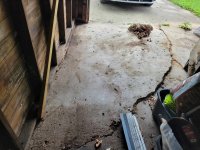
Had to reply to main due to file limitations. Here are some additional photos of my beauty. The left wall isn’t fully pictured due to storage, but it will be much easier to do than the right wall. (I play Jenga in there for the spots where it rains!)

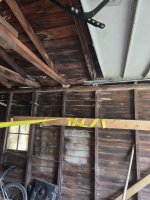
The yellow tow strap preciously anchored to the 2x6 is my doing. It connects to a 2x6 on the opposite wall, held in place by a slacked come-along. Last year, we were on track to be hit with 80MPH gusts and a horrible, nasty storm. I threw that bad boy together beforehand, in the fear of the Winds of Change folding my garage in two--nothing happened. In fact, the come-along and tow strap haven’t moved whatsoever since that point in time. I’ve left it up as a just-in-case, but there’s been no movement.

Any other lumber was installed by the previous owner, or the one before him, because my house changed hands a few times over a single year. The decking has seen better days; the rafters in parts kind of ****, but the more I inspect, the more I can probably save most of the decking and some of the rafters. A lot of their tails are damaged, so maybe not, but that’s something I need to research. Anyway...

Side_1 is the less problematic wall. There used to be a door near where that cinderblock was, as evidenced by the framing cut out for it. Before you panic about the siding, don’t worry: those thin sheets aren’t really attached! They’re held in place by the rafter tails and a prayer. That part has no structural siding, aside from that. So, that’ll be easy to work on. You can notice the additional rot in all the Right_ pictures, and delicious organic matter growing in some cevices.

Moving to Rear_1, the back isn’t in horrible shape. The Virginia Creepers from the neighboring vacant property have abandoned our ceasefire, so it’s time for me to find some vinegar, soap, and maybe a flamethrower. I don’t know if you can tell, but there’s a slight angle in the ground toward it. That’s from my leftover pile of clay and dirt from when I installed my French drains. Doesn’t pose an issue.

Side_2 is the right, problematic wall with the window. Did I mention there’s a mature Black Walnut nearby? Nope, I guess, from looking at my original post. Torch me for that if you deem it necessary, please, because that’s a detail! I’m sure Wally’s caused some trouble for the foundation, but the neighbor’s garage, two feet to its right, has been fine. Their garage is a lot newer, though, and probably has a layer of something more than sand and clay as a compacted layer. The tree is one of those afterthoughts for me, because if I have to pour around the roots, I’ll pour around the roots. (I’d use the root barrier stuff to, hopefully, prolong things, and cut out roots that wouldn’t harm the tree if they were missing. Another conversation to have with the neighbor.)

Also, it may be hard to notice in Side_2, but the right wall bows slightly outward. For all the Google Map photos I’ve seen of this place, it’s been like that for the last 15 years, slightly improved after a previous owner.

And Garage.jpeg, ain’t she pretty? You know, some people spend a lot of time trying to seal their garage doors, but the local cat population has no issue waltzing through the gap between mine and the foundation on that side. Mother Nature’s incredible.
 

Attachments

  • Side_2.jpeg
    Side_2.jpeg
    118.5 KB · Views: 63
  • Rear_1.jpeg
    Rear_1.jpeg
    101.7 KB · Views: 61
  • Side_1.jpeg
    Side_1.jpeg
    540.3 KB · Views: 56
  • Front_1.jpeg
    Front_1.jpeg
    195 KB · Views: 51
  • Back_1.jpeg
    Back_1.jpeg
    334.9 KB · Views: 52
  • Left_1.jpeg
    Left_1.jpeg
    309.2 KB · Views: 46
  • Right_3.jpeg
    Right_3.jpeg
    357.3 KB · Views: 45
  • Right_2.jpeg
    Right_2.jpeg
    357.6 KB · Views: 44
  • Right_1.jpeg
    Right_1.jpeg
    364.2 KB · Views: 43
  • Garage.jpeg
    Garage.jpeg
    108.3 KB · Views: 67
OP
T

ticks_are_fun

Member
Joined
May 1, 2026
Messages
8
$1100 just for a permit? That is ridiculous. I think in Green Bay I spent maybe $250 total iin permits for my 24x28 new shop build. I built my shop mostly by myself, or as the contractor, and I spent $25,000 back in the fall of 2019. I also built it in part to make my 1973 house feature competitive with other newer and some new homes in the Green Bay market with three to four car garages selling in the $400,000 range.

If the housing market is that depressed where you can buy a house for less than $100,000, to put money into a detached garage can go both ways. Keep the cost low as possible which means a lot more work for you to regain the most and still sell within market norms with a bit more property features. Or put more money into it and ride out the market reversal like is starting to happen in Detroit. Not sure if it applies where you are, but I've heard of people building onto what already exists (once it is structurally sound) to maintain the grandfather clause. For instance, maintain three walls of its present location to saitisfy the "grandfather clause" and then build out into you lot to gain more structure.
A building permit is somewhere around $180, and any inspector would force me to get one for the electrical. Another $180 or so there. (Unless, of course, the wiring magically becomes less sketchy-looking over a weekend by someone with access to the garage. Don’t know who that’d be.) But on top of both of those, I need a permit if I’m messing with a structural wall in the slightest. I’ve scoured hundreds of pages for the city’s permits and master fees, and the work I’m doing would trigger a more thorough investigation. Now, if I want to rebuild the garage from scratch, new everything, there’s an almost $900 fee to pay to sit in front of a committee and explain why I don’t want to lose the grandfather zoning for the garage; none of my reasons work. That doesn’t even cover the zoning guy they’d send out here, which is another fee. There’s something else that would need to be pulled, too, but I can’t remember the verbiage.

Here are some depressing details because I like to type about my city! The housing market in Flint began to sour when General Motors, founded in Flint, began outsourcing more jobs in the 1980s, and other changes followed. There are other reasons at play from the 1960s, when the population was near 200,000, but GM played a massive role. By 1980, GM employed close to 80,000 people in Flint, but that number began to be cut. As of today, they employ over 4,000 in Flint. Outsourcing, bankruptcy, housing market crash, and the water problem have kept Flint in a rough spot. People continued to leave because the city’s economic engine essentially left, meaning the tax base decreased, less money flowed through, and many, many houses were left to rot. Somewhere around 2023, there were around 23,000 vacant houses. There are close to 9,000 dilapidated ones as of this year, but I’m drifting from the topic.

I live in a nicer area, with our 70-acre park three lots down. The river’s a few-minute walk, and our area is becoming part of Genesee County’s first state park. Now, despite the tragedies, crime, and being one of the top 5 poorest cities in the country, there has been significant rebuilding. The dozens tear down structures, money is invested into parks and public infrastructure, and an increasingly large number of people are coming here because it’s affordable. That alone has been an economic engine for us. I don’t know if our area will get the same uplift as Detroit’s recovering market has, but it’s moving up with a shadow of a doubt. You can still buy decent fixable houses ($~30k in renovations) for $10k-$20k. They’re small lots, but they’re damn cheap, especially in this economy. I got a 6.5% mortgage 2 years ago because I wasn’t going to time the market, and even with that, my mortgage is $750 a month. We’ll have this house paid off in another 5 years with the extra cash going toward principal each month. It does have me thinking of putting money into things, because my property value is steady, I can’t lie, but it's still a lot.
 

Cane

Well-known member
Joined
Feb 8, 2022
Messages
339
It sounds like you're not planning on staying there forever. I would concentrate on making it functional and quit worrying about making it right. A come along, sledgehammer, and a load of plywood to line the inside would make it sturdy and usable. They can't see what your doing behind closed doors. Same with the electrical. You said tarped roofs are everywhere. That will keep the rain out for now. You can always take it back and do a section of the roof at a time or just tin it and forget it.

Rafter tail just scab on a new one. No need to replace the whole rafter. Some spray foam or a bag of concrete will fill in the sill gaps. Scab in or add pieces where the wood is rotten. Nobody cares what it looks like underneath the plywood liner. If you want to reside it you can do that after you get it functional. Break out and poor a bag of concrete just where the door is will seal it up. When I first did my shop I just put a board across the sill area, shimmed it up level and lagged it down. Filled the gaps with spray foam it seal it up. Was like that for a long time and I'd back my semi in to do rear-end work.

The old rule on remodeling is don't worry about making it pretty underneath just make it functional. Nobody will see it when you cover it up. I live in a house built in 1914 and have rebuilt it from the studs, moved walls, windows, and doors. The art is making the crooked and out of square that you can't fix look good. Remember it's been standing there a long time the way it was built. A little work and refreshing it'll be just fine.
 

CraigStu

Well-known member
Joined
May 22, 2014
Messages
4,013
Location
Blacksburg, Va
Does the $110k house value include the garage which is assumed to be safe and functional? All these numbers sure make a case for spending very little. Apparently your house is one of the ones at a higher price/value in your neighborhood so you are already on the wrong side of that adage about not wanting to be the most expensive. Thinking another way, if a safe and functional garage is part of your value, but I suspect any buyers home inspector would question that, then putting $ into the garage makes a bit more sense. IE if you had a buyer who would pay $110k, but the inspector dings the garage, then the buyer comes back and offers $90k....So if you can keep that total value by spending $10-15k it would make sense to do that. I know you are not selling right now but my experience is that any problem that an inspector finds automatically causes either a price drop, or a sellers expense for a repair to keep the price the same. Just trying to say that maybe your potential expense is more worthwhile long term than it is just $ for your own pleasure.
 

andyvh1959

Well-known member
Joined
Feb 15, 2020
Messages
2,590
Location
Green Bay WI
So how much work can you do inside where no one sees what you are doing? Anything you do know only improves the structure. Looking at the inside of the roof, maybe add new rafters spaced between whats there now. Then add some joists to better tie the walls rogether at the top plate. Add studs if needed to standradize the stud c-c because some of the studs look a bit unevenly spaced.

Once that is all stable, four two ton bottle jacks should be enough to lift the whole thing up and get at the bottom sill. Support it on cribbing. Trim the studs where rotted, trim all the studs to match, and attach new pressure treated sills. Then bust out the current floor, fill/compact the subsoil, put down 2x6 framing for a new slab pour, put in proper reinforcing mesh/rebar/anchors, pour a new slab inside. Then put a row of 8" block around the slab, and set the structure back down on the new foundation.

Of course a cement truck on your property would be kinda obvios, same for a dump truck delivering a couple yards of gravel for a base. Maybe get the gravel delivered into the garage at night? So maybe rent a mobile mixer and mix/pour the cement yourself inside, in sections until you get to the last section with the mixer on top of the new portion. A 6"x 14' x 20' slab is almost five yards of concrete, or in four sections 1.25 yards each. All a LOT of work to be discrete. But what is done is certainly better than anything there right now.
 
OP
T

ticks_are_fun

Member
Joined
May 1, 2026
Messages
8
It sounds like you're not planning on staying there forever. I would concentrate on making it functional and quit worrying about making it right. A come along, sledgehammer, and a load of plywood to line the inside would make it sturdy and usable. They can't see what your doing behind closed doors. Same with the electrical. You said tarped roofs are everywhere. That will keep the rain out for now. You can always take it back and do a section of the roof at a time or just tin it and forget it.

Rafter tail just scab on a new one. No need to replace the whole rafter. Some spray foam or a bag of concrete will fill in the sill gaps. Scab in or add pieces where the wood is rotten. Nobody cares what it looks like underneath the plywood liner. If you want to reside it you can do that after you get it functional. Break out and poor a bag of concrete just where the door is will seal it up. When I first did my shop I just put a board across the sill area, shimmed it up level and lagged it down. Filled the gaps with spray foam it seal it up. Was like that for a long time and I'd back my semi in to do rear-end work.

The old rule on remodeling is don't worry about making it pretty underneath just make it functional. Nobody will see it when you cover it up. I live in a house built in 1914 and have rebuilt it from the studs, moved walls, windows, and doors. The art is making the crooked and out of square that you can't fix look good. Remember it's been standing there a long time the way it was built. A little work and refreshing it'll be just fine.
Certainly not a forever home. I want a few acres someday so I can have an area to screw around with. I miss having quads and a space to throw a few project cars, but I also love livin' cheap. Thanks for the suggestions; it seems I have a lot of work to do regardless of which route I take.

As long as it can be functional and not collapse while I'm drinkin' a beer, that's my total end goal. The old-growth wood, even the crappy stuff in there, is still holding up strong. I'd like to keep as much of that as possible. I'd let the garage collapse from an unexpected "windstorm" and throw up a carport at this point, but the city would give me less grief about fixing up the garage.
 
OP
T

ticks_are_fun

Member
Joined
May 1, 2026
Messages
8
Does the $110k house value include the garage which is assumed to be safe and functional? All these numbers sure make a case for spending very little. Apparently your house is one of the ones at a higher price/value in your neighborhood so you are already on the wrong side of that adage about not wanting to be the most expensive. Thinking another way, if a safe and functional garage is part of your value, but I suspect any buyers home inspector would question that, then putting $ into the garage makes a bit more sense. IE if you had a buyer who would pay $110k, but the inspector dings the garage, then the buyer comes back and offers $90k....So if you can keep that total value by spending $10-15k it would make sense to do that. I know you are not selling right now but my experience is that any problem that an inspector finds automatically causes either a price drop, or a sellers expense for a repair to keep the price the same. Just trying to say that maybe your potential expense is more worthwhile long term than it is just $ for your own pleasure.
I bought the best-condition house in my neighborhood for a price tag that wasn’t inflated by private development. (Two roads away in my neighborhood, within shouting distance on a clear day, and those houses go for $150-200k. Hardly ever on the market, and I wish I had waited a few months to buy.) My neighborhood was built in the early 1920s specifically for GM workers, and those private developers came in sometime later.

The garage reduced the price by a grand thanks to my realtor, but most garages around here ****. There’s a case that, given a much better garage, the property value would increase. Not sure by how much, but it would only get better. Locally, though, you can expect to buy a house with a turd of a garage because it’s so common. A few sellers laughed at me when I toured other homes before buying this one because the garage needed repairs, and I wanted to see how much I could get the price reduced by. I was lucky to get anything shaved off for this one.

With that said, and as you mention long term, I could see getting my money back — if things continue in an upward direction, as they’re still doing. Hell, my property value probably went up slightly within the past few days. The Land Bank razed a house/lot kitty corner from mine this Monday. They’re running out of ones to demo in my neighborhood specifically, but paired with part of our area becoming a state park, I can see values going up. I’m still weighing the odds.
 
OP
T

ticks_are_fun

Member
Joined
May 1, 2026
Messages
8
So how much work can you do inside where no one sees what you are doing? Anything you do know only improves the structure. Looking at the inside of the roof, maybe add new rafters spaced between whats there now. Then add some joists to better tie the walls rogether at the top plate. Add studs if needed to standradize the stud c-c because some of the studs look a bit unevenly spaced.

Once that is all stable, four two ton bottle jacks should be enough to lift the whole thing up and get at the bottom sill. Support it on cribbing. Trim the studs where rotted, trim all the studs to match, and attach new pressure treated sills. Then bust out the current floor, fill/compact the subsoil, put down 2x6 framing for a new slab pour, put in proper reinforcing mesh/rebar/anchors, pour a new slab inside. Then put a row of 8" block around the slab, and set the structure back down on the new foundation.

Of course a cement truck on your property would be kinda obvios, same for a dump truck delivering a couple yards of gravel for a base. Maybe get the gravel delivered into the garage at night? So maybe rent a mobile mixer and mix/pour the cement yourself inside, in sections until you get to the last section with the mixer on top of the new portion. A 6"x 14' x 20' slab is almost five yards of concrete, or in four sections 1.25 yards each. All a LOT of work to be discrete. But what is done is certainly better than anything there right now.
On the inside? All of it. I have a non-running car parked in front of the garage (I have the parts, but the willingness has yet to arrive), and some foliage growth to my right. My driveway’s over 80ft long, with the garage at the back of it, so to see inside, past my cars, and past whatever other junk I’ll temporarily put in the way, you would need to walk up my driveway.

My brother’s been following the thread—from what I’ve sent him—and he had a similar idea about the roof and plates. I’m pretty sure the ridge board is in good condition, so apart from ripping the roof down to the decking, replacing those parts, and sistering the rafters, the top plates should be easy enough. Same for the studs. Great suggestions!

And yeah, the one part I keep trying to find an easy way to do is the slab. If my partner’s uncle is willing to lend me his skid steer (he’d do the work because he loves every excuse to use the thing) and I rent a hydraulic jack, breaking out the inside wouldn’t take long at all. Almost wondering if I should saw where the foundation sits, rip that out, and have him do the rest. That, of course, is a tremendous amount of noise for a few hours. I’m writing that off as a dream. I’d be fine taking a sledgehammer to parts of it and having him haul the chunks out into the backyard, where I could tarp them if I were paranoid enough. This is the part of the job I’d hire out in a heartbeat—but I know a concrete finisher wouldn’t take it up without a permit. I have had yards of river rock and dirt delivered a few times, for grading and my French drain, and nobody batted an eye. Took me 8 or so hours to move 2-2.5 yards of rock up to the small hill in my backyard from the front.

The most discreet way I see is me buying a concrete mixer, grabbing 60-lb bags, and working on one side of the foundation at a time. More expensive to get the bags, but I’ll do what I have to. I’ll need to call around for this, but if I were to rip out the interior slab rest, I wonder if the chance of getting a truck up there would be better. I have no experience with that process and haven’t spoken with anyone in that field. I helped coordinate things when my MIL got the interior slab of her garage replaced, and I don’t remember anyone stopping by to check permits or anything. Maybe I’m doomed to do it all by hand, bag by bag. It’ll be a funny story to tell in 30 years to my grandkids, while they wheel me to the operating room to get a full spine replacement.
 

CraigStu

Well-known member
Joined
May 22, 2014
Messages
4,013
Location
Blacksburg, Va
If you have a pickup, bags are often the best diy way to go even if more $. I haven't messed w/ concrete myself but have done a lot of gravel. I once had a small dump truck load of standard driveway gravel delivered. By the time I shoveled it all into a small yard trailer to move to where I wanted it, I was done w/ that. Bags loaded into the truck bed w/ the help of an HD guy, then slice the end and let gravity move the gravel down into the little trailer was the way I did all the rest. A 60lb bag w/ one guy on each end is pretty easy to get into the truck.
 

KenC

Well-known member
Joined
Dec 20, 2009
Messages
2,577
Local Lowes now sells gravel and sand in what look to be 1 cuyd containers. Really, a 3x3x3 what looks like woven plastic fabric. They load on your trailer or truck with a fork lift. Really handy, but expensive. About twice what the same amount would be from a bulk yard but loaded loose with a front end loader . I think my next smaller concrete project, I'll get the sand in my old '97 F150, take my trailer for the gravel and set my little mixer up nearby. The mixer is an ancient 7 cuft dry, 3.5 wet with a cast iron ring gear around the drum. They were sold by a lot of stores in the 60s-80s. Maybe still are, but I haven't look. Indestructible and indispensable.
 

DaveAndStuff

Well-known member
Joined
Feb 3, 2026
Messages
280
Every home is a forever home, and every home is not a forever home.

Make hay while the sun shines
 

andyvh1959

Well-known member
Joined
Feb 15, 2020
Messages
2,590
Location
Green Bay WI
Having someone with a skid steer is a huge plus. Most of the flor can be lifted out in chunks with a skid steer. Grading the substrate inside the garage with a skid stter is easy too. Maybe get the structure lifted up on cribbing and then bring in the skidsteer to take out all of the concrete, prep the base, haull in/dump the gravel. If he is good with the skidsteer thats an afternoon job once the strucure is up clear of the concrete.

If that can be done, have him prep the substrate, gravel in and leveled, then pour a new slab with proper reinforcing., anchor rods, conduit for wiring, ground rods Once the concrete sets you have a great new form level sruface to work on, and rebuild the sill plates/studs.
 
To avoid these ads, REGISTER NOW!
Top Bottom