To avoid these ads, REGISTER NOW!

Rebuilding my rotten detached shop!

westcoast94

Member
Joined
May 23, 2026
Messages
13
Hello everyone!

It's my first time posting on here. I am located in Canada BC. I have no previous building experiance but I am good at figuring stuff out.

I will be rebuilding my 26x16 shop in my backyard. Currently the sheathing, sill plates trusses etc are all rotten. Its honestly a tear down, but I don't want to run into zoning and permit issues so I am rebuilding around the existing structure one wall at a time.

I have many books on home building but nothing specific to garages.

I could really use some help from knowledgeable people in the forum. I keep running into simple problems and spending hours and hours googling and getting nowhere. Progress has been very slow because of this.

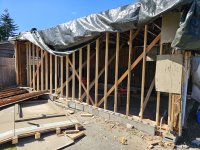
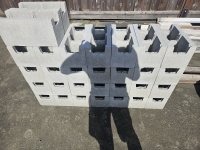
See picture #1 for the current status of the shop. Old cmu where laying loose. I have new bond beams and will run horizontal and vertical rebar

My current plan is to roughen up the slab edge, lay cmu blocks in mortar. Rebar into the slab and concrete fill.

Currently, I am debating what size sill plate to use, I am leaning towards a double sill with the bottom sill being 2x8 PT with sill gasket. The walls will be 2x4 framed.20260522_130849.jpg20260521_153853.jpg20260521_142522.jpg20251015_164132.jpg
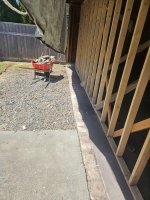
I am also not sure if it best to have sill flush with foundation and have the sheathing overlap? I have seen this recommended but I find it bizzare. People are so adamant to not have sill plate touching concrete but then recommend overlapping the sheathing.

Other options being, still flush but not overlapping or have the sill plate inset so that the face of the sheathing is flush with the face of the foundation.

Amy help appreciated and I can post pictures along the way that hopefully can help other.

Thank you very much
 
To avoid these ads, REGISTER NOW!
OP
W

westcoast94

Member
Joined
May 23, 2026
Messages
13
PT lumber for the sill, sitting on sill seal. I would consider core filling all the CMU block since it's only one course.
Should I run 2x8 for the sill? I'm worried the pt sill will warp as the wall is only 2x4. I was considering using standar lumber with sill seal or using 2x6 sill then ripping 2x peices to fit. the slab is lightly out of square as well so the reveal inside won't be consistent if you get what I mean. Sill will overhang 1/2" on one side and be flush with the other end.

I'd like it to look proffesionally done
 

NUTTSGT

Super Moderator
Staff member
Joined
Sep 14, 2009
Messages
50,901
Location
Northern Central Ohio
A 2x8 is 7 1/2" wide, whereas, the block is 8". So the CMU courses should be wider than the sill plate.

I wouldn't overhang the sill to the outside of the block but would overhang the sheathing to cover the gaps.
 
OP
W

westcoast94

Member
Joined
May 23, 2026
Messages
13
A 2x8 is 7 1/2" wide, whereas, the block is 8". So the CMU courses should be wider than the sill plate.

I wouldn't overhang the sill to the outside of the block but would overhang the sheathing to cover the gaps.
I have to overhang the sill otherwise my walls won't be square.

Block measures 7 5/8, a dried pt 2x8 measures 7 3/8 so the block will be proud by 1/4" except that I have to overhang the sill by 1/2" so one end will have a 1/4 reveal and other other 3/4.. is there not a good way to make this look better..

Also, you say to overhang thr sheathing but have not addressed the concerns of having plywood touching concrete.
 

manwithtools

ALLIANCE MEMBER
Joined
Aug 24, 2015
Messages
13,729
Location
Lebanon, TN
one end will have a 1/4 reveal and other other 3/4.. is there not a good way to make this look better..
It's going to look a lot better than what you have today...

It's a shed, I would not worry about that small discrepancy. Once things are in the shed, you won't see the sill plate. You can install a piece of heavy plastic sheeting under the sill seal and let it lap over the face of the block (behind the plywood) Trim the sheeting after the plywood out sheathing and siding is up.
 
Last edited:
OP
W

westcoast94

Member
Joined
May 23, 2026
Messages
13
It's going to look a lot better than what you have today...

It's a shed, I would not worry about that small discrepancy. Once things are in the shed, you won't see the sill plate. You can install a piece of heavy plastic sheeting under the sill seal and let it lap over the face of the block (behind the plywood) Trim the sheeting after the pplywood out sheathing and siding is up.
Good idea! I understand what you are getting at but it's not a shed. It's 26x16 shop that will be fully finished and insulated so I want it done right. I'm not putting all this work in to have it look diy
 
OP
W

westcoast94

Member
Joined
May 23, 2026
Messages
13
Pretty cool project.
Have you considered going to 2X6 stud walls? If you know you're insulating etc. go for more wall cavity.
I did but I'm trying to keep the cost down. I'm not too worried about 2x4 insulation I basically want to keep it above frezing in the winter.
 

MikeC55

Well-known member
Joined
Nov 1, 2020
Messages
419
Location
CT
If you're sticking with 2 x 4 walls, I'm not sure why you need a 2 x 8 sill. A 2 x 6 will be plenty and might even bend a little to keep it lined up with CMU on outside edge (this is how my garage/shop was built). Some of the CMU will be exposed on the inside, but you can either fill with concrete (what I plan to do) or spray foam. Or nothing. Mine has open CMU's now and it has not adversely impacted the structure and I live in a similar climate (was built in 60+ years ago). There's no structural benefit for 2 x 8 vs. 2 x 6 in this regard.
 
OP
W

westcoast94

Member
Joined
May 23, 2026
Messages
13
If you're sticking with 2 x 4 walls, I'm not sure why you need a 2 x 8 sill. A 2 x 6 will be plenty and might even bend a little to keep it lined up with CMU on outside edge (this is how my garage/shop was built). Some of the CMU will be exposed on the inside, but you can either fill with concrete (what I plan to do) or spray foam. Or nothing. Mine has open CMU's now and it has not adversely impacted the structure and I live in a similar climate (was built in 60+ years ago). There's no structural benefit for 2 x 8 vs. 2 x 6 in this regard.
The only reason for using 2x8 sill is for appearance.
 

u2slow

Well-known member
Joined
Nov 20, 2011
Messages
3,585
Location
BC
I used 6" block and 2x6" sill to cover them over. Outer wall sheathing drops below the sill.

If you are filling the block cores, then i dont see the need to widen the sill plate.
 
OP
W

westcoast94

Member
Joined
May 23, 2026
Messages
13
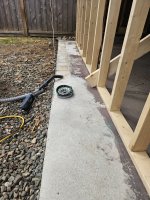
Here is what I am working on currently. Prepping the slab for mortar. Unfortunately the finish is very smooth anybody experienced with masonry? I am wondering if I need a bonding agent/slurry coat or if I should get a cutting disc and gouge up the slab along where the mortar will lay.
20260523_142729.jpg
 
To avoid these ads, REGISTER NOW!

340RedCoupe

Member
Joined
Mar 24, 2018
Messages
17
Location
Cleveland, OH
I would do a cost comparison on 2x4 walls vs 2x6 I went with 2x6 wasn’t that much more and the better insulation benefit is nice. As far as the sheeting overlaying the block maybe consider PT plywood for the bottom couple of feet unless I missed it you didn’t say how tall the walls are if taller than 8’ fill at the bottom instead of the top.
 

MikeC55

Well-known member
Joined
Nov 1, 2020
Messages
419
Location
CT
I'm planning to do a concrete pour to accomplish something similar on front wall of my garage (fitting a single OH door instead of the current 2 doors), so I've been reading up on bonding agents. They claim that roughing the surface isn't necessary if used as directed. Seems like it wouldn't hurt tho.
 

mm08822

Well-known member
Joined
Jan 13, 2012
Messages
5,890
Location
NJ
Make sure to dowel the cmu's to the slab. Filling the cores with mortar will further help lock the blocks to the dowels/slab. Cheaper than foam, more durable.

You could also consider PT plywood that touches the cmu's. Not a full 4' needed. 1', 2' etc., will work. E.G. - if the total sheathing height needed was 9', then 1' wide PT would simplify overall sheathing effort. 1' + 4' + 4' = 9'

Could also use 30# felt for sill sealer.

Any value to just pour concrete (still pinned to slab) instead of cmu's?

J-bolts also!
 

theoldwizard1

Well-known member
Joined
Feb 22, 2011
Messages
43,127
Location
SE MI
Currently, I am debating what size sill plate to use, I am leaning towards a double sill with the bottom sill being 2x8 PT with sill gasket.
Why ?

The only time I would uses a double sill plate is if the wall was going to buy built laying down and the sill plate is longer than the longest piece of PT you have (or can buy).
 
OP
W

westcoast94

Member
Joined
May 23, 2026
Messages
13
I'm planning to do a concrete pour to accomplish something similar on front wall of my garage (fitting a single OH door instead of the current 2 doors), so I've been reading up on bonding agents. They claim that roughing the surface isn't necessary if used as directed. Seems like it wouldn't hurt tho.
I tried asking before about bonding agents in reddit and everyone told me to just use a portland cement slurry. It's hard to get clear answers online. I'm still not sure what to use to be honest
 
OP
W

westcoast94

Member
Joined
May 23, 2026
Messages
13
Why ?

The only time I would uses a double sill plate is if the wall was going to buy built laying down and the sill plate is longer than the longest piece of PT you have (or can buy).
The wall is 26 ft long and will be built in the ground in sections
 
OP
W

westcoast94

Member
Joined
May 23, 2026
Messages
13
Make sure to dowel the cmu's to the slab. Filling the cores with mortar will further help lock the blocks to the dowels/slab. Cheaper than foam, more durable.

You could also consider PT plywood that touches the cmu's. Not a full 4' needed. 1', 2' etc., will work. E.G. - if the total sheathing height needed was 9', then 1' wide PT would simplify overall sheathing effort. 1' + 4' + 4' = 9'

Could also use 30# felt for sill sealer.

Any value to just pour concrete (still pinned to slab) instead of cmu's?

J-bolts also!
I am using bond beams and will be filling core with concrete as there is no core fill grout here in canada rhat I can find. There will be vertical and horizontal rebar.

I am considering singing pt plywood on the bottom. Is it fine to have such a small strip of 1'.

Lots of people told me it would be easier to pour concrete but I though about it alot and for whatever reasons it seemed harder. It would be a lot of bagged concrete.
 

mm08822

Well-known member
Joined
Jan 13, 2012
Messages
5,890
Location
NJ
I am using bond beams and will be filling core with concrete as there is no core fill grout here in canada rhat I can find. There will be vertical and horizontal rebar.

I am considering singing pt plywood on the bottom. Is it fine to have such a small strip of 1'.

Lots of people told me it would be easier to pour concrete but I though about it alot and for whatever reasons it seemed harder. It would be a lot of bagged concrete.
Not sure you ever needed grout as compared to just standard mortar. Isn't that rather expensive, anyway?

Pouring vs. cmu's has some logistical trade-offs. Part of it is, what do you have to mix concrete or mortar with? Couldn't you get a pallet of bags offloaded close to the garage/handy for mixing?

I wouldn't go less than 1', 16" or 2' (half sheets) would be even better. What is the overall sheathing height required? If it were 96" or less, than even one full sheet horizontally could be less work too. Need costs and height as decision inputs.
 
OP
W

westcoast94

Member
Joined
May 23, 2026
Messages
13
Not sure you ever needed grout as compared to just standard mortar. Isn't that rather expensive, anyway?

Pouring vs. cmu's has some logistical trade-offs. Part of it is, what do you have to mix concrete or mortar with? Couldn't you get a pallet of bags offloaded close to the garage/handy for mixing?

I wouldn't go less than 1', 16" or 2' (half sheets) would be even better. What is the overall sheathing height required? If it were 96" or less, than even one full sheet horizontally could be less work too. Need costs and height as decision inputs.
Not sure.. are you saying I can fill with mortar? All I have is forums and Google. Google said to use core fill grout but I can't find any. I'm sure concrete would work fine.

I could get a pallet I guess but I'm not sure it would be easier for me or save me any money. Maybe I'm wrong

About 8 ft not very tall, I guess I could use a full sheet pt sideways? Might be worth the cost
 

Jeff Ivers

Well-known member
Joined
Apr 9, 2010
Messages
2,555
Location
Oklahoma
If you are only going one block high, how can you run horizontal rebar? The blocks need to be pinned to the slab every 3 or 4 feet and filled with concrete and j-bolts inserted to bolt the PT sill to. The sill should be the same dimension as the wall. Since your are replacing all 4 walls, make sure your block wall is square and the correct dimension so there is no need to overlap the sill. Be sure to set the sill back from the outer side of the block wall the width of the sheathing. Once sheathed, apply that house wrap (forget the name) so that it extends down the block a few inches to the lowest point your siding will extend to.
 

mm08822

Well-known member
Joined
Jan 13, 2012
Messages
5,890
Location
NJ
Not sure.. are you saying I can fill with mortar? All I have is forums and Google. Google said to use core fill grout but I can't find any. I'm sure concrete would work fine.

I could get a pallet I guess but I'm not sure it would be easier for me or save me any money. Maybe I'm wrong

About 8 ft not very tall, I guess I could use a full sheet pt sideways? Might be worth the cost
All I've ever seen is regular mortar to fill the cores. Has never appeared to be any problems. It's more for housekeeping/critter control. Sure, it adds additional bearing surface, but for any 8' wall/ceiling/roof, not sure it makes a difference.

Money is one thing, also logistics, final job results, durability, etc.

I would only sheath horizontally, regardless of sheathing type. (Same for sheetrock.)
 
OP
W

westcoast94

Member
Joined
May 23, 2026
Messages
13
If you are only going one block high, how can you run horizontal rebar? The blocks need to be pinned to the slab every 3 or 4 feet and filled with concrete and j-bolts inserted to bolt the PT sill to. The sill should be the same dimension as the wall. Since your are replacing all 4 walls, make sure your block wall is square and the correct dimension so there is no need to overlap the sill. Be sure to set the sill back from the outer side of the block wall the width of the sheathing. Once sheathed, apply that house wrap (forget the name) so that it extends down the block a few inches to the lowest point your siding will extend to.
In regards to sheathing I had just asked about this on reddit. I specifically asked whether I should inset the sill and have the face of the sheathing flush with block VS flush the sill and overhang the sheathing overlapping the block. I got so many conflicting answers. Some say they would never inset the sill, others said you have to overlap to keep a good drainage plane and keept bugs/air out, but nobody explained why it was okay to have plywood touching concrete, dosen't seem right to me.

Currently I'm planning on flushing the sill and stopping the sheathing just before the block with no contact. Either that or overlap the block but use pt plywood and/or vycor on the backside so there is no contact with the block. Then I will overhang the siding 1 inch or so down past.

What do you think of those ideas? What are the reason you suggest insetting the sill?

I would have to rip down the 2x8 sill or use a smaller sill plate if I inset it, I don't want overhang on the inside edge of the block.


This is how I will run horizontal


20260523_173149.jpg
 

Jeff Ivers

Well-known member
Joined
Apr 9, 2010
Messages
2,555
Location
Oklahoma
In regards to sheathing I had just asked about this on reddit. I specifically asked whether I should inset the sill and have the face of the sheathing flush with block VS flush the sill and overhang the sheathing overlapping the block. I got so many conflicting answers. Some say they would never inset the sill, others said you have to overlap to keep a good drainage plane and keept bugs/air out, but nobody explained why it was okay to have plywood touching concrete, dosen't seem right to me.

Currently I'm planning on flushing the sill and stopping the sheathing just before the block with no contact. Either that or overlap the block but use pt plywood and/or vycor on the backside so there is no contact with the block. Then I will overhang the siding 1 inch or so down past.

What do you think of those ideas? What are the reason you suggest insetting the sill?

I would have to rip down the 2x8 sill or use a smaller sill plate if I inset it, I don't want overhang on the inside edge of the block.


This is how I will run horizontal


20260523_173149.jpg
Thanks for the picture that explains how you will run horizontal rebar.

The sill plate should be the same dimension as the wall - if building 2x4 walls, use 2x4 sill plate.

I think some of the contradictions you are experiencing are because some use the sheathing as the final siding of the building and others apply sheathing and then siding. My comments are based on the latter option. For instance, if applying barn metal as the siding, I want that to extend below the bottom of the sill plate, so that moisture cannot blow in under the sill plate and I also do not want a space between that and the blocks.

If you are using sheathing as the final siding, then I would have the sill flush with the outer edge of the block, apply Tyvek (finally remembered the name) so that it extends an inch or two below the bottom of the sill and then have the sheathing extend the same distance.

Either way you go, build so moisture cannot get in below the sill.
 

andyvh1959

Well-known member
Joined
Feb 15, 2020
Messages
2,590
Location
Green Bay WI
I have built three garages since the early 80s, each with a row or two of 8" block masonry set on the slab to get the sill plate 6" to 8" above the grade. Used normal sill sealing products and have never had an issue.
 
To avoid these ads, REGISTER NOW!
Top Bottom