To avoid these ads, REGISTER NOW!

ZMotorsports Shop Projects 2.0

OP
Z

zmotorsports

ALLIANCE MEMBER
Joined
Oct 20, 2009
Messages
21,405
Location
Northern Utah
Continuing on.

Cam locking plate installed on bank 1 during Stage 2 timing. The flats should be parallel with the head surface and the plate should snap right into position.
buick21.jpg

Although these phasers aren't as loose as some I've seen where the internal locking pin is completely destroyed and the cam will turn 15-30 degrees in relation to the sprocket, these are barely moving. But when I push on the chain I can see some wiggle between the phaser and the camshaft, which is not good as these should lock solid when working properly. Based on what I am seeing initially, I am not expecting the internal locking pin to be sheared, but more than likely worn or the groove that the pin locks into is worn, but I doubt I will find anything that has catastrophically failed inside the phase, just wear is what I am expecting to find. The looseness between the locking pin and groove is more than likely causing the rattle or diesel like sound as the phaser bounces around trying to lock. At least that is my assumption at this point.
buick22.jpg

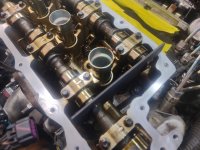
The camshafts on Bank 2 during Stage 2 should be slightly angled and the Stage 2 locking plate should snap into place on the flats on the back of the Bank 2 camshafts.
buick23.jpg

I like to run around all of the fasteners and break them loose with the chains still in place. Make sure to place a wrench on the hex locations on the camshafts so you don't damage the locking plates during this step.
buick24.jpg

Bank 1 secondary chain and phasers disassembled.
buick25.jpg

And on the bench. Everything still looks good as far as chains, guides and idlers goes.
buick26.jpg

Now remove the locking plate from Bank 2 and bar the engine over a little more than two turns to get Bank 2 into Stage 1 timing. This will place the dot on the crank sprocket around the 5 o'clock position and the flats on the camshafts parallel with the head.
buick27.jpg

Bank 2 now in Stage 1 timing position.
buick28.jpg

And the locking plate installed with the flats parallel with the head.
buick29.jpg

Then remove the primary chain and components as well as the secondary components from Bank 2.
buick30.jpg


Stay tuned for a few more pictures.
 
To avoid these ads, REGISTER NOW!
OP
Z

zmotorsports

ALLIANCE MEMBER
Joined
Oct 20, 2009
Messages
21,405
Location
Northern Utah
Last of the pictures from last night's work.

All of the timing components removed and laid out on the workbench.
buick31.jpg

Next the fun part begins and my least favorite, cleaning sealant off the components. This is probably one of the most critical steps however, because a shoddy job here will almost definitely result in a leak. After all this work that is the last thing you want to experience, so take your time and be thorough. Also, I do NOT recommend using powered or mechanized tools to clean. The temptation may be there, but try to resist and go about it the old fashioned way because there are no short cuts to do this job properly. I have seen people create more work and a LOT more expense going about it quickly using powered cleaning tools and end up damaging sealing surfaces and/or fastener holes by rounding them over or putting waves in the sealing surfaces, so just grab a good scraper and be gentle on the aluminum surfaces. If you haven't tried these plastic razor blades, I highly recommend them, followed by a nice quality carbide scraper. Also, make sure to place towels or rags around any oil pan openings to keep debris out of the oil pan which can plug the pickup screen.
buick32.jpg

After the bulk of the sealant is removed, I grab a red Scotchbrite pad (7447) and cut a strip off.
buick33.jpg

Then cut that strip in half to avoid waste and to make the pad smaller and more conducive to cleaning around the small ridges.
buick34.jpg

The nice thing is that it doesn't require a lot of hard scrubbing. If you removed the bulk of the sealant in the previous step, then just a few swipes or passes and the sealing surfaces are clean of all debris.
buick35.jpg

Then just wet a rag with brake wash and give everything a wipe to double check the sealing surfaces.
buick36.jpg

The cam/rocker cover sealing surfaces only needed a wipe with rag and brake wash as there was no sealant on these, other than where the front cover intersected the head. That is only about a half inch wide bead that needs cleaning. Bank 1 cleaned.
buick37.jpg

And Bank 2 cleaned.
buick38.jpg

Then I raised the car and moved down to the bottom of the block to finish the cleaning process. Rags stuffed into the front opening to keep debris out of the oil pan. Also, the angle and direction in which you scrape the sealant off plays a role. As you are cleaning with the scrapers plan your work and move down and away. I try to not rely on the rags as the only barrier, I try to act as though the rags are not there and keep debris away from the area by directing the old sealant and debris where I want it to go, then the rags end up being just an added level of cleanliness. I hope that makes sense, not sure if I'm getting across what I am trying to say there.
buick39.jpg

Block and heads all cleaned and this part is ready for reassembly.
buick40.jpg


Next will be getting the front cover to this stage and awaiting the last few parts.

Thanks for looking and taking the time to follow along.
 

stinkity stoink

Well-known member
Joined
Apr 8, 2007
Messages
734
Location
New Jersey
Great detail I love the explanations.

So after you remove the phasers on one side, you need to turn the engine more to remove the phasers on the other side? I have never done one of these or anything like it, but I always got the vehicle to top dead center on number one and went from there. I would be so afraid to turn the engine when it wasn’t in time like that.

Excellent job I love following along!
 
OP
Z

zmotorsports

ALLIANCE MEMBER
Joined
Oct 20, 2009
Messages
21,405
Location
Northern Utah
Great detail I love the explanations.

So after you remove the phasers on one side, you need to turn the engine more to remove the phasers on the other side? I have never done one of these or anything like it, but I always got the vehicle to top dead center on number one and went from there. I would be so afraid to turn the engine when it wasn’t in time like that.

Excellent job I love following along!

Thank you.

Different engine manufacturers and even different configurations within those brands have varying steps or processes for the replacement. You are correct in having the engine at top dead center, most use TDC on Cylinder #1 and replace the chain or sometimes two chains, however, this engine has a total of three different chains(2 secondary and 1 primary), therefore the second bank needs to be in a different orientation so there is little to no pressure on the cams from the valves. The key is just to seek out the specific information for the exact engine family that you are working on to ensure you have the proper procedure. Then it's simply nuts and bolts.

Hope that answers your question.


***Edit.

Just after hitting reply, I remembered seeing a few people just go in and rip the entire timing assembly out on Stage 1, then use the flats on the camshafts on Bank 1 to turn the camshafts into the correct orientation for reassembly. Then start on Stage 1 (Bank 2) timing chains and primary chain assembly, then roll the engine over into Stage 2 to assemble the Bank 1 secondary components.

Thinking about this, with the crank and cams not connected a person could move them into any position he wanted so I can see the reasoning as it is one less time barring the engine over. Theory is just rip everything out, then put it in time when assembling. I guess you could do that, but to be honest, it really is not that big of a deal to do the process the way GM states in their FSM and place it in each corresponding Stage to disassemble then again for assembly. Barring the engine over is not a big deal so I just prefer to do it the way GM states, but if you were adventurous, just rip it apart, time it and put it back together. :unsure:
 
Last edited:

ScepterToad

Well-known member
Joined
Nov 9, 2023
Messages
335
Nice work Mike! As always!

I did have one question I was thinking about yesterday I wanted to ask, if you'll indulge me.

I suspect, based on your stated lack of desire to have noises in your Jeep when driving, that I already know the answer, but I need to ask.

I enjoy driving my Jeep on a daily basis and as with any car, I enjoy having the windows down. Cooler weather through hot weather (not in winter). Many times I'll drive home with the windows down in 85+ degree humid midwestern summer. However, with the soft top recently I've been VERY annoyed with the flapping of the top with just one window down (and soft top closed). The tire noise is bad enough. The top flapping and sounds like it's gonna rip apart is enough for me to roll up the windows and turn the air on.

Here's the question. How does your bestop top behave in these situations? Does it flop around and make a bunch of noise with a window down at highway speeds?
 
OP
Z

zmotorsports

ALLIANCE MEMBER
Joined
Oct 20, 2009
Messages
21,405
Location
Northern Utah
Nice work Mike! As always!

I did have one question I was thinking about yesterday I wanted to ask, if you'll indulge me.

I suspect, based on your stated lack of desire to have noises in your Jeep when driving, that I already know the answer, but I need to ask.

I enjoy driving my Jeep on a daily basis and as with any car, I enjoy having the windows down. Cooler weather through hot weather (not in winter). Many times I'll drive home with the windows down in 85+ degree humid midwestern summer. However, with the soft top recently I've been VERY annoyed with the flapping of the top with just one window down (and soft top closed). The tire noise is bad enough. The top flapping and sounds like it's gonna rip apart is enough for me to roll up the windows and turn the air on.

Here's the question. How does your bestop top behave in these situations? Does it flop around and make a bunch of noise with a window down at highway speeds?

Thanks Keith.

Like you, I love having the top flipped back. I flip it back when driving around town even, but the wife doesn't care for it flipped back unless off-road and then it depends on how much traffic and the dust conditions. If heavy traffic, the top stays up as I try to keep the interior as clean as I can, despite the dusty environment.

The key with any of these soft tops is keeping them tight. The framed ones are harder to do that with for some reason. I only have the Sunrider top now, which is just the front portion where the Freedom tops mount. Previously I had the full soft top but the frameless and slant back design that I would run in the warmer months. I liked it at first, but eventually I got to where I didn't like the lack of security I felt with it as I carry a lot of **** in my Jeep, but the wife liked the ability to have the top back when off-roading, especially when driving through canyons and forested areas, so the Bestop Sunrider fit the bill perfectly as it allows that open top feel, but still allows the fiberglass top security.

That being said, I really don't get much buffeting or wind impacting the top, but one thing I have noticed on both of my soft tops is that only having one window down, like the driver's side only, seems to magnify the buffeting of the top. I usually lower my driver's rear window down about half way if I'm going to have my driver's window down and that buffeting noise goes away. Same with the wife's side, if she rolls her window down at all, I reach over and roll her rear window down a little as well as that eliminates that wind buffeting. Like you, I really enjoy having the windows down when driving the Jeep and when I'm alone in the Jeep the radio is NEVER on. However, when the wife hops in, the first thing she does after buckling in is reaching for the radio. :rolleyes:

That's ok though, I love having my passenger princess with me so if that means the radio is on and I can't listen to my V8 then so be it, that's a small price. :ROFLMAO:

Not sure if that answers your question or not, kind of a long way around trying to answer it. 😁
 
OP
Z

zmotorsports

ALLIANCE MEMBER
Joined
Oct 20, 2009
Messages
21,405
Location
Northern Utah
Thanks Mike! I may try to roll the window down and see if that helps. I'm just getting dang tired of all the noise. I get that it's a Jeep, but it's a bit much.

Hope that helps Keith.

And yeah, I get it, even with their Jeep quirks, I would never sell mine.

That being said, I've had people in mine that are shocked at how there are no rattles or squeaks, well at least not for very long anyways.

Funny story, well maybe you'll find it funny, I didn't as it messed with my head for a few miles; the wife and I were coming off a trail last week during our adventure to southern Utah. I knew we were nearing the end of the trail and approaching the highway so I found a wide spot to pull off and air up the tires. Upon airing up, we drove the last half mile or so to the highway and at that turn, you could make a left and take the pavement directly back to town, but there were construction signs up that stated expect delays and one lane road. However, to the right was a very well groomed gravel highway that went about 8 miles and joined the highway just north of town so we turned right and as we were cooking right along on this gravel highway I got a slight squeaking sound coming from the rear interior. I thought the only thing I did was open the toolbox drawer to grab my Powertank inflator so it must be something that shifted in the toolbox drawer. I pulled over and the wife asked what I was doing, I said that squeak is driving me up the wall. "What squeak" she said. HUH? You can't hear that? "NOPE".
This went on for probably 4 of the 8 miles, after about the fourth or fifth stop, I pulled over and ended up with about half the toolbox unloaded on the side of the trail moving things around in the drawer. Back in the Jeep and moving along the wife said, "I knew you wouldn't be able to let it go and we wouldn't be able to listen to the radio until you found your squeak." It doesn't even bother her anymore, she's just used to it and expects it when something isn't right. I don't know if that's a good thing or not though, :unsure: but I was finally able to relax and enjoy the drive back to town, without the radio I might add. :bounce:
 
OP
Z

zmotorsports

ALLIANCE MEMBER
Joined
Oct 20, 2009
Messages
21,405
Location
Northern Utah
Noise don’t bother me since I’m deaf and don’t hear everything with hearing aids. But smell and taste are my heightened senses and it drives my wife nuts.

One of the things that really messes with my head is listening to everyone else's rattles, creaks and squeaks all while banging around when off-roading. If I'm spotting for someone and all I can hear is their clevis hooks banging around in their "D" ring mounts on their bumper, or a shock bushing that's deteriorated to the point of being metal on metal and is still banging around since the last trip that I spotted for them, I struggle focusing on anything else. :rolleyes:
 

signcrafter

Well-known member
Joined
May 9, 2012
Messages
12,359
Back to work on the Buick LaCrosse.

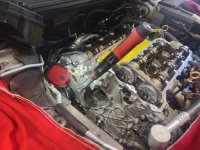
To remove the front timing cover, there is a threaded hole that goes into a blind pocket in the block. This is located just above and to the right (if facing) of the water pump, about the 10 o'clock position. I just use the bolt I removed from the alternator and thread it into this hole. Once in a short distance it will bottom out. Slowly turn the fastener inward as the timing cover is popped loose from the block and heads. Be cautious and observant at this time to ensure ALL timing cover fasteners are removed. If you miss one, this step will reveal it so pay attention to avoid damaging the front cover.
buick11.jpg

Here you can see the front cover popped away from the intersection at the heads.
buick12.jpg

Then a little maneuvering and the front cover is away from the engine and out of the engine bay.
buick13.jpg

Set aside for cleaning.
buick14.jpg

I know it only has approx. 30k miles on it, but I wanted to ensure the timing chains showed no signs of stretching. When the car came into my shop one of the first things I did was check the oil level and it was a little low, maybe a pint to pint and a half. Not terrible, but I explained to the owner that these engines do not like to be low on oil and to keep an eye on it as well as NOT following the oil life monitor on the dash. I prefer to service these in the 3k to 4k mile range but definitely NOT over 5k as some of the oil life monitors won't trip the service interval on these until 7+ thousand miles which is way, way too long to go. He informed me they service it between 3k and 4k and the inside is actually indicative of that. But now with 150k on it, I suggested he check the oil every couple of fuel filling events and not just rely on it having oil between service intervals.

As you can see by the distance the tensioner is extended, the chains are still nice and tight.
buick15.jpg

Next came the camshaft position plates for the GM High Feature V6. While these aren't 100% required, they are inexpensive enough and make for a good go/no go gauge during teardown and reassembly.
buick16.jpg

Barring the engine over clockwise to get the crankshaft timing mark at the roughly 7 o'clock position and the bank 1 (nearest firewall) camshaft flats parallel with the heads. This is where I left off for the night on Wednesday as the kids and grandkids stopped by, so this became lesser priority. My grandson had to see what Papa was working on so he came running over and wanted me to lift him up to see what was happening in the engine bay.
buick17.jpg

Yesterday I ran to my local dealership and picked up a few of the parts. The remainder should arrive over the next day or so, which will give me time to get everything thoroughly cleaned and ready for reassembly.
buick18.jpg

Continuing on, the primary chain tensioner is also showing a tight chain. You can also see the timing dot on the crank sprocket pointing to the partial one visible right near the lower edge of the guide on the tensioner.
buick19.jpg

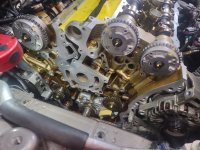
Phasers are in Stage 2 timing and components ready to come apart. Double check to ensure there are 12 links from timing mark on intake to timing mark on exhaust phasers.
buick20.jpg


Stay tuned.
With newer engines and what they take to time them correctly I always get the tools and have a bunch of them for many different engines. Like you said they are fairly reasonably priced and just not worth taking the chance of timing it wrong without them in my opinion. Thankfully the 3.6L is only 3 flat bars with notches so they were really cheap when I bought them years ago. I recently did a 1.5L ford and it had all kinds of stuff for timing the crank pulley(no key so free spinning), crank position sensor, cams, and vacuum pump, and flywheel lock. Have a 2.3L explorer to do a front cover reseal on so need to order those tools, think some overlap with the 1.5 but not all. Usually buy the import sets off amazon because the OE tools can get crazy expensive. I'm not a fan of using knock offs for timing an engine but just can't justify spending hundreds of dollars to time one engine and they seem to get good reviews. Luckily haven't had an issue yet.

Specialty tools are getting out of control with all the newer engineering going into vehicles. Seems like every repair I need to do I need a specialty tool just for that vehicle or engine. I used to consider specialty tools things other then regular hand tools, but you usually could use them on multiple makes/models. Now each vehicle needs it's own set of tools. I remember when I was starting out always thinking the older guys were silly because they all said stuff like "you can't work on newer vehicles because of all that fancy computer stuff on them". Now I'm starting to sound just like that. LOL
 

PugetDude

ALLIANCE MEMBER
Joined
Mar 13, 2013
Messages
22,400
Location
Superstition Mountains, AZ
Nice work Mike! As always!

I did have one question I was thinking about yesterday I wanted to ask, if you'll indulge me.

I suspect, based on your stated lack of desire to have noises in your Jeep when driving, that I already know the answer, but I need to ask.

I enjoy driving my Jeep on a daily basis and as with any car, I enjoy having the windows down. Cooler weather through hot weather (not in winter). Many times I'll drive home with the windows down in 85+ degree humid midwestern summer. However, with the soft top recently I've been VERY annoyed with the flapping of the top with just one window down (and soft top closed). The tire noise is bad enough. The top flapping and sounds like it's gonna rip apart is enough for me to roll up the windows and turn the air on.

Here's the question. How does your bestop top behave in these situations? Does it flop around and make a bunch of noise with a window down at highway speeds?
"It's a Jeep thing" probably isn't the answer you are looking for....🤣
 
OP
Z

zmotorsports

ALLIANCE MEMBER
Joined
Oct 20, 2009
Messages
21,405
Location
Northern Utah
I didn't get much work completed on the Buick over the weekend. I decided to take Monday off and make it a 3-day weekend as the wife had it off and I wanted to spend time with her.

Saturday I went to breakfast with my son and grandson, then headed out to the shop for a few hours.

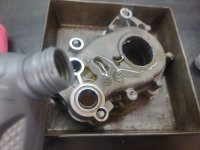
I had intended to get the new oil pump and all of the timing components installed on Saturday ready to button it up on Monday, but the universe said otherwise. Here I'm priming the new oil pump, adding oil to the inlet.
buick41.jpg

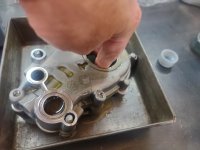
Then turning the pump until it pushed oil out the outlet port.
buick42.jpg

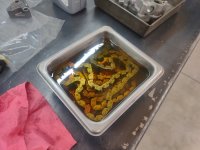
Timing chains in an oil bath awaiting installation.
buick43.jpg

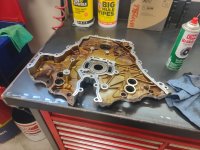
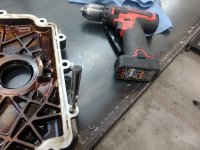
I then turned my attention to cleaning the front cover. There shouldn't be much sealant inside or outside on the cover, if there is, then too much sealant was applied during the last job. This was a small approx. 1/16" bead that I pulled off.
buick44.jpg

Next I removed the water pump gasket from the groove.
buick45.jpg

buick46.jpg

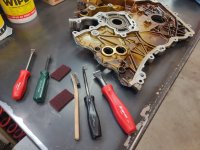
Then the tools ready to begin cleaning the sealing surface of the front cover. Take your time here, don't rush it and ensure you get all of the sealant removed. Also, like I mentioned on the block, don't use mechanized means to remove the sealant as it can create more damage than good.
buick47.jpg

The only mechanized process I use is to find a properly sized drill bit for the bolt holes.
buick48.jpg

Then while keeping the drill bit perpendicular to the surface, go through each hole to remove any residual sealant.
buick49.jpg

I have found a cotter pin tool works great for removing sealant from the grooves on these covers. It is almost the perfect size.
buick50.jpg


Stay tuned for more..
 
OP
Z

zmotorsports

ALLIANCE MEMBER
Joined
Oct 20, 2009
Messages
21,405
Location
Northern Utah
Continuing on.

A cotter pin tool is efficient in removing the sealant from the machined groove.
buick51.jpg

I then go over the surface with a carbide scraper to remove the majority of the sealant on the sealing surface and followed lastly by a Scotchbrite pad to ensure all sealant is removed.
buick52.jpg

Making sure to go around the alignment pins.
buick53.jpg

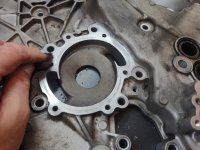
And the water pump sealing surface. I know some people will not remove the water pump during this repair if they are not planning on replacing it. I just replaced the water pump approx. 30k miles ago when I did the chains, but I prefer to separate the pump from the front cover during disassembly as I don't feel the $5 gasket is worth the risk at this point.
buick54.jpg

With all of the sealing surfaces cleaned, it takes a dip in the solvent tank to remove any and all residue.
buick55.jpg

Then blown off and sealing surfaces wiped down with brake wash and a more in-depth inspection.
buick56.jpg

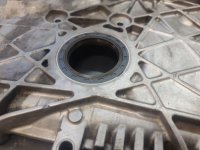
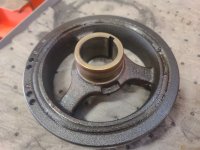
That is when I noticed this circular groove and notch around the crankshaft seal and suspected something was awry.
buick57.jpg

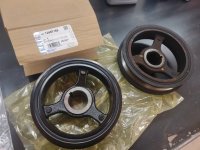
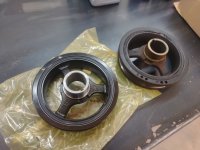
Although the harmonic balancer hadn't completely failed, it is showing signs of deterioration and it will only get worse. A new balancer will be ordered, so there's a delay.
buick58.jpg

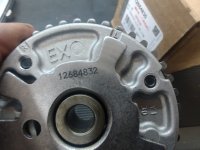
I thought I would go ahead and get the new phasers and maybe the chains installed as I could do much of the reassembly while I awaited a new balancer. I had marked the cam phasers from the invoice and transferred those locations to the box to avoid mixing them up during assembly. Upon opening the boxes and beginning assembly is when I noticed this. The 12684830 part number should be the Bank 1 intake phaser. A 12684831 is the Bank 2 intake phaser and part number 12684832 is for both exhaust cam phasers.

This one should have been the Bank 1 Intake phaser.
buick59.jpg

However, when I opened the box I saw an "EX" on the casting and then I noticed the part # 12684832 for the exhaust phasers. Well ****, a part from GM is boxed incorrectly. I opened the remainder of the boxes up to see if they were correct, which they were, but the dealership had already closed and it would be Tuesday before obtaining the correct one.
buick60.jpg


Stay tuned for more pictures..
 

Jgaz

Well-known member
Joined
Dec 16, 2016
Messages
1,662
Location
AZ
Continuing on.

A cotter pin tool is efficient in removing the sealant from the machined groove.
buick51.jpg

I then go over the surface with a carbide scraper to remove the majority of the sealant on the sealing surface and followed lastly by a Scotchbrite pad to ensure all sealant is removed.
buick52.jpg

Making sure to go around the alignment pins.
buick53.jpg

And the water pump sealing surface. I know some people will not remove the water pump during this repair if they are not planning on replacing it. I just replaced the water pump approx. 30k miles ago when I did the chains, but I prefer to separate the pump from the front cover during disassembly as I don't feel the $5 gasket is worth the risk at this point.
buick54.jpg

With all of the sealing surfaces cleaned, it takes a dip in the solvent tank to remove any and all residue.
buick55.jpg

Then blown off and sealing surfaces wiped down with brake wash and a more in-depth inspection.
buick56.jpg

That is when I noticed this circular groove and notch around the crankshaft seal and suspected something was awry.
buick57.jpg

Although the harmonic balancer hadn't completely failed, it is showing signs of deterioration and it will only get worse. A new balancer will be ordered, so there's a delay.
buick58.jpg

I thought I would go ahead and get the new phasers and maybe the chains installed as I could do much of the reassembly while I awaited a new balancer. I had marked the cam phasers from the invoice and transferred those locations to the box to avoid mixing them up during assembly. Upon opening the boxes and beginning assembly is when I noticed this. The 12684830 part number should be the Bank 1 intake phaser. A 12684831 is the Bank 2 intake phaser and part number 12684832 is for both exhaust cam phasers.

This one should have been the Bank 1 Intake phaser.
buick59.jpg

However, when I opened the box I saw an "EX" on the casting and then I noticed the part # 12684832 for the exhaust phasers. Well ****, a part from GM is boxed incorrectly. I opened the remainder of the boxes up to see if they were correct, which they were, but the dealership had already closed and it would be Tuesday before obtaining the correct one.
buick60.jpg


Stay tuned for more pictures..
Mike,
Your attention to detail is impressive.
It’s hard to get that level of perfection when dealing with the average flat rate shop
 
OP
Z

zmotorsports

ALLIANCE MEMBER
Joined
Oct 20, 2009
Messages
21,405
Location
Northern Utah
Continuing on.

I figured I could install the 3 phasers that were correct and then swap out the incorrect one on Tuesday. But things took a turn. I had not done one of these with the phenolic spacers before so this threw me for a loop. The phenolic spacers were supposed to be used on the earlier versions of these engines, say around 2004/05 through about 2008 or 2009. After that they supposedly redesigned the cam saddles to negate the need for these spacers, from my understanding. However, when I installed the new phaser onto the camshaft with this .062" phenolic phaser and I snugged the center bolt down, I noticed that is tightened the camshaft. I could still turn it with a wrench on the flats, but barely. THIS did NOT feel right so I stopped.
buick61.jpg

Washer with new phaser.
buick62.jpg


I began researching and unfortunately, there is not a lot of information available specifically discussing these washers, other than on some GM forums and I was finding contradicting information at that. What most people were stating is that IF the engine had the phenolic spacers then they must be reused. I didn't like that information without an explanation so I kept digging for specifications particularly discussing camshaft end play but was not coming up with much. I was able to locate a TSB from GM on a NTSB site, but it was mainly discussing a DTC P0008 and P0009 code in relation to measuring camshaft end play. The TSB stated if you GM High Feature engine is getting these two codes then to remove the cam cover and measure end play by inserting either a 2mm or 2.5mm hex key (allen wrench) and if they fit dependent on the design, then the washer would need to be added and it gave the GM part # for the phenolic washer. That was about it, nothing more in the explanation.

I then found a short one page article on an engine builders forum that stated the washers use with either the old style cam caps or the new style "saddle" caps but again, pretty vague information. I was bothered by the comments on several of the forums and their contradicting opinions of the authors so I decided to just measure and investigate myself.

I started by measuring the backspacing between the new and old style of phasers.
buick63.jpg

buick64.jpg

And started a small log of the measurements. I also learned that the two designs are an Aisin (early) and the Delphi (later) designs and they are identifiable mainly by the number of fasteners on the backside. The early style (Aisin) has a 5-bolt pattern and the later (Delphi) design uses a 4-bolt pattern.
buick65.jpg

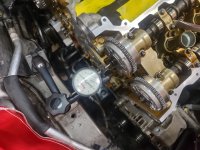
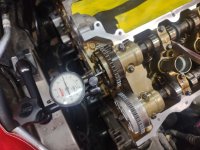
On the GM TSD all it stated about camshaft end play was that the upper limit was .016". But I wasn't sure how that was controlled, because I questioned whether that would be dialed down by the phenolic washer alone. Usually there is a journal that also serves as the thrust surface, so I thought I'd take some additional measurements of both the new phaser installed with and without the spacer and learned that with the spacer installed there was absolutely zero clearance, in fact it would nearly lockup the camshaft. So I removed the spacer and zero'd the dial indicator with the camshaft pushed one direction.
buick66.jpg

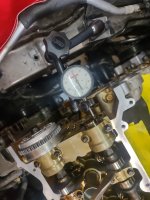
Then the other and measured just over .008" total end play. So pretty much in the middle of what was locked up and what was the upper limit. Then it hit me, the reason this measurement has a limit is because of the air gap on the sensor that mounts in the front cover.
buick68.jpg

Then just to confirm the phaser and the spacer have no effect on the camshaft end play, I removed the phaser and zero'd the dial indicator and checked it. I again landed at the ~.008" so the phenolic washer and the phaser being installed has zero effect.
buick69.jpg

While I am dead in the water as far as parts, I figured I would reinstall the OEM phenolic washer.
buick70.jpg


Stay tuned for more..
 
OP
Z

zmotorsports

ALLIANCE MEMBER
Joined
Oct 20, 2009
Messages
21,405
Location
Northern Utah
Continuing on .

I reinstalled the OEM phaser.
buick71.jpg

Zero'd the dial indicator.
buick72.jpg

And confirmed that the end play with the OEM components is the same as the new phasers without the washers.
buick73.jpg

Then two last checks that I wanted to verify were the teeth to cam saddle dimension on the new phaser.
buick74.jpg

Matched the dimension of the old phaser teeth to the saddle.
buick75.jpg


I don't have pictures because it was getting late and I was hustling as we were heading out the door to pick up my FIL for dinner, but I also double checked the distance from the cam saddle to the actual reluctor ring on the OEM phaser vs. the new phaser to ensure the air gap between the cam sensor and the reluctor will be the same and they were only off by a couple of thousandths, so they are nearly identical, even though the cam phasers are different thicknesses. If you look closely at the gap between the reluctor ring on the old phaser to the new you can see a slight difference, but the overall dimension from the cam saddle to the outside of the reluctor is pretty much the same.


Then just before closing up shop I removed the seals from the front cover and replced them with the new ones from the gasket kit.
buick76.jpg


That is pretty much where I left off on the Buick for the weekend. I am convinced now after taking a LOT of measurements that the new cam phasers without the phenolic washers will net me the same dimensions as the old phasers that used the phenolic washers.

Sorry for the long drawn-out explanation, but I hope this will help anyone doing this job and they run across a similar situation. I also recorded a short video explaining the differences and will post it to my YouTube channel.

Thank you for following along.
 
To avoid these ads, REGISTER NOW!
OP
Z

zmotorsports

ALLIANCE MEMBER
Joined
Oct 20, 2009
Messages
21,405
Location
Northern Utah
Mike,
Your attention to detail is impressive.
It’s hard to get that level of perfection when dealing with the average flat rate shop

Thank you Jim. I appreciate that. I explain to the people I do work for that I do not work by flat rate, although I will use it as a "guide", I work and charge based on time and materials. Most seem to be okay with that and those that aren't can go elsewhere. I believe in quality over quantity in most things in life.
 
OP
Z

zmotorsports

ALLIANCE MEMBER
Joined
Oct 20, 2009
Messages
21,405
Location
Northern Utah
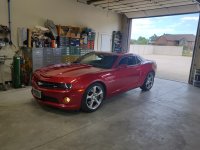
Sunday the wife and I were able to have a nice relaxing morning sitting on the deck and enjoying coffee and then we decided to take the cover off the Camaro and go for a drive. The car hasn't been out of the shop in months, so it was a nice relaxing drive. My wife even mentioned that I seemed more relaxed than I did the day before. I didn't realize it, but I guess I was a little preoccupied when I was trying to locate information on the cam phasers and until I found the answers I was looking for, I was probably a little more quiet than normal.

Cover off, tires and fluids checked, car wiped down and ready to hit the road. We ended up putting nearly 200-miles on it Saturday afternoon and it felt good to get it out on the road.
sunday1.jpg

Monday I took the day off and after mowing lawns, I decided to give the Camaro a wash and get all of the bugs off from the previous day's drive.
monday1.jpg

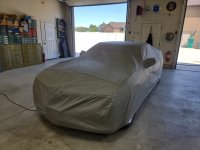
Then pulled it back into the shop and covered it up.
monday2.jpg

monday3.jpg

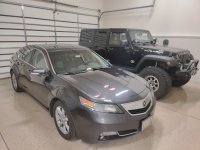
While I had the washing equipment out, I pulled the wife's daily around and gave it a cleaning.
monday4.jpg

Parked back in the attached garage next to our clean Jeep.
monday5.jpg


Then being early enough I went ahead and gave my daily a washing and parked it back in the garage. This is the first time in quite a while all our vehicles were spotless at the same time.
monday6.jpg


Unfortunately that didn't last. Both the wife and I were rained on during the drive this morning. The weather app showed nothing as far as rain in the forecast yesterday, but it got us this morning. 🤬
 

signcrafter

Well-known member
Joined
May 9, 2012
Messages
12,359
Good catch on the spacers Mike, and thanks for the tip about using a drill bit to clean out the bolt holes. Those can be a pain and guess I never thought about using a drill bit to clean them up.
 
OP
Z

zmotorsports

ALLIANCE MEMBER
Joined
Oct 20, 2009
Messages
21,405
Location
Northern Utah
Good catch on the spacers Mike, and thanks for the tip about using a drill bit to clean out the bolt holes. Those can be a pain and guess I never thought about using a drill bit to clean them up.

Thanks Scott. As soon as it didn't feel right, I stopped and started researching but was quite disappointed in the available information so I figured I would share what I learned throughout the ordeal.

As for the drill bit trick, those holes can be a pain to clean out and the drill bit that fits snugly into the hole sure makes short work of them. It's quick and effortless compared to trying to snake the sealant out using a pick or screwdriver. Plus, it reduces the risk to the square face of the bolt hole compared to something like a chamfer tool or other means.

Glad the tip was helpful.
 

ntsqd

Well-known member
Joined
Jan 22, 2005
Messages
974
Location
Lower left coast
I've concluded that I'm highly sensitive to the buffeting. Late models seem to buffet a lot more than older vehicles. I'll speculate that it's a function of their better aerodynamics. It can easily reach the amplitude that is intolerable for me, yet my wife doesn't even notice it. For me it's a low frequency pressure wave that makes my head feel like it's going to implode! First time that I encountered it was a Crew-Cab Square body that I drove as part of my job in racing. I soon learned to crack the right-rear window if I had the driver's window open to any degree. Just cracking an opposite side window is almost always enough to completely stop it although when possible a diagonally opposite window works best.
 
OP
Z

zmotorsports

ALLIANCE MEMBER
Joined
Oct 20, 2009
Messages
21,405
Location
Northern Utah
Mike, once again, your tenacity and determination to problem solve are outstanding. Not being comfortable, continuing to think about the problem, condition, causation and resolution are markers demonstrating your drive for perfection.

Thank you Joel. I appreciate the comments.

Perfection is usually the target, but seldom hit. That being said like the saying goes; "aim small, miss small".

I appreciate your continued support and tracking of my projects Joel.
 
OP
Z

zmotorsports

ALLIANCE MEMBER
Joined
Oct 20, 2009
Messages
21,405
Location
Northern Utah
I was able to get the timing chains assembled, everything torqued and paint marked last night in preparation for the front cover and rock cover installations. Still waiting on the harmonic balancer with an expected delivery date of Friday now. 🤬

Cam phasers and idlers installed, torqued to spec and paint marked. I also installed a new oil pump this time, just in case.
buick81.jpg

Chains have been soaking in motor oil for the past few days and I added a little moly lube to the chain guides. I know many people install everything in the timing system dry, but I just can't seem to do that. It probably makes little difference, but I feel better at least. :unsure:
buick82.jpg

All three chains installed using Stage 1 and Stage 2 positions.
buick83.jpg

I then barred the engine over two revolutions listening for any interference or anything odd and then set the crank mark back on Stage 2 timing mark and made certain there were still 12-links between the cam phasers on each bank.
buick84.jpg

Twelve links each. Check.
buick85.jpg

Then one last check is to ensure the cam plates line up with the Stage 2 positions on each bank after those couple of revolutions.
buick86.jpg

Check.
buick87.jpg


Next will be to install the front cover, replace the spark plug tube seals on the rocker covers and install them.

Then start full reassembly including pulling a vacuum on the cooling system to test its integrity.


Thanks for looking.
 

aka Larry

Well-known member
Joined
May 2, 2012
Messages
8,056
Location
Eastern, NC
Just curious, but do your customers ever get to see your pics & explanations Mike? Yes, I know they could get on GJ and see them like the rest of us, but I somehow doubt they would.

Point being if it were me, I'd feel much better about paying "X" when I know the level of care being put into the work being done.
 
OP
Z

zmotorsports

ALLIANCE MEMBER
Joined
Oct 20, 2009
Messages
21,405
Location
Northern Utah
I love these write ups!! Great catch on the harmonic balancer !! I am pretty certain most place would have just put everything together and would not have caught that or cared about it.
Dave

Thank you. I am glad these projects come across and help others.

One thing that worried me is when I started searching for information about the phenolic washers is that there is a LOT of erroneous information on not only one forum, but multiple forums, and all GM related. When people were asking about the washers when replacing cam phasers the answers were almost identical across the entire line; "if the OEM used washers make sure to put the washers back on with the new cam phasers." I wonder how many were assembled using the washers and were tight upon startup? Then I am curious if the phenolic washers just ended up wearing away until clearance presented itself, or what else took place? We'll never know, but it definitely wasn't correct information.
 
OP
Z

zmotorsports

ALLIANCE MEMBER
Joined
Oct 20, 2009
Messages
21,405
Location
Northern Utah
Just curious, but do your customers ever get to see your pics & explanations Mike? Yes, I know they could get on GJ and see them like the rest of us, but I somehow doubt they would.

Point being if it were me, I'd feel much better about paying "X" when I know the level of care being put into the work being done.

Good question Vincent. Most will never know the extent of the repairs, but on some issues, or findings, I text the owners pictures and/or short videos showing my findings.
 

signcrafter

Well-known member
Joined
May 9, 2012
Messages
12,359
Couple more bolts and it will be ready to fire Mike. :ROFLMAO:

I get nervous doing tube seals in those phenolic covers. Looking forward to seeing how you do it. Just seems like they get brittle and the seals baked into there take some pounding to get them out.
 
OP
Z

zmotorsports

ALLIANCE MEMBER
Joined
Oct 20, 2009
Messages
21,405
Location
Northern Utah
Couple more bolts and it will be ready to fire Mike. :ROFLMAO:

I get nervous doing tube seals in those phenolic covers. Looking forward to seeing how you do it. Just seems like they get brittle and the seals baked into there take some pounding to get them out.


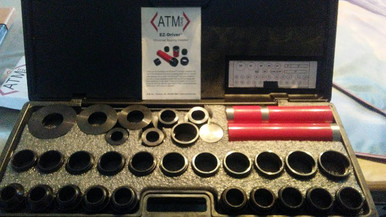
I agree Scott, they require a little extra attention. I have found my handy dandy and fancy ATM driver set works great for this. I can utilize a sized driver just larger than the seal on one side of the cover, then drive it out from the other which puts the force directly at the seal's OD fitment rather than spanning a larger distance on the cover and putting undue forces on the composite material and lead to failure. Then the same process for installation which puts the forces right at the seal rather than spanning a larger distance.

I hope that makes sense.........and yes Scott, I did just put another plug in for the ATM driver set. ;)
 

signcrafter

Well-known member
Joined
May 9, 2012
Messages
12,359
I agree Scott, they require a little extra attention. I have found my handy dandy and fancy ATM driver set works great for this. I can utilize a sized driver just larger than the seal on one side of the cover, then drive it out from the other which puts the force directly at the seal's OD fitment rather than spanning a larger distance on the cover and putting undue forces on the composite material and lead to failure. Then the same process for installation which puts the forces right at the seal rather than spanning a larger distance.

I hope that makes sense.........and yes Scott, I did just put another plug in for the ATM driver set. ;)
I saw it hanging out on your bench in the post the other day about installing front cover seals. It's still on my long list of tools needed. Having a pretty good month so planning on getting a 3D printer for shop organization and other stuff, I mean for the kids to learn something new. At least that's what I plan on telling the wife. :cool: I need to just pull the trigger on that ATM kit one of these days. If I end up needing to do my truck rear end I will probably get it. Wife doesn't question tool purchases because she knows they all paid for themselves. I just have a hard time justifying those bigger purchases to myself when it's not the only option for getting the job done, just the nicest option. But then wonder why I waited so long to get it after I get a new tool.

Where did you get yours from Mike? I know you have said before but can't remember.
 
OP
Z

zmotorsports

ALLIANCE MEMBER
Joined
Oct 20, 2009
Messages
21,405
Location
Northern Utah
Where did you get yours from Mike? I know you have said before but can't remember.

I ended up purchasing mine directly from Arizona Transmission and Machine after they took production back over from Mayhew.

However, I don't think they sell them directly any longer. I think they are available through eBay or ATSG (Automotive Transmission Service Group).
 

Boosted1

Well-known member
Joined
Nov 25, 2007
Messages
1,680
Location
Georgetown, KY
Outstanding attention to detail on the Buick.
Curious do you price by the job or by the hour?
I hope that doesn't come across negative :)
I imagine most of the repair shops would not take the time you do to do the job to the top level.
 
OP
Z

zmotorsports

ALLIANCE MEMBER
Joined
Oct 20, 2009
Messages
21,405
Location
Northern Utah
I didn't get as much time on in the shop last night as I was hoping, but I was able to get the front cover installed and torqued to spec.

The new GM harmonic balancer arrived.
buick91.jpg

Slightly better condition than the original one. :bounce:
buick92.jpg

Next up was to give the front cover a wipe with a rag and brake wash, followed by a bead of GM Engine Sealant, my go-to sealant.
buick93.jpg

Then one final wipe of the block to remove any residue on the sealing surface. I should also note that I do a dry run installing large components like this before I actually apply the sealant. This aids me in determining interference locations, hoses or tubes I may need to move out of the way or just overall determining the angle in which the component needs to be installed. I would rather bump a hose or wire loom now and move it out of the way than after it has a bead of sealant on it which could be disturbed and end up creating a leak afterwards due to having a section of sealant wiped off.
buick94.jpg

After hand starting the fasteners, running them down to lightly making contact with the cover I then go to the torque wrench and torque all of the fasteners to spec.
buick95.jpg

You should have minimal sealant coming out from the sealed edge. Much more than about 1/16" to 1/8" coming out and you have put too much sealant on it.
buick96.jpg

I go around with a mirror to ensure a small amount of sealant around the perimeter, and nothing looks out of place.
buick97.jpg

Lastly, I gave the crossemember under the engine a wipe down with a rag and brake wash before covering up the engine for the night.
buick98.jpg


I really wanted to get the cover installed to allow the sealant overnight to cure so that was the main goal of the night.

Thanks for looking.
 
To avoid these ads, REGISTER NOW!
Top Bottom