To avoid these ads, REGISTER NOW!

Service entrance surge suppression

bronc076

Well-known member
Joined
Jul 17, 2023
Messages
190
Location
Ozarks
Im having a mini split installed in the new shop and the HVAC company we use is good but a little heavy on the upsells, I get it, they are running a for profit business. Last fall I did pass on the $500 capacitor upgrade offered during the semiannual maintenance/cleaning, I have a Grainger catalog.

So as part of the quote they suggested a surge suppressor that mounts by the panel, and explained benefits, all of which make sense in this modern world of cheap Chinese circuit cards and simple machines burdened with excessive electronics. Here is the one they offered to install for $500 (apparently their favorite number).


My question.

Do these things actually do any good? I understand identifying successful preventative events can be difficult. I'm just curious if the pros on here think these are worth installing.

The model suggested screws to the wall by the panel, I'd prefer something that plugs directly into the panel and takes up a couple breaker spaces.

Im sure "it can't hurt", and "it's cheap insurance" are valid viewpoints. I wonder how often Eaton honor the warranty.


thanks!
 
To avoid these ads, REGISTER NOW!

Chuckster in NJ

Well-known member
Joined
Jan 26, 2010
Messages
2,276
Location
Hunterdon County NJ
Short answer is: YES, these work!……… I highly suggest installing one.

I have a main panel suppressor along with individual suppressors on each HVAC unit (condensers and air handlers) including my well…….. Overkill? Maybe.
 

mm08822

Well-known member
Joined
Jan 13, 2012
Messages
5,856
Location
NJ
I've installed more after people experienced lightning strikes nearby and other multiple "same time" unexplained failures. Better to be proactive. (Cheaper for you.)

SS's are rated in joules. A higher value means it can absorb more excess energy before it's possible failure while clamping excess voltage.

Best is to put one at the service panel and one local to the equipment.

As for caps, pull the ac condenser control panel cover and write down the caps info. Buy a spare. Replace what you have if very old or just wait until it fails.

$500 is a little steep for a planned replacement while they are there for other purposes. A service call during hot weather and no ac twists people's arm otherwise.
 

mike93lx

ALLIANCE MEMBER
Joined
Dec 9, 2013
Messages
37,384
Location
Richmond, VA
I have them in all three of my panels as well as on each of the a/c condensors.

If you can't DIY (it's not hard but in-panel work isn't for everyone), I doubt you can do better than $500
 

mm08822

Well-known member
Joined
Jan 13, 2012
Messages
5,856
Location
NJ
Yes.

You want the wires as short as possible anyway b/c it provides a lower clamping voltage and possibly faster response.

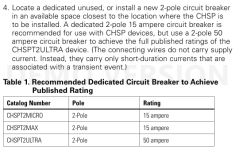
1779979833866.png
 

NWOhioChevyGuy

Well-known member
Joined
Feb 20, 2007
Messages
1,919
Location
Buckeye Hill (Morenci, MI)
That reminds me I have two sitting here to install on my main panel and mini split.
And I need to order another for the sub panel in the garage.

I asked the same questions to our EE at work and he went way into the weeds on how they are perfect for my set up.
We had a lightning strike last August that took out several pieces of equipment.
 

purplezr2

Well-known member
Joined
Jun 1, 2010
Messages
5,290
Location
Central MN
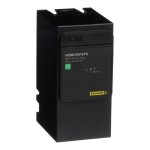
What is the difference between the ones above that are wiring in, but the ones that just snap in to a breaker location.

I have the one below in my Square D panel for my house, it was required by code.

HOM250PSPD_DA19_1500x1500-Photoroom.jpg
 

larry4406

Well-known member
Joined
Jan 27, 2006
Messages
19,043
Location
Northern Virginia
I added one at my main panel. It is a combination 240V50A breaker for the kitchen range and a surge protector. I have a CH style panel.

I also added one at the septic system sub panel, and one at the outdoor HVAC unit disconnect.
 
To avoid these ads, REGISTER NOW!

mike93lx

ALLIANCE MEMBER
Joined
Dec 9, 2013
Messages
37,384
Location
Richmond, VA
What is the difference between the ones above that are wiring in, but the ones that just snap in to a breaker location.

I have the one below in my Square D panel for my house, it was required by code.

HOM250PSPD_DA19_1500x1500-Photoroom.jpg
Ease of install. In a flush mount panel, the breaker-style are so much simpler.
 

mike93lx

ALLIANCE MEMBER
Joined
Dec 9, 2013
Messages
37,384
Location
Richmond, VA
I added one at my main panel. It is a combination 240V50A breaker for the kitchen range and a surge protector
I have a similar one in my pool subpanel that is feeding my shed. Two pole 20a with integrated surge.

In my main panels, I have a pair of homeline two pole surge-only units
 

Buckaroo5

Well-known member
Joined
Oct 18, 2012
Messages
813
Location
Central Ohio
This is all good info. It seems the general recommendation is protection at the service panel and at each of the mini-split condensers. Why do you need the ones at the individual mini-splits? Why won't the one at the main panel cover it?
 

mike93lx

ALLIANCE MEMBER
Joined
Dec 9, 2013
Messages
37,384
Location
Richmond, VA
This is all good info. It seems the general recommendation is protection at the service panel and at each of the mini-split condensers. Why do you need the ones at the individual mini-splits? Why won't the one at the main panel cover it?
I have them at my a/c condensors just because they are on the opposite side of the house.

Belt and suspenders
 
Last edited:

rlitman

Well-known member
Joined
Oct 18, 2010
Messages
24,579
Location
Long Island
What is the difference between the ones above that are wiring in, but the ones that just snap in to a breaker location.
The voltage from a surge rises as fast as the electric field travels (basically, a decent fraction of C). Adding inches of wire between the bus and the surge suppressor delays the protection enough to make a big difference (after a few feet, it's so bad that the suppressor will effectively never do anything). So if you have the ability to get one that snaps onto the bus like a breaker, it is ALWAYS going to be the best option (no matter what the nameplate specs you're comparing say).
 

mm08822

Well-known member
Joined
Jan 13, 2012
Messages
5,856
Location
NJ
This is all good info. It seems the general recommendation is protection at the service panel and at each of the mini-split condensers. Why do you need the ones at the individual mini-splits? Why won't the one at the main panel cover it?
It could, but maybe not. All depends on so many things, in particular how the house is wired, distances, where the surge enters the house, etc.
Putting one at the point of use for sensitive (and expensive ) electronics covers some of the issues above. Also if the one at the service fails and goes undetected, the local SS adds another layer of protection.

Lightning strikes and surges are each time different and never the same magnitude or duration as previous ones. Any SS may not protect equipment every time.
 
Last edited:

rlitman

Well-known member
Joined
Oct 18, 2010
Messages
24,579
Location
Long Island
This is all good info. It seems the general recommendation is protection at the service panel and at each of the mini-split condensers. Why do you need the ones at the individual mini-splits? Why won't the one at the main panel cover it?
Two reasons:

First: the very most a surge protective device can do is clamp the line voltage to the ground. That's fine when you're at the panel where all the grounded wires meet. It may not be fine at some distance to the panel with a device sitting on the actual ground outside (or on a rooftop). In those cases, the ground voltage at that spot MAY in extreme circumstances (usually due to nearby lightning) be at a significant potential to the ground voltage in the panel. In such situations, an SPD at the device can help.

Second: I said above that having the SPD plug directly into the panel bus shortens the time delay to it clamping down on voltage surges, but there's still some let-by that ends up "ringing" through your system. Particularly down low-impedance paths (i.e. bigger breakers). Mini-splits can be more sensitive to surge damage, so if you're going to spend on surge protection beyond your main panel, this is the next best place to add a smaller (and much cheaper) SPD.
 

bad_idea

Well-known member
Joined
Jun 11, 2011
Messages
4,332
Location
Pasquotank, NC
I have considered installing one of these in my panel. I have a main panel / power meter combo on the back of the house, 200 amp sub panel in the house (all electric, no gas), 90 amp sub panel in the detached garage, and a 30 amp sub panel in the shed for the pool equipment. Sounds like I should install one of those surge suppressors on the bus bar in the main panel on the back of the house? It is a Square D Homeline panel, what surpressor should I install? Thanks.
 

mm08822

Well-known member
Joined
Jan 13, 2012
Messages
5,856
Location
NJ
Here's a simple analogy:
Put 10 deadbolts/chains/latches on your front door so it can't be broken down.(Main service SS)
Every window and backdoor is another point of entry. (Pool wiring, shed wiring, cable, telephone, water, gas lines).
The bug-a-las want the booty stashed in the house. (Your electronic devices)
Protect the booty, store it in a safe. (The local SS at the equipment.)
 

Codyboy

Well-known member
Joined
Jan 31, 2019
Messages
1,621
Location
S.E. TEXAS
Are these devices proven to actually work?
I never understood how something wired in as a branch circuit could stop a surge (rise in voltage) on the line wires coming in to the panel.
If they are supposed to work like the plug in surge protector strips , I'll not use them. Those things are fire starters IMO as I have seen it a few times in peoples houses. I think most of those that were burned up were from bad neutrals where 240 volts was on line to neutral.
Not sure if they would work correctly as far as lightning goes. Probably not.

We had lightning arresters on a lot of line equipment at the utility. Even there , I was not convinced they actually work due to the amount of burned up transformers after a thunderstorm rolled through.
 

mm08822

Well-known member
Joined
Jan 13, 2012
Messages
5,856
Location
NJ
Are these devices proven to actually work?
I never understood how something wired in as a branch circuit could stop a surge (rise in voltage) on the line wires coming in to the panel.
If they are supposed to work like the plug in surge protector strips , I'll not use them. Those things are fire starters IMO as I have seen it a few times in peoples houses. I think most of those that were burned up were from bad neutrals where 240 volts was on line to neutral.
Not sure if they would work correctly as far as lightning goes. Probably not.

We had lightning arresters on a lot of line equipment at the utility. Even there , I was not convinced they actually work due to the amount of burned up transformers after a thunderstorm rolled through.
Lightning and surges are equivalent to waves in the ocean........different every day, every minute,second.

Something is better than nothin. These are called suppressors (not eliminators) for a reason.

BTW, an open neutral isn't necessarily a transient spike but a prolonged overvoltage...big difference. This goes back to joule rating of the device and what it is built for.
 
To avoid these ads, REGISTER NOW!
Top Bottom