To avoid these ads, REGISTER NOW!

Use mostly Metric, SAE is seldom-used (What would you recommend?)

ecotec

Well-known member
Joined
Oct 5, 2010
Messages
5,408
How dare you prove that SAE is still relevant lol.
As I said above… the vast majority of electrical work is still SAE.

Having said that… SAE tools go for very little at garage/estate sales.

If you are not accounting for gas and time… which I am perfectly willing to acknowledge changes the cost… an apprentice can set themselves up with a good socket set for about one hour’s pay after taxes if they get lucky.

Another point… our local does not require a socket set on the tool list anymore… but it is a pain in the *** to find a complete socket set in the gang boxes (sets always seem to be missing 1/2” or 9/16” sockets). Since they are not required, there is not a hurry to spend money on whatever you can find. You can wait until something nice falls into your lap.

Even though socket sets are considered a “contractor supplied tool”, I would not want to be without my own socket set.
 
To avoid these ads, REGISTER NOW!

lotus_esprit

Well-known member
Joined
Nov 26, 2009
Messages
111
Working on a newer Toro snow thrower (4 stroke). The parts on the frame were SAE. The parts on the engine were metric !
Try working on an original Land Rover Defender (admittedly not very common in the US), even the last ones made in 2016 had metric on the body, combination of metric and SAE on the drivetrain and suspension, and still had a couple of BSF bolts left in for good measure dating back to 1948, requiring three different sized BSF/Whitworth sockets.
 

Semi-hole mechanic

Well-known member
Joined
Feb 2, 2017
Messages
1,017
Ok, but you are in a different universe than most of us. As I'm sure you know, 99% of all fasteners used on USA sold passenger vehicles in the last 30+ years are metric. The only ones I've encountered that aren't are the seat belt anchor bolts. Yes, my ancient lawn mower is inch sized fasteners. And yes, I'm sure inch fasteners on heavy trucks still exist today. And on airplanes, battleships, space stations, nuclear reactors....... And I use inch tools around the house on various things. But not on any of my vehicles that were built in the last 50 years :ROFLMAO:
Last 50 years? Nope, more like 40, maybe 45. My first car was a ‘78 Pontiac Grand Prix SJ with an 301 Pontiac, and you needed both sets of tools to work on it. To change the alternator you needed SAE wrenches to take the adjuster bolt loose and to remove the long bolt that held it to the block, but metric wrenches to take the terminals loose. Dad would get frustrated working on it with me because he always grabbed the wrong wrench. His ‘78 Ford LTD was still mostly SAE as was his ‘81 F150, because Ford was slower to change than GM.
 

richfinn

Well-known member
Joined
Jan 29, 2011
Messages
4,809
Location
Leeds, Yorkshire, England
My tools are exclusively Metric now (living in the UK), Imperial tools became obsolete for me about 30 years ago as the last of the Old British car brands finally faded into classic car territory.

If I had to buy some now for restoration work, I would go for Ko-ken SAE sockets in 1/4" and 3/8" and a few separate 1/2" in select sizes for hub nuts/lug nuts.

For wrenches I would go with a set of Facom 440 in SAE (I like the wrenches and the plastic holders).
 

Aaron_W

Well-known member
Joined
Feb 6, 2018
Messages
2,890
Location
Northern California
The Quinn 3/8" Master Socket Set was recently on sale for $65, full SAE sockets 1/4" to 1", shallow and deep, no skips. And metric 6mm - 24mm, also shallow and deep. Plus a surprisingly decent 90T sealed head ratchet (believed to be identical to the Gearwrench 90T), plus extensions and universal.

Add to that a set of no skip SAE polished wrenches for $25 and some SAE hex keys for $10, and you would have an incredibly complete very decent quality SAE tool setup for $100, with. full set of metric sockets as a bonus!

Review of the Master Socket Set here:

Yep I was just going to say, this sounds like a good use case for HF. Those Quinn sets are inexpensive and are pretty nice. Toss in some Pittsburg wrenches and what ever the not bottom end Allen wrenches are and you could have a pretty decent SAE set for the OPs rare use at around $100.

HF has some Pittsburg SAE only socket sets that are even cheaper and could probably keep the total under $100. If they are going to spend 99% of their time in a dark drawer no real reason to spend a lot of money.
 

dscheidt

Well-known member
Joined
Apr 26, 2017
Messages
2,880
Last 50 years? Nope, more like 40, maybe 45. My first car was a ‘78 Pontiac Grand Prix SJ with an 301 Pontiac, and you needed both sets of tools to work on it. To change the alternator you needed SAE wrenches to take the adjuster bolt loose and to remove the long bolt that held it to the block, but metric wrenches to take the terminals loose. Dad would get frustrated working on it with me because he always grabbed the wrong wrench. His ‘78 Ford LTD was still mostly SAE as was his ‘81 F150, because Ford was slower to change than GM.
GM went metric for new designs in the early 70s with the Chevette and Vega. After that, anything new was metric, but existing designs stayed as they were. Ford and Chrysler did pretty much the same thing, a couple years later. So from the mid 70s until the early 2000s, amercian cars and trucks were a mix of stuff, because engines, transmissions, and suspension designs went on a long time, but other stuff changes. Where it got really fun was where a design changed and a part had a mix (like a starter mounted with sae, but metric electrical connectors, because the solenoid was a new design). the aftermarket did whatever it wanted, making it even more fun. There was also some **** made with metric heads on SAE threads, because the US gov't wanted one set of tools for a vehicle, and that bled into the regular market.
 

ecotec

Well-known member
Joined
Oct 5, 2010
Messages
5,408
GM went metric for new designs in the early 70s with the Chevette and Vega. After that, anything new was metric, but existing designs stayed as they were. Ford and Chrysler did pretty much the same thing, a couple years later. So from the mid 70s until the early 2000s, amercian cars and trucks were a mix of stuff, because engines, transmissions, and suspension designs went on a long time, but other stuff changes. Where it got really fun was where a design changed and a part had a mix (like a starter mounted with sae, but metric electrical connectors, because the solenoid was a new design). the aftermarket did whatever it wanted, making it even more fun. There was also some **** made with metric heads on SAE threads, because the US gov't wanted one set of tools for a vehicle, and that bled into the regular market.
GM used SAE Allen head bolts on their pickup truck front disc brakes until the late 90’s. I think, in 2000 they changed to T-55 headed bolts.
 

liliysdad

Well-known member
Joined
Jul 18, 2008
Messages
5,372
I despise getting parts for my older American stuff, and it having metric hardware. I just went through this with a set of lead mil-style battery terminals. I replaced the dorky metric stuff with SAE, and had to drill the main lug hole out for a 3/8 bolt. I can look past the nonsense for universal parts, but every now and then you get a hard part that has been rebuilt or "updated" with metric hardware, and that's just dumb.
 

driftpin

Well-known member
Joined
Dec 22, 2016
Messages
11,178
Location
Miami-Dade/Broward Co. Florida
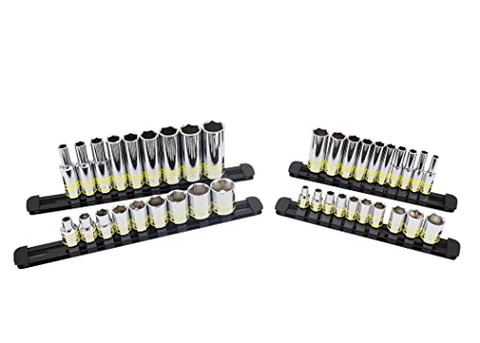
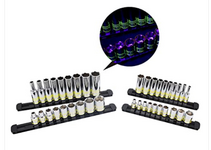
I posted in Hot Deals about an Astro Pneumatic 1/4" and 3/8" regular and long socket set, with high-visibility banding. A bargain at 38 pieces for $30! Act quickly, if you want it, it's a close-out. A good travelling set for an older vehicle.


1756733733752.png
 

pfbz

Well-known member
Joined
Dec 17, 2008
Messages
954
I posted in Hot Deals about an Astro Pneumatic 1/4" and 3/8" regular and long socket set, with high-visibility banding. A bargain at 38 pieces for $30! Act quickly, if you want it, it's a close-out. A good travelling set for an older vehicle.


1756733733752.png
Yup, I picked up a set of those as well a while back. Decent enough set, comes on usable rails, great 'second toolbox' set or travel set. The UV markings are a bit gimmicky, but they are also easy to read in normal light.
 
To avoid these ads, REGISTER NOW!

Fixr

Well-known member
Joined
Dec 23, 2012
Messages
9,702
Location
SW VA
I work on a 2 ton grain truck and rarely need to get above 3/4-13/16. Dad's tractor for some reason gets bigger than I thought it would. Most everything starts at 9/16 or 5/8"
I know some guys who work on old British stuff that is at least 90% Whitworth. Should virtually the rest of the wrenching world admit that this newfangled metric stuff will never catch on? (Stirring the pot)
 

Fixr

Well-known member
Joined
Dec 23, 2012
Messages
9,702
Location
SW VA
GM used SAE Allen head bolts on their pickup truck front disc brakes until the late 90’s. I think, in 2000 they changed to T-55 headed bolts.
I wouldn't be a bit surprised if Stellantis is still using SAE, Whitworth, bicycle threads, and gas/kerosene lantern threads. (Those are all real things)

Edit: there are probably also Studebaker Conestoga wagon axle and wagon body threads that some diehards are clinging to.
 

BobsYourUncle69

Well-known member
Joined
Dec 21, 2023
Messages
409
Location
Westchester New York
Before Id moved here , Id hardly ever needed SAE anything but was pleasantly surprised at how affordable quality older SAE tools are , the various market places are flooded with them after I moved here but metric stuff seems to fetch a significant amount more.

I come across SAE in daily life as the co-ops equipment like snow blowers along with other equipment , couplings on the water pumps and plumbing fittings are all SAE.
Some of the aftermarket stuff I've fitted to my Tacoma like the camper shell brackets , new rear bumper are also SAE but everything that is factory is all metric.

Im mostly sorted on SAE stuff and I paid less than the cost of one Gedore metric socket set for all of my SAE Stuff from various platforms ,of which the majority is made in USA.
 

BlakeTheCarGuy

ALLIANCE MEMBER
Joined
Oct 10, 2018
Messages
9,300
Location
Roanoke Virginia
At work it’s very rare SAE comes out though I did need some today to remove a bull bar on the front of a F-150 used car. All my coworkers thought I was crazy and said they would have just used metric because none of them even have SAE. But on the side and weekends I tend to use SAE more mainly because I’m usually working on my dad’s Freightliner or one of our older mowers or something like that. I do still use metric outside of work when needed too. Tools I use a lot for SAE is 1/4-1-1/2 sockets and wrenches. Keep in mind though working on a semi truck some stuff will be bigger. Some sixes I’ve only touched once or twice and some sizes I use every time I work on it. Sizes rarely touched are 11/16 and 1-7/16 sizes used all the time are 5/16, 3/8, 1/2, 9/16, 5/8, 13/16.
 

ecotec

Well-known member
Joined
Oct 5, 2010
Messages
5,408
A year after my last post in this thread, and my most often used sockets and wrenches are still SAE (mostly in this order… 7/16, 9/16”, 3/4”, 1/2”).

But I still would not recommend using much of your tool budget for SAE. There is so much SAE out there for pennies on the dollar.

I am about to head out the door to go build a factory. We’ll see if I use any metric today…

I would argue that the people that plan on attending an auto tech school with SAE on the tool list should start looking for cheap SAE months ahead of time. They will cut down their debt by a lot by buying their SAE second hand.

Maybe a 5/16” nut driver and sockets for aftermarket worm drive clamps.
 

Gmonkee

Well-known member
Joined
May 9, 2010
Messages
2,701
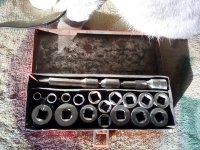
This can cross a few wires but a lot of metric sizes cross over to imperial. If you get a metric socket set and add a select few imperial sockets to it it covers both up to 22mm/ 7/8" perfectly. I carry it In a WW2 era socket box 3 X 8" among with a set of wobble plus extensions.
No universal joints required.

I have been doing this for two decades in various shops.
To a 5- 20 mm set I added 1/4, 3/8, 13/16 and 7/8".
It works for wrenches too. I knew what socket was where because this set was the only one for every job. Still do.

I was mobile most of the time and had limits on what I could carry. I didn't carry deep sockets as my wrenches did that need.

To add to an imperial set is adding 5, 6, 7, 9, 10, 12, 15, 18mm . Same number in the end but it's buying a near full metric set, not four loose units.IMG_20260529_083527.jpg
 
Last edited:

Gmonkee

Well-known member
Joined
May 9, 2010
Messages
2,701
It appears the 5, 6 and 7 have migrated elsewhere after retiring from wrenching. It now starts at 1/4" and 8mm.
I must not see too many Fords anymore.
 

CHI_Tool&Die

Well-known member
Joined
Jul 20, 2021
Messages
1,378
Location
Chicago, IL
This can cross a few wires but a lot of metric sizes cross over to imperial. If you get a metric socket set and add a select few imperial sockets to it it covers both up to 22mm/ 7/8" perfectly. I carry it In a WW2 era socket box 3 X 8" among with a set of wobble plus extensions.
No universal joints required.

I have been doing this for two decades in various shops.
To a 5- 20 mm set I added 1/4, 3/8, 13/16 and 7/8".
It works for wrenches too. I knew what socket was where because this set was the only one for every job. Still do.

I was mobile most of the time and had limits on what I could carry. I didn't carry deep sockets as my wrenches did that need.

To add to an imperial set is adding 5, 6, 7, 9, 10, 12, 15, 18mm . Same number in the end but it's buying a near full metric set, not four loose units.IMG_20260529_083527.jpg
I’ve been toying with this idea for work. I just don’t use metric enough to warrant an entire set. So I’ve thought about using my SAE set and just adding what isn’t an equivalent in metric.
 

Airmedic1

Member
Joined
Sep 27, 2023
Messages
20
When I quit wrenching for a living in 1991 most of my stuff was and still is SAE. I only had a few metric wrenches and sockets. Since then I have purchased metric sockets in 1/4", 3/8" and 1/2" in deep and shallow plus combinations up to 30mm.
I still use the SAE most of the time because I'm a hobbyist and I work on older stuff but I'm amazed at the number of metric nuts and bolts on my 1985 Chev K20 project truck. Not on the engine or drive train but on the body and suspension.
 

Paco Pena

Well-known member
Joined
Jul 20, 2010
Messages
2,429
Location
Vancouver Canada
For God's sakes man this is Garage Journal! You also need a full set of Whitwoth sockets and wrenches just in case you stumble over anything requiring British Standard fasteners.....

Paco
 

BobsYourUncle69

Well-known member
Joined
Dec 21, 2023
Messages
409
Location
Westchester New York
Some metric and SAE sizes are exact like 1-1/16 = 26.99mm which is super close, the difference between 2 different manufacturers 27mm would factor more than the size difference would , I believe 23mm has an exact match too as do a couple of others. I think 7/8 is too sloppy on 22mm though , i damaged the chrome on my new shower head like that , I was new here and figured , it's water so must be SAE and it was actually 22mm. The 22mm didn't damage the chrome on the 2nd shower head so luckily it was the kids bathroom that got the 1st shower head.

So I have SAE or metic skips only when it's almost exact as one also rounded off a 1/2 fastner when using a 13mm before on my vice. The exception is my Gedore Metric /SAE c19 sockets , those don't round anything and it's normal of they fit a little loose.
I also feel 7/16 is too lose for an 11mm fastener when using a 12 point wrench or socket as it gets too close to the corners for my liking on such small fasteners.
 
Last edited:

Gmonkee

Well-known member
Joined
May 9, 2010
Messages
2,701
Mine are mostly 6 point. A few filler 12 pt snuck in for being cheap. I wasn't spending a lot, it's a mid range Knova set with mostly Truper add ins. All worth less than 40 bucks.
 
To avoid these ads, REGISTER NOW!
Top Bottom