To avoid these ads, REGISTER NOW!

Epoxy floor peeling apart, can i still redo these area with concrete sealer ?

ningji

New member
Joined
May 23, 2026
Messages
4
My 1st post here, pls be bear with me.
I'm from Worcester MA, can have heaven snow in winter, salts on the road.
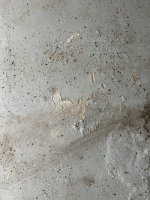
IMG-6695.jpg
Hired someone did the epoxy floor 3 years ago, the epoxy under where my car parking area is peeling off a lot, it's a common problem as you all aware.
Before that, the 45 years old concrete floor was dusty.

I understand it's better to redo the floor, but i may not get to it in years.

if i just sand these bad epoxy area (make it a rectangle so won't look very bad with different colors), clean with the lawn leave blower (not water so as to protect the remaining epoxy), and apply concrete sealer, would this be a good DIY solution ?
 
To avoid these ads, REGISTER NOW!

Shea

Well-known member
Joined
Sep 19, 2012
Messages
2,865
Location
California
I can see dusting of the exposed concrete, which is most likely why the epoxy is peeling up. Did the installer grind the floor or etch? Dusting is due to a weak surface layer, which etching won't remove.

You can grind the affected area to remove the epoxy and weak surface layer (sanding won't do this). Applying a penetrating sealer afterward is better than nothing, but it won't be very effective at protecting the concrete from salt and water damage. The reason is that the open pores produced by grinding absorb much of the sealer. As a result, it can't provide the protection you need right at the subsurface.

Instead, I would buy a cheap DIY EpoxyShield kit and apply it to that area after grinding. It will provide better protection than a sealer and not stand out as much as a big square of bare concrete.
 

dynatrix

Member
Joined
May 26, 2026
Messages
5
Just sealing those spots probably won’t last long. The concrete underneath looks weak/dusty, which is likely why the epoxy failed in the first place. Best temporary fix is to grind the loose areas clean and patch with a cheap epoxy kit instead of just using sealer.
 
OP
N

ningji

New member
Joined
May 23, 2026
Messages
4
Applying a penetrating sealer afterward is better than nothing, but it won't be very effective at protecting the concrete from salt and water damage. The reason is that the open pores produced by grinding absorb much of the sealer.
actually since the concrete floor is so old and dusty, i would rather it can absorb the right chemicals and hardening the floor.

This is AI says:

Concrete densifier​

This is more like:

“hardening the concrete itself”
Usually:

  • lithium silicate
  • sodium silicate
  • potassium silicate
It chemically reacts with concrete and:

  • hardens surface
  • reduces dusting
  • strengthens weak surface somewhat
Importantly:

  • it penetrates INTO the slab
  • not a coating layer
  • so it does not peel
For old dusty concrete:
this is often exactly the right tool.
 
OP
N

ningji

New member
Joined
May 23, 2026
Messages
4
Just sealing those spots probably won’t last long. The concrete underneath looks weak/dusty, which is likely why the epoxy failed in the first place. Best temporary fix is to grind the loose areas clean and patch with a cheap epoxy kit instead of just using sealer.
what do you think of lithium silicate densifier ? to harden this old concrete 1st ?
 
To avoid these ads, REGISTER NOW!

dynatrix

Member
Joined
May 26, 2026
Messages
5
what do you think of lithium silicate densifier ? to harden this old concrete 1st ?
Yeah, it can help with the dusty concrete a bit. But I’d still grind the loose stuff off first, otherwise anything you put on top may keep peeling.
 

Shea

Well-known member
Joined
Sep 19, 2012
Messages
2,865
Location
California
actually since the concrete floor is so old and dusty, i would rather it can absorb the right chemicals and hardening the floor.

This is AI says:

Concrete densifier​

This is more like:


Usually:

  • lithium silicate
  • sodium silicate
  • potassium silicate
It chemically reacts with concrete and:

  • hardens surface
  • reduces dusting
  • strengthens weak surface somewhat
Importantly:

  • it penetrates INTO the slab
  • not a coating layer
  • so it does not peel
For old dusty concrete:
this is often exactly the right tool.
Densifiers do not fix bad concrete. It would be a waste of money to apply one to concrete dusting as badly as yours. The primary problem with dusting is a weak surface layer. This is most commonly caused by too much bleed water in the mix, though it can be other issues as well. When the bleed water rises to the surface of the slab and evaporates, it carries all the fines, also known as laitance. It's a weak surface layer that lacks much of the free lime and other minerals that densifiers require to react with. Adding water to the surface to make it smoother during the finishing process will create the same issue.

The better the condition of the concrete to begin with, the better a densifier works, and vice versa. If you had a very light dusting issue, a densifier could be a good choice. But when it's so bad that it's breaking down beneath a coating and causing it to lift, the only way to fix the dusting is to remove the weak layer.
 
OP
N

ningji

New member
Joined
May 23, 2026
Messages
4
Densifiers do not fix bad concrete. It would be a waste of money to apply one to concrete dusting as badly as yours. The primary problem with dusting is a weak surface layer. This is most commonly caused by too much bleed water in the mix, though it can be other issues as well. When the bleed water rises to the surface of the slab and evaporates, it carries all the fines, also known as laitance. It's a weak surface layer that lacks much of the free lime and other minerals that densifiers require to react with. Adding water to the surface to make it smoother during the finishing process will create the same issue.

The better the condition of the concrete to begin with, the better a densifier works, and vice versa. If you had a very light dusting issue, a densifier could be a good choice. But when it's so bad that it's breaking down beneath a coating and causing it to lift, the only way to fix the dusting is to remove the weak layer.
Hi Shea, thx for the details, this is good info.
my big question is, how deep should i remove the weak layer ?

Years ago when the contractor working on epoxy, he did grind the concrete floor 1st, the problem is, seems it's still dusty after grinding.
i'm worried about the situation of the whole garage concrete.
 
Last edited:

mrtynafixit

New member
Joined
Jun 3, 2026
Messages
2
Concrete sealer over partially peeled epoxy isn't going to hold up great — the sealer can't bond to the spots where the epoxy's still stuck, and you'll likely end up with more lifting over time.

Honest temp fix: grind or sand the peeled patches down to bare concrete, fill them with a polyurea patch product, and leave it. Not pretty, but stable. The road salt and freeze-thaw cycles you're dealing with in Worcester are brutal on coatings — any thin topcoat over a compromised floor is just going to keep peeling.

When you do get around to redoing it, make sure whoever you hire diamond grinds the whole slab first. That's almost certainly what the original guy skipped — it's the number one reason epoxy fails under the tires specifically.

There's a rundown of what actually causes this and what a proper redo looks like at garagefloorsrsm.com — written for homeowners, not contractors.
 
To avoid these ads, REGISTER NOW!
Top Bottom