To avoid these ads, REGISTER NOW!

Line wrench or Box-end for brake bleeder fittings?

mslim

Well-known member
Joined
Mar 25, 2015
Messages
287
Location
Fayetteville, AR
I get that you have to use a line wrench or flare nut wrench for tightening a union on a hard line. I'll use an open end to hold the union stationary and a flare nut on the actual fitting, but..... I can't think of any reason to necessarily use a flare nut wrench on the actual bleeder fitting. I've done this in the past but it's easy to dislodge the flare nut wrench faffing around with the drain hose and container.

Wouldn't it make more sense to just use a 6 point box wrench and this take it off when the job is done?
 
To avoid these ads, REGISTER NOW!

Stelzer

Well-known member
Joined
Mar 14, 2022
Messages
445
Location
Portland, OR
I'm not a pro, but I play one at home for friends & family. Never once used a flare nut wrench to tighten/loosen bleeders. Usually the smallest 10/12mm I can get in there. Maybe professionals would have a different opinion
 

sweet victory

Well-known member
Joined
Jun 9, 2016
Messages
1,262
Location
USA
For brake bleeder fittings, I prefer 6 pt box wrenches. I've nearly rounded off bleeder fittings on my 911 even while using snap on flare nut wrenches. I imagine the heat cycles from all the canyon roads get them hot and seized. An 11mm Armstrong I got from cripe distributing lives in my cart for this sole purpose.

i-BZCgDJ6-L.jpg
 

sweet victory

Well-known member
Joined
Jun 9, 2016
Messages
1,262
Location
USA
Probably old school but, I have more than a few six point boxed end bleeder wrenches in assorted sizes. lengths, and shapes just for this purpose. Did the trucks stop selling these? :dunno:

My SO dealer carries a bunch in large and interesting shapes and sizes. I believe they're shaped the way they are so brakes can be bled without removing wheels. I've never worked on cars professionally, so that doesn't really appeal to me.
 

Dave455

Well-known member
Joined
Mar 19, 2013
Messages
5,797
Location
Sussex, England
Absolutely! Use the box end!

I actually have a 9mm semi deep socket in my vehicle box, specifically for loosening the bleeders initially (much better access with a socket and extension), then I use the box end wrench for bleeding!
 

lilredex

Well-known member
Joined
Apr 29, 2006
Messages
5,950
Location
Toronto
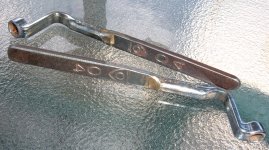
These are my brake bleeder wrenches, once one piece, they were separated for ease of use.
 

Attachments

  • Brake Bleeder #3A.JPG
    Brake Bleeder #3A.JPG
    859.7 KB · Views: 29
  • Brake Bleeder #3B.JPG
    Brake Bleeder #3B.JPG
    454.3 KB · Views: 29
To avoid these ads, REGISTER NOW!

mrjaw14

Well-known member
Joined
May 22, 2012
Messages
1,958
Location
Nashville, TN
I use a 6 point box wrench as well. I make sure I can loosen them, then slip my bleed tool hose through the box onto the bleeder. With the hole in the middle bleeders just seem softer and easier to round, so I take no chances with 12 point or flare nut wrenches.
 

mreisner

Well-known member
Joined
Jun 25, 2019
Messages
900
Location
North of Detroit
I use a 6 point box wrench as well. I make sure I can loosen them, then slip my bleed tool hose through the box onto the bleeder. With the hole in the middle bleeders just seem softer and easier to round, so I take no chances with 12 point or flare nut wrenches.
6 point always, Mac rbrt if I have one that small.
 

rooster59

Well-known member
Joined
Nov 16, 2014
Messages
935
Location
Land of the Pines
Bleeders that haven’t been opened in years, driven in winter in heavy salt … or bleeders cracked every year in no salt?

My fav would be 6pt wrench, or 6pt socket on a breaker bar follow with box end wrench. If it’s all rusty replace the bleeder screw. Whatever you do, don’t round them off. Or worse break them off.
 

AEAdam

Well-known member
Joined
May 27, 2023
Messages
2,717
Location
SE PA
My SO dealer carries a bunch in large and interesting shapes and sizes. I believe they're shaped the way they are so brakes can be bled without removing wheels. I've never worked on cars professionally, so that doesn't really appeal to me.
I think there's more to it than that.

A normal box wrench is designed to clear the largest std fastener. The wrench is then rotated until features inside the wrench (or socket) contact NEAR the corners of the fastener. Snap on called this "flank drive".

If I'm not mistaken, brake bleeder wrenches are not "flank drive" and instead are proper hex recesses that taper ever so slightly top to bottom. So you push the wrench down until you get firm contact.

Because I drove old cars or crappy cars for a long time, I've had trouble with simple brake jobs. I picked these up on eBay for a couple bucks each. Even at list price, they are worth the money for the one bleed screw you wreck and need vise grips to mess with.

IMG_7941.jpeg

Snap on has made these for a long time, and obviously made them in the sizes most often needed. I have 1/4"-3/8", 8-10mm. Other std bleeder sizes include 5/16" and 7/16", 7, 9, & 11mm.

Just note, because of the taper 5/16" = 8mm and 7/16" = 11mm. 3/8" might fit the 10mm. 7mm is a bit bigger than 1/4" so I'd try 1/4" on a 7mm bleeder*

So I'd think about what sizes you need, then start searching on eBay to see if you can find what you need.

*NOTE: When I find these "strange" sizes, I often wonder if they are metric equivalents for a SAE std. Example: I'm not sure the caliper bolts on my Durango are actually 11mm SHCSs or are just std 9/16" bolts with 7/16" internal hex heads that an 11m Allen fits nicely.

I know this has come up before and someone found a reference to a metric std for 7mm heads. I wonder if Germans chose that hose clamp because it's small and can be turned with either a 1/4" socket or a 7mm.

In my machine shop there are a lot of devices etc with 8mm hex heads. I call that size the "Machinist's friend" because 8mm and 5/16" are very close together and sometimes its just more convenient to have one set of tools in the machine shop.

Bleeder screws could be similar, designed to be turned with either SAE or metric tools.
 
Last edited:

Mr_B

Well-known member
Joined
Nov 21, 2016
Messages
5,374
Location
Reading
Box, or even a ratchet and socket.

Line wrench for brake lines.
+1 on a socket and ratchet to loosen it if the bleeder looks like it could be difficult or access not best with a long box wrench .
I pretty much always use 12 point box wrench purely for wrench clock positioning/swing clearance (decent quality wrenches make big difference on not rounding out fittings) but been a few times it been handy have 6 point box wrenches so worth grabbing a half decent set when see a deal .
 

mikey03

Well-known member
Joined
May 17, 2024
Messages
2,039
The only reason to ever use a line wrench on anything is cause a box end won’t fit because there’s a line on both sides. Otherwise why would you ever use one on purpose?

now with regular open end wrench some guys use them for speed on already broken loose fasteners but there also mostly for where you can’t fit a socket or box end wrench tbh
 

AEAdam

Well-known member
Joined
May 27, 2023
Messages
2,717
Location
SE PA
The only reason to ever use a line wrench on anything is cause a box end won’t fit because there’s a line on both sides. Otherwise why would you ever use one on purpose?

now with regular open end wrench some guys use them for speed on already broken loose fasteners but there also mostly for where you can’t fit a socket or box end wrench tbh
Are you asking us or telling us?

You use a line wrench because sealing nuts on fluid lines are often soft, either because they are brass or they are thin. Line wrenches are thicker to spread the load out and to contact more sides to avoid distortion/damage to the nut to allow it to function correctly.
 
To avoid these ads, REGISTER NOW!
Top Bottom