Outlawmws
Well-known member
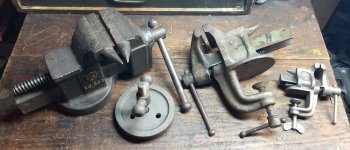
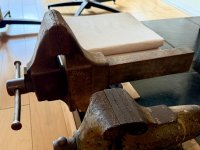
I did come home with a vise. Ca. 1914 Bonney "Champion" No. 112 (1-1/2" jaws).
Nice!
Other than the slide shape, very similar to the Colton patent vises in styling.


I did come home with a vise. Ca. 1914 Bonney "Champion" No. 112 (1-1/2" jaws).
They are similar.Other than the slide shape, very similar to the Colton patent vises in styling.
Thanks, Oregon! Pretty amazing to have them all together.^^^Well damn Micahd.....awesome finds there!
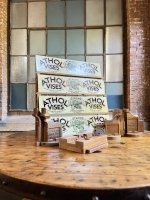
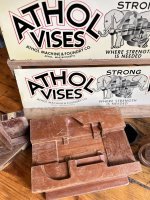
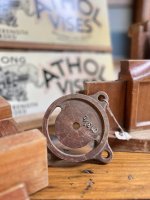
Four, double-sided, 1950s vise signs made by the Athol Machine & Foundry Co.
Staged beautifully together! Is that your place? Looks like a loft in a converted factory building.Athol/Starrett wooden vise patterns
Thanks a bunch, Private. Unfortunately not my place, but thankfully only about 30 minutes from me. The building is an old cotton mill, most of which has been turned into a wedding venue.Staged beautifully together! Is that your place? Looks like a loft in a converted factory building.
I think someone on another site (maybe bvf?) demanded to know who bought those. Great score!It isn’t often that I have the pleasure of introducing something truly “new” to the world of American vises - something that, until very recently, has never seen the light of day in this digital age.
Four, double-sided, 1950s vise signs made by the Athol Machine & Foundry Co. These came directly from the gentleman whose father worked at the LS Starrett Co as a stationary fireman (i.e. a boiler operator) from 1951-1970. These signs are four of sixteen that he saved from extinction while visiting his father at work while Starrett was piling up and scrapping obsolete inventory.
The Athol/Starrett wooden vise patterns came from a completely different source but, as luck would have it, only a few days earlier.
Impressive! I was just in Athol. The two Emmert turtlebacks I picked up last week came from an auction at LS Starrett in Athol.These came directly from the gentleman whose father worked at the LS Starrett Co as a stationary fireman (i.e. a boiler operator) from 1951-1970.
Thanks a bunch! Yes, I wanted to keep it quiet until I received them.demanded to know who bought those. Great score!
Thanks, Mongo! Wow, that’s so neat. Were they NOS?Impressive! I was just in Athol. The two Emmert turtlebacks I picked up last week came from an auction at LS Starrett in Athol.

No, both Emmerts had been in service. One is complete and just needed some light cleaning, the other is missing a few minor pieces but functional. No broken castings on either.Thanks, Mongo! Wow, that’s so neat. Were they NOS?
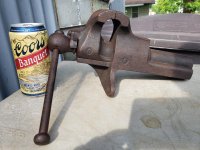
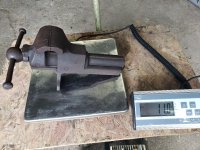
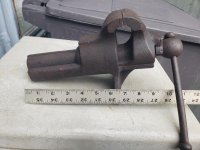
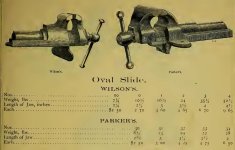
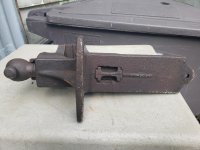
Can any one identify this oval slide w/ 3-1/2" jaw; 6" open'g.? Chas. Parker? Age? Value? more info i.e catalog?
Thanks, Edmund.

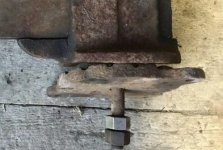
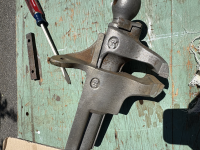
Definitely a Reed IMHOAnother "help identify this vise" request. This rather rusty vise is for sale locally and there is only this one picture available. The key identifying characteristics of this vise, at least to my eyes, is the mounting system. It looks like it has a separate toothed/serrated baseplate with a bolt hole at each corner that would be bolted down to the bench. Then it looks like the center bolt could be loosened and the vise body could be lifted and swiveled to different orientations and then tightened back down. Is anyone familiar with style of mounting and specific manufacturers/model numbers?
Thanks, Tom
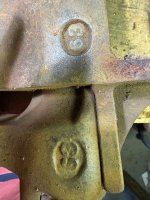
Thanks for the reply. I've got it in a vinegar soak now to de-rust. The retainer nos are "11.22.44". Also, I've seen some similar "Parker" oval slide types with a fixed nut in the shaft tunnel, mine has a removable nut that drops out of the bottom when the screw is removed. I'll post some additional pic after the vinegar bath.I believe I see the outline of the Parker Jaw, (can you get a pic with less rust?) the main screw retainer looks Early Parker to me, is the last No 14 or 44? (I don't think its 11)
Parker made unlabeled vises for other sellers, so may be why no makers name.
Outlawmws:I believe I see the outline of the Parker Jaw, (can you get a pic with less rust?) the main screw retainer looks Early Parker to me, is the last No 14 or 44? (I don't think its 11)
Parker made unlabeled vises for other sellers, so may be why no makers name.
 www.garagejournal.com
YepAnother "help identify this vise" request. This rather rusty vise is for sale locally and there is only this one picture available. The key identifying characteristics of this vise, at least to my eyes, is the mounting system. It looks like it has a separate toothed/serrated baseplate with a bolt hole at each corner that would be bolted down to the bench. Then it looks like the center bolt could be loosened and the vise body could be lifted and swiveled to different orientations and then tightened back down. Is anyone familiar with style of mounting and specific manufacturers/model numbers?
Thanks, Tom

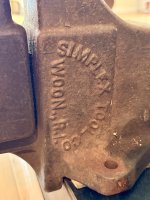
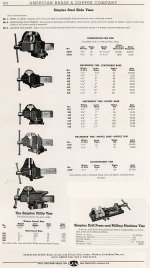
Thanks! Good info. Did a double take when I saw “Woon” on the side. Thought they were always Desmond Stephan out of Urbana.SoCal: Your vise is fairly rare. Here is a 1936 catalog page showing Simplex vises even though it had become Desmond Stephan by 1932.
They were solidly built vises
November 22, 1944?but why 11-22-44?
November 22, 1944?
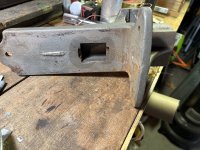
So, now out of the vinegar bath and cleaned up a bit, and lo and behold, stress cracks in the likely places in the casting at the base of the fixed jaw - see photos. I didn't see through the rust... Who knew you need to carry a jeweler's loupe or magniflux to a yard sale.. Oh well, I guess I lost my $3 gamble... On to plan B. The screw, nut and moveable jaw seems to be in good condition - see pics...so, if anyone has a Chas. Parker manufactured [Sargent Mod. 63 ] oval slide vise needing these parts, let me know.Thanks for the reply. I've got it in a vinegar soak now to de-rust. The retainer nos are "11.22.44". Also, I've seen some similar "Parker" oval slide types with a fixed nut in the shaft tunnel, mine has a removable nut that drops out of the bottom when the screw is removed. I'll post some additional pic after the vinegar bath.


My personal opinion is that with no base, $225 seems high. If I were in your shoes, I might let them know how far you’re driving for it and ask if they could do $150-$175Second opinion request please:
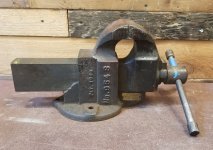
Charles Parker "Eclipse" 954 4-inch jaw, stationary bench vise. Catalog says 46 pounds, 6.5" throat.
Asking price $225. Driving distance 160 miles round trip. ( ± $65 in fuel costs)
Appears to be in decent shape, but only one photo available.
Yea? Nay?
Sure looks like a fixed base to me--three holes and all.My personal opinion is that with no base
Sure looks like a fixed base to me--three holes and all.
Thank you both for correcting me…I obviously didn’t look close enoughthe 954 catalog illustration does not show any base