To avoid these ads, REGISTER NOW!

Tool Organisation Was the Wrong Question — We Should Optimize for Speed of Retrieval, Certainty of Return & Protection of Value of tools.

sarel.wagner

Well-known member
Joined
Jun 2, 2010
Messages
331
Location
Centurion, Gateng Province, South Africa
Tool Organisation Was the Wrong Question. We Should Optimize for Speed of Retrieval, Certainty of Return & Protection of Value of tools. (WIP is the Real Killer)
I've been thinking a lot about tool storage over a long period of time and more so lately, and I believe we've been optimizing for the wrong thing. Most garage/tool discussions focus on "organization" and pretty foam shadows, perfect drawer layouts, color-coded everything, Instagram-worthy tool walls. But is that really what matters most in a working garage or at home garages? What we should actually be solving for:
  • Speed of retrieval: How fast can I grab exactly what I need (and only what I need) when I'm in the middle of a job?
  • Certainty of return: Systems that make it almost automatic (or idiot-proof) to put tools back where they belong, so nothing walks off or gets buried.
  • Protection of value in use: Keeping tools clean, undamaged, rust-free, and ready to perform when I actually need them. Dont just take this point on face value....
"Organization" is often a static beauty contest. What we need is dynamic workflow efficiency and loss/damage prevention.And the even bigger elephant in the garage? Work In Progress (WIP).

Half-finished projects, parts scattered across the bench, tools left out "because I'll need them again tomorrow, this is me," random fasteners and hardware everywhere. This destroys any tool organization system faster than anything else. Curious how others think about this. Do you have systems that prioritize quick grab/return over perfect looks?

What works (or fails) for managing ongoing projects and keeping tools protected/ accounted for?Photos of your current setups, failures, or wins welcome.

SP
 
To avoid these ads, REGISTER NOW!

kbuhagiar

Well-known member
Joined
Dec 27, 2005
Messages
1,738
Location
Escondido, CA
Half-finished projects, parts scattered across the bench, tools left out "because I'll need them again tomorrow, this is me," random fasteners and hardware everywhere. This destroys any tool organization system faster than anything else. Curious how others think about this. Do you have systems that prioritize quick grab/return over perfect looks?
All tools get put away every night, whenever possible. Period. Fasteners/hardware/parts labelled and/or bagged at work area.
Admittedly I am retired and usually have the luxury of time.
 

svtride

Well-known member
Joined
Sep 6, 2009
Messages
201
I loath any racks/organizers that require 2 hands to retrieve a tool out of my tool box. Many sockets sets at purchase come with those “snap in” racks. They are immediately discarded. I won’t fasten racks to floor of tool box drawer either. Gravity is all I care use.
 

Gmonkee

Well-known member
Joined
May 9, 2010
Messages
2,754
One wide open topped box. Everything goes in it and most used tools are on top.
I do not have a lot of tools, just the most versatile in that box.
 

lolaetype

Well-known member
Joined
Dec 11, 2019
Messages
2,080
Location
North Western Arkansas
All tools get put away every night, whenever possible. Period. Fasteners/hardware/parts labelled and/or bagged at work area.
Admittedly I am retired and usually have the luxury of time.
Usually on multiday projects in the garage, when I'm done for the day I'll collect all the tools I have out, clean them and either put them where they go and/or lay out on the workbench the tools I know I'll need when I commence work the next day.
 
OP
S

sarel.wagner

Well-known member
Joined
Jun 2, 2010
Messages
331
Location
Centurion, Gateng Province, South Africa
Usually on multiday projects in the garage, when I'm done for the day I'll collect all the tools I have out, clean them and either put them where they go and/or lay out on the workbench the tools I know I'll need when I commence work the next day.
I usually run out of workbench/table space even before then :( I now know what my problems were, sure lots of people have similar issues....
 

milkovich

Well-known member
Joined
Oct 15, 2007
Messages
681
Location
Akron Ohio
The price of VIM mag rails is kind of overkill for a home gamer, but even if it's 1 double rail for deep and short 8mm-24mm sockets, it's a huge reduction of "therbligs" for a "messy worker" like me. The other innovation that maybe is less than 10 years old is the EVA foam inserts. I'm never going to buy an EVA tray unless it's custom because I like pliers, ratchets, wrenches from different manufacturers, but being able to see what's missing at a glance another huge time saver especially if the outline of the tool is a bright color, and the cutouts in the outline for grasping the tool are generous.
 
OP
S

sarel.wagner

Well-known member
Joined
Jun 2, 2010
Messages
331
Location
Centurion, Gateng Province, South Africa
I am compiling a list of ideas or principles if you like, for myself. One of them is the missing tool flag. been thinking about this critically over a few years now. Got a notebook full of notes and now busy refining and distilling those. I had all the drawer solutions, none worked over time for me. Trays, grids, Ernst, clip in types, blow moulded cases, trays, you name it.
 

YesIHaveAHammer

Well-known member
Joined
Jun 1, 2025
Messages
800
Organising based on task rather than type of tool.

Sometimes also keeping tools and fasteners/supplies for that task together. For example you'd have small pliers in your electronics box/drawer, together with wire and connectors etc. - rather than have an all pliers drawer.

It depends on what work you do, how varied it is, where you do it, and your appetite for having duplicates.

Some other members left some remarks around this page in this thread https://www.garagejournal.com/forum...-your-toolbox-organizers.549220/post-11318034
 

zendriver

Well-known member
Joined
Dec 10, 2014
Messages
29,810
Location
Indiana
Why wouldn’t well organized tools be easier to get and put back? :headscrat

Asking for a friend, since my stuff is just kind of in drawers, sometime I forget exactly which one.

I wish I was highly organized
 

AEAdam

Well-known member
Joined
May 27, 2023
Messages
2,737
Location
SE PA
Interesting question. For aviation, the goal was very clear: They are "tool accountability" systems, not retrieval efficiency systems. Boxes where I work are still shared, and mechanics place tool "chits" in the spaces where the tools came from. The boxes also record what is missing and can do an accounting at the end of a shift to ensure everything is back.

For the rest of us, tool accountability is related to, or secondary to, retrieval (just knowing where it is). And that's related to the "efficient retrieval" of the tool.

Ok, so where does this word salad leave us:
  1. Good to have a home location for tools. Doesn't have to be a foam cut out. Could be an outline on a wall or just a drawer.
  2. I think the act of locking a tool box makes you look to see if everything is put away. I do this. It also stops borrowing.
  3. Where specifically tools are kept I think is a science unto itself. Example: I think my socket drawer is a cafeteria or buffet line. I move past it from left to right starting with the socket because I know exactly what size I need, then extensions, then ratchets. I pick the tools with my left hand, and am holding the last tool with my right (I'm right handed). In a buffet, people put silverware first. Silverware should be LAST. I think if you thought about it, you could do a good job arranging tools.
Watched the video of the toolbox tour guy touring Olsen motorsports. Olsen had his sockets aligned by size, which made a lot of sense to me. Mine are organized by the sets I bought them in=dumb. At the very least I'd prefer all my sockets have offsets for 12, 14. Or maybe evens and odds would make more sense. He may have done the same thing with wrenches, organizing them in groupings of size rather than groups of sets.
 

OccupantRJ

Well-known member
Joined
May 15, 2009
Messages
10,997
Location
Eastern North Carolina
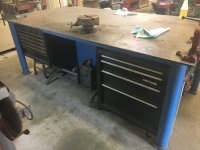
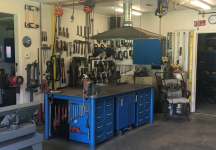
My shop is laid out as much as possible for point of use. An example is that if I need to do something in a vise, I choose one of the six vises depending on what needs to go on once the item goes into the vise. At one spot the tools needed for pipe work are near at hand. One has the tools for metal work such as scribe, square, punches, hammer, saw, belt sander, etc. SAE tools in a cabinet, metric in another, testing tools, scanner, smoke machine etc, in another. Friends who come over know to generally stand where they are working and look around where they are for the tools they will likely need. I have had a shop of some sort for 60 years and I have found nothing that works better for me than point of use methods. This is one work cell in the shop.IMG_3718.png
 

Wfallison

Member
Joined
Oct 12, 2019
Messages
17
Location
Home
My shop is laid out as much as possible for point of use. An example is that if I need to do something in a vise, I choose one of the six vises depending on what needs to go on once the item goes into the vise. At one spot the tools needed for pipe work are near at hand. One has the tools for metal work such as scribe, square, punches, hammer, saw, belt sander, etc. SAE tools in a cabinet, metric in another, testing tools, scanner, smoke machine etc, in another. Friends who come over know to generally stand where they are working and look around where they are for the tools they will likely need. I have had a shop of some sort for 60 years and I have found nothing that works better for me than point of use methods. This is one work cell in the shop.IMG_3718.png
Love that bench.
 

rust in the eye

Well-known member
Joined
Oct 2, 2017
Messages
2,751
Location
Chicagoland
Do we all organize tools soley by type and size without regard for frequency of use?
For ultimate speed of retrieval it perhaps makes sense to have the most frequently used size, we'll say wrenches, closest at hand leaving the infrequently used ones in the back of the rack. Of course most all commercially available organizers sort in order so taking up drawer space with stuff seldom touched.

Storing tools "out of order" would drive some insane.
 
To avoid these ads, REGISTER NOW!

kbuhagiar

Well-known member
Joined
Dec 27, 2005
Messages
1,738
Location
Escondido, CA
My shop is laid out as much as possible for point of use. An example is that if I need to do something in a vise, I choose one of the six vises depending on what needs to go on once the item goes into the vise. At one spot the tools needed for pipe work are near at hand. One has the tools for metal work such as scribe, square, punches, hammer, saw, belt sander, etc. SAE tools in a cabinet, metric in another, testing tools, scanner, smoke machine etc, in another. Friends who come over know to generally stand where they are working and look around where they are for the tools they will likely need. I have had a shop of some sort for 60 years and I have found nothing that works better for me than point of use methods. This is one work cell in the shop.IMG_3718.png
This is similar to how my garage/shop is laid out, but on a much smaller scale, lol!
I only have four vises and three work benches. :LOL:
 
OP
S

sarel.wagner

Well-known member
Joined
Jun 2, 2010
Messages
331
Location
Centurion, Gateng Province, South Africa
We have a lot that can be gleaned from the processes in Aviation and Aerospace MRO. This me thinks is the gold standard. Here it is a rigorous process, and a costly one. Speed of retrieval is not a thing because lives matter, total loss leads to grounding, fines and worse. Full inventory at shift end, no sign-off or release of craft over a single socket or wrench costing $5 and not accounted for, makes sense here.

Taking this home would kill the work and enthusiasm. Your pocket would quickly run out of $ and so would you progress. For us at home, and in say automotive workshops, the needs are completely different. Also every person works differently, do different things, think differently about how things should be done.

Most people at home and some at work optimise storage aesthetics instead of retrieval speed and value-in-use of a tool, and not tool accountability, simply because they can. Flagging of missing items, be it shadow foam, pins coloured differently or by other means is valuable everywhere. Tool loss is costly in many ways. A misplaced tool is a loss, of time wasted in looking for it. A tool left in customer vehicle or thrown in metal recycling with scraps is a total loss, again costly. Frustration is a downer.

Various strategies exist, like point of use, or arranging and aligning by size. Colour coding is a thing and there are layers to it. We can take some strategies from aviation, but others would not really work for us at home. I think the wife would not be agreeable after searching for a missing 10mm socket and delaying dinner by an hour or so ;)

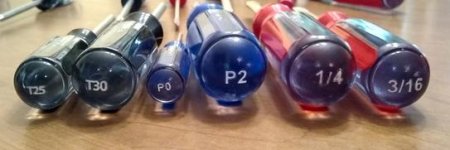
Colour coding is helpful in a cognitive way. SAE vs Metric for example. Tools in this category are not colour coded from factory. Screwdrivers frequently are colour coded from factory. This is important as the first layer of identification. We can leverage this to reduce effort and time in finding the right tool. We can add a secondary colour identification layer to speed up the identification process, and it looks nice too. This secondary colouring can also serve as a flag for missing items like in shadow foam inserts.
 

Attachments

  • IMG_3938.jpeg
    IMG_3938.jpeg
    41.2 KB · Views: 36
  • IMG_3937.jpeg
    IMG_3937.jpeg
    25.1 KB · Views: 24
OP
S

sarel.wagner

Well-known member
Joined
Jun 2, 2010
Messages
331
Location
Centurion, Gateng Province, South Africa
Tool identification is one thing, rumbling through a drawer full of wrenches to find the 1/2” between 60 others is frustrating to say the least. Only to find it is on a table behind a part you working on is just pure frustration. Work in Progress (WIP) is the biggest culprit here. My daughter used to say my tools are everywhere, because WIP. Parts will be here in a few days, so I leave the tools with the work. My process was broken. My toolboxes was organised, but not my process. I was solving for the wrong problem. Tools that are in the box sure looked nice, gaps for misplaced and missing tools included.

The missing wrench spot for the 13mm was soon taken up by misplacing the 12mm in its place and all wrenches migrated to fill the gap, never could find my 13mm. Ended up with no gaps, and less wrenches.

Identifying the real problem is difficult and it takes time and critical thinking. The analogy is to illness, once diagnosed we can be treated and patient can recover. If the diagnoses is wrong, the patient my not recover.

It took me many many years to identify and recognise my problem and it was WIP, and not returning tools to storage. No matter what I did all organisational strategies failed. And no wonder they failed because I did not correctly identified where it failed. A complete lack of critical and analytical thinking on my part.

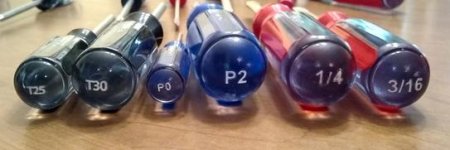
Another failure on my part was buying the wrong tools. I have plenty examples of tool sets never used at all, what a waste and what an idiot I was at the time. Many sets of screwdrivers, each set with the same coloured handles across the set. None marked on their handle ends as to what tip profile they are.

The first place we can improve retrievability and efficiency, is when buying tools that are colour coded meaningfully.
 

kbuhagiar

Well-known member
Joined
Dec 27, 2005
Messages
1,738
Location
Escondido, CA
Keep in mind that there is no one-size-fits-all solution. What works for me may be antithetical to others.
And a high level of organization does not necessarily reflect a superior skill set.

I couldn't stand to work in my radiator guy's shop - it's a friggin disaster zone - but he's the absolute best at what he does.
 
OP
S

sarel.wagner

Well-known member
Joined
Jun 2, 2010
Messages
331
Location
Centurion, Gateng Province, South Africa
Strategies used to improve tool use, speed up identifying and finding tools for the task. Point of use was mentioned, so was organised tools to retrieve and return tools faster. Colour coding can be used to quickly identify tools, so can storing by size. Organisation strategies are valuable tools in the arsenal.

We have to decide what is important to us. Some would say saving time as they have money, others will maintain saving money as they have time aplenty. Budgets are finite and so is time, sadly. People differ, situations differ and so does what we do. We all take ideas from others and attempt to apply it to our situation, sometimes effectively, sometimes not. We use what makes sense for us, discard what does not.

Lets unpack the “tools have value in use” statement. Having a property always requires maintenance. Having a chainsaw to trim trees if you have trees makes perfect sense. Having no trees to trim, and buying a chainsaw, makes no sense at all. So having or buying a chainsaw and having no trees would mean the chainsaw have no value in use, as we cannot use it at all.

Other tools are the same. Tool collectors and aficionados buys tools for a different reason. Collecting and displaying the tools are the use case. So this value in use also can differ for different people.

Some tools that are not used frequently have opportunity value. When the opportunity arises and we need that tool, even if it was stored for the last year, its value is realised upon use. If we do not have the tool, or have it but we cannot locate it, the value is lost, the project WIP is stalled.

Lets get back to strategies of use. We mentioned a few previously. An important strategy is based on frequency of use. These strategies can be combined to improve tool use, reduce wasted motion, injuries and reduce wasted time.

We have certain tools that we can call universal. Tools we use all the time, no matter the industry we in, no matter what we do. Pens, pencils and marker pens are some. Tape measures, callipers and rulers could be another. Scribes and punches or marking knives yet another.

A pocket ruler is such a tool. Its in the name. There are others. My observation taught me that no matter what I do, certain tools are used frequently. For me its a pocket rule, scribe, pocket knife or multitool, paint marker and pencil or sharpie, callipers, gloves, a pocket level, tape measure and a punch. I wear an apron in the workshop and garage and these items are in the apron pockets, or on my belt, all the time.

So frequency of use combined with point of use. My point of use can now be everywhere for these tools as they are on my person. This to me is classified as first order of use. I frequently, depending on type of work, have a rolling tool trolley and drag that to where I work. I trained the trolley to follow me, or maybe it trained me to drag it along. This is second order of use to me.

I store the next highest frequency of use items on the outside of the trolly. Colour coded screwdrivers I use frequently, longer rulers, a few wrenches, bits and sockets. Magnets and magnetic holders are the stars here. These may be swapped out depending on the task at hand. Magnetic trays and work or task lights with magnets are stored on the outside as well as some other tools for the specific task.

Most tools and lights are cordless. Lights must charge via USB-C, in fact devices with internal batteries must all use the same charging method, I refuse to buy anything else.

Third order of use are less frequently used tools, but the tools must remain easily accessible. Tool trolly with a lid and storage underneath is ideal. For lesser used tools, forth order of use types, they remain inside of closed drawers for me.
 

swsman

Well-known member
Joined
May 5, 2021
Messages
548
Location
Earthbound
Why wouldn’t well organized tools be easier to get and put back? :headscrat

Asking for a friend, since my stuff is just kind of in drawers, sometime I forget exactly which one.

I wish I was highly organized
Zendriver,

I labeled all of the drawers on my main boxes. Anyone that can read can find what is needed.

For automotive electrical work most everything is contained inside of the plastic toolbox I bought over 20yrs ago.

Invested into bunch of storage totes that contain oils/other things I do not use as often.

Cordless is all in one spot as are the batteries.

Really not hard keeping things where they belong, just takes some prior planning.

Would love to have more space (standard 2 car residential garage), but I am my own enemy with all the tools, vehicles, other materials in there.

My socket storage idea was 2x4 with socket rails screwed on. I grab drive size as needed, once done it is returned to the main box.
 

Gmonkee

Well-known member
Joined
May 9, 2010
Messages
2,754
Reduction of the quantity of tools that were 2nd options to another area outside the main work area.

One DOE wrench set, a 3/8 socket set in a decent range for you. A set of regular screwdrivers. A small selection of useful pliers.

Not a drawer full of each. Not two drawers of sockets 2" to 4mm in three drive sizes and three depths.
My needs are all met by a small box of sockets so that is in the kit.

I get lost in a pile of options, less efficient at just getting into the actual labor. It's easy to choose the best option of two or three viable sets and just go.
For regular homeowner stuff this has served me well.
 
Last edited:

Madjik Man

Well-known member
Joined
Dec 3, 2015
Messages
1,519
I just wish there was a 3D print version of something by similar to the magrail.

Something that can accommodate the socket studs/t-bolts which are sold separately.
 

joecon

Well-known member
Joined
Oct 4, 2010
Messages
679
Every tool should have a place, and it should be in that place unless you are using it. Wasting time looking for a tool is never a good use of time. In a business it is a dis service to the customer and the owner of the business owner. If you start out organized, it is easier to continue that way.
 

kbeefy

Well-known member
Joined
Sep 14, 2013
Messages
3,447
Location
Harington, Eastern Washington
I use a version of that philosophy...

My Most used tools are in my Job box. 40" wide x 24" deep and whatever standard height is with an open workbench top.

0828220838_HDR.jpg

My most used tools are sockets, so the top drawer is my socket drawer. It's not my only socket drawer, and it doesn't have every socket in it.
It has what I'm most likely to need for any particular job. It also has an assortment of ratchets and extensions that I am most likely to want to use. 1/4 shallow and deep SAE and metric, 3/8 shallow deep and flex SAE and Metric, and 1/2 shallow and deep in SAE and Metric.

My next most used tool is wrenches, so my next drawer is the wrench drawer. It's not my only wrench drawer, and it doesn't have every wrench in it. It has what I'm most likely to need for any particular job. 6mm-25mm combo, stubby, ratcheting, and XL flex ratcheting. My knipex smoth jaw adjustabIe plier wrenches also live in this drawer. I don't need SAE wrenches very often and they take up alot of room, so they are in another drawer in another box.

0822211134_HDR.jpg

I usually leave tools used out until the job is done or another job is started, No sense in figuring out which size is needed again if I already did it once. Darn eyes are not getting better at reading sizes on tools. Tools usually get placed on top of the toolbox until they are needed again or returned to their drawer.

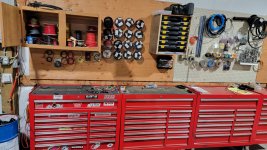
I do a fair amount of wiring work and have a bunch of wiring tools, so they have their own tool chest parked under the wall of wire and connectors. Most used tools in the top drawer and lesser used ones in the drawers below.

20240223_090734.jpg

20240223_090811.jpg

I have a problem with not wanting to toss hardware, so it sometimes accumulates in a bin on a table nearby.
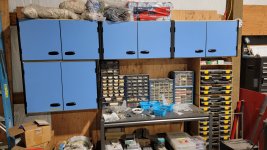
I started an organization process with 4 additional bins. During cleanup, my assorted hardware bin gets sorted into either washer, nut, bolt, or screw bin. When one of those bins gets full (they are about 1/2 quart each) or I get bored, I'll sort the hardware into my hardware storage shelf.

20231030_133140.jpg
 

Fav Onefour

Well-known member
Joined
Jul 14, 2022
Messages
700
Location
MN cold and hot
I do Kaizen method.
Tools should be easy to grab, use, and put back.
I often do small rearrangement to make the work area more efficient. One focus is having tools close to the task and easy to grab.
 

Jagmandave

Well-known member
Joined
Nov 6, 2011
Messages
6,302
Location
Overland Park, Ks.
My uncle and his father and grandfather ran their own mechanic's shop from about 1900 till the early 70's when their property got bought out for a huge downtown development and they closed the shop up, by then it was just my uncle and his son, my cousin.....that said the first time I visited his shop when I was about 20 I was shocked to see that he did not own a toolbox of any kind. All his wrenches and such were laid out on a huge, thoroughly oil soaked wood bench! He did have specialty tools in the metal boxes they came in arranged on shelves and such.
 
OP
S

sarel.wagner

Well-known member
Joined
Jun 2, 2010
Messages
331
Location
Centurion, Gateng Province, South Africa
Principle: Contextual Organization
If you used a mobile cart and your workflow can accommodate this way of working, use it, otherwise don’t. :unsure:
Mobile and Point-of-Use Trolley (small cart that follows the work) versus larger roll cabinets where the context is different. The mobile trolly is used differently than the roll cabinets, context is not the same. We are not digging into roll cabinet drawers quite so much because we have the mobile cart. Think 3rd and 4th order storage here.

On the mobile cart we “Store Together” what we “Use Together” Take sockets as a good example. Sockets are used with extensions, wobble adapters, ratchets etc. Makes sense to store the cordless ratchet driver and most used impact drivers in the same drawer or open top. Now add a few batteries with the cordless tools and whatever else you would use in conjunction with sockets to the same space.

Main Roll Cabinet(s), the Larger Stationary Storage
We can use more standard category-based grouping (e.g., all sockets in one drawer, all wrenches in another, pliers in another). This is acceptable because the main cabinet is the “base of operations,” not the active point-of-use. We still apply normal principles here, dedicated places, color coding (red/blue/third + category colors), bright echo, no hidden items, safety features, etc.

Why This Makes Sense?
The mobile trolley is a task-specific satellite for point of use, its job is to optimize immediate workflow. We pay close attention to frequency of use of tools in making them easiest to retrieve. As an aside, train the mobile cart to follow you and remain close by as you move around while working, saves bunches of time and effort.

The big roll cabinet is the strategic warehouse, standard grouping by tool type makes sense for inventory management, bulk storage, and long-term organization. This avoids forcing “used together” logic everywhere, which would become overly complex in the large cabinet.

This refinement keeps the system pragmatic, aggressive optimization where it matters most (point-of-use), while allowing sensible standardization in the main storage.
 
OP
S

sarel.wagner

Well-known member
Joined
Jun 2, 2010
Messages
331
Location
Centurion, Gateng Province, South Africa
I created a printable guide for myself on these ideas and principles I want to use. Some of these I do already but no all of them yet. There is a PDF attached, the below picture is part of the first page.

If you have any other ideas, please add them here. None of this is cast in stone, this is just my thinking and nobody need to follow any of these, but you welcome to.

1781348689571.png
 

Attachments

  • Tool_Organization_Guiding_Principles.pdf
    10.2 KB · Views: 8
To avoid these ads, REGISTER NOW!
Top Bottom