I like and respect your thoroughness and disciplined approach.Plans are important. Plans are good. Plans are the secret to success. I enjoy planning and like to have at least a rough plan for projects.
The first thing to know about restoring a car is that it will be apart in pieces for 3-5 years. You need a place for the car, room to work, and room for storing all the parts you take off the car. You don’t do this in the garage you park cars in – not if you want to stay married! Thus, a 4 step plan:
Since 1963 Imperials are rather rare I expected to spend 6-12 months looking for a car, flying out to check out a car, probably in California, Florida, or Arizona, and then paying $2,000 to have the car shipped.
- Build a workshop.
- Locate and acquire the car.
- Restore the car.
- Enjoy driving the car!
While planning the workshop I happened to check Craigs List. And discovered a 1963 Imperial 30 miles away. At a good price.
Having no real choice in the matter, I headed over to check it out. It was, indeed, a 1963 Imperial Crown 4 door hardtop. The body was straight with only a few spots needing work. Checking it over it was solid – no rust in the frame, solid floorpans and trunk, and little to no rust in the fenders. The only rust spot on the whole car was a small hole in the bottom of the drivers door.
Further, all of the pieces were there! All of the chrome trim was present (and there is a lot of chrome trim on this car!). All of the underhood pieces were in place, including air conditioning and the AutoPilot (cruise control). The interior was missing carpets and the trim panels for the rear doors were in the trunk, but all of the important pieces were there. Even the jack was in the trunk!
I was able to drive it around the block. The suspension was worn, the brakes were scary, and the engine had a knock. Just what I was looking for!
This was not according to plan. I was a year away from being ready to start working on a car. And this was too good a deal to pass up. So I made an offer on the car. And two days later it was delivered to my driveway.
So, time to build a workshop and start the 3-5 year (or longer…) journey to bring this behemoth back – an Imperial Journey.

You are using an out of date browser. It may not display this or other websites correctly.
You should upgrade or use an alternative browser.
You should upgrade or use an alternative browser.
Imperial Journey - a Restoration Saga
- Thread starter rdoty
- Start date

Ohmthis
Well-known member
I’m getting back to reading up on your work. Nice work, and practice makes perfect! I like how you are incorporating the French seam into the corner.With the main seat insert largely under control it was time to deal with the next challenge – corners!
“But”, I hear you say, “haven’t you already handled corners in multiple places?” Yes – flat corners. These are three dimensional corners where the top, front, and side of the seat meet. Further, they are curved. The corners of the seat are rounded. Rounded side to side and front to back.
This complexity is the main reason I’m trying to use the original seat covering as a template for the new seat covers.
But before that it made sense to start with s simple corner.
Test corners
After achieving reasonable success with this simple corner I ratcheted my courage up a couple of levels and cut out corner pieces for one of the seat corners using the seat templates. These were partial pieces – I just used eight inches or so from each piece rather than the full two foot long piece. This is the piece on the right in the picture above.
I then fit the corner together with staples. This fitting process was an exercise in frustration. I re-did it several times until it seemed close. With trepidation I took it to the sewing machine and stitched it up. Sewing seams that curve in three dimension out of heavy vinyl seems to be an acquired skill. The piece is fighting you all the way – it really wants to go off track, bunch up (creating wrinkles), and in general just be difficult. But I finally reached the end of each seam.
The final result was, indeed, a corner. And it did fit over the corner of the seat. But it still needs work. I need to take the lessons learned and do at least one more test piece.
Test fitting of test corner


Ohmthis
Well-known member
I know it was frustrating and a headache, but you learned a lot. By having to troubleshoot the problem, you are much better prepared for an issue later.This is a little out of order, but I'll confess my mistakes in the hopes it might help someone else.
Having achieved an almost acceptable test panel with the junk vinyl, I decided to make one last test panel. This last test panel would use the actual vinyl I will be using for the seats. I also needed to change thread from the cheap Amazon thread I’ve been working with to the good thread for the actual seats. And this is probably a good time to change the needle.
The first step was to fill up several bobbins with the good thread and swap in the new bobbin. Then thread the good thread through the machine, using the old thread to pull it through to make sure that the machine was threaded properly. Next, change out the needle. Finally, make a quick test seam to verify everything, and start working on the final test panel.
The result was immediate disaster. Seams completely open on the back. Seams with the stitches very loose on the back. Not Good! Time to start troubleshooting.
Hmm, it looks like I installed the needle backward. OK, rotate the needle to the correct position and try again. This time I’m getting stitches, but they are very loose. That looks like the tension setting needs to be adjusted. Spend the next hour or so changing the tension adjustment to both tighter and looser with very little change.
With frustration rising it was time to walk away. Well, it was lunchtime. Grab a sandwich, fire up the Internet, and start researching the problem.
With a list of things to check, head back to the machine and return to pounding my head against a brick wall. After chasing several more dead ends, I started studying the threading of the machine. I knew this was good, since I hadn’t changed anything and had used the old (working) thread to pull the new thread through the machine.
Just a minute – something doesn’t look right here… In fact, if you look at it closely… It looks like the thread has jumped off of both of the tensioner disks. KRUD.
Pull out the user manual, study the section on threading the machine a dozen times, and thread it according to the instructions.
Grab another scrap of vinyl and run a test seam. MUCH better, but not perfect. OK, start adjusting the tensioner. This time it makes a noticeable difference. After a half dozen seams the machine is dialed in nicely.
Take a scrap of the seat vinyl, which is much heavier than the test vinyl, and run a test seam. Good, but not quite perfect. A few small adjustments of the thread tensioner and it is sewing perfectly with the seat vinyl.
Yup, as usual, the one thing that you know can’t be the problem is what bites you. Yes, further confirmation that I’m an idiot.
Now, I can finally cut out the pieces for the test panel using the actual seat vinyl and sew them together.This heavier material has a different feel, but I was able to achieve a successful result.
Final test panel
This panel is actually better than it looks in the picture – as soon as it is stretched all of the wrinkles disappear. After a roller coaster day I think I’m ready to start working on an actual seat.

Time to bring all of the pieces together (pun intended), make a complete seat cover out of junk vinyl, and see if it actually fits. No, I’m not concerned at all. Nope, nope, nope…
Step one: cut out all of the pieces:

Step two: sew it together:

Step three: find the hog ring pliers and box of hog rings and install it:
It actually fits! Still some improvements needed in my technique, but it looks like it is time to make a real seat cover!

Test seat cover installed
Since this is a first test I didn't do anything with inserts, french seams, or any other "nice" touches. I was just amazed that the pieces actually went together and that it didn't fit on the seat like a clown suit.
Now to see if I'm actually learning and making progress or if this was just a fluke to get my hopes up!
Step one: cut out all of the pieces:
Step two: sew it together:
Step three: find the hog ring pliers and box of hog rings and install it:
It actually fits! Still some improvements needed in my technique, but it looks like it is time to make a real seat cover!
Test seat cover installed
Since this is a first test I didn't do anything with inserts, french seams, or any other "nice" touches. I was just amazed that the pieces actually went together and that it didn't fit on the seat like a clown suit.
Now to see if I'm actually learning and making progress or if this was just a fluke to get my hopes up!
The test cover was just that – a test. The actual vinyl is different – heavier and harder to stretch. And the test cover could have been a fluke.
One way to find out – stop stalling and make a real seat cover! Drag out the production vinyl, arrange the templates, find the marking tools and scissors, grab a cup of coffee, and start making things real. Or making real mistakes; time will tell…
The first step was to make the pleated insert. Sharp eyes will notice something wrong with the inserts – they have square corners. I really wanted the rounded corners, but ultimately decided that my skill level just isn’t there. Yet.
Even using the square corners I still cheated. Recall that the panel shrinks when sewing padded pleats. I compensated for this but the insert was still a tiny bit off in size. Since the insert isn’t full width it requires additional panels on each side. I cut these panels over size, sewed them to the insert, and then used the template to cut the entire panel to the exact finish size.
Once the center panel with pleats was done all that was left was to cut out and sew the rest of the seat back. Which may have been a slightly larger job than this sentence suggests…
In any case it was finally done. It took a bit of time and brute force to fit the finished cover over the seat back and line up the corners, edges and seams. I had to take the cover off, move it a tiny bit, and fit it again. Several times. But things finally looked halfway decent. Take a deep breath, flip it over, and start securing the cover to the frame with hog rings.
This is really the critical stage. This is when you stretch, pull, and tweak the cover so that everything lines up and there are no wrinkles. Hopefully. I tackle this job by working on opposite edges (top and bottom together then left and right sides together) going from the inside out and repeatedly checking for fit.
With the last hog ring installed it was time to flip it over and (hopefully) admire my work.
The verdict? Not too bad! Not perfect, but good. I know where every little issue and flaw is, but no one else will notice. I’m happy with it for a first attempt.
I got focused and didn’t get pictures of the build process, so here is the final result:

Seat Back installed in car
One way to find out – stop stalling and make a real seat cover! Drag out the production vinyl, arrange the templates, find the marking tools and scissors, grab a cup of coffee, and start making things real. Or making real mistakes; time will tell…
The first step was to make the pleated insert. Sharp eyes will notice something wrong with the inserts – they have square corners. I really wanted the rounded corners, but ultimately decided that my skill level just isn’t there. Yet.
Even using the square corners I still cheated. Recall that the panel shrinks when sewing padded pleats. I compensated for this but the insert was still a tiny bit off in size. Since the insert isn’t full width it requires additional panels on each side. I cut these panels over size, sewed them to the insert, and then used the template to cut the entire panel to the exact finish size.
Once the center panel with pleats was done all that was left was to cut out and sew the rest of the seat back. Which may have been a slightly larger job than this sentence suggests…
In any case it was finally done. It took a bit of time and brute force to fit the finished cover over the seat back and line up the corners, edges and seams. I had to take the cover off, move it a tiny bit, and fit it again. Several times. But things finally looked halfway decent. Take a deep breath, flip it over, and start securing the cover to the frame with hog rings.
This is really the critical stage. This is when you stretch, pull, and tweak the cover so that everything lines up and there are no wrinkles. Hopefully. I tackle this job by working on opposite edges (top and bottom together then left and right sides together) going from the inside out and repeatedly checking for fit.
With the last hog ring installed it was time to flip it over and (hopefully) admire my work.
The verdict? Not too bad! Not perfect, but good. I know where every little issue and flaw is, but no one else will notice. I’m happy with it for a first attempt.
I got focused and didn’t get pictures of the build process, so here is the final result:
Seat Back installed in car
larry4406
Well-known member
That looks sew nice! 
Seriously, excellent job!
Seriously, excellent job!
v8nutz
Well-known member
Nice work! I've been doing some upholstery work on my truck lately and sewing a straight line is damn near impossible for me. I don't have a walking foot machine though. I wouldn't dare try what you are doing.
The secret is practice. The first 50 times you do it the results look like they were done by a drunken squirrel. But after doing it enough times the lines slowly get better and better until they look like they were done by a sober squirrel. This is why I started off just sewing seam after seam after freakin' seam in scrap panels.Nice work! I've been doing some upholstery work on my truck lately and sewing a straight line is damn near impossible for me. I don't have a walking foot machine though. I wouldn't dare try what you are doing.
Another secret is having a straight like to follow. I use a combination of blue marking pencils for the back of the vinyl and silver erasable marking pens for the front of the vinyl.
Like most large jobs, this is a series of small jobs glued together end to end.
With the seat backs done next up was the arm rest. You know the drill by now: take the old cover off, take the old cover apart, use the pieces of the old cover to make templates, cut out new pieces, sew them together, and re-install.
Like the rest of the seat, the after market cover was installed over the factory cover, allowing me to use the original factory cover to make the templates.

Arm rest foam core and new cover.
The biggest surprise was that the arm rest was nothing but a chunk of plywood and a big block of foam. For some reason I thought that it was a plywood box with foam padding on the sides.
In this picture you see the new cover, which is made inside out and then turned outside out when installed. If you wish you can also install the cover inside in. You can see that the foam block is covered with cheese cloth – this makes it much easier to install the tight fitting cover over the grabby foam.
With the new cover installed the arm rest doesn’t look half bad. Maybe I’m actually making progress!

Finished arm rest
Like the rest of the seat, the after market cover was installed over the factory cover, allowing me to use the original factory cover to make the templates.
Arm rest foam core and new cover.
The biggest surprise was that the arm rest was nothing but a chunk of plywood and a big block of foam. For some reason I thought that it was a plywood box with foam padding on the sides.
In this picture you see the new cover, which is made inside out and then turned outside out when installed. If you wish you can also install the cover inside in. You can see that the foam block is covered with cheese cloth – this makes it much easier to install the tight fitting cover over the grabby foam.
With the new cover installed the arm rest doesn’t look half bad. Maybe I’m actually making progress!
Finished arm rest
Well this is a milestone! The bottom of the rear seat is done and installed in the car. And it isn’t half bad!
The starting point was rough: worn, torn, pleats filled with crumbling foam (and foam powder), and just generally shot.

Factory seat cover (which was under the aftermarket seat cover)
Unfortunately I got focused on making and finishing the seat and forgot to take progress pictures as I went along. At least this spares you the long drawn out description of the process.
Surprisingly I didn’t have my usual gallery of mistakes, errors, and screwups to document. It actually went fairly smoothly. Maybe I’m learning?
Well, the big exception to no problems was the foam. The original foam was in horrible shape:

Seat bottom original foam
Yeah, that can’t be reused. Or even repaired and saved. Has to be replaced. Fortunately I had already purchased a sheet of 1″ thick upholstery foam for just this purpose.
To be continued...
The starting point was rough: worn, torn, pleats filled with crumbling foam (and foam powder), and just generally shot.
Factory seat cover (which was under the aftermarket seat cover)
Unfortunately I got focused on making and finishing the seat and forgot to take progress pictures as I went along. At least this spares you the long drawn out description of the process.
Surprisingly I didn’t have my usual gallery of mistakes, errors, and screwups to document. It actually went fairly smoothly. Maybe I’m learning?
Well, the big exception to no problems was the foam. The original foam was in horrible shape:
Seat bottom original foam
Yeah, that can’t be reused. Or even repaired and saved. Has to be replaced. Fortunately I had already purchased a sheet of 1″ thick upholstery foam for just this purpose.
To be continued...
Ohmthis
Well-known member
Hell of a job!
The initial plan was to cut the new foam about 4″ larger on the front and wrap it down the front to avoid feeling the front of the seat frame. So I did that.
After sewing up the seat cover I did a test fit over the naked seat frame and it seemed to fit. Encouraging! Or a setup for calamity… In either case I forged ahead.
The first step in installation is to put a layer of burlap on top of the springs to avoid the springs digging into the foam and destroying it. Since I bought extra burlap I installed a double thick layer, securing in place with hog rings.
Next lay the foam on top of the frame and test fit the seat cover. Hmm, not gonna work. Upholstery foam is quite dense – has to be to support my chunky ****. The “1 inch” foam is closer to 1-3/8 thick and doesn’t wrap over the front of the frame at all well. The seat cover doesn’t hold it in place and doesn’t fit at all. OK, time to take a step back and regroup.
If a 4″ overlap is too much, cut it down to 2″ and test fit the seat cover. Nope, still doesn’t work. This foam is just too dense, too thick, and too stiff to wrap over the edge.
Take another step back. Give up on wrapping it over the edge. Cut the front edge about 1″ oversize and bevel it at 45 degrees. The theory here is that this will allow the foam to squish over the edge a bit, preventing you from feeling the seat frame while sitting down, yet allowing the seat cover to fit..
NOW try test fitting the seat cover. Hmm, it seems close. It looks like the cover will pull the foam into place making everything neat and tight when it is installed.
Duct taping my courage in place I flipped the seat over and grabbed the hog rings. After checking the left to right alignment of the seat cover I started in the center of the front. A few hog rings attached the front of the cover to the seat frame. I then went around the worktable to the back of the seat and stretched the center of the seat cover into place. To my amazement I was able to stretch the seat cover into position and hog ring it to the frame!
Well, that seemed to work. Holding my breath I flipped the seat over and checked my handiwork. To my surprise it looked great! The cover was tight enough to stretch into place cleanly, but not so tight that it would tear out. The few wrinkles easily wiped out – and looked like they would be pulled out when I finished the installation.
Flip the seat back over and continue installing hog rings. Keep working from the center out, alternating front and back to keep a balanced tension on the seat cover. Coming to the ends of the seat I worked the wrinkles out of the cover, stretched the cover into position, and installed the last of the hog rings.
Now for the penultimate moment of truth (penultimate is the fancy word for next to last): flip the seat over and work it for adjustment, alignment of seams and edges, and smooth out any wrinkles.
Umm, it worked… The seat actually looks good! The seams look good, it fits properly, there aren’t any wrinkles, and nothing jumps out as an issue.

Rear seat

After sewing up the seat cover I did a test fit over the naked seat frame and it seemed to fit. Encouraging! Or a setup for calamity… In either case I forged ahead.
The first step in installation is to put a layer of burlap on top of the springs to avoid the springs digging into the foam and destroying it. Since I bought extra burlap I installed a double thick layer, securing in place with hog rings.
Next lay the foam on top of the frame and test fit the seat cover. Hmm, not gonna work. Upholstery foam is quite dense – has to be to support my chunky ****. The “1 inch” foam is closer to 1-3/8 thick and doesn’t wrap over the front of the frame at all well. The seat cover doesn’t hold it in place and doesn’t fit at all. OK, time to take a step back and regroup.
If a 4″ overlap is too much, cut it down to 2″ and test fit the seat cover. Nope, still doesn’t work. This foam is just too dense, too thick, and too stiff to wrap over the edge.
Take another step back. Give up on wrapping it over the edge. Cut the front edge about 1″ oversize and bevel it at 45 degrees. The theory here is that this will allow the foam to squish over the edge a bit, preventing you from feeling the seat frame while sitting down, yet allowing the seat cover to fit..
NOW try test fitting the seat cover. Hmm, it seems close. It looks like the cover will pull the foam into place making everything neat and tight when it is installed.
Duct taping my courage in place I flipped the seat over and grabbed the hog rings. After checking the left to right alignment of the seat cover I started in the center of the front. A few hog rings attached the front of the cover to the seat frame. I then went around the worktable to the back of the seat and stretched the center of the seat cover into place. To my amazement I was able to stretch the seat cover into position and hog ring it to the frame!
Well, that seemed to work. Holding my breath I flipped the seat over and checked my handiwork. To my surprise it looked great! The cover was tight enough to stretch into place cleanly, but not so tight that it would tear out. The few wrinkles easily wiped out – and looked like they would be pulled out when I finished the installation.
Flip the seat back over and continue installing hog rings. Keep working from the center out, alternating front and back to keep a balanced tension on the seat cover. Coming to the ends of the seat I worked the wrinkles out of the cover, stretched the cover into position, and installed the last of the hog rings.
Now for the penultimate moment of truth (penultimate is the fancy word for next to last): flip the seat over and work it for adjustment, alignment of seams and edges, and smooth out any wrinkles.
Umm, it worked… The seat actually looks good! The seams look good, it fits properly, there aren’t any wrinkles, and nothing jumps out as an issue.
Rear seat
Last edited:
Now for the ultimate moment of truth: installing the seat bottom in the car. Will it fit? Is the new seat foam so thick that it won’t go under the seat back or between the sides of the car? How will it look? Will it collapse as soon as I sit on it?
To my surprise – nay, to my amazement! – it slid into place, looks great, and sits comfortably,

Rear seat
The biggest surprise, and one of my greatest concerns, was that the inserts on the seat back and seat bottom actually lined up! I had been sweating this and wondering if the inserts were actually a good idea.

The inserts line up!
While the rear seat isn’t perfect it is rather good for a first attempt – better than I was really expecting when I started this project. It is certainly much better than what was there before!
To my surprise – nay, to my amazement! – it slid into place, looks great, and sits comfortably,
Rear seat
The biggest surprise, and one of my greatest concerns, was that the inserts on the seat back and seat bottom actually lined up! I had been sweating this and wondering if the inserts were actually a good idea.
The inserts line up!
While the rear seat isn’t perfect it is rather good for a first attempt – better than I was really expecting when I started this project. It is certainly much better than what was there before!
stinkity stoink
Well-known member
That came out fantastic!! What a great job
driftpin
Well-known member
I appreciate your descriptions allow the trials and tribulations to be described. The end result is one you should be proud of. It functions as a seat should, and it looks decent, and besides polishing your skills, you picked-up a lot of experience.
Thanks driftpin!I appreciate your descriptions allow the trials and tribulations to be described. The end result is one you should be proud of. It functions as a seat should, and it looks decent, and besides polishing your skills, you picked-up a lot of experience.
I've got a couple of reasons for these posts:
First, whining about the problems I encounter and how I screw up (and recover) makes me feel better about it.
Second, to show that old dogs can learn new tricks with a bit of determination and a plan!
Swanny1953
ALLIANCE MEMBER
Well done - I don't have the stones to attempt what you have accomplished!!!
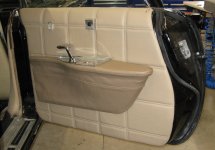
In addition to the seat covers the door cards need to be replaced. Someone had started to do this job on the rear doors – the factory cardboard door cards had been replaced with hardboard, but had not been covered. The arm rests and door handles were in the trunk.

Rear Door card as it came with the car
The front door cards still had the covers on them, so I had a reference to work from.

Front Door Card. I really hate that lower carpet, so it is going to go!
The door card itself is fairly straightforward – just use it as a pattern and trace it onto the vinyl. For a more luxurious appearance back the vinyl 1/4″ sewfoam. I decided to sew through the vinyl and foam for a richer appearance, similar to the factory. The factory door cards had a double stitch, so I tried that on a test piece. I liked the way that looked and decided to use it.
To be continued...
Rear Door card as it came with the car
The front door cards still had the covers on them, so I had a reference to work from.
Front Door Card. I really hate that lower carpet, so it is going to go!
The door card itself is fairly straightforward – just use it as a pattern and trace it onto the vinyl. For a more luxurious appearance back the vinyl 1/4″ sewfoam. I decided to sew through the vinyl and foam for a richer appearance, similar to the factory. The factory door cards had a double stitch, so I tried that on a test piece. I liked the way that looked and decided to use it.
To be continued...
Jagmandave
Well-known member
I think you're doing a fantastic job!
Just so you know, that carpet on the bottom of the door cards did serve a purpose, so your shoes didn't scuff or leave black marks on the vinyl as you get in or out of the car.
On heavier doors, especially on my sloped driveway, I use my foot to hold the door open or help open it.....
Just so you know, that carpet on the bottom of the door cards did serve a purpose, so your shoes didn't scuff or leave black marks on the vinyl as you get in or out of the car.
On heavier doors, especially on my sloped driveway, I use my foot to hold the door open or help open it.....
Thanks!I think you're doing a fantastic job!
Just so you know, that carpet on the bottom of the door cards did serve a purpose, so your shoes didn't scuff or leave black marks on the vinyl as you get in or out of the car.
On heavier doors, especially on my sloped driveway, I use my foot to hold the door open or help open it.....
Oh, I'm aware of the reason. I just think it looks massively fugly and absolutely hate it! Especially when it is 60 years old, dirty, and can't be cleaned. The replacements will be vinyl all the way down!
The arm rests were a bit of a project, with a combination of convex and concave curves that the vinyl somehow fit. I started off trying to make a template from scratch, but quickly became frustrated. Fortunately I was able to salvage the cover from one of the rear arm rests, separate it into its three component pieces, and use these to create a template. The people that did the original design for the factory knew what they were doing - using the new templates the new covers fit surprisingly sell.
From there it was the usual routine of sewing the pieces together, fitting the new cover to the arm rest, and stapling it to the back. The end result wasn’t perfect, but I deemed it acceptable. Certainly better than what was there before!
The arm rests were done in the tan vinyl, same color as the seat inserts, to provide a bit of contrast.
New rear door card
I'm quite happy with the double stitching. After trying it on some test pieces I thought it provided a rather luxurious look. I made these panels by laying out straight lines on a 6" grid with an erasable silver pen. First sew a single seam down these silver lines. Then came back and used the outside of the foot on the sewing machine as a guide. Feed the vinyl though keeping the original seam at exactly the same location on the foot. With a bit of practice I was able to hold consistent seams. The only trick was to make sure you were on the same side of each original seam - if you switched sides you would have one square 5-1/2" and the next 6". Not the look you want!
With this the back seat project is done. I’m rather happy with the way this turned out! Looking at the front seat you can see how hideous the original seat covers were. You can also see that the new panels are a fairly close match to the headliner -this was the most important consideration for the new upholstery.
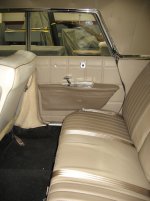
Rear Seat
Now to move on to the front seats, using the lessons learned so far.
From there it was the usual routine of sewing the pieces together, fitting the new cover to the arm rest, and stapling it to the back. The end result wasn’t perfect, but I deemed it acceptable. Certainly better than what was there before!
The arm rests were done in the tan vinyl, same color as the seat inserts, to provide a bit of contrast.
New rear door card
I'm quite happy with the double stitching. After trying it on some test pieces I thought it provided a rather luxurious look. I made these panels by laying out straight lines on a 6" grid with an erasable silver pen. First sew a single seam down these silver lines. Then came back and used the outside of the foot on the sewing machine as a guide. Feed the vinyl though keeping the original seam at exactly the same location on the foot. With a bit of practice I was able to hold consistent seams. The only trick was to make sure you were on the same side of each original seam - if you switched sides you would have one square 5-1/2" and the next 6". Not the look you want!
With this the back seat project is done. I’m rather happy with the way this turned out! Looking at the front seat you can see how hideous the original seat covers were. You can also see that the new panels are a fairly close match to the headliner -this was the most important consideration for the new upholstery.
Rear Seat
Now to move on to the front seats, using the lessons learned so far.
senlow
Well-known member
That sounds like experience speaking.The arm rests were a bit of a project, with a combination of convex and concave curves that the vinyl somehow fit. I started off trying to make a template from scratch, but quickly became frustrated. Fortunately I was able to salvage the cover from one of the rear arm rests, separate it into its three component pieces, and use these to create a template. The people that did the original design for the factory knew what they were doing - using the new templates the new covers fit surprisingly sell.
From there it was the usual routine of sewing the pieces together, fitting the new cover to the arm rest, and stapling it to the back. The end result wasn’t perfect, but I deemed it acceptable. Certainly better than what was there before!
The arm rests were done in the tan vinyl, same color as the seat inserts, to provide a bit of contrast.
New rear door card
I'm quite happy with the double stitching. After trying it on some test pieces I thought it provided a rather luxurious look. I made these panels by laying out straight lines on a 6" grid with an erasable silver pen. First sew a single seam down these silver lines. Then came back and used the outside of the foot on the sewing machine as a guide. Feed the vinyl though keeping the original seam at exactly the same location on the foot. With a bit of practice I was able to hold consistent seams. The only trick was to make sure you were on the same side of each original seam - if you switched sides you would have one square 5-1/2" and the next 6". Not the look you want!
The upholstery is looking amazing. You are doing a great job.
With the rear seat done it was time to turn to the front seat with high hopes and expectations of replicating the successful work on the rear seat. Yeah, that is a bit of forsehadowing…
The front seat had to come out. Unlike the back seat, the seat bottom and seat back are all part of one assembly and come out as a unit. Or do they?
I had removed the front seat once before and did not look forward to doing it again. It is a 6-way power adjustable bench seat, weighs well over 100 lbs, and barely fits through the door. The last time it was out was before the car was painted; I’m now rather paranoid about scratches.
Since the seat backs have to come off anyway I decided to try removing them in place. Well, what do you know! Take off the side cover, remove one bolt, and you can wiggle the seat back off of its retainers. With both seat backs off it just takes undoing two bolts to remove the arm rest. Eyeballing the situation it looks like removing just the seat base will be quite a bit easier.
As mentioned, the front seat is heavy. Even with pieces removed. When I try to apply brute force I just do not have the brute I did in my younger days. No problem – drag the engine hoist out of its place of honor and hook it to one end of the front seat.
Since no lifting was required on that end She Who Must Be Obeyed agreed to guide the engine hoist and keep that end of the seat from hitting anything. I was able to lift the other end of the seat and guide it out, moving it about six inches at a time. After a few minutes the seat was safely on the garage floor with no damage, no drama, and no injuries.
Now with unwarranted confidence let’s dive into the actual work!
The front seat had to come out. Unlike the back seat, the seat bottom and seat back are all part of one assembly and come out as a unit. Or do they?
I had removed the front seat once before and did not look forward to doing it again. It is a 6-way power adjustable bench seat, weighs well over 100 lbs, and barely fits through the door. The last time it was out was before the car was painted; I’m now rather paranoid about scratches.
Since the seat backs have to come off anyway I decided to try removing them in place. Well, what do you know! Take off the side cover, remove one bolt, and you can wiggle the seat back off of its retainers. With both seat backs off it just takes undoing two bolts to remove the arm rest. Eyeballing the situation it looks like removing just the seat base will be quite a bit easier.
As mentioned, the front seat is heavy. Even with pieces removed. When I try to apply brute force I just do not have the brute I did in my younger days. No problem – drag the engine hoist out of its place of honor and hook it to one end of the front seat.
Since no lifting was required on that end She Who Must Be Obeyed agreed to guide the engine hoist and keep that end of the seat from hitting anything. I was able to lift the other end of the seat and guide it out, moving it about six inches at a time. After a few minutes the seat was safely on the garage floor with no damage, no drama, and no injuries.
Now with unwarranted confidence let’s dive into the actual work!
The seat backs were much like the rear seats with a few differences. Since all sides are visible the covers must cover everything. Unlike many cars there is a separate flat panel on the back of the seat – this should simplify the job.Like the rear seat, the seat back is in surprisingly good shape.
The job should be familiar by now: take apart the seat cover, use it to make templates, cut out and sew the new cover, and fit it into place. Easier said than done, but by now fairly routine. The only really tricky part is that the back of the seat turns in near the top – this makes the corner seams a bit of a challenge to sew. Good thing I tackled the rear seat first! This would have been a major headache a few weeks ago.
The cover for the seat back fit surprisingly well. Time to pat myself on the back and move on to the next part – the back panel. This panel is much like the door cards: 1/4″ foam padding, double stitching on a six inch grid, fold around the back and staple in place. The panels fit nicely – the whole seat back looks good!
The arm rest was the same process as the rear arm rest: strip off the factory cover, make templates, cut and sew the vinyl, and unroll the new cover over the foam, turning it from inside out to outside out. By some miracle this cover also fit well.
The end result was two seat backs and an arm rest ready to install.

Seatback and Arm Rest

Back of front seat showing cover panel
The job should be familiar by now: take apart the seat cover, use it to make templates, cut out and sew the new cover, and fit it into place. Easier said than done, but by now fairly routine. The only really tricky part is that the back of the seat turns in near the top – this makes the corner seams a bit of a challenge to sew. Good thing I tackled the rear seat first! This would have been a major headache a few weeks ago.
The cover for the seat back fit surprisingly well. Time to pat myself on the back and move on to the next part – the back panel. This panel is much like the door cards: 1/4″ foam padding, double stitching on a six inch grid, fold around the back and staple in place. The panels fit nicely – the whole seat back looks good!
The arm rest was the same process as the rear arm rest: strip off the factory cover, make templates, cut and sew the vinyl, and unroll the new cover over the foam, turning it from inside out to outside out. By some miracle this cover also fit well.
The end result was two seat backs and an arm rest ready to install.
Seatback and Arm Rest
Back of front seat showing cover panel
Good thing this was saved for last – the base of the front seat was trashed! Once the aftermarket covers were removed you could see that the factory covers were completely shot – worn out, shredded, stretched, and basically horrible. The factory foam was entirely missing; this is the one place where they had completely replaced the factory foam with new foam. And they didn’t use automotive foam – they used a regular foam that is quite soft. This would explain why the front seat never felt right and why it had such poor support!

Front Seat Base

Front Seat Original Cover

Front Seat Foam
This is going to be a job. I need to replace the foam as well as the seat covers. I don’t know why Chrysler used carpet on the seat base as well as the door cards, but I hate it – that has to go!
Wish me luck – I suspect I’ll need it…
Front Seat Base
Front Seat Original Cover
Front Seat Foam
This is going to be a job. I need to replace the foam as well as the seat covers. I don’t know why Chrysler used carpet on the seat base as well as the door cards, but I hate it – that has to go!
Wish me luck – I suspect I’ll need it…
GreyOwl
Well-known member
Chrysler, as well as the others. used carpet anywhere you might scuff with your feet. It shows less marking than vinyl especially if you had a small rock or something in your shoe sole.