sashik3
Active member
The day both my kids passed their driving tests, my wife looked at our garage and said the thing I'd been avoiding for years: "Where are they going to park?"
There was no room. There hadn't been for a long time.
That was the moment the dream stopped being a daydream.
---
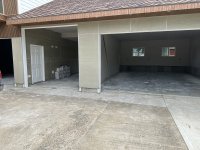
Here's what I ended up designing: a detached 60x32 ft six-car garage — dedicated workshop, small office, a roughed-in bathroom, a center drive-through bay that doubles as a full car wash and detail station, and a full second floor prepped for a future apartment. Built on 2.2 acres in Kansas. I drew every line of it myself using Punch Professional Home Design after an architect quoted me $25,000 for blueprints.
I spent 2.5 months doing nothing but planning before a single shovel touched the ground. Permit submissions, engineering reviews, utility locates, weather timing, material sourcing, contractor scheduling — all of it figured out on paper first.
A few things that might surprise people who haven't done a build like this:
— The building is 32 feet wide. Not 31, not 33. Because 32 lands clean on the standard 16/24" framing grid, so the plywood, siding panels, drywall, and roof trusses all drop in without a cut. That number alone probably saved a couple thousand dollars in wasted material.
— The center bay has a 9-foot door. I didn't strictly need it at the time. But boats, lifted trucks, trailers, tall equipment — that one decision means the building can say yes to almost anything that rolls up to it.
— Before a drop of concrete went down, I ran underground conduit, a second 200-amp panel, water and sewer rough-ins, copper refrigerant lines for HVAC that doesn't exist yet, and pre-wired spots for future heat pumps and solar. None of it is in use. All of it is waiting. Doing it while the walls were open cost almost nothing. Doing it later would've meant a demolition crew.
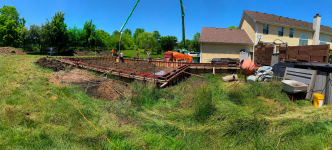
— I built a temporary crushed rock road with geotextile fabric running parallel to my existing driveway before any machinery showed up. Fully loaded concrete trucks rolled over it after rain with zero problems. The fabric lets you scrape the rock right back off when you're done instead of grinding it permanently into the dirt.
The drive-through bay was the requirement that made everything harder. Because I needed to drive straight through the center and out the back into the yard, it forced me to completely rethink the roofline, the load-bearing structure, and the rear foundation wall. There's a slope difference front-to-back, so I had to build a ramp inside the bay to make the grade work.
I had the trusses designed by the plant engineer — asked them to swap some 2x4 members for 2x6 and raise the pitch slightly for more headroom upstairs. 45-day lead time from Menards. When they arrived, the trailer was too long to get them to the site, so the driver dropped them at the driveway entry and I used long carts to roll them in one at a time.
The upstairs is still unfinished. But every wire, every pipe, every utility it'll ever need is already in there — roughed in while the walls were open, designed once so I'd never have to tear into it twice.
---
I'll keep updating this thread as the build progresses — site prep, excavation, foundation, framing, roofing, electrical, siding, the car wash bay setup, all of it.
Happy to answer questions about the planning and design process specifically if anyone is working through something similar. There were a lot of decisions I wish I'd seen someone else document before I had to figure them out myself.
What would you have done differently on the layout — especially on a 6-car footprint with a workshop built in? Curious what this crowd thinks about the drive-through center bay vs. just going wider.
There was no room. There hadn't been for a long time.
That was the moment the dream stopped being a daydream.
---
Here's what I ended up designing: a detached 60x32 ft six-car garage — dedicated workshop, small office, a roughed-in bathroom, a center drive-through bay that doubles as a full car wash and detail station, and a full second floor prepped for a future apartment. Built on 2.2 acres in Kansas. I drew every line of it myself using Punch Professional Home Design after an architect quoted me $25,000 for blueprints.
I spent 2.5 months doing nothing but planning before a single shovel touched the ground. Permit submissions, engineering reviews, utility locates, weather timing, material sourcing, contractor scheduling — all of it figured out on paper first.
A few things that might surprise people who haven't done a build like this:
— The building is 32 feet wide. Not 31, not 33. Because 32 lands clean on the standard 16/24" framing grid, so the plywood, siding panels, drywall, and roof trusses all drop in without a cut. That number alone probably saved a couple thousand dollars in wasted material.
— The center bay has a 9-foot door. I didn't strictly need it at the time. But boats, lifted trucks, trailers, tall equipment — that one decision means the building can say yes to almost anything that rolls up to it.
— Before a drop of concrete went down, I ran underground conduit, a second 200-amp panel, water and sewer rough-ins, copper refrigerant lines for HVAC that doesn't exist yet, and pre-wired spots for future heat pumps and solar. None of it is in use. All of it is waiting. Doing it while the walls were open cost almost nothing. Doing it later would've meant a demolition crew.
— I built a temporary crushed rock road with geotextile fabric running parallel to my existing driveway before any machinery showed up. Fully loaded concrete trucks rolled over it after rain with zero problems. The fabric lets you scrape the rock right back off when you're done instead of grinding it permanently into the dirt.
The drive-through bay was the requirement that made everything harder. Because I needed to drive straight through the center and out the back into the yard, it forced me to completely rethink the roofline, the load-bearing structure, and the rear foundation wall. There's a slope difference front-to-back, so I had to build a ramp inside the bay to make the grade work.
I had the trusses designed by the plant engineer — asked them to swap some 2x4 members for 2x6 and raise the pitch slightly for more headroom upstairs. 45-day lead time from Menards. When they arrived, the trailer was too long to get them to the site, so the driver dropped them at the driveway entry and I used long carts to roll them in one at a time.
The upstairs is still unfinished. But every wire, every pipe, every utility it'll ever need is already in there — roughed in while the walls were open, designed once so I'd never have to tear into it twice.
---
I'll keep updating this thread as the build progresses — site prep, excavation, foundation, framing, roofing, electrical, siding, the car wash bay setup, all of it.
Happy to answer questions about the planning and design process specifically if anyone is working through something similar. There were a lot of decisions I wish I'd seen someone else document before I had to figure them out myself.
What would you have done differently on the layout — especially on a 6-car footprint with a workshop built in? Curious what this crowd thinks about the drive-through center bay vs. just going wider.
 and drawings
 .
.