To avoid these ads, REGISTER NOW!

Teaching a New Welder - What Do You Wish You Had Been Shown?

dr_clyde

Well-known member
Joined
Jan 7, 2009
Messages
6,430
Location
Holland, MI
A friend of a friend is changing careers and has enrolled in the local community college's welding program. She's decided she's had enough of the restaurant industry and would prefer to do something with welding. Our mutual friend told her that I had a weld shop and after scheming for a bit asked me if I could give her some private lessons to get a leg up in her classes. I said I would be happy to, and we made plans for a night or two a week for her to come by the shop after work and get some arc time.

It's been many moons since I was in weld school, and have some difficulty remembering what some of my classmates really liked or disliked at the time.

For those who have been through basic welding school, what do you wish your instructor focused on? What would you have liked to go deeper on or spent more time with? What didn't you like? I personally really enjoyed the chemistry and metallurgy of it, but I know that's not everyone's cup of tea. I also really enjoyed the deep dives we did into aluminum welding. I even took an independent study course on specialty aluminum welding.

We're starting out with basic MIG welding, as that's her next class in the fall. She's already completed the basic stick course, and then will do the TIG module after completing the MIG class this fall. This is helpful, as she'll already have a basic understanding of arc welding, and the PPE/safety requirements and whatnot. But as far as I know, she has never MIG welded at all, ever.

I have plenty of clean sheet metal/plates to practice on and have modern, professional grade equipment to use, so it really comes down to curriculum.

I have done a bit of teaching in the past, but it is usually to co-workers or employees who have already been through a basic course or two and we needed to give some OTJ training. I have also given some surface level training to welding voyeurs, but those students were just curious from an artistic perspective, not trying to make a new career.

What say you all?
 
To avoid these ads, REGISTER NOW!

larry4406

Well-known member
Joined
Jan 27, 2006
Messages
19,069
Location
Northern Virginia
I’m self taught MIG and it likely shows.

That said
  • Chart for settings. Metal thickness, wire size, gas
  • Setting of gas pressure
  • Proper grounding
  • Wire feed tension adjust
  • Polarity if not using gas and other style wire (name escapes me)
 

larry4406

Well-known member
Joined
Jan 27, 2006
Messages
19,069
Location
Northern Virginia
Also push vs pull.

I’ve tried both and I think I like pull better.

I’m no dime stacker. The cursive “e” thing I try but it doesn’t really show.

I’ve got a Lincoln Pro-MiG 175 240V. Heat settings A-E and then wire feed speeds 1-10.
 

pi_guy

Well-known member
Joined
Jul 27, 2014
Messages
2,814
Location
N/A
I have been teaching a kid for the last two years. I have given him links to follow up and read term and concepts to look up online and a few books in library.
Then we have done gas welding, MIG on a hockey net repairs, Si Bronze MIG welding on copper and focused on TIG his project an art table he is learning the use of other tools to cut, prep and finish.
We spent time of safety different materials doing the classes over time you experience all the little things like a bad weld as the gas ran out or having those it is just not working right days. He is an accomplished piano player and wants to build welded art sculptures. Took him a while to get the wire feed finger motion down but now he turns out pretty welds.

I talked to him about buying my Miller Suitcase and related pile of equipment for 500$ and 100 hours of labor. I will be forced to give up driving when I go on stronger drugs and my ability to do work is going to dwindle as I reach my expiration date in 9 months to a year.
Wish I had gotten out there to see your shop.
 

danielbuck

Well-known member
Joined
Apr 15, 2014
Messages
919
Make sure you are comfortable. Either sitting or standing. Just makes sure you're comfortable, and can run the full length of the weld joint a few times dry before doing it for real, to make sure you're still in a comfortable position at the end. Having have a way of propping your hands on something. Much easier to stay steady when you are comfortable and have some support.
 

gamescastspencer

Well-known member
Joined
Apr 4, 2016
Messages
157
Location
Saint Peters, MO
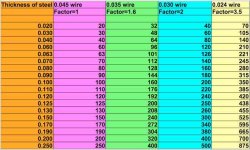
Learning to set wire speed based on measuring a 6 second trigger pull, times 10 to get IPM. Determining the desired WFS based on material thickness and wire diameter/burn off. Along with having an understanding on how those variables play with each other and the compensation needed to make changes on the fly.

Charts from Welding Tips and Tricks (Jody)
IMG_3052.jpegIMG_3053.jpeg

That alone was the biggest improvement in my wire feed welding experience which was a fairly recent thing, in the last year or so. Tig is my favorite process and was my go to, then stick, then mig. Now that I don’t have to fight the machine getting it setup, I much enjoy the speed of wire feed for general fabrication, structural shapes, etc. Tig still for small/precision stuff.

Even in the modern day with auto set machines, digital readouts, charts on the machine, I think its very valuable to not have to rely on them, and reality is, a lot of industry is probably not using machines that have those features/luxuries.
 

strutaeng

Well-known member
Joined
Dec 12, 2011
Messages
2,250
Location
Dallas, TX
How about a few exercises on weld symbols? Seems really easy, but in practice sometimes it's not.

If you have some shop drawings available, those would be good to share to see how things are identified in fabrication.

Welding Procedure Specification (WPS) as well...?

I'm a self-taught hobbyist welder (SMAW, FCAW, GMAW) but have experience on the Construction Documents/Specifications on the structural engineering side for buildings. I have reviewed a lot of structural steel submittals for large projects, as well as certified welding inspector testing reports for critical welds.
 
Last edited:

ADKAmateur

Active member
Joined
Feb 9, 2026
Messages
31
So i retired a couple of years back and had a 90 day notice period where I didn't need to go into the office. I was going to be moving to Upstate NY from the NYC area at the end of those 90 days so I wanted to take advantage of that time and find a legit welding school. I did 40 hours of MIG at a welding school on Long Island. Since then I have done three or four TIG classes with Justin from the Fabrication Series when he goes to NJ. From both of those experiences, I think the best thing is literally having you someone looking over your shoulder and giving you real time feedback on torch angle, speed, etc. Then having them walk away and let you weld for an hour or so on coupons, have them come back, look over your shoulder and give you more advice. Wash, rinse repeat. I think the more time you can spend watching and coaching her the better. That is what I really appreciate from the classes I have taken, particularly with Justin. He will walk by you and yell "get that torch closer."
 

sqznby

Well-known member
Joined
Oct 26, 2013
Messages
981
Location
Coastal NC
I like the idea of starting with Oxy-Ace. But in all honesty, she will more than likely never use it.
Had to build a 4" box using Oxy-Ace for my first class. Had to build up and hold pressure to move on to the next stage of the class.
I'd find out what she was interested in and where she wanted to go and start from there.
Start with the basics and slowly get more advanced as she progresses.
 
To avoid these ads, REGISTER NOW!

gahrajmahal

Well-known member
Joined
Dec 12, 2008
Messages
2,523
Location
Cincinnati, Ohio
I taught blueprint reading for machine trades adult classes. I always did a segment on welding symbols as I often had welders take my class. Another teacher was teaching welding at night too and we always took a “field trip” down the hall to look at their machinery and any projects they were working on.
Since you have an actual shop welding actual components for customers that have to be built in a particular sequence to an exact size and dimension, you can add this critical component to her education. Fixturing and method and how to get a good finished part. That’s difficult to reproduce in a school weld shop. They rarely get technical work to complete in my observation.
 
Last edited:

jsaw

Well-known member
Joined
Oct 11, 2008
Messages
1,783
Location
Geneva, N.Y.
Its been a long time for me too. I think me learning oxy-acet first really helped me understand puddle control. I've helped a couple people trying to arc weld and that is where they were messing up.
Same here , I learned oxy-acet first, then stick welding. For me, MIG is the most difficult method of all. There are heat settings, and wire speed settings that have to be just right, and having the big nozzle in the way makes it tougher to see the puddle. When stick welding it seems much easier to me to see the puddle.there is less adjustments. With stick, just bump the amperage up or down a notch as needed. I can "whip" the arc in order to run cooler, or also to help preheat things . Also I can actually "feel" what I am welding with the end of the electrode. It is easier to get into tight places with stick. I have bent electrodes so that I could reach into tight locations.
 
Last edited:

freebirdwelds

Well-known member
Joined
Dec 5, 2022
Messages
3,943
Location
Landrum, South Carolina
I've been welding almost 50 years now, mainly heavy equipment. Stick and dual shield Mig. I burn 150+ pounds of rod and 350+ pounds of wire a month.
Depending on what you do you'll need: fabrication skills, isometrics, some weight training, and out of position welding is a must. None of this means anything if your going to be sitting at a bench tacking widgets all day. But real world welding relies on it heavily.
 

545_days

Well-known member
Joined
Oct 30, 2016
Messages
577
Location
Texas
The most helpful thing to me was learning how to adjust the machine and seeing how changing an input changes the weld.

Select random setting: run a bead, change amperage, run another, change again, run another, etc. until you have figured out the " best" amperage. Now increase it decrease the wire speed, run a bead, change wire speed again, trying another bead, etc. Learning how a weld looks that is too hot, too cold, wire feed too fast, too slow, really helped me learn to look at my welds and adjust the machine for the best results.

The other important lesson for newcomers is to hold the torch with gas flow on for a few seconds while the puddle cools instead of pulling it away the instant you finish the weld and allowing oxygen to contaminate the weld.
 

oscarsnapkin

Well-known member
Joined
Feb 22, 2025
Messages
465
I completed a 240 hour course at a community college at the end of last year. The most important thing I learned is that I don’t like welding. We covered SMAW, GMAW, FMAW and oxy-fuel cutting. We basically ran the same bead over, and over, and over again. Occasionally we’d switch position to vertical, overhead, etc. I get that repetition is important, but it was mind-numbing. It sounds like you’ll be teaching your student in a much more “interesting” environment. We didn’t cover much as far as setting up the machines, so I’d definitely recommend going deep into that. If I had to weld something today I doubt I could get the machine adjusted properly. We covered stick welding first, which I think was good because it made MIG and fluxcore seem super easy. I would’ve liked if we had learned how to weld with different metal gauges instead of the exact same piece everyday. One of the things that I was glad we learned was how to read the numbering system used for welding rods, but I’m sure you’ll cover that. The class was free, so I really shouldn’t complain. I think it was paid for mostly by a shipyard in Philadelphia that is looking for welders. Being unemployed I applied and was accepted. There was 16 of us in the class. Most of them were looking to immediately jump into welding jobs. Without a doubt, no one was capable of working as a welder after the course. I was basically looking for something to help me learn MiG welding for doing rust repair on my VW. For the amount of time I had to put into it, I feel like I got very little out. I will say this, the two teachers were excellent as far as telling us what we were doing wrong and giving pointers. They were just restricted by the curriculum. Maybe I should swing by your shop and take some lessons! Good luck. I wish I could’ve learned in an environment like yours.
 

danski0224

Well-known member
Joined
Jan 29, 2005
Messages
13,353
Location
Near Naperville, IL
The above is true of any welding class I have taken.

Running a bead on a short and flat coupon, in your preferred position, is completely opposite from welding in the field.

Moving from something flat to something round adds more difficulty. Then use your non dominant hand.

There's no substitute for experience.

The class just begins to bring some familiarity with the process.

And no, I am far from a professional welder.
 
OP
D

dr_clyde

Well-known member
Joined
Jan 7, 2009
Messages
6,430
Location
Holland, MI
Thanks for the input guys.

Our first lesson is tomorrow, we will get a better idea of what she's looking to achieve with me when we actually sit down in the shop and start working.

Hopefully we can get her where she wants to be in time for school to start in a few months.
 

macgyver37

Well-known member
Joined
Mar 7, 2013
Messages
609
Location
Pittsburg, Kansas
I also learned with oxy fuel and had to weld up a water tight box in school.

I think what I had trouble with was not getting to a 'real' job as quick as my high school brain wanted to. I know that practice is needed, but I would suggest to try and work some real world situations into the learning as it should help keep her interest and more importantly remind her that the boring practice and setup details matter most when doing a real paying job.

I think since she is already taking some classes, I'd try to get an understanding of what they will cover and fill in the blanks. I'd also try to keep working towards the idea that you need to show her what the real world might be as a welder so she doesn't get done with school and find she wasted her time.
 
OP
D

dr_clyde

Well-known member
Joined
Jan 7, 2009
Messages
6,430
Location
Holland, MI
The first lesson went quite well! Thanks again for everyone's input.

We spent a few minutes going over how wire welding works, how to set the machine up, when to use what kind of gas and why, and general theory.

I had sheared up a box of coupons, and then we spent a few hours doing some practice welds with both short-circuit and pulsed spray transfer.

We even ran the machine out of wire so we had an opportunity to learn how to swap out a roll of wire.
 

KSJeff

Well-known member
Joined
Dec 19, 2011
Messages
760
Location
Andover, Kansas
Troubleshooting was valuable to me. But, if she can stick weld, she can probably mig weld without much help. I'd move her to TIG.
 
To avoid these ads, REGISTER NOW!
Top Bottom