To avoid these ads, REGISTER NOW!

ZMotorsports Shop Projects 2.0

OP
Z

zmotorsports

ALLIANCE MEMBER
Joined
Oct 20, 2009
Messages
21,347
Location
Northern Utah
Nice to see that trailer in action Mike! I was wondering if the bed would lay back down by itself once the car came off the ramps, but looks like it sits right there. Does it just balance there, or is it hydraulic?

Thanks Keith, the main reason for wanting (and needing) a car hauler was as our fleet is aging I wanted to be able to quickly and safely haul one of our vehicles home in the event of an issue, secondary was that I would like to be able to **** project cars or cars to flip in the future if time allows. Although my wife was "all in" on the trailer idea at first as I don't think she put quite the heavy emphasis on it that I did, until yesterday that is. :unsure: I had originally planned on fabricating a car hauler, but when this one came along that was "almost" exactly what I was planning on fabricating and at the price I was able to get it at, it was a no brainer to snag it and then "tweak" those few things to really make it perfect me.

The trailer's tilt deck at the moment is accomplished by a non-powered hydraulic "dampening" cylinder that only requires some weight to offset the balance and move it in either the down or back up/level positions. This is overwhelming the most common method of accomplishing this amongst most tilt deck car trailer manufacturers. HOWEVER, it is not my favorite and my plan all along when I was planning on fabricating a trailer was to build a powered tilt deck car hauler. The main two reasons for wanting a powered deck is because on longer vehicles, when the front axle passes that fulcrum, the deck begins to tilt back level and if the rear axle is not yet on the trailer it can cause issues, such as coming in contact with the underside of the body or frame just ahead of the rear tires. The second reason is because I plan on installing a winch and box on the front and that will offset the balance of the deck, and although the dampening cylinder can be adjusted to aid in the weight, it really throws off the consistency and control.

I've had the trailer for nearly 9-months now and had purchased nearly all of the parts and pieces to do what I want with it, but just haven't made the time. All of the components are sitting in my shop to add a 12k pound winch to the front of the deck, 4 additional tie downs in the deck, as well as the components to add a full hydraulic tilting deck which will greatly add to the versatility of the trailer, especially when a dead vehicle is being collected. I just need to make the modifications a priority now.

Probably much more than you were asking Keith, but hope this answers your question.
 
To avoid these ads, REGISTER NOW!

ScepterToad

Well-known member
Joined
Nov 9, 2023
Messages
329
That's perfect Mike, thanks! The deck coming into contact with the vehicle was exactly what I was thinking when I saw the picture of the Jeep front tires coming off the ramps. That particular Jeep is probably high enough for the trailer to not hit the bumper, but anything shorter would.

A follow up though....what sort of power requirements will that hydraulic system have? Will 12v power from the tow vehicle cover it?
 

ntsqd

Well-known member
Joined
Jan 22, 2005
Messages
960
Location
Lower left coast
Winches pull close to, and sometimes more than starting does. The hydraulic pump motor will be no slouch in amps demand either, so I'm sure that an on-board battery is planned for. Given how puny the trailer battery charge wire in an RV 7 pin trailer connector is vs. it's length I'm interested to see how Mike decides to deal with that.
 
OP
Z

zmotorsports

ALLIANCE MEMBER
Joined
Oct 20, 2009
Messages
21,347
Location
Northern Utah
That's perfect Mike, thanks! The deck coming into contact with the vehicle was exactly what I was thinking when I saw the picture of the Jeep front tires coming off the ramps. That particular Jeep is probably high enough for the trailer to not hit the bumper, but anything shorter would.

A follow up though....what sort of power requirements will that hydraulic system have? Will 12v power from the tow vehicle cover it?

Winches pull close to, and sometimes more than starting does. The hydraulic pump motor will be no slouch in amps demand either, so I'm sure that an on-board battery is planned for. Given how puny the trailer battery charge wire in an RV 7 pin trailer connector is vs. it's length I'm interested to see how Mike decides to deal with that.


Yes, the car hauler will have it's own onboard 12VDC power supply to power both the winch and HPU, possibly even a tongue jack, although I'm on the fence about the tongue jack. I loved the powered tongue jack on my enclosed trailers, but just not sure it's necessary in this application.

I have a plan to add both the battery as well as the HPU under the deck to keep the tongue box that will be added free of the clutter as most manufacturers that offer powered units cram the battery and HPU into the tongue box. I will then add some jump taps that will be accessible in the event the battery dies so the deck can be tilted to access the battery. Just trying to keep everything clean and tidy and out of view as well as low and centered as possible and keep the tongue box solely for accessories used solely for hauling a vehicle, such as tie downs, straps, etc.
 

ntsqd

Well-known member
Joined
Jan 22, 2005
Messages
960
Location
Lower left coast
I seem to recall your saying in the past that you didn't want to have to run an extension cord out to a wall-wort maintainer. I have to do that with a couple vehicles now and then, so I get why.
Little solar panel on the lid of the tongue box? I'd expect even in that storage space that it would get enough mid-day sun to make it worthwhile. I've given it some thought for one rig in particular. If there were a sanitary way to route the wire it would already be done, but there really isn't one. Or just throw a trickle charger on it once in a while?
 
OP
Z

zmotorsports

ALLIANCE MEMBER
Joined
Oct 20, 2009
Messages
21,347
Location
Northern Utah
I seem to recall your saying in the past that you didn't want to have to run an extension cord out to a wall-wort maintainer. I have to do that with a couple vehicles now and then, so I get why.
Little solar panel on the lid of the tongue box? I'd expect even in that storage space that it would get enough mid-day sun to make it worthwhile. I've given it some thought for one rig in particular. If there were a sanitary way to route the wire it would already be done, but there really isn't one. Or just throw a trickle charger on it once in a while?

Yes, the plan is a small solar charger to keep the battery topped off. I will also wire it to charge while connected to the tow vehicle.
 

rattle_snake

Well-known member
Joined
Jun 25, 2015
Messages
5,175
Location
Chandler, AZ
Unfortunate that your son is having issues with his Jeep. Intermittent electrical gremlins are very frustrating. Beyond DTC, looking at the signal integrity with an o-scope is kind of the only way to have visibility into such things.

I believe you recently put in a reman motor in hoping to not to continue to have issues.

I suggest a complete Ford engine/trans/TC swap. 7.3 godzilla, 6R, Atlas, tons, 40s. :cool:
 
OP
Z

zmotorsports

ALLIANCE MEMBER
Joined
Oct 20, 2009
Messages
21,347
Location
Northern Utah
Unfortunate that your son is having issues with his Jeep. Intermittent electrical gremlins are very frustrating. Beyond DTC, looking at the signal integrity with an o-scope is kind of the only way to have visibility into such things.

I believe you recently put in a reman motor in hoping to not to continue to have issues.

I suggest a complete Ford engine/trans/TC swap. 7.3 godzilla, 6R, Atlas, tons, 40s. :cool:

Thanks Justin, but I don't think we are quite at the point of going to that extreme. I mean a Chevy LS, yeah I get that, but a F**d. Seems like a step in the wrong direction, even from a Mopar. :bounce:
 

swsman

Well-known member
Joined
May 5, 2021
Messages
547
Location
Earthbound
Congrats on the step into retirement, or dipping the toe rather. I hope to take the full head first plunge here in a few years.


Tim, we do get winter snow with that brine **** on the roads, but it isn't as bad as where you are at. Usually within 24-72 hours after a major snowstorm, our roads are pretty much cleared off and we can wash the brine solution off immediately , keeping rust and corrosion at bay by keeping the undercarriages relatively in good shape, although nowhere near as well as say AZ or CA. But it is not uncommon to get 300k plus miles out of vehicles here as long as they are mechanically cared for.

Thanks for confirming the SK adjustable retainer tool. I didn't purchase it as a kit, just the single tool, and while I appreciate you helping me to "push tool purchases" ( ;) ), I think you are giving me way too much credit to think I have 48 people following me or giving a **** what I do....:ROFLMAO:
Both of you will be surprised.
Job well done is a job well done, and both of you set the bar pretty high.

I have two sets of cheap universal stuff for trim removal, ordered both SK tools mentioned. They will get use of this I am sure as I maintain a small fleet of vehicles/motorcycles etc.

Also got some Astro stuff unrelated to this thread.
For those looking for SK tools mentioned I found them on JB Tools for reasonable prices.
I have ordered from them in the past, so far so good.
 

bugnut

ALLIANCE MEMBER
Joined
Jul 14, 2012
Messages
3,860
Location
Central Ohio
Mike, maybe i misread, but does the tilt cylinder on the trailer not have a ball valve to lock it in position? Would not that simple addition achieve holding the deck in position?
 
OP
Z

zmotorsports

ALLIANCE MEMBER
Joined
Oct 20, 2009
Messages
21,347
Location
Northern Utah
Mike, maybe i misread, but does the tilt cylinder on the trailer not have a ball valve to lock it in position? Would not that simple addition achieve holding the deck in position?

Joel, no this setup does not have the ball valve. I have seen a few of the ones you are talking about and yes, it would help to "lock" it in the tilted position until ready to lower, but I like the other pro's of having the deck powered in both directions.
 
OP
Z

zmotorsports

ALLIANCE MEMBER
Joined
Oct 20, 2009
Messages
21,347
Location
Northern Utah
Last night had an issue that almost stopped me and my son in our tracks. It definitely made my heart drop into my stomach when I saw it. There was definitely some Divine intervention in the extraction method however.


The crankshaft position sensor on these Mopar 4.7 liter engine is not fun to access. The starter motor needs to come out in order to access it. Fortunately, my son's has altered suspension, otherwise the passenger's side upper control arm is also directly in the way on a stock WJ. I thought getting the starter motor out of the way would be the worst part of the job, and we've done that before so not terrible.

After getting the starter motor out of the way we pulled the crankshaft position sensor out and noticed that the circuitry was exposed. Well, that's not normal. Oh ****!!! The end is still stuck in the block, and STUCK it was. It wasn't budging. I thought maybe it broke on the O-ring groove and I could reach in with a pick, remove the O-ring and then extract the broken end from the bore. NOPE. The break was above the O-ring groove, so the O-ring was not exposed. 🤬

Time to gather our thoughts and give this a think for second.
sensor1.jpg


After realizing it did not move with a pick or even an extractor, I thought maybe I could tap the plastic piece, then thread a bolt into it and pull it out. I didn't have a bolt the same size as the tap that best fit the plastic piece, so after tapping it a bit, I reached up with an angled pair of needle nose pliers, then put an angled pry bar under the needle nose pliers and was able to extract the broken piece from the bore in the block. Whew. That was a relief and definitely had us scrambling, but that could have gone so much worse.
sensor2.jpg

Here you can see the threads created in the plastic about 3/8" down into the plastic. Just enough to create a good bite. I didn't want to go too deep and break the end off nor expand the plastic in the bore creating more friction, so it was a trial and error until it pulled out.
sensor3.jpg

New OEM Mopar sensor installed.
sensor4.jpg

And a little heat barrier on the sensor, connector and wiring harness for added protection.
sensor5.jpg


Thanks for looking.
 

ntsqd

Well-known member
Joined
Jan 22, 2005
Messages
960
Location
Lower left coast
I'd be interested in a pic of that ram on the trailer if you decide to take one. I'm curious how it works. One of the functions of the remote reservoirs on some shocks is to act as an accumulator for the fluid volume displaced by the shock shaft when compressed. If this is a normal hyd. ram with the two ports plumbed together then it will need to have some air in the system or it would go into hydraulic lock before fully compressed.

A couple of the guys & I on the old Broncofix email list played around with the idea of replacing one of the links in a front 4 link or one of the caster-control links in a radius arm front suspension with a hyd. ram. This was in the days when the RTI score was king. The idea was to plumb it end to end and then have a valve that could be opened for articulation and closed for highway driving. Unless the ram used was a thru-shaft design where the internal volume doesn't change no matter where it is in its stroke, such a system would need an accumulator of some sort. Using a thru-shaft ram in the location is a big problem in packaging, not to mention that they were almost unheard of then. Needing an accumulator introduced considerable hysteresis in the system. The best thought was to put the valve in 'T' branch to the accumulator. Then closing the valve would cause hyd. lock at that point in the ram's travel. However none of us were convinced that it would be exactly rigid, that even with the valve closed there would still be a little bit of play or slop in the ram. Maybe enough to matter and maybe not.
Some of us played with the idea that all of the fluid in that ram be PSF under pump pressure, and that closing the valve also closed the ram to the pump, resulting in all of the fluid in the ram being under significant pressure. We still weren't convinced that it would work as hoped. As the 'formula' for the Wristed Radius Arm was somewhat well known in those circles and BCB soon came out with their copy of Gary's "wristed axle housing" soon after it all was set aside as a decent idea, but there were easier ways. Then Dennis at 4x Doctor made some extended radius arms, and Lars made some minor geometry changes to that design that resulted in the "Lars Bar" and all of that wristed arms stuff became moot.
Sorry, got on a roll there......

Anyway, I am curious about how they're making it work.
 
OP
Z

zmotorsports

ALLIANCE MEMBER
Joined
Oct 20, 2009
Messages
21,347
Location
Northern Utah
So, another question for the experts here to see if there is something I am missing or to confirm my thinking.


With this crankshaft sensor on my son's WJ packaged right between the starter motor and exhaust manifold into the block, I worry about the sensor getting baked and causing premature failure. I realize that the engineers design these sensors for the environments in which they will be used, BUT, I also realize that many times there is a gap between laboratory conditions where components are designed and the real-world conditions when components live.

That being said, I have used heat barrier sleeving and protective measures quite a bit over the years in certain areas and/or applications and I have taken note that many race teams also wrap their sensors and wiring in various areas and situations.

My experience is from school of hard knocks and not theoretical, so I am open to opinions or correct me in my thinking. I understand heat to be transmitted or transferred by a couple of means, conductive, convection and radiant. The sensor is in immediate contact with the block so therefore heat is conducted from the block to the sensor, but the engine block is also cooled by the cooling system, so those temperatures are somewhat controlled and let's say limited to around 200-230 degrees. I would think the sensors should be able to handle those temperatures fairly well.

Similar with convection, being air and water, but again I would say the block being cooled by the cooling system somewhat controls the convection temperature, but there is also the air temperature and we all know that underhood temperatures can vary depending on many variables.

I would say radiant heat would be the one I am most concerned with as the sensor is only a couple of inches from the exhaust manifold and the temperatures of an exhaust manifold can easily get up to the 500-800~ish ranges and those temperatures can cause the sensor to climb to well over the block's temperature that it is affixed to. Add in a Jeep that is crawling or driving at slow speeds where the air movement underneath is less than driving down the highway and I can see where this could become a problem. I see so many Jeeps with crumbling polyloom casing and it is magnified when people add underbelly skids and armor which traps the heat in like an oven.

I also see some manufacturers that have been wrapping certain sensors for a while now, the GM Duramax has an aluminized wrap around the turbo vane sensor as does the Ford Powerstroke around the IPR (Injector Pressure Regulator) which uses a thermal sleeve, but these are directly fastened to the turbochargers. But I have seen people leave these off and pay the price in terms of increased replacement of said sensors, so they must serve a purpose and work as designed, otherwise I wouldn't think the manufacturer would waste the time and money on them.

I added some heat sleeve over the crankshaft position sensor, the connector and about 5 inches up the wire loom last night and I have to wonder, do you think it will do any good to protect the sensor from premature failure and prolong the life or did I just waste my time and money?

I would appreciate any opinions and/or discussions on the matter of heat barrier sleeving/protection on sensors and wiring.


Thank you.
 

Jgaz

Well-known member
Joined
Dec 16, 2016
Messages
1,647
Location
AZ
Mike, I owned a 2001 Dakota with a 4.7L for 14 years. It was my daily driver in Phoenix for the first three years I owned it.

At around 5 years and approx. 60K miles I had to replace the crank sensor. At that time I wondered about the same possible issues you did. Based on other heat sleeve covered sensors I had seen I covered mine in a similar way.

I drove the truck daily in Michigan for another 9 years and about 110K miles before selling it to my nephew. I had no further problems with the crank sensor.
Nephew drove it to about 225K with no problems.

This is an admittedly small sample and could be nothing more than a coincidence but I sure don’t think you hurt anything by covering your sensor like you did.
 

ntsqd

Well-known member
Joined
Jan 22, 2005
Messages
960
Location
Lower left coast
My first thoughts on the topic:

Without a fairly sophisticated reflector the energy in radiated heat decays exponentially with distance from the source. $20 words that say what most already know intuitively. Double the distance and it's roughly 1/4 of the energy.
Nice to know, doesn't do this situation any good unless you can move the sensor or the heat source. Which I doubt.

Heat shields work. Place a metal barrier between the heat source and the sensor (or floor or trans tunnel or...... ) and the heat that does reach the part or area of concern can be radically reduced. Even better when airflow is encouraged on either or both sides of the barrier. Forced to choose I'd pick the 'cold' side to have airflow.
in terms of shielding ability it doesn't matter what the shield is mounted to. Exhaust mounted shields do need to be more robust than engine block or floor mounted shields. Mostly due to the larger temperature swings, but also because exhausts seem to vibrate a lot more than the engine does. SS and aluminum both work well as heat shields even though their thermal transmission rates are substantially different (112 BTU-in/hr-ft^2 vs. 960 BTU-in/hr-ft^2).

Insulation works both ways. It will keep the heat out until it can't. And then it helps keep the heat in. So give it a fighting chance at keeping the heat out with other methods.
 
To avoid these ads, REGISTER NOW!
OP
Z

zmotorsports

ALLIANCE MEMBER
Joined
Oct 20, 2009
Messages
21,347
Location
Northern Utah
Mike, I owned a 2001 Dakota with a 4.7L for 14 years. It was my daily driver in Phoenix for the first three years I owned it.

At around 5 years and approx. 60K miles I had to replace the crank sensor. At that time I wondered about the same possible issues you did. Based on other heat sleeve covered sensors I had seen I covered mine in a similar way.

I drove the truck daily in Michigan for another 9 years and about 110K miles before selling it to my nephew. I had no further problems with the crank sensor.
Nephew drove it to about 225K with no problems.

This is an admittedly small sample and could be nothing more than a coincidence but I sure don’t think you hurt anything by covering your sensor like you did.

Thank you Jim. I appreciate the feedback and real world experience with the exact situtaion.


My first thoughts on the topic:

Without a fairly sophisticated reflector the energy in radiated heat decays exponentially with distance from the source. $20 words that say what most already know intuitively. Double the distance and it's roughly 1/4 of the energy.
Nice to know, doesn't do this situation any good unless you can move the sensor or the heat source. Which I doubt.

Heat shields work. Place a metal barrier between the heat source and the sensor (or floor or trans tunnel or...... ) and the heat that does reach the part or area of concern can be radically reduced. Even better when airflow is encouraged on either or both sides of the barrier. Forced to choose I'd pick the 'cold' side to have airflow.
in terms of shielding ability it doesn't matter what the shield is mounted to. Exhaust mounted shields do need to be more robust than engine block or floor mounted shields. Mostly due to the larger temperature swings, but also because exhausts seem to vibrate a lot more than the engine does. SS and aluminum both work well as heat shields even though their thermal transmission rates are substantially different (112 BTU-in/hr-ft^2 vs. 960 BTU-in/hr-ft^2).

Insulation works both ways. It will keep the heat out until it can't. And then it helps keep the heat in. So give it a fighting chance at keeping the heat out with other methods.

Thanks Thom. My original thought was trapping heat in such as when shutdown and heat soak. Will the barrier sleeve trap heat? That was where my mind went. That being said, I thought the sensor itself creates very, very little heat, the heat is coming from an outside source, engine block and exhaust manifold. So my thinking was that if I can reduce the amount of heat getting to the sensor from an outside source it would be of more help than trapping a smaller amount inside the sleeve. At least that is where I landed last night, but also why I posed the question.

Thank you guys for your feedback and input. Much appreciated.
 

swsman

Well-known member
Joined
May 5, 2021
Messages
547
Location
Earthbound
My take on this is what you did certainly adds another layer of defense.

Part location being where it is prompts earlier replacement table versus the prior part.

That should keep you/your son in the clear, having access to hoist/tools/know how makes it a no brainer to inspect at 3yrs or so interval.

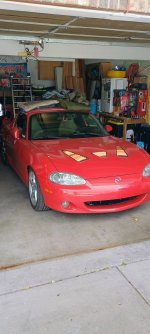
Miata NB is notorious for cooking CPS as it is located on the passenger side, back end of the timing valve cover.
That cylinder runs the hottest.

Once it starts going bad it causes a crank, no start condition. Having dealt with this I keep a spare one and a 10mm wrench in the glovebox.
Lucky for me access is straight forward and done within a minute or so.
 

ntsqd

Well-known member
Joined
Jan 22, 2005
Messages
960
Location
Lower left coast
No familiarity with the sleeve used. As a general comment I'd expect that the insulation part of it's performance is directly related the thickness of the material behind the reflecting foil. In this case thinner is probably better because it won't retain the heat-soak energy for as long as a thicker material would.

I doubt the sensor makes much of it's own heat as it obviously doesn't consume much power. My expectation is the same as you outlined, the heat is coming from various other sources. The exhaust is likely the worst offender while in operation. Between it and the sensor is where my thinking would be for any sort of thermal baffle.
 
OP
Z

zmotorsports

ALLIANCE MEMBER
Joined
Oct 20, 2009
Messages
21,347
Location
Northern Utah
Thanks for the feedback guys.

My son carries a spare CKP in his Jeep, but that being said, this one would be a nightmare to change on the side of the road as the starter motor MUST be removed in order to access the sensor. Poor design in my opinion. I used to think the Jeep/Mopar 4.0 was bad, but I'd do them any day of the week and twice on Sunday over a 4.7 liter on the side of the road. Stock the starter motor cannot be removed because the right upper control arm is right below the starter motor, so on those the exhaust has to be dropped to remove the starter motor which must be removed to access the CKP. What a joke, even from a seasoned mechanic's point of view. Very poor design.
 

ntsqd

Well-known member
Joined
Jan 22, 2005
Messages
960
Location
Lower left coast
Which is closer to the sensor, the exhaust tube, or the manifold? If manifold, tubular or cast iron? Where I'm going with this is heat-soak on hot shut-down. Any tubes will loose their heat far more rapidly than a casting. Knowing the answers will give better insight into if this is a short term heat-soak situation or a long term heat-soak situation. Which may or may not change how you approach going any further.
 
OP
Z

zmotorsports

ALLIANCE MEMBER
Joined
Oct 20, 2009
Messages
21,347
Location
Northern Utah
Which is closer to the sensor, the exhaust tube, or the manifold? If manifold, tubular or cast iron? Where I'm going with this is heat-soak on hot shut-down. Any tubes will loose their heat far more rapidly than a casting. Knowing the answers will give better insight into if this is a short term heat-soak situation or a long term heat-soak situation. Which may or may not change how you approach going any further.

Without an actual measurement Thom, I would say it is about sixes. The cast iron manifold is just a few inches above the sensor and starter motor, but the exit of the manifold where the pipe connects is also just a few inches from the sensor and then the catalytic converter is a few inches from that connection.
 
OP
Z

zmotorsports

ALLIANCE MEMBER
Joined
Oct 20, 2009
Messages
21,347
Location
Northern Utah
Oh good, double whammied! :(


Exactly Thom. Very similar situation to the oil sending unit on my Jeep that I documented a year or so ago where after several sending unit replacements I discovered the real issue with radiant heat and installed an aftermarket adapter where I was able to move the sending unit a little further away from the exhaust manifold as well as wrapping it in heat protection/barrier sleeving.

It's been fine since so I was hoping for similar outcome here, with the heat barrier anyways as we couldn't relocate the sensor in this association.
 

swsman

Well-known member
Joined
May 5, 2021
Messages
547
Location
Earthbound
Exactly Thom. Very similar situation to the oil sending unit on my Jeep that I documented a year or so ago where after several sending unit replacements I discovered the real issue with radiant heat and installed an aftermarket adapter where I was able to move the sending unit a little further away from the exhaust manifold as well as wrapping it in heat protection/barrier sleeving.

It's been fine since so I was hoping for similar outcome here, with the heat barrier anyways as we couldn't relocate the sensor in this association.
The only other thing I can think of in your case is to fabricate an additional shield around the sensor.
Whether this is worth the effort versus earlier component replacement is up to you fellas.

Very possible there are clearance issues for such thing anyways.

Previous owner of my DR650 spent a lot of time and effort drilling a bunch of small holes on the wings of the engine skidplate. This is to aid in cooling as the bike is air cooled.

1781213729413.jpeg
 
OP
Z

zmotorsports

ALLIANCE MEMBER
Joined
Oct 20, 2009
Messages
21,347
Location
Northern Utah
The only other thing I can think of in your case is to fabricate an additional shield around the sensor.
Whether this is worth the effort versus earlier component replacement is up to you fellas.

Very possible there are clearance issues for such thing anyways.

Previous owner of my DR650 spent a lot of time and effort drilling a bunch of small holes on the wings of the engine skidplate. This is to aid in cooling as the bike is air cooled.

1781213729413.jpeg


Agreed, a heat shield to create an air gap between the component and the source of the heat is probably ideal and a path I've used a lot over the years. Unfortunately, there is simply no room in this situation, hence the heat barrier sleeve.

I think in this circumstance I'm just going with the theory that something is better than nothing. Although, I'm sure there are hundreds of thousands of these things out there with no additional heat protection and just as they came from the factory, so I'm sure I'm overthinking this whole
thing. :unsure:
 

rd65

Well-known member
Joined
Sep 29, 2017
Messages
2,738
Location
Granite Falls, WA
My take on this is what you did certainly adds another layer of defense.

Part location being where it is prompts earlier replacement table versus the prior part.

That should keep you/your son in the clear, having access to hoist/tools/know how makes it a no brainer to inspect at 3yrs or so interval.

Miata NB is notorious for cooking CPS as it is located on the passenger side, back end of the timing valve cover.
That cylinder runs the hottest.

Once it starts going bad it causes a crank, no start condition. Having dealt with this I keep a spare one and a 10mm wrench in the glovebox.
Lucky for me access is straight forward and done within a minute or so.
Not sure about the cooling system in NB but in my 1.6 NA coolant routing through the head is a joke. Coolant reroute is on the list when I pull the head for rebuilding.
 

swsman

Well-known member
Joined
May 5, 2021
Messages
547
Location
Earthbound
Not sure about the cooling system in NB but in my 1.6 NA coolant routing through the head is a joke. Coolant reroute is on the list when I pull the head for rebuilding.
I will keep it brief as this is Mikes thread, feel free to PM or start a new one.

I did good baseline on the car, part of that was new water pump, new thermostat, new radiator etc.
Miatas like to run hot, tiny car with that engine shoved in there.

On mine I added Singular Motorsports hood louvers, I will be honest never noticed much if any difference.

I use Torque Pro app on an old Android phone connected to OBD II adapter. This gives me real time data vs factory sweep/garbage gauge.
 

Attachments

  • IMG_20250817_132823004_HDR_AE.jpg
    IMG_20250817_132823004_HDR_AE.jpg
    443.1 KB · Views: 10

BORING HOP YARD

Well-known member
Joined
Jan 13, 2007
Messages
1,100
Location
Boring Oregon
Hey Mike, I would think that you could collect some data to see how much the sleeving protects firsthand.
If you have a thermometer probe that could be inserted into the sleeve and heat the outer sleeve with a heat gun or even a bbq
I could Invision using an infrared thermometer to measure the heat being applied to the outside and thermometer probe on the inside.
You might have one on a smoker or grill. Always enjoy reading your post and wanted to give back.
Thank you.
 
OP
Z

zmotorsports

ALLIANCE MEMBER
Joined
Oct 20, 2009
Messages
21,347
Location
Northern Utah
Hey Mike, I would think that you could collect some data to see how much the sleeving protects firsthand.
If you have a thermometer probe that could be inserted into the sleeve and heat the outer sleeve with a heat gun or even a bbq
I could Invision using an infrared thermometer to measure the heat being applied to the outside and thermometer probe on the inside.
You might have one on a smoker or grill. Always enjoy reading your post and wanted to give back.
Thank you.

That may be a good benchtop test to perform. Thank you. Gaining access to the actual sensor connector on the Jeep is out of the question, but I could try to duplicate some heat being applied to some protective sleeving on the bench and measure internal and external temperatures. I may try that out of curiosity when I get some time.

Thank you.
 
OP
Z

zmotorsports

ALLIANCE MEMBER
Joined
Oct 20, 2009
Messages
21,347
Location
Northern Utah
I had a little cabinetry project in the coach that I have been working on over the last week. A couple of years ago the sliding tambour door in our galley slide in the coach caught and broke the attachment mechanism so I repaired it while we were out on a road trip. It had held up well, but during our last trip it jammed in its track again and this time caught one of the slats in the tambour sliding door and dislodged it in the track. I slid it into place enough to complete our trip and not bug the ever living **** out of me during the trip, but I knew I had to address it before our next trip.

I have not messed with one of these tambour slat style of doors before so this was a learning exercise. I had never heard of Hide Glue before and after reading a couple of articles on an antique/vintage furniture restoration forum, I got a crash course.

Getting the dang mechanism out of the cabinet was the worst part. I had to remove the sliding pantry cabinet and access the opening from the backside but only with about an 8" compartment to work through. After removing the tambour door and getting it on the bench, I found one slat that had completely became disbonded and about 4 others that were coming off of the canvas on the backside, so I figured I would repair all while I was at it. I went through the slats one by one and marked each one with a small piece of masking tape that needed to be glued so I didn't miss any.
slats1.jpg

I then ordered a bottle of Hide Glue from my local Grainger. I really didn't want to deal with the "original" hide glue which is in pellet form and needs to be melted in a glue pot. That is for the serious woodworkers and I am not that. I wanted quality, yet ease and convenience. ;)
slats2.jpg

Slats glued and excess squeegeed out of the backside of the canvas and then clamped in position for about an hour or so while I worked on yardwork.
slats3.jpg

I then went slat by slat and broke the pivot point free, turned the door over, placed some wax paper on the canvas and clamped again leaving it on overnight. The next morning before leaving for work, I went out broke the pivot points between the slats free again and coiled the door and stood it on end to dry throughout the next couple of days. The plan was to install it the next day, but with my son's WJ issue, this got pushed off a couple of days, which worked out well to ensure it fully dried.
slats4.jpg

Last night I reinstalled the tambour door into the cabinet and before fully assembling the sliding pantry drawer I ran the slide in and out multiple times to ensure nothing was catching. I then fully reassembled the cabinets and cleaned up the tools, and ran it in and out a couple more times for good measure.
slats5.jpg

Everything worked perfectly and the tambour door slides in the tracks nice and smooth. Slide retraced and in travel mode.
slats6.jpg


That was a learning opportunity to say the least, but hopefully everything is glued well enough to last another 24 years.

Thanks for looking.
 

rd65

Well-known member
Joined
Sep 29, 2017
Messages
2,738
Location
Granite Falls, WA
I will keep it brief as this is Mikes thread, feel free to PM or start a new one.

I did good baseline on the car, part of that was new water pump, new thermostat, new radiator etc.
Miatas like to run hot, tiny car with that engine shoved in there.

On mine I added Singular Motorsports hood louvers, I will be honest never noticed much if any difference.

I use Torque Pro app on an old Android phone connected to OBD II adapter. This gives me real time data vs factory sweep/garbage gauge.
The main issue is that the coolant enters and exits the head within 6"-12" of each other. Engine was originally for a FWD car, coolant entered & exited on opposite ends of the head. Since the miata is RWD they decided to change coolant routing, the back 2 cylinders get very little cooled coolant. Enter the aftermarket with various kits to use the blocked off coolant port at the back of the head.
 

ntsqd

Well-known member
Joined
Jan 22, 2005
Messages
960
Location
Lower left coast
Most American V8's also suffer from that Thermal Gradient. One car I owned I put a gauge at both ends of the RH cylinder head. Just going down the road 10°F warmer at the rear was normal. Pulling grade while flat-towing the avatar made it worse. I think the highest delta that I ever saw was almost 30°F
 
To avoid these ads, REGISTER NOW!
Top Bottom