To avoid these ads, REGISTER NOW!

Which tool sizes metric and SAE are literally the same like same tool dies used but different logos? 3/4 and 19? Any more?

mikey03

Well-known member
Joined
May 17, 2024
Messages
2,090
So I been seeing alot of posts lately about subbing between some metric and SAE sizes and also yesterday TTC video measured wrenches from different brands and showed a pretty big tolerance gap.

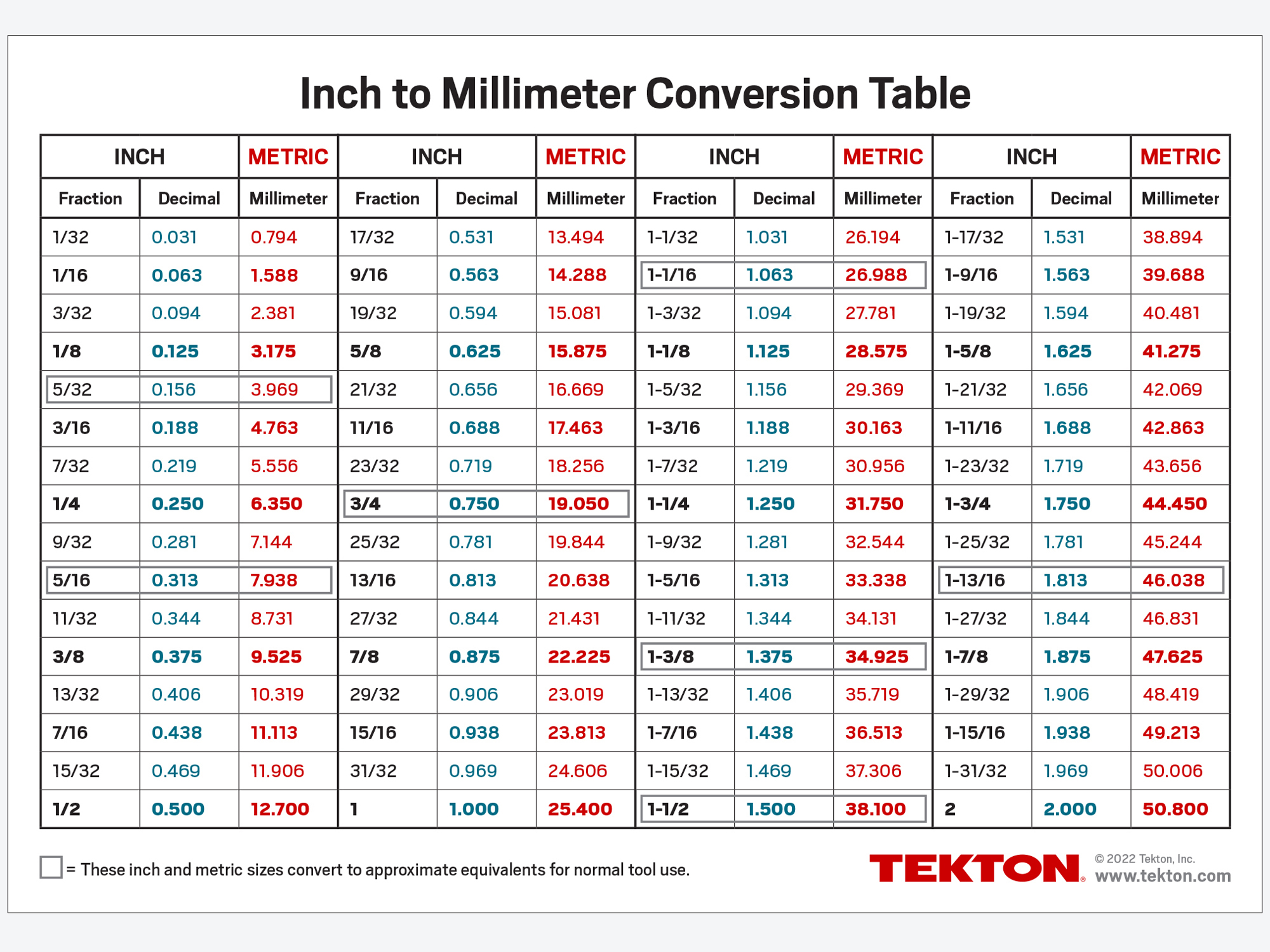
It made me think if some metric and SAE sizes are close like 7/16 inch is really 11.1mm then if the tool maker tolerance for the die used is less than the difference in the metric to sae then there literally the same tools and honestly I bet the factory uses the same die.

So I broke out my calipers and measured some and yeah there’s def a difference between 7/16 and 11mm so I think those are different dies. But 3/4 and 19mm was basically exact the same like literally. If you do the maths 3/4 inch is 19.05mm so maybe if the tolerance of the die is 0.05mm then it’s the same tool.

We got tool makers like @Astro_Pneumatic_Tools here and some real smart people so the first question is what is the tolerance of tool dies for sockets and wrenches. And as the die gets used to make tools it going to warp slightly maybe 0.01mm every 100k presses idk just made it up. So they must got specs to say when the die is worn out to be replaced. And I’m guessing the better companies like snap on would replace them at a tighter tolerance range compared to a cheaper company.

Then the final question is are any makers literally using the same die for two sizes and stamping different?
 
To avoid these ads, REGISTER NOW!
OP
M

mikey03

Well-known member
Joined
May 17, 2024
Messages
2,090
Yea that discussed what is close enough to interchange. I want to know what is literally the same tool from the factory. That if you buy the two sizes your getting the same wrench or socket from the same die with different markings.

I figure 3/4 and 19 are the same. Though honestly if I was a tool maker and selling equal same and metric I guess you still need two dies.

So now I’m thinking if I was a tool maker and if 3/4 is 19.05 do I have two dies and when the 19mm die gets a little sloppy and stretched out from use by a small amount then I shift it to run 3/4 tools since a slightly stretched out 19mm die might be stretched out 0.05mm which then make it exact 3/4 inch

could prob run 11mm dies until they get stretched out to 11.1 and now it 7/16 but maybe the stretching isn’t uniform in all ways so this don’t work.
 

Gmonkee

Well-known member
Joined
May 9, 2010
Messages
2,774
Go through your wrenches with a caliper and write down what you get between different brands. You may be surprised how some of your favorites are not the most precise.

In fact my most precise can be useless on something with slightly damaged fasteners.
I end up using a more generous tool. Six point sockets are the most forgiving at fitting everything.
 
To avoid these ads, REGISTER NOW!

bonneyman

Well-known member
Joined
Apr 22, 2010
Messages
8,789
Location
Desert SW
15mm and 19/32".

19/32" works out to 15.0813 mm. On my Bonney's I can use them interchangeably. In fact when I couldn't find any 15mm 3/8" drive sockets I grabbed several 19/32" as place holders.
 
Last edited:

Astro_Pneumatic_Tools

Well-known member
Joined
Oct 30, 2013
Messages
2,108
Location
South El Monte
There's a few questions here, I'll try to answer them all as much as I can.

Dies are mentioned a lot in the post, if we ARE talking dies yes they get reused, 100%. Any brand saying otherwise, well i'm not sure why they wouldn't. Because forging dies make a blank, for example on a combo wrench one end is like a donut shape without the hole there yet and the open end side will have jaws but they're not "open" yet.

This might get used for even more than just a 19mm and 3/4", even a 3/8" and 10mm because the rough shape and length of the wrench is fine to share among those and the toleranced sizing has not been made yet.

Next step might be cutting or punching, in this case they again can sometimes share tooling. Some tool designs require machining in this step, those you can set the program to whatever you want so no reason to share set-ups. Just load the SAE or Metric file.

The equivalent of the above happens for sockets as well. And in my experience even more often. You can buy less different types of wire coil if you share machines and set-ups (even the outside diameter of like 7/8" of a socket in Cr-V can show up in a massive coil thats fed into a cold forging machine into the socket size needed). This is why some more budget sets can have 2-3 sockets in a row with the same OD and different hex sizes, with varying wall thickness. Having machines set up for each and every socket OD and hex size is costly in material and storage space, or takes time grinding down OD to have a consistent wall thickness. This obviously matters more for impact sockets, but still something brands get wrong for a lower tooling cost or production cost and I see few people pointing out so brands continue doing it.

BUT more to OP's question, I think the part we're actually talking about here is broaching. Does broaching change per size, even among close sizes? If you're not familiar with broaching google it, but imagine increasing steps from slightly smaller to full sized in sharp high speed steel steps in a set up drenched in oil vertically pushing through the open end jaw until its pushed through and that means at final size.

Yes, we change those. Why? Because when we talk about tooling, that aint it. Tooling dies like forging dies might cost us $4,000 or $8,000 for a new wrench. Even stamping of the brand or size, or part number is called tooling. That's bespoke to us, needs to be bought because its not sitting around anywhere with our new model numbers already, and that might be $200-400 for the wrench. 60% of that if somewhere cheaper to make than Taiwan, 2-4X that for the dies we make in the USA, depends on size. Some of our large U.S. tooling dies are moved around with forklifts only and cost $90-100,000.

So broaches. Think of these like a drill bit, or a CNC cutter. Has to be replaced at the factory side as a part of doing daily business, it's factored into our cost on each unit just like buying steel is. You're only going to get lets say 2,000 wrenches before you should replace it. That could be 1 week of production. If you're replacing something weekly, there's no real economies of scale in using a 19mm one on a 3/4". On a low scale, cheaper, or careless operation might they? Sure, but just that there's little $ upside, and no real set up change time.
Fun fact, as broaching wears out the wrench opening dimension actually shrinks. If you think about broaches, as they wear down, the result is more material on the wrench. Difference is the finish goes to hell, you'll see streaks and lines in the open jaw rather than flat. You might stack 2, 4 wrenches together when doing it. So the ones at the bottom will look the most rough as the bur is formed from a dull cutter dragging that half shorn material into the next wrench.

So the answer is no, we typically don't. And what tolerance is used it outlined very clearly in ASME standards which applies to where you target and where you throw away the broach, to your point yes the tolerance range more than allows for the the difference on some SAE vs metric sizes, and we can target closer to the size written on the wrench but worth mentioning 19.00mm is not perfect, that's a wrench that would not pass standards. It has to fit onto something.
But more outfits WOULD use the same for both if it really did save you all that much coin. We do have to audit production to make sure they are not stretching replacements intervals which saves money on something we're realistically already paying for. But have to buy them either way, so 20 19mm and 20 3/4" broaches is about the same as 40 19mm from a supplier.

The caveat for this is specialty jaws unique to you and your new design. UP FRONT there could be some benefit to buying new specialty machined broaches with higher minimum orders and prices for your wrench design with less total variations so using one type for 16mm & 5/8, 19mm & 3/4". But long term, if you're really in the tool making business and making something meant to be sold for years - that should disappear.

Hope this answers your question
 
Last edited:

john.k

Well-known member
Joined
Jun 4, 2024
Messages
1,032
If the sockets are the wavy flank drive type ,they are a lot more tolerant of size difference ..........I recently bought a Force brand (Taiwan) set that are universal ,the set has all metric sizes ,no skips ,and inch from 3/8 to 11/16..........the old Metrinch sets were claimed to be both using the same sockets
 
OP
M

mikey03

Well-known member
Joined
May 17, 2024
Messages
2,090
There's a few questions here, I'll try to answer them all as much as I can.

Dies are mentioned a lot in the post, if we ARE talking dies yes they get reused, 100%. Any brand saying otherwise, well i'm not sure why they wouldn't. Because forging dies make a blank, for example on a combo wrench one end is like a donut shape without the hole there yet and the open end side will have jaws but they're not "open" yet.

This might get used for even more than just a 19mm and 3/4", even a 3/8" and 10mm because the rough shape and length of the wrench is fine to share among those and the toleranced sizing has not been made yet.

Next step might be cutting or punching, in this case they again can sometimes share tooling. Some tool designs require machining in this step, those you can set the program to whatever you want so no reason to share set-ups. Just load the SAE or Metric file.

The equivalent of the above happens for sockets as well. And in my experience even more often. You can buy less different types of wire coil if you share machines and set-ups (even the outside diameter of like 7/8" of a socket in Cr-V can show up in a massive coil thats fed into a cold forging machine into the socket size needed). This is why some more budget sets can have 2-3 sockets in a row with the same OD and different hex sizes, with varying wall thickness. Having machines set up for each and every socket OD and hex size is costly in material and storage space, or takes time grinding down OD to have a consistent wall thickness. This obviously matters more for impact sockets, but still something brands get wrong for a lower tooling cost or production cost and I see few people pointing out so brands continue doing it.

BUT more to OP's question, I think the part we're actually talking about here is broaching. Does broaching change per size, even among close sizes? If you're not familiar with broaching google it, but imagine increasing steps from slightly smaller to full sized in sharp high speed steel steps in a set up drenched in oil vertically pushing through the open end jaw until its pushed through and that means at final size.

Yes, we change those. Why? Because when we talk about tooling, that aint it. Tooling dies like forging dies might cost us $4,000 or $8,000 for a new wrench. Even stamping of the brand or size, or part number is called tooling. That's bespoke to us, needs to be bought because its not sitting around anywhere with our new model numbers already, and that might be $200-400 for the wrench. 60% of that if somewhere cheaper to make than Taiwan, 2-4X that for the dies we make in the USA, depends on size. Some of our large U.S. tooling dies are moved around with forklifts only and cost $90-100,000.

So broaches. Think of these like a drill bit, or a CNC cutter. Has to be replaced at the factory side as a part of doing daily business, it's factored into our cost on each unit just like buying steel is. You're only going to get lets say 2,000 wrenches before you should replace it. That could be 1 week of production. If you're replacing something weekly, there's no real economies of scale in using a 19mm one on a 3/4". On a low scale, cheaper, or careless operation might they? Sure, but just that there's little $ upside, and no real set up change time.
Fun fact, as broaching wears out the wrench opening dimension actually shrinks. If you think about broaches, as they wear down, the result is more material on the wrench. Difference is the finish goes to hell, you'll see streaks and lines in the open jaw rather than flat. You might stack 2, 4 wrenches together when doing it. So the ones at the bottom will look the most rough as the bur is formed from a dull cutter dragging that half shorn material into the next wrench.

So the answer is no, we typically don't. And what tolerance is used it outlined very clearly in ASME standards which applies to where you target and where you throw away the broach, to your point yes the tolerance range more than allows for the the difference on some SAE vs metric sizes, and we can target closer to the size written on the wrench but worth mentioning 19.00mm is not perfect, that's a wrench that would not pass standards. It has to fit onto something.
But more outfits WOULD use the same for both if it really did save you all that much coin. We do have to audit production to make sure they are not stretching replacements intervals which saves money on something we're realistically already paying for. But have to buy them either way, so 20 19mm and 20 3/4" broaches is about the same as 40 19mm from a supplier.

The caveat for this is specialty jaws unique to you and your new design. UP FRONT there could be some benefit to buying new specialty machined broaches with higher minimum orders and prices for your wrench design with less total variations so using one type for 16mm & 5/8, 19mm & 3/4". But long term, if you're really in the tool making business and making something meant to be sold for years - that should disappear.

Hope this answers your question
Thanks man that’s exactly what I was wondering. 👏👏👏👏👏👏
 
To avoid these ads, REGISTER NOW!
Top Bottom