To avoid these ads, REGISTER NOW!

What is the attraction of Hammer Drills

KnurledNut

Well-known member
Joined
Jan 28, 2011
Messages
8,110
Location
n/a
It was a good tool back in the day but in all honesty it's a POS compared to the SDS Max. The spline drive has a zip tie around the trigger and is used exclusively for driving ground rods.
Of course. 13-15A has a lot more going for it than a 8.5A motor.
My Thunderbolt gets used more for demo chipping than drilling.
 
To avoid these ads, REGISTER NOW!

silkman

Well-known member
Joined
Feb 23, 2021
Messages
367
Location
Athens
Hammer drills are the tool of choice when you drill through brick. You Americans would know it if your houses were made of bricks instead of cardboard. I think the problem with drilling concrete with one is there aren't any good drill bits, like the 3 or 4 cutter sds drill bits. Obviously an sds is great on concrete.

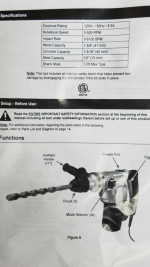
My local big chain supply store has this for $260. Why would anyone buy it, vs. a cordless or an SDS type?

1100W
40 Nm max torque
16mm in steel , 24mm in masonry, 40mm in wood
Non SDS chuck

1769636441457.png
Exactly. IMO this tool is useless in today's world, other than working exclusively on metal I cant imagine why one would prefer it to a 18V cordless,.
 

KnurledNut

Well-known member
Joined
Jan 28, 2011
Messages
8,110
Location
n/a
My local big chain supply store has this for $260. Why would anyone buy it, vs. a cordless or an SDS type?

1100W
40 Nm max torque
16mm in steel , 24mm in masonry, 40mm in wood
Non SDS chuck

1769636441457.png
I own Makita, Hilti and Milwaukee corded hammer drills. There are big differences between them and their cordless variants.
Focusing on this Bosch:
-It has a heavy duty gearbox that will last longer doing heavy duty things than most cordless versions.
-This also means different gear ratios.
No load RPM is 3,000 vs 2,100 for the latest Milwaukee cordless. Greater range of optimal speeds for metal. Better with wire wheels.
Impact rate is 51,000 BPM vs 33,000. Faster in concrete.
Maximum masonry ratings: 24mm vs. 16mm.
-Keyed heavy duty chuck. (looks like ROHM and might have carbide jaw inserts)
I have found this works better and is longer lasting when used with stuff like holesaws, self-feed and ship auger bits, mixing paddles, etc. (This Bosch has a clutch.)
-Constant sustained power. The latest batteries have incredible life and brushless motor technology allows for compensated power output as loads change, but the peak torque declines as the battery drains.
-Brushed drills have better trigger control finesse than brushless which is more stepped and can behave erratically. Do any cordless drills have a trigger lock or adjustable trigger? I dunno.
-Reparability.
3601A9C5.011.gif
 

WAS Jr

Well-known member
Joined
Nov 8, 2014
Messages
275
People work in the real world, not the magical world of dnschmidt where the right tool for the job is always at hand.

I've drilled a 1/2" hole through 14" thick concrete, using a m12 fuel drill. Did it ****? Did it take forever? Did it use a battery and a half? All yes. Was it better than the alternatives available? Also yes.

Say you're an electrician, doing service work. You need to mount one box to a concrete wall. Would you rather climb down, walk to your truck, dig ourt the sds, walk back, climb the ladder,drill three holes, climb down, walk back to the truck, walk back to the job, or just drill your three holes with the drill you already have on your belt?
I’m
 

WisJim

Well-known member
Joined
Dec 20, 2010
Messages
2,274
Location
Menomonie, WI
When I first got my Milwaukee hammer drill at least 30 years ago, it was a great improvement over using my old single speed 1/2" drill for drill holes in concrete. Then when we got Hiltis at my job, they were an improvement over the hammer drill, but not as great of improvement as the hammer drill was over the regular drill.
 

YesIHaveAHammer

Well-known member
Joined
Jun 1, 2025
Messages
802
Sds doesn't work for non-masonry drilling and is even heavier. But it really depends on use case.

Corded can last a lot longer than cordless
I own Makita, Hilti and Milwaukee corded hammer drills. There are big differences between them and their cordless variants.
Focusing on this Bosch:
Thanks for your insights.

I'm not challenging anyone here, just want to understand how other people are using things and making choices, rather than dismiss any tool as past its time while only having a narrow point of view.

From these benefits, it seems the user may:
  • Use it heavily, intensely, and often, still wants it to last for many years
  • Drills medium masonry, but doesn't have an inline SDS drill (same weight)
  • Drills and uses other attachments for metal
  • Uses high torque lower speed attachments, but 40 Nm is enough (M18 Fuel is 158 Nm)
That's quite a demanding user; heavy use and a diverse range of tasks. If they can only have one drill, it seems quite a suitable choice., but seems likely someone like that could have at least two drills nowadays. My father had this type as his only drill in the late 90s, and it seems it was a good choice given his workload and technology/money constraints of those days.
 

engineer2

Well-known member
Joined
Dec 13, 2009
Messages
11,798
Location
Chicago burbs
Every contractor I know has a corded SDS on the truck, usually Bosch. Hilti is good too. Time is money for them.
Important to sharpen up that masonry bit!

With my Makita 18V drill in hammer mode half a dozen 3/4" dia. x 4" deep in my foundation to anchor the wood platform for my plastic shed was no problem and went quickly. I also did a couple dozen 1/2" anchors for my basement walls. No problem!
 

dscheidt

Well-known member
Joined
Apr 26, 2017
Messages
2,888
I have seen fine ag lime added in small quantities for flow if being pumped, but Indiana is the “Limestone capital of the world” and its interesting they pay more for washed fluvial rock here.

None of the 4 local plants here that I have purchased from personally or help family/friends with their projects has it nor did any of the slabs or foundation my father demoed with his excavator/hammer did either.

Yes, because limestone isn't a good aggregate for the Indiana climate. Concrete with limestone aggregate is more porous than stuff made with harder rock, which means it's more subject to damage from freeze/thaw/freeze cycles, which you guys get a lot of. It’s also possible there is some impurity that makes it more unsuitable.

The limestone that is added is done at the batch plant, type IL cement can be up to 15% limestone. It’s supposed to be equivalent to normal Portland, and has approval for use in roads.
 

twistedstang

Well-known member
Joined
Jan 13, 2016
Messages
273
Location
Lexington, MI
If I'm installing Tapcons, I'll use a hammer drill. If im installing large drop-ins, ill use a SDS. No way do I want to hold a big SDS drill all damn day if im drilling 1/8" holes
 
OP
D

dnschmidt

Well-known member
Joined
Oct 3, 2014
Messages
7,270
Location
Phoenix, AZ
1) dscheidt is right I do have every tool in the world so I can't knock him for that comment. In fact I have at least five hammer drills. 1 corded Metabo, one corded Black and Decker Industrial that I bought when they first came out about 50 years ago, a cordless Makita and two cordless Milwaukee M12's. for drilling holes in concrete block or red brick. For Tapcons they work great. For drilling holes for Simpson concrete bolts (these are the absolute nuts) they ****. If it makes him feel any better I only have three SDS drills. I corded Bosch, 1 cordless Bosch, 1 cordless Milwaukee so there. Now that I've cleared up that subject on to my main point.

2) My original question was why are all the Home Depot sales only on hammer drills. When I'm drilling or taping metal, yes I tap metal using a drill, I don't want the wobble of a hammer drill. Now I know this is Garage Journal and nobody, with a few well known exceptions, actually answers the OP's original question, but that was my question.
 

Dagny

Well-known member
Joined
Jul 25, 2014
Messages
2,984
Location
Northern Wi.
Chippewa county Wi. has the best concrete rock in the world. you ain't drilling it without some hammer.
 

dscheidt

Well-known member
Joined
Apr 26, 2017
Messages
2,888
My original question was why are all the Home Depot sales only on hammer drills.
Because that’s what sells. Seriously, I haven’t seen a non hammer drill in the hands of a trades worker in ages. Yes, I agree with you about regular chucks being better for some tasks, which is why everyone still sell them.

Drill and impact driver combos are the ‘first one is free’ for cordless tool pushers. They’re the gateway into buying the stuff that’s got better margins, like batteries, and tools they don’t have to compete on price quite as hard. Mechanics buy into a system for impact wrenches or ratchets, not drills. Construction and general use buyers outnumber machinists. Those buyers want hammer drills.
 

Dakotadadv8

Well-known member
Joined
May 30, 2021
Messages
1,483
Op hammer drills works well. Great for small holes in concrete get quality concrete drill bits.
 

Sno-Pro

Active member
Joined
Sep 15, 2021
Messages
29
One bit, still have it and occasionally use it 15 years later. Slab was probably 40 years old, I did about 30-40 holes 4" deep. Each took about 30-40 seconds if I had to guess.
Picture of the bit. Have you got the video mounting the compressor?
 

willf650

Well-known member
Joined
Mar 10, 2010
Messages
797
Here you go


Not as good as the deal I got. I managed to snag this for $339 In 2024
 

Sno-Pro

Active member
Joined
Sep 15, 2021
Messages
29
I need to bolt my compressor down, so I'll try and get one this weekend
One bit, still have it and occasionally use it 15 years later. Slab was probably 40 years old, I did about 30-40 holes 4" deep. Each took about 30-40 seconds if I had to guess.

I need to bolt my compressor down, so I'll try and get one this weekend

Who the hell videos themselves mounting an air compressor?
Apparently he was going to.
 
To avoid these ads, REGISTER NOW!

LopezBart

Well-known member
Joined
Oct 13, 2023
Messages
2,534
Location
Lopez Island, WA
I bought an M18 SDS drill when I needed to drill the 48 9/16" x 8" deep holes for the 1/2" threaded rods that hold the trusses down in our shop. I've since used it to drill a variety of other holes for anchors in concrete - I used Red Heads to provide additional anchoring for the sill plates; those were a bunch of 1/2" x 5". As an experiment, I drilled a 6" x 9/16" hole in a granite rock.. might need to suspend a big rock on some 1/16" stainless leader just for fun...

I've used my corded Bosch and M18 hammer drills in the past for drilling concrete. The SDS is far faster, and the bits are better.
 

lbhsbz

Well-known member
Joined
Jan 13, 2010
Messages
1,173
Location
Long Beach CA
Apparently he was going to.
I took a short video, but can't upload it. I don't have a host.

Cliffs notes, got about 1" deep in 10 seconds or so, then musta hit a piece of rebar or something because the carbide tip is gone now lol.
 

Dakotadadv8

Well-known member
Joined
May 30, 2021
Messages
1,483
Corded Dewalt drill no hammer feature with Bosch concrete drill bit 6 inch depth 5/8 inch holes. Drilled 3 holes like butter. Sds drill may be better.
 

mikey03

Well-known member
Joined
May 17, 2024
Messages
2,085
I've drilled a 1/2" hole through 14" thick concrete, using a m12 fuel drill. Did it ****? Did it take forever? Did it use a battery and a half? All yes. Was it better than the alternatives available? Also yes.
one of the alternatives wasn’t driving home to get your SDS rotorary hammer or realizing you need to buy one and going to Home Depot? 🤣🤣😎
 

Tactile

Well-known member
Joined
Sep 2, 2020
Messages
237
Location
Melbourne, AU
There was a time, with Bosch gear anyway, where you could buy a cordless drill without the rotary hammer function and those tools were lighter and shorter. Now every cordless drill they make (even in the 12V range :rolleyes:) is a combi drill! I got a Bosch cordless SDS for this reason, let it do the hard, dusty work drilling concrete and demolishing masonry, tiles etc and keep the drilling tool out of all this ****.

Bosch make small hammer with a chuck that can take normal bits as well as SDS to if that's an issue for anyone. I'm sure the other brands probably have the same thing.
 

mikey03

Well-known member
Joined
May 17, 2024
Messages
2,085
I seent Milwaukee makes a m12 fuel drill that isn’t a hammer and I was thinking of buying one since I don’t need my m12 to have a hammer function but idk I forget if it was really much smaller or lighter and honestly I’m worried maybe the not hammer model uses a cheaper internals.
 

Ultradog MN

Well-known member
Joined
Jan 20, 2024
Messages
752
Location
Twin Cities
Lot of guys here who bought a cheap battery powered hammer drill and think that makes them a pro when it comes to drilling holes in concrete.
I say God bless them for at least trying.
On another note...
Do people still use tapcons?
I gave up on those aggravating things long ago.
 

Attachments

  • 51320263643.jpg
    51320263643.jpg
    666.5 KB · Views: 10

signcrafter

Well-known member
Joined
May 9, 2012
Messages
12,338
I don't understand why everyone is arguing over this. It's pretty simple in my opinion, a hammer drill is capable of drilling holes up to a certain size in masonry. It will make the hole, depending on hardness of concrete it may take some time. For the average homeowner DIYer that drills a few smaller holes every now and then they are fine. But SDS is a whole different level of drilling capability when it comes to making holes in concrete. If you are drilling bigger size holes or a bunch of holes and SDS will make your life much easier.

I have 3 m12 impact/drill kits and one m18 impact/drill kit that all came with hammer drill function on the drill. I've probably used it a couple times to make holes in concrete when I didn't have an SDS. But I also have the m12 sds that I use all the time for tapcons, and then a few bigger SDS plus and SDS max drills that are mostly corded. They just drill better and quicker and are more enjoyable to use. Have many bits in bunch of sizes and even core bits up to about 3", have a core drill for bigger holes or if I need to drill a bunch of bigger holes. Core drill works better then SDS, just like SDS works better then a hammer drill.

Back in the late 90s when I was younger I bought a dewalt 18V drill that had hammer drill function, not sure if it was the first cordless with hammer or not but I know not many had one back then. Other guys would ask to use it instead of dragging a cord out for a few holes because the other option was a corded milwaukee hammer drill. I used it for all my concrete drilling needs back then because that's what I had. But eventually I bought an SDS because I needed it for chipping concrete and then found out how much better sds drilled so switched to them.

The SDS drills work good for removing tile and thinset and breaking up concrete and stuff like that. But again if you have a bunch to do then a dedicated breaker works better then an SDS, just like an SDS works better then a hammer drill.

In the end it all comes down to your personal situation. Nothing wrong with a hammer drill if you only doing a few smaller holes here and there. Not everyone needs an SDS. But don't think there any argument that an SDS does drill holes better then a hammer drill. There really is no question there, the only question is if it's worth it to you to have one. It's sort of like a lift, I don't have one and do a ton of work with jacks and jack stands on the ground, but there is no question a lift is a much nicer tool to raise a vehicle. Not everyone needs a lift and a jack and stands will get almost all repairs done. But it sure would be nice to have one. I just don't get all the back and forth about you do or don't need an sds, it just depends on your individual situation and everyone's situation is different.
 

signcrafter

Well-known member
Joined
May 9, 2012
Messages
12,338
Lot of guys here who bought a cheap battery powered hammer drill and think that makes them a pro when it comes to drilling holes in concrete.
I say God bless them for at least trying.
On another note...
Do people still use tapcons?
I gave up on those aggravating things long ago.
What do you find aggravating about tapcons? I've been using them for probably 25 years and have used thousands of them. They aren't always the best anchor to use in every situation but for a lot of things they work great and are fast and easy.
 

driftpin

Well-known member
Joined
Dec 22, 2016
Messages
11,226
Location
Miami-Dade/Broward Co. Florida
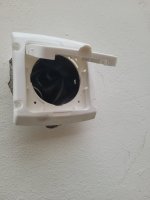
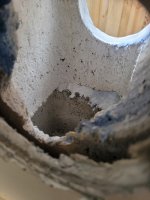
I used my HFT SDS-MAX to drill a 4" hole for a dryer vent. I bought a 4" diamond bit from https://www.diamondtoolstore.com/collections/concrete-core-drill-bits
and was able to make a neat, smooth 4" dryer vent hole in 65 year-old CBS. I used a borescope to look behind the plaster interior wall, and I assumed that I was at a point on the wall where I'd be drilling into the cell and not the web. That happened. I still have to put some grout into the hole where it has the cell in the block I hit, aligning w/a lower course block. I want to close-off the lower open cell w/some grout. I'll put some rubble into the lower open cell, and then throw in some grout. I may use some hard-set expanding foam for wide gaps, and layer-in a couple squirts to close-off the rubble, and then add the grout.

Some pics. The dry-cut coring bit went through the CBS/CMU easily. It said in the coring bit, "Do-not use for impact tools," but I did use that setting (impact drill) on my SDS-MAX and it worked OK. I only needed the one hole, and I considered it a cost of doing the job, if the coring bit gave its all on this one hole. It was cutting well at the end of the hole as it did to begin. I think it still has cutting ability, though I don't know anything I'd be using it on after this.

The coring bit came w/a threaded (for the coring bit base) SDS-MAX adapter and a pilot carbide drill bit, for < $100, shipped from Orange Co. CA and it arrived in 2 days to Miami FL.

My SDS-MAX demo hammer/impact drill from Harbor Freight paid for itself on its first job. It's 8.5 amps. Still going strong. I check the grease vault before each use, and fill it as needed. It was < $90 on sale. This is not the current model.

20260604_160415.jpg
1781444442789.png
20260604_160300.jpg

The hole to the exterior, and the lower CMU cell which I will fill w/some rubble, and maybe a high-expansion foam, and then some grout.
20260604_160355.jpg

Some caulking inside yet to do.
1781403924394.jpeg

The louvred exhaust vent fits snugly to the exterior stucco on CMU wall after a bit of trimming w/a side-grinder and a 4" masonry grinding disc. A neat feature is that the vent panel swings open 90* so you can use a 1-1/2" or a 2" shop vac hose to easily clean the exhaust ducting.
20260604_170823.jpg20260604_170837.jpg
 
Last edited:

Ultradog MN

Well-known member
Joined
Jan 20, 2024
Messages
752
Location
Twin Cities
What Tapcon alternative do you like @Ultradog MN ?
Always interested in a better fastener
I tapcons are rather expensive and I have frequently busted phillips bits installing them.
I use a tapcon drill bit but not the blue screw.
Drill the hole then stick a piece wire into it. Drive a nail along side the the wire.
I normally use one strand of romex 12 g copper wire and a 16 penny galvanized nail to fasten a bottom plate to the floor for a wall in a basement or garage or for firring strips on a basement wall. Roofing nails or those short joist hanger nails work great for attaching elec boxes and conduit to a concrete block wall. Sometimes use the wire bare - other times leave the insulation on the strand. Depends on brick or block or poured A 16 penny galvanized nail will pull the nail head through the wood before it pulls the nail out of the concrete.
It's faster and cheaper.
 

KnurledNut

Well-known member
Joined
Jan 28, 2011
Messages
8,110
Location
n/a
I tapcons are rather expensive and I have frequently busted phillips bits installing them.
I use a tapcon drill bit but not the blue screw.
Drill the hole then stick a piece wire into it. Drive a nail along side the the wire.
I normally use one strand of romex 12 g copper wire and a 16 penny galvanized nail to fasten a bottom plate to the floor for a wall in a basement or garage or for firring strips on a basement wall. Roofing nails or those short joist hanger nails work great for attaching elec boxes and conduit to a concrete block wall. Sometimes use the wire bare - other times leave the insulation on the strand. Depends on brick or block or poured A 16 penny galvanized nail will pull the nail head through the wood before it pulls the nail out of the concrete.
It's faster and cheaper.
While I have no problem with the hex head Tapcons, I have a high disdain for the phillips and torx head versions and generally avoid them. I learned the hard way not to use them on high volume concrete forms. I’ve had them break and blowout.
When I was building new homes I would occasionally drive two 16d coated sinkers together in a 1/4 hole. This wasnt a general practice but more of a remedy to a problem, like a messed up 3/16 Tapper hole that hit rebar, etc. It held surprisingly well. I’ve used my fair share of tapered square hardened cut nails too.
For interior treated bottom plates on slabs, our primary method of attachment was nailing washer pins with a powder actuated gun. This connection was the most permanent and reliable for strength. To meet OSHA/MSHA safety regulations, I had to take training and get licensed to operate them secularly, which is still an active certification today.
Exterior sill plates that didn’t have pre-cast J-bolts got Powers Wedgebolt screw anchors. Several years ago, Tapcon started making those too which I have used and work well.
 

JohnX14

Well-known member
Joined
Jun 2, 2014
Messages
553
Location
Boston 'burbs
I tapcons are rather expensive and I have frequently busted phillips bits installing them.
I use a tapcon drill bit but not the blue screw.
Drill the hole then stick a piece wire into it. Drive a nail along side the the wire.
I normally use one strand of romex 12 g copper wire and a 16 penny galvanized nail to fasten a bottom plate to the floor for a wall in a basement or garage or for firring strips on a basement wall. Roofing nails or those short joist hanger nails work great for attaching elec boxes and conduit to a concrete block wall. Sometimes use the wire bare - other times leave the insulation on the strand. Depends on brick or block or poured A 16 penny galvanized nail will pull the nail head through the wood before it pulls the nail out of the concrete.
It's faster and cheaper.
I know a lot of people who use this method, and I hear it works great. I've never used it

I only use the tapcons with a hex head. I never had any luck with the phillips head. (Granted some installs will need flush type of phillips head, and in that case I'd use them.)
 
To avoid these ads, REGISTER NOW!
Top Bottom