To avoid these ads, REGISTER NOW!

Soldering wire to circuit board... 1st time. Advice welcomed.

67carl

Well-known member
Joined
Dec 10, 2013
Messages
3,893
Location
California
I had had an oops moment that resulted in me pulling 2 wires off a circuit board. I found where they need to be soldered back on, but I've never soldered to a circuit board. I don't want to assume, but I imagine it is straightforward and the same as soldering wires together;

  • clean the wire and the board
  • heat soldering iron
  • tin both the wire and the spot on the board
  • clean the soldering iron tip with sponge
  • hold the wire to the spot, apply soldering iron to the wire and board
Some confirmation or correction would be appreciated.

IMG_1829.jpegIMG_1826.jpegWiringSolder.png
 
To avoid these ads, REGISTER NOW!
OP
6

67carl

Well-known member
Joined
Dec 10, 2013
Messages
3,893
Location
California
Those wires are through hole.

You need to get the broken bit of wire and the solder out of the existing hole to start. Then you can strip the wire and re-solder.

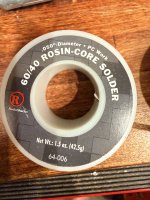
What solder do you have?


Solder doesn't go bad with age, does it :D?

Use the soldering iron to remove the solder from the hole... thanks. Didn't know it was through hole. Glad I posted here. Any techniques for a through hole?

IMG_1949.jpeg
 

PCustoms

Well-known member
Joined
Jul 23, 2011
Messages
22,598
Location
VT
Solder doesn't go bad with age, does it :D?

Technically it does...

IIRC it's the flux that goes bad, but to be honest I forget as we have to toss it when it hits the date. That said I have some very old RadioShack rolls myself that get used on general things

Use the soldering iron to remove the solder from the hole... thanks. Didn't know it was through hole. Glad I posted here. Any techniques for a through hole?

IMG_1949.jpeg

You'll be soldering from the bottom of the board where the wire pokes through. The objective is to have the solder wick into the hole. If the solder wicks too far (up into the wire) you can eventually get a broken wire like you're seeing now.

If you overheat everything the board may blister or you might melt the wire insulation.
 
Last edited:

kngelv

Well-known member
Joined
May 25, 2011
Messages
2,225
Location
Detroit, MI
You have already received some good advice. I would do it in this order:

1. Remove old solder and wire remnant by using a solder sucker or wick
2. Strip and tin each wire with enough bare to get through the hole and a little extra.
3. Tin the hole.
4. Make sure tinned wire fits through hole.
5. Use flux paste even though you have flux in your solder.
6. Put wire in hole and try and keep the soldering iron on the tip of the wire below the board.
7. Let the solder flow from the top of the board down.
8. Let cool and snip off excess wire.

Good luck.

James
 
OP
6

67carl

Well-known member
Joined
Dec 10, 2013
Messages
3,893
Location
California
Awesome responses with advice and questions.

Some notes I gathered -

Solder
  • What I found for the solder I have - Set the temperature-controlled iron to 650°F. This range provides the perfect amount of heat to melt 60/40 rosin-core solder quickly without lifting the metal pad off the circuit board.
  • Through Hole - Instead of laying the wire on a pad, push the stripped end of your wire through the hole in the circuit board. If the wire is thin, bend the tip slightly to the side (a tiny "J-hook") so it mechanically clips into the board and doesn't fall out while you are
Flux
  • Coat the wire: Strip your wire, then dip the bare copper directly into the flux paste or brush a tiny amount onto it
  • Coat the board pad: Dab a very small speck of flux onto the circuit board pad where you want to solder.
  • Tin the components: Touch the iron tip and 60/40 solder to the wire, then to the pad. The flux will smoke, cleaning away invisible oxidation instantly.
  • Join the wire: Put the tinned wire on the tinned pad, add a tiny bit more flux if it looks dry, and touch the iron to both for 1–2 seconds to fuse them.

This is the soldering station I have.

1781454547817.png
 
To avoid these ads, REGISTER NOW!

larry4406

Well-known member
Joined
Jan 27, 2006
Messages
19,148
Location
Northern Virginia
I’m no export.

When I replaced failed capacitors on a circuit board, I snipped the leads first (you don’t need to do this your wire is broken)

Then I used a desoldering iron with a bulb. Briefly touched the board and as soon as the solder liquified, sucked it out with the stub (your wire).

Follow others lead/advice for the stranded wire from here on.

In my case I placed the capacitor, fluxed its lead and then soldered.

High magnification lighting helped greatly.
 

Spikes

Well-known member
Joined
Mar 19, 2021
Messages
161
Location
Arkansas
These sort of threads always seem to devolve into a pi$$ing match after a few replies. Once you've got the broken bits of wire out of the holes and tinned the wires, it'll solder up like a dream.
I love seeing Radio Shack stuff, nostalgic, I guess. I have a collection of Radio Shack thru-hole components and cringe every time I have to use one.
I also have some IBM solder from the 1980s. My Father-in-Law was a repair tech back in the day. His workdays involved a suit, tie, oscilloscope and soldering iron.
 

Chuckster in NJ

Well-known member
Joined
Jan 26, 2010
Messages
2,287
Location
Hunterdon County NJ
This is the soldering station I have.

1781454547817.png
👍👍 You will have no issues with this station.……… Most problems occur when you use a "no frills" 120 volt iron and when you start working on a board, the "plug in" irons tip MAY "energize" components doing damage. The cheap plug in irons have their place but NOT when working on delicate electronic circuit boards.

BTW! Next step is to buy a de-soldering station. :beer:
 

kngelv

Well-known member
Joined
May 25, 2011
Messages
2,225
Location
Detroit, MI
The big problem most people have is putting solder directly on the iron. They just end up wwith a giant puddle. That's why I suggested the OP put the iron on the bottom of the wire and feed the solder from the top.

James
 

Innovate1

Well-known member
Joined
Jul 28, 2014
Messages
4,287
Location
Illinois near St. Louis, Missouri
Sounds like you have it pretty well covered. A temp controlled station is needed to work on circuit boards and as you have read too much heat will burn the board and may lift the copper from the board. I would strip back the wire until I saw bright copper strands and then "tin" the wire with solder trying to keep the solder from wicking in farther than needed. If the copper is tarnished the solder won't stick. Keep the solder to a minimum so the wire will still go in the hole. Then clean out the hole in the board. A desoldering bulb or solder sucker will work but with short leads I find just poking them out with a dental pick or quickly grabbing them with tweezers when hot works just as well or better. A little solder on the tip will help with heat transfer but it looks like you have soldered electronics before so probably know that. I wouldn't bother with trying to bend the wire tip to keep it in the board - if you can hold the lead to the side it may stick in the hole.
 

Stuart in MN

Well-known member
Joined
Sep 8, 2005
Messages
23,069
Location
Minneapolis
In the absence of a solder sucker or solder wick, I've sometimes been able to clear solder from a through hole by heating it with the iron, then just as the solder melts blow on it. If you have compressed air and a blow gun, even better.

(Yes. I know this is a bush way of doing things but sometimes you have to improvise. 🙂. )
 

Tactile

Well-known member
Joined
Sep 2, 2020
Messages
237
Location
Melbourne, AU
And of course keep the sponge damp. That's all I would add.
I'm surprised that station has both a sponge and the brass wool cleaner. Wet sponges are a bit of a no-no with modern plated tips. The wet sponge shocks the hot tip and causes micro cracks in the plating. When the flux gets under the plating the tip is done for quickly.
 

Chuckster in NJ

Well-known member
Joined
Jan 26, 2010
Messages
2,287
Location
Hunterdon County NJ
In the absence of a solder sucker or solder wick, I've sometimes been able to clear solder from a through hole by heating it with the iron, then just as the solder melts blow on it. If you have compressed air and a blow gun, even better.

(Yes. I know this is a bush way of doing things but sometimes you have to improvise. 🙂
Chuck Norris would just take a straw and **** it up then spit it out. :rocker:
IMG_3750.jpeg
 
To avoid these ads, REGISTER NOW!
Top Bottom