Coming down off my rant, I will focus on last night's work on our coach.
Our Monaco Dynasty was optioned with the HWH air leveling system vs. hydraulic leveling jacks. Air leveling was on my "must have" list for this coach when we were looking to upgrade from our previous coach, a 1991 38' Beaver Contessa, that had air ride, but hydraulic leveling jacks. I seem to have some strong opinions on when coaches should have air leveling vs. the cheaper hydraulic leveling option, but let me just say I was able to find a coach that checked all the boxes on the "must have" list and nearly all on the "like to have" list.
I will give a quick preface on the how the system is designed to operate. The air springs under the coach support the weight of the rig and when in "travel" mode, the coach's air system provides the needed air to support the weight at each corner by going through ride height valves. These ride height valves do just that, they keep the coach at a certain ride height and as the coach goes through turns it will shed air from the high side and add to the low side to keep the coach as level as possible for ride comfort in these heavy rigs.
Now when you arrive at a campsite, or just stop for lunch, and want to level the coach after shutting it down, this is where the HWH system comes into play. There is also one made my Lippert that came along a few years later in the Monaco line, but I much prefer the HWH version.
The touchpad at the driver's seat is activated by selecting one of two modes, manual or automatic. In manual mode the system will show a low corner or side in yellow and you simply depress the "DOWN" button on the opposing side or end and air will be exhausted to bring the high side or end down. If the coach settles to the lowest point, then you would use the UP arrow on the low corner or end to add air to the corresponding air springs until all yellow lights are extinguished indicating the coach is level. In either manual or automatic mode, the system is designed to ignore the ride height valves and use the level placed usually somewhere in the middle of the coach, ours is in the middle bay, just above the ceiling lining and is relatively easy to access. I had to "tweak" the sensor a bit when we first purchased the coach because what the system saw as level was not quite level, but an easy adjustment.
In automatic mode it does much the same thing, but, you guessed it, automatically. The system will ignore the ride height valves and look at the high points and exhaust air until the high side or end comes down to match the other(s). It will continue to exhaust until the air springs are resting on their internal bumpstops and after a few seconds of no movement when exhausting, it will determine the coach is at its lowest point at that corner or end and then shift over to add air to the low corner or end. At first it will use the air in the coach's air tanks but when that pressure drops to approx. 60-65 PSI where the PPV (Pressure Protection Valves) won't allow any more air to be drawn from the coach's air reserve, then there is a little auxiliary air compressor that will come online to provide the air pressure to the low side or end air spring and it does this through the HWH air manifold which is often referred to as the six-pack manifold. There are six air solenoids in an aluminum manifold that control the flow of air to each axles. My coach has three of these six-pack manifolds, one for the steer axle, one for the drive axle and one for the tag axle. The HWH system directs air from this auxiliary air compressor to the corresponding valve to the corresponding air spring.
The system sounds complex and although it kind of is, it is also very simplistic if you break it down. The problem is, most people don't understand the sequence of operation nor how important it is that air lines go EXACTLY where they are designed to go and nowhere else. All too often I see online of people, or get phone calls from friends that have had their coaches into shops for work on their air system and now all of a sudden their air leveling is not functioning properly. It almost always comes down to an air line reconnected incorrectly.
If you've stayed with this far congratulations, although you're probably uninterested in the operation.

Last August during our annual weeklong stay in Ouray, CO I noticed around day 5 that the front left corner of the coach had slightly dropped out of level. While my air suspension system is tight, I don't know of any rig that is 100% sealed from at least some air loss over time. Our coach will easily sit dead nuts level for about 4 days, but then over the next couple of days it will drop maybe about 3/8" at some point and need to be releveled, so on a 4 or 5+ day stay in one place the system needs to relevel. By this time the air in the coach's tanks has dropped to the point where no additional air can be moved from the tank(s) to the leveling system so it relies on the auxiliary air compressor to raise a low side or end. I noticed that the air compressor was running but not providing air to bring that corner up to level. I had to start the coach, build up air pressure and relevel the coach in which is remained level the remainder of the weeks stay.
This got my attention because many of the places we stay we will hop, skip and jump from campground to campground every few days and I don't usually get to the point where the system needs to relevel. We haven't been anywhere since where it needs to relevel, but since the coach was up on jackstands I wanted to check it out and see if my assumption was correct about what was failing or had failed.
Now let me cover the operation of the releveling system. In automatic mode the HWH system will wake up every 30-minutes, check the level based on the system's "black box" and if an adjustment is needed it will make the adjustment, if no adjustment is needed it merely goes back to sleep for another 30-minutes. This goes on the whole time the system is in the automatic mode. Knowing how tight my system is, many times I will just turn it off and kick it back on every few days to let the system confirm the level or adjust, but many people leave the system on automatic all the time. That is what it is designed for so no harm in doing so but many people's system is not as tight so their system may need to adjust the level once or twice a day.
Here is where the complexity of the system tricks many people up, but if you break it down it is actually quite a simple system. The auxiliary air compressor has an air line feeding the air leveling manifolds with the six-pack valves as well as a check valve to allow air pressure one way from the auxiliary air compressor, but not allow air pressure to flow out of the air leveling system back to the compressor.
It also has an electrical connector with two wires, one is a constant 12VDC through a 15-amp fuse. This goes to the supply side of the load side of the relay. It also has a switched 12VDC coming from the HWH controller. When this switched positive receives a signal from the HWH controller in either the manual or automatic mode, it will go through a normally closed (NC) pressure switch that is designed to open @ approx. 115 PSI to avoid over-pressuring the system, and then to the switched control side of the relay. Hope you're with me so far because this is where two things happen simultaneously but tricks people up.
When the solenoid engages there are two leads on the load side of the relay, one lead goes to the air compressor's motor (which is grounded through the chassis) and the other lead goes to a normally open (NO) air solenoid located at the bottom of the water separator/filter bowl. The sequence of operation is when the solenoid engages, the air compressor runs as well as the NO air solenoid located at the bottom the bowl will close. This air solenoid closing allows pressure to build in the system, push the check valve open and supply air to the six-pack air manifolds so it can distribute the needed air to the correct side or end of the coach. IF that air solenoid fails to close the small volume of air will merely dump out through the air solenoid and it will not allow pressure to be built. Then when the system reaches level OR the pressure switch is opened, it opens the control side of the circuit which opens the load side of the relay shutting off the air compressor's motor as well as removes power from the air solenoid allowing it to go back to its normally open status thus expelling any head pressure and moisture from the system so it is ready to start again upon the next cycle. Again, complex, but actually quite simplistic if you break it down component by component. I think what trips most people up as they look at the whole pie rather than piece by piece to see where there system is breaking down in the sequence of operation. Hope you are still with me.
My assumption when testing was that something was amiss with the air solenoid because I did not sense that it was not getting air to the six-pack manifolds when activated so that was where I wanted to begin my diagnosis.
I tested it under the coach, but without my wife to push the button on the dash in manual mode, I just used my Power Probe to provide power to the control side of the relay and test the system as a whole. Sure enough I was getting air coming out of the normally open air solenoid which should have been closed upon providing 12VDC.
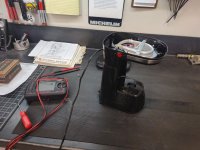
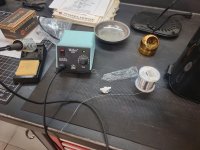
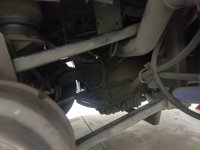
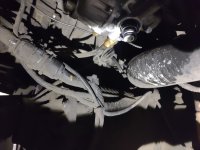
Rather than try to tear it apart or go any further under the coach, I simply disconnected the air line as well as the two wires and removed the whole assembly from the coach and brought it to the bench.
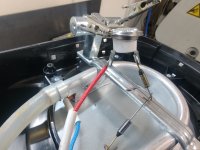
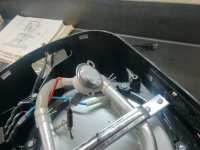
I have a Viair compressor on mine at this point, but it was originally outfitted with a Thomas air compressor from the factory. When we purchased the coach back in early 2007 the Thomas air compressor had failed and it was 4X the cost of a Viair so I sourced a Viair with similar cfm output and power requirements. I then fabricated a small cover to enclose the system as it resides just over the steer axle right out in the elements, which is probably why the first air compressor failed in only 5 years. This one has been in service for 19 years now and only started to have issues late last summer, so the enclosure must have aided in its survival. Some people state that the Thomas air compressor is a little quieter than the Viair, but the Viair is a popular choice on the Monaco forums. Some models have the compressor located in the engine bay which is right under the bedroom so in those cases maybe replacing with the Thomas would be a worthwhile cost, but ours is way up front and undetectable from the bedroom if the system is in automatic mode. Maybe it is aided in lower decibals by the cover, but it cannot be heard from the bedroom.
If you're still with me, wow, you've stayed through my overview.


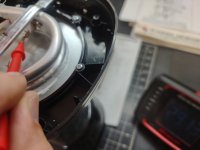
I connected the air solenoid alone to battery voltage just to see if I could hear anything and I could hear a faint audible click, but by applying air to the solenoid it never went to the closed state. I am sure I could find a replacement, but first I wanted to see if I could disassemble and save this one.

I didn't have a small enough spanner wrench for the small 1/8" holes in the solenoid's body, so I improvised by using two punches and a prybar to unthread the base from the stem.

Yeah, that can be problematic.

After some time running wire brushes and chasing with air through the various parts of the valve, I was able to clean it up enough to easily move back and forth inside the stem.

Time to thread it back together and give it a test. Sure enough air passes through until powered on, which closes the valve, and stops the air flow.
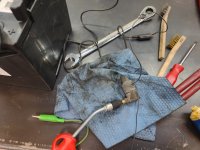
Now to reassemble the unit as a whole but I noticed a couple of O-rings that I wanted to replace.

This one goes on the bottom of the bowl and where the air solenoid threads into.

I assembled everything back to original as well as removed the check valve to ensure it was functioning correctly as well. Then tested the unit as an assembly to ensure it will work properly when installed back in the coach.

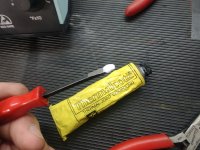
With everything functioning perfectly, I coated the electrical connections with some NOCO battery gel and cleaned up my tools and mess. It is now ready to reinstall.

If you followed along, thank you and I hope that I explained it well enough to follow along and understand the system's operation.
Thank you for following along.