So, here we go.
Do you remember the February 2020 stock market crash that occurred during the first year of COVID?
Many believe it was the result of financial markets responding to the outbreak of COVID.
There are a lot of analysts that forecast
price using mathematical approaches that are frequently observed in financial markets. One of these approaches is using Fibonacci ratios based upon Fibonacci numbers.
I’ll leave you to ask ChatGPT what Fibonacci numbers and ratios are and how they are found in nature and many other fields. Very few analysts forecast
time using any approach. If they do, they often rely upon time cycles repeating, using numbers that again are observed in financial markets (e.g. 30, 60, 90, 120, 150, 180, 240, 270 & 360 days, months & years). Some of these numbers, like the series just stated relate to the degrees in a circle, others, for example 144 do not.
There have also been financial timetables produced in the 1800s/1900s. For example, by
Louise McWhirter which puts forward the idea that stock markets observe an 18-19 year cycle. Some believe that Louise McWhirter was in fact the legendary trader
William Dilbert Gann.
Samuel Benner also produced another timetable in 1872.
In 2019 there was talk amongst market forecasters that there would be a significant crash in financial markets. Their best estimate of timing was late 2019, probably September/October which are historically bearish months in stock markets.
Now, I warned my sister to shift her superannuation funds into cash based upon this forecast. She didn’t do this. As September/October passed I kept warning her, saying timing is often imprecise, so do it no later than 31 December.
At around that time I thought, could I forecast the expected date of the crash? Based upon my knowledge of the 18.6-year real estate cycle I knew the expected crash was not the end of cycle (real estate and stock market) crash. It was going to be what is referred to as the mid cycle slow down in the real estate cycle which also manifests itself in stock markets in countries where a real estate cycle exists.
So, I thought could I somehow use a time count of 18.6 years and Fibonacci numbers to predict the timing of the crash. The logic I applied was that if the peak-to-peak spans 18.6 years, then bottom-to-bottom spans 18.6 years and the mid cycle slow down to the next mid cycle slow down spans 18.6 years.
Nominal peaks and bottoms in stock markets are easy to identify; they are the lowest lows and the highest highs. Based upon what I know now,
real bottoms in stock markets often occur at higher lows and
real highs often occur at lower highs but this is a discussion for another day.
I needed to identify when the last mid cycle stock market correction started in the
S&P / ASX 200. That is a discussion in itself, but I settled on 1 July 2001. I then counted forward 18.6 years or 6798 days which produced a date of 11 February 2020.
I then identified the closest Fibonacci number to 6798 which is 6765 and counted forward 6765 days which produced a date of 9 January 2020.
Now keep in mind I may have been making this forecast in late 2019 but it is really a forecast relying upon picking a date in 2001 and working from there. So, it could be viewed as an almost two-decade forecast. Forecasts always involve a margin of error, so I thought to myself, that January to February 2020 would be an ideal window to be on high alert.
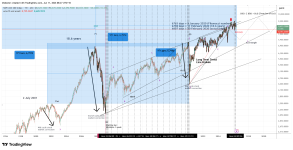
The nominal peak of the ASX 200 occurred on 20 February 2020 (see chart attached). The ASX 200 then fell about 39%.
As for my sister she moved her superannuation in December 2019. She told her ex-husband to do the same and he did too.
Over the following years I have gone on to make many more forecasts, at various time scales. Some are reasonably accurate and some are simply not. That is the nature of forecasting.
Sometimes, there will be more than one choice because the time count is dependent upon selecting the correct starting point.
Hope you enjoyed.