To avoid these ads, REGISTER NOW!

Welding mild steel to hard mystery plate

rslaback

Well-known member
Joined
Jul 24, 2010
Messages
4,078
Location
Westcentral Wisconsin
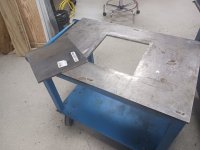
I've got a work project that involves welding some strips of A36 to a piece of hardish something on a large metal cart.

The cart was originally used to move around injecting molding tools. The top of the cart is a piece of 1/2" thick plate. I know the top is hard because when someone welded to it once before the welds cracked off easily when hit with a hammer. It also didn't like being cut by my carbide cold saw. But I also know it isn't the hardest steel in the world because it does have scratches on it and the plate is welded to mild steel legs (MIG from what I can tell).

I know my best shot is a preheat to around 800 and then a long cool down with torch reheats but I'm open to other tips as well.

I'm also stuck with MIG because of equipment on hand.
 
To avoid these ads, REGISTER NOW!

larry4406

Well-known member
Joined
Jan 27, 2006
Messages
19,264
Location
Northern Virginia
I can’t offer welding help, but can the attachment be redesigned to a drill, tap, and bolted connection?

If hardened probably a PIA to drill and tap as well.
 

PCustoms

Well-known member
Joined
Jul 23, 2011
Messages
22,892
Location
VT
I've got a work project that involves welding some strips of A36 to a piece of hardish something on a large metal cart.

The cart was originally used to move around injecting molding tools. The top of the cart is a piece of 1/2" thick plate. I know the top is hard because when someone welded to it once before the welds cracked off easily when hit with a hammer. It also didn't like being cut by my carbide cold saw. But I also know it isn't the hardest steel in the world because it does have scratches on it and the plate is welded to mild steel legs (MIG from what I can tell).

I know my best shot is a preheat to around 800 and then a long cool down with torch reheats but I'm open to other tips as well.

I'm also stuck with MIG because of equipment on hand.

Is this a "must do" or just trying to modify an already modified dodad?

It's probably a chunk of tool steel, not sure what the process is for welding on it but I'm not sure I'd repurpose a stripper plate into a die cart...
 
OP
R

rslaback

Well-known member
Joined
Jul 24, 2010
Messages
4,078
Location
Westcentral Wisconsin
Is this a "must do" or just trying to modify an already modified dodad?

It's probably a chunk of tool steel, not sure what the process is for welding on it but I'm not sure I'd repurpose a stripper plate into a die cart...
It's kind of a salvage job. We needed to move a tool with a hydraulic cylinder mounted to the bottom so the cart got a hole torched in it. I'm trying to turn that mess into a more usable cart with a removable plate to allow both uses. The strips to hold the plate in place are what I'm hoping to weld.
 

whateg01

Well-known member
Joined
Mar 13, 2006
Messages
11,340
Location
doo dah, kansas, usa
I might try to find a piece of 11 ga bigger than the top and either fold the edges down or attach strips of angle or bar to the bottom to keep it from sliding off. Seems less hassle.
 

RoninB4

Well-known member
Joined
Jul 22, 2020
Messages
3,562
Location
Under My House
-I'm not a welder but there doesn't look like much depth of penetration on the weld from your co-worker. I would contend that this isn't what I'd call "tool steel" as it's too large for the expense of real tool steel. As for it being from a stripper plate...kinda large for that and stripper plates are usually just 4140 PH unless there's a special reason to use tool steel inserts. These are opinions based upon machine shop and die making experience. I'll leave more informed opinions for an actual welder to chime in.
 

RoninB4

Well-known member
Joined
Jul 22, 2020
Messages
3,562
Location
Under My House
Would abrasion resistant steel tell the carbide blade in my cold saw to **** off?
-With a heat treated hardness of 500 BHN (50 Rc) for AR steel I wouldn't think carbide would have trouble cutting it unless your blade is dull.
It did cut it but it did a number on the blade.
-Were you cutting near a welded section? Welding can create crystallization in the metal that could cause trouble.
 

Steve from Socal

Well-known member
Joined
Jan 27, 2009
Messages
3,498
Location
Hutchinson Ks.
-With a heat treated hardness of 500 BHN (50 Rc) for AR steel I wouldn't think carbide would have trouble cutting it unless your blade is dull.

-Were you cutting near a welded section? Welding can create crystallization in the metal that could cause trouble.
AR will dull a carbide tool that is not fed with consistant moderate pressure,
 

john.k

Well-known member
Joined
Jun 4, 2024
Messages
1,103
Wearplate is most likely ......to weld ,use a 312 or 316 stainless rod .....the more preheat the better with HSLA steels
 
To avoid these ads, REGISTER NOW!

MongoTA

Well-known member
Joined
Mar 10, 2018
Messages
1,004
Location
CT
Run a file across the edge and see if the file cuts or if it skates across. If it skates, it could be hardened steel.
 

john.k

Well-known member
Joined
Jun 4, 2024
Messages
1,103
The weld breakout is known as a ''clip test'' ...you weld a clip one side .then break (or bend flat) it out with hammer blows .
 

goldtang

Well-known member
Joined
Feb 11, 2012
Messages
474
Location
Western Australia
I am not a welder just worked with a few over the years from memory and at a guess if the plate is hard to work with it may be some form of wear/ abrasive resistant plate , you would will Have to heat it to about 150 Celsius/300 Fahrenheit the whole area to be welded and use low-hydrogen MIG wires Let it cool slowly , just my 2 cents ,
 

dffay

Well-known member
Joined
Jul 9, 2015
Messages
434
There are Problem Solver Welding Electrodes that are a stick welder solution for joining mystery metals. All must be ferrous but wildly different tensile strengths and carbon content.
 

john.k

Well-known member
Joined
Jun 4, 2024
Messages
1,103
Generally 312 or 316 stainless .......austenitic deposit does not cause hydrogen embrittlement ..........and fabulously expensive .
 

Gmonkee

Well-known member
Joined
May 9, 2010
Messages
2,808
I used to stick weld on excavator and backhoe buckets. Nobody did it with wire feed I know of.

Deep V cuts and 7018 rods got hard plate to stick to mild steel. Even the Cat 320 excavators couldn't tear them apart. I think it was cranked up to 180 amps or so. Big Miller 3 phase welder.
 

MoonRise

Well-known member
Joined
Nov 5, 2010
Messages
4,029
Location
NJ
Mystery steel 1/2" plate that is sort-of hard (maybe).

Trying to fill in the torch-cut hole in that plate with a chunk of A36 mild steel, but have that filler plate be removable if you still need/want to use the cart to haul the hydraulic cylinder dodad around.

Best would be to try and find out what the mystery plate is. Because that will narrow down the possibilities of how to proceed.

Usual filler electrode for welding hardenable steel to mild steel is 309 or 312. Sometimes the super-missile do-all electrodes are suspected to be 312-ish electrodes, but not actually classified or certified as 312 and may have a slightly different alloy blend than actual 312 filler. And usually cost more too.

If the previous worker just tried to slap some short-circuit transfer mode GMAW beads onto the 1/2" thick steel plate, the attempted weld probably insta-chilled when it hit that thick room temp 1/2" plate and never melted into the plate. Aka classic lack of fusion/penetration with the weld bead just sitting on the surface of the plate.

1/2" steel plate takes some serious amperage to weld successfully.

If you want to avoid the whole welding to mystery steel factor, maybe just weld or bolt your support bars or angle iron to the mild steel frame and not the 1/2" plate.
 

welder4956

Well-known member
Joined
Apr 8, 2010
Messages
3,071
Location
Birmingham, AL USA
For welding mild steel to an unknown hardenable steel, I would use E309 or E312 stainless stick electrodes with a 400 F preheat of the hardened steel. The stainless electrodes have much more ductility than carbon steel electrodes and the austenitic welds will not be susceptible to hardening by carbon pickup from the hardenable steel. The 400 F preheat will also slow the cooling rate of the weld to reduce the potential for cracking in the base metal alongside the weld.
 

john.k

Well-known member
Joined
Jun 4, 2024
Messages
1,103
Incidentally ,when cost is no object ,the army workshhop here used nothing but the 312 Weldall electrodes ......Ive seen army trailers with all welding done with weldall..........cost of electrodes exceed the value of the trailer
 
To avoid these ads, REGISTER NOW!
Top Bottom