OP
sarel.wagner
Well-known member
I do have this

And will get this next, same idea as the Hazet assistant, less expensive
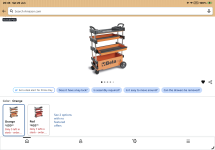
And will get this next, same idea as the Hazet assistant, less expensive

There's a lot of world salad in this thread. Like to add my last 2 cents:
Automotive Toolbox History:
After WW2, auto mechanics primary worked out of narrow sheet metal tool boxes with lots of thin drawers. They stacked boxes on top of boxes on top of boxes to increase their storage drawer area without changing the footprint of the toolbox(es). It was a smart efficient storage solution for small garages and makes sense for homeowners today.
American dealerships expanded, many or most had some sort of lift or ramp. Gone were "grease pits" that I saw in my youth. Standing mechanics wanted wider roll cabs that functioned like kitchen counters and cabinets. As the US grew more prosperous and car dealerships expanded further, these boxes got bigger and bigger such that they were no longer really practical to move. Additionally, mechanics could be working on cars significant distances from their boxes. 2 or 4 bay dealerships gave way to 20-40 bay repair facilities.
Thus roll carts became popular. Like tool boxes these were small at first and grew. But their primary purpose was to hold a few essential tools and function like a trolley to transport tools, parts, equipment etc from place to place. Earliest models had no drawers at all. They were simple carts.
Today, young mechanics are advised to start with carts then, over time, buy the bigger roll cabs. So they too are growing. But the chief function of a roll cart remains its mobility.
My 2 car garage is easy to walk across and I don't need the massive KRL roll cab I have. I also don't have a lift so I'm often working from a creeper seat or a creeper getting up and down. In terms of raw utility, I should really have something like a Hazet Assistant, which I believe was designed for European mechanics who worked on rear engine cars from the ground. In terms of US cars and automotive work I'd say the Hazet Assistants are essentially upside down tool boxes, designed to be accessed from a creeper or a stool.
So, I think we have modeled our home tool boxes after pro's boxes that were designed for circumstances we don't share. We would be better off with something like Assistants. And think about this: how often do you use your heavy duty impact gun and sockets in your engine bay? For me, it's never ever. Those tools are used under cars and should probably be stored on something that rolls around and is accessible from a creeper.
LAST:
While I've thoughtlessly modeled my tool storage on pros' solutions, I DO find utility in having a roll cart, even in a small garage. True I don't need to walk 100' to get a wrench, but I like not having to walk at all. I put the cart immediately adjacent to the car I'm working on. It isn't another fixed tool box in my garage. So too, I do like to work outside, or when my garage is full, I'll pull out the cart. I think this makes SOME sense.


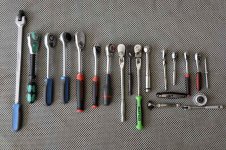
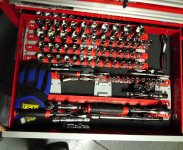

Me Overthinking this, is a constant reminder by many. I do agree I am thinking critically about this.
Everywhere I look and read, I find ideas and I have used many of these ideas. Yet, everywhere I work turns into a mess from WIP. For me, nothing worked, my toolboxes, I do have a few, start out neat and organised, but the end result remained the same, sockets and wrenches everywhere but back in their drawers. That became frustrating, in the extreme. So extreme measures, I guess, is what I need, and that includes exploring the extremes for solutions, see how deep the rabbit hole goes.
My main aim is to understand what is happening, why do I do this. Seemingly I do not have the ability to return them tools to where they should be.
What I now do understand somewhat better is, I was focused on the wrong thing completely. That thing was an organised toolbox. My problem was never the toolbox organisation. It was tools at WIP and buried in there somewhere. When I do machining, I wear an apron with some of my most used items in its pockets. This prompted me to think about why that worked. The items always naturally and without thinking, went right back to its spot on the apron. So that bit worked.
So this was a trigger for me when I thought about it, why could I return my tools in this case? So the overthinking started, critical thinking really. Let’s define what it really means.
Critical thinking is the intellectually disciplined process of actively and skillfully conceptualizing, applying, analyzing, synthesizing, and evaluating information gathered from observation, experience, reflection, reasoning, or communication. It is purposeful, self-directed thinking that aims to make reasoned judgments based on sound evidence and logic, rather than emotion, bias, or unexamined assumptions.
Overthinking defined me thinks…. What I dont know is if my thinking is skilful and logical, but we can cover that another day.

very true, sometimes analysing the problem helps but most times 'sod it let's just try this' leads to a good resultIn reality the best solutions are simple and often arrived at by mistakes rather than design.


