Post #0071g - War of the weeds – Tidying and solarisation continued - Part LXVI
This is the final update in Part LXVI #0071.
The next photo is of the downslope side of the swale drain as it heads towards the gully. Again, it’s dominated by Paspalum sp., whereas today (2026) it’s been overrun by clover.
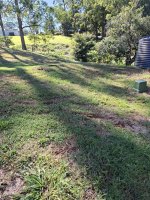
I’d say the brown patches in the turf are likely the effects of spot spraying weeds with a broadleaf herbicide which tends to cause the turf to suffer slightly. Crows foot grass or Eleusine tristachya eventually became established in a patch to the left and this should be dealt with eventually.
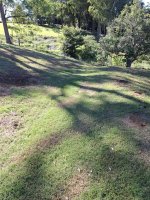
Behind the shed the turf laid in the swale drain was responding well to being mown. Although the push mower was being used, the ride-on was also running over it. This explains the line left by the mower deck’s anti-scalping wheel.
I’d say too that a lot of the brown patches are from the mower deck scalping the turf. I know from more recent experience that’s it’s virtually impossible to avoid this, even with the deck set at the maximum cutting height.
On the bank itself, the Paspalum sp. has taken hold in the disturbed areas, creating the patchiness.


Again, the line left by the mower deck’s anti-scalping wheel is evident, as are the aftereffects of targeted spraying of Paspalum sp..
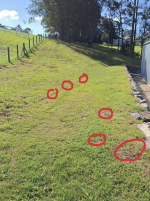
Behind the garage, the swale drain area is very compacted and the turf was struggling, looking thin and brown. Today, it’s got some thick patches of clover in it. Moving towards the fenceline, there was some nice Kikuyu, so that should develop well.

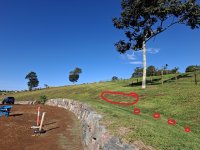
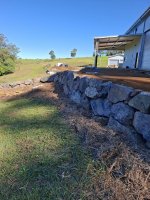
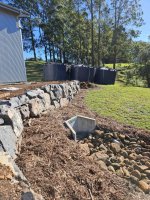
The last three photos show the bank above the retaining wall at the upper house pad site. This area was reshaped/regraded and thus was heavily disturbed and the regrowth is mainly Paspalum sp. and South African pigeon grass or Setaria sphacelata. This area was initially dealt with in January 2025 using a small machine with a mulching head attachment.

The swale drain itself had a couple of strips of turf laid in it but these didn’t extend to the edge of the retaining wall, hence the patchy areas and Paspalum sp.. The plan was to gradually spray the non-desirable grasses on the bank but the time for this never eventuated (what was I thinking!), so it was left alone. There’s ended up being some nice spread of Kikuyu from the upper areas of the bank into the lower areas.

Again, this swale drain is difficult to mow with a ride-on with a wide deck, as it has some tricky transitions, so there tends to end up being anti-scalping wheel marks post mowing.
The highlighted area is too unsafe to do on a ride on mower and I’ve found it has to be done with the push mower or brush cutter. The ultimate plan is to landscape the entire bank, however, that’s some time away.
So, that brings this series of posts to an end.
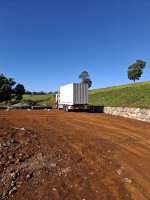
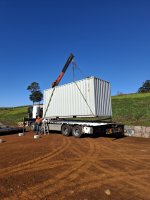
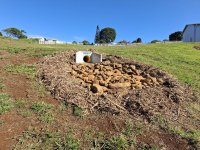
Next up, seven bales of sugar cane mulch are placed in various areas to manage weeds and grass.
This is the final update in Part LXVI #0071.
The next photo is of the downslope side of the swale drain as it heads towards the gully. Again, it’s dominated by Paspalum sp., whereas today (2026) it’s been overrun by clover.
I’d say the brown patches in the turf are likely the effects of spot spraying weeds with a broadleaf herbicide which tends to cause the turf to suffer slightly. Crows foot grass or Eleusine tristachya eventually became established in a patch to the left and this should be dealt with eventually.
Behind the shed the turf laid in the swale drain was responding well to being mown. Although the push mower was being used, the ride-on was also running over it. This explains the line left by the mower deck’s anti-scalping wheel.
I’d say too that a lot of the brown patches are from the mower deck scalping the turf. I know from more recent experience that’s it’s virtually impossible to avoid this, even with the deck set at the maximum cutting height.
On the bank itself, the Paspalum sp. has taken hold in the disturbed areas, creating the patchiness.
Again, the line left by the mower deck’s anti-scalping wheel is evident, as are the aftereffects of targeted spraying of Paspalum sp..
Behind the garage, the swale drain area is very compacted and the turf was struggling, looking thin and brown. Today, it’s got some thick patches of clover in it. Moving towards the fenceline, there was some nice Kikuyu, so that should develop well.
The last three photos show the bank above the retaining wall at the upper house pad site. This area was reshaped/regraded and thus was heavily disturbed and the regrowth is mainly Paspalum sp. and South African pigeon grass or Setaria sphacelata. This area was initially dealt with in January 2025 using a small machine with a mulching head attachment.
The swale drain itself had a couple of strips of turf laid in it but these didn’t extend to the edge of the retaining wall, hence the patchy areas and Paspalum sp.. The plan was to gradually spray the non-desirable grasses on the bank but the time for this never eventuated (what was I thinking!), so it was left alone. There’s ended up being some nice spread of Kikuyu from the upper areas of the bank into the lower areas.
Again, this swale drain is difficult to mow with a ride-on with a wide deck, as it has some tricky transitions, so there tends to end up being anti-scalping wheel marks post mowing.
The highlighted area is too unsafe to do on a ride on mower and I’ve found it has to be done with the push mower or brush cutter. The ultimate plan is to landscape the entire bank, however, that’s some time away.
So, that brings this series of posts to an end.
Next up, seven bales of sugar cane mulch are placed in various areas to manage weeds and grass.





















 I will be starting this fun in spring of '27