Placeholder17
Well-known member
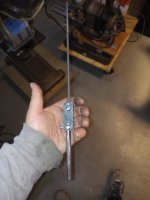
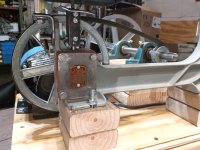
I have finally finished converting a 1940's Montgomery Wards 12" scroll saw to a die filer. This was my first ever vintage tool, but it sat abandoned after I restored a Craftsman 24" scroll saw. The first time I considered putting a file in the Craftsman, I realized it was too fast and there is only one shaft bushing in the Craftsman gearbox, so without overarm support the bushing will wear fast from filing pressure. I then remembered that the old 12" saw spindle rides in a bore at both ends of the shaft, and was much smaller, giving me room for a jackshaft for speed reduction.
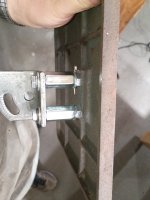
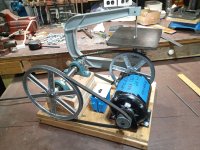
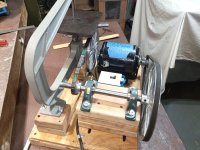
I made a chuck from a hunk of cast iron cut out of a dumbbell weight and bent an aluminum plate into a shield on top of the chuck to protect the spindle bore from swarf. I've got an 8" pulley on the saw, 1.75" / 10" pulleys on the jackshaft, and a 3.25" variable sheave pulley on the motor (set at max diameter) for 123 RPM at the saw.
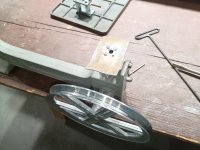
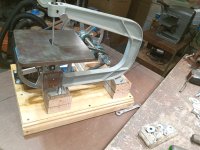
I drilled the chuck at 1/4" bore for standard machine files, but it can also take chainsaw files. With the original upper spring assembly removed from the saw overarm, the chainsaw files pass through the hole in the arm and don't need to be cut down. I did have to shim the table up alot so that the smooth shank of a machine file would not project above the table.
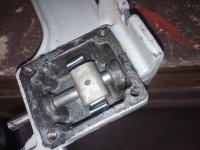
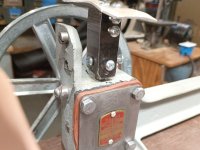
The saw itself was somewhat cheaply made back in the day; the spindle bores in the crank case have no bushings; the spindle just rides in holes in the cast iron. Also, the bottom bore was reamed incorrectly and the factory had to grind a slight flat on the spindle to get it to go into the bore (fortunately not the bearing side while filing). The mechanism for keeping the spindle from spinning was just a bent spring plate riding on the gearbox cover that was thin and flexible. I made a new plate from sheet metal that was at least twice as thick. The drive spindle bushing is slightly worn from the saw having been run dry when I got it, but at only 123 RPM I'm not worried about any more wear.
All assembled, this machine is pretty compact and fits nicely on a shelf in my garage.
I made a chuck from a hunk of cast iron cut out of a dumbbell weight and bent an aluminum plate into a shield on top of the chuck to protect the spindle bore from swarf. I've got an 8" pulley on the saw, 1.75" / 10" pulleys on the jackshaft, and a 3.25" variable sheave pulley on the motor (set at max diameter) for 123 RPM at the saw.
I drilled the chuck at 1/4" bore for standard machine files, but it can also take chainsaw files. With the original upper spring assembly removed from the saw overarm, the chainsaw files pass through the hole in the arm and don't need to be cut down. I did have to shim the table up alot so that the smooth shank of a machine file would not project above the table.
The saw itself was somewhat cheaply made back in the day; the spindle bores in the crank case have no bushings; the spindle just rides in holes in the cast iron. Also, the bottom bore was reamed incorrectly and the factory had to grind a slight flat on the spindle to get it to go into the bore (fortunately not the bearing side while filing). The mechanism for keeping the spindle from spinning was just a bent spring plate riding on the gearbox cover that was thin and flexible. I made a new plate from sheet metal that was at least twice as thick. The drive spindle bushing is slightly worn from the saw having been run dry when I got it, but at only 123 RPM I'm not worried about any more wear.
All assembled, this machine is pretty compact and fits nicely on a shelf in my garage.
Attachments
-
 IMG_20260628_130411857.jpg543.2 KB · Views: 12
 -
 IMG_20260628_130213299.jpg505.6 KB · Views: 11
 -
 IMG_20260628_130422732.jpg526.1 KB · Views: 12
 -
 IMG_20260628_135627365.jpg850.9 KB · Views: 12
 -
 IMG_20260628_135633305.jpg729.5 KB · Views: 13
 -
 IMG_20260628_135641041.jpg698 KB · Views: 13
 -
 IMG_20260628_135646938.jpg648.5 KB · Views: 11
 -
 IMG_20260628_135653265.jpg668.9 KB · Views: 13
 -
 IMG_20260628_154614932.jpg656.7 KB · Views: 13