As the reviews for this exact product confirm from the orange & blue box customers. My guess is the heater elements are **** or possibly the connections to them are poor. (No detail on how these connections are made internally.)10 kw pulls 41.7 amp + fan motor and controls. One element could of failed and melted going to ground pulling 20.5 amps or less where it broke and melted. Elements are nickel- chromium resistance heater core insulated by magnesium oxide then a steel case and aluminum fins. Electric water heaters use type of element with no fins. Most failures the core just breaks and stops heating.

You are using an out of date browser. It may not display this or other websites correctly.
You should upgrade or use an alternative browser.
You should upgrade or use an alternative browser.
Nearly had a fire...need to understand why breaker didn't trip.
- Thread starter rich_kildow
- Start date
fitter30
Well-known member
Did some work a major element and heater factory in St. Louis they would spot weld them element to connector. Who knows with foreign manufacturer.As the reviews for this exact product confirm from the orange & blue box customers. My guess is the heater elements are **** or possibly the connections to them are poor. (No detail on how these connections are made internally.)
Study here and you will may understand the error in your statement.I don't know about breakers, but fuses have to exceed their rating by A LOT for some period of time before blowing. Like 100% for multiple seconds.
Unless you know the time/current curve of the circuit interrupter your just guessing what may happen. If you need something specific to happen then you select the circuit interrupter that has the properties you need.
lg
no neat sig line
rancherbill
Well-known member
So you're saying that they didn't have the Overheat Shut Off in the area that would overheat. Sounds like a poor design to me.The area where the over temp interlock is located might not have gotten that hot by then.
Things wear out, things get old, things happen and the safety device in this unit obviously was not working. It obviously had it certifications which imply someone who knew what they were doing said it was a 'safe' product. My belief was the shut off was of poor quality because of poor quality control or manufacturing control.
As I said in post 8, location matters. You are assuming failure/poor installation of the sensor.So you're saying that they didn't have the Overheat Shut Off in the area that would overheat. Sounds like a poor design to me.
Things wear out, things get old, things happen and the safety device in this unit obviously was not working. It obviously had it certifications which imply someone who knew what they were doing said it was a 'safe' product. My belief was the shut off was of poor quality because of poor quality control or manufacturing control.
The shortcoming could simply be the DESIGN didn't anticipate that failure mode or did and would have made too many false trips.
Just b/c a heating element is crapping the diaper, does not mean the temperature of the immediate space will be high enough and for a long enough time to trip it.
rlitman
Well-known member
I don't know about breakers, but fuses have to exceed their rating by A LOT for some period of time before blowing. Like 100% for multiple seconds.
Yes. I deal a lot with both breakers and fuses. As a general rule, the thermal portion of a thermal magnetic breaker will likely trip in under 3 hours with a continuous load of the nameplate rating, but may trip on a load as low as just over 80% of that. For a 40A breaker, that's 32A. FYI, with a 41A load, even a 50A breaker might trip with this heater without the breaker panel being in a relatively cold location. I can attest to returning home from a long day servicing a remote site, to find out at 2am that the 30A breaker tripped with a precisely 24A load, just so I could turn around and drive the 3 hours back to reset it and turn something off.You think they are calibrated that close ?
The magnetic portion usually doesn't come into play until 5x the nameplate rating.
Back to the OP's issue, this wasn't an overcurrent situation - YET. Let's think this through with ohms law. What you have here is a variable resistor that varies from 11.5 ohms (when the element is its full length; it looks like you have two elements in parallel, with each at 5000W to add up to 10kW) down to something closer to 0 ohms when it's completely burned up. By the time it burned to half it's length, that one element would be pulling 41A on its own. As it shortens, it will get hotter and hotter until at some point either it get so hot that the wire burns back faster than the arc can keep up (think flux core welding wire) and the element fails "open", or it gets so short that the current increases to the point that the breaker actually trips.
I'm sure the inadvertent arc welding show was quite dramatic, and the instructions do warn you to not store it near any flammable liquids or vapors, but your home wiring remained safely protected by your circuit breaker, and adjacent combustible surfaces were never exposed to dangerous temperatures (as can be seen by how much of the paint remains on the heater). So, I don't believe this was likely going to run away into becoming a house fire, as much as such a situation was a possibility.
OP
rich_kildow
Member
- Joined
- Jun 22, 2009
- Messages
- 12
That's a very good perspective on the danger we may or may not have been in. The intact paint really does show how little heat there actually was and your explanation of why the breaker did not trip helps put my mind at ease.Yes. I deal a lot with both breakers and fuses. As a general rule, the thermal portion of a thermal magnetic breaker will likely trip in under 3 hours with a continuous load of the nameplate rating, but may trip on a load as low as just over 80% of that. For a 40A breaker, that's 32A. FYI, with a 41A load, even a 50A breaker might trip with this heater without the breaker panel being in a relatively cold location. I can attest to returning home from a long day servicing a remote site, to find out at 2am that the 30A breaker tripped with a precisely 24A load, just so I could turn around and drive the 3 hours back to reset it and turn something off.
The magnetic portion usually doesn't come into play until 5x the nameplate rating.
Back to the OP's issue, this wasn't an overcurrent situation - YET. Let's think this through with ohms law. What you have here is a variable resistor that varies from 11.5 ohms (when the element is its full length; it looks like you have two elements in parallel, with each at 5000W to add up to 10kW) down to something closer to 0 ohms when it's completely burned up. By the time it burned to half it's length, that one element would be pulling 41A on its own. As it shortens, it will get hotter and hotter until at some point either it get so hot that the wire burns back faster than the arc can keep up (think flux core welding wire) and the element fails "open", or it gets so short that the current increases to the point that the breaker actually trips.
I'm sure the inadvertent arc welding show was quite dramatic, and the instructions do warn you to not store it near any flammable liquids or vapors, but your home wiring remained safely protected by your circuit breaker, and adjacent combustible surfaces were never exposed to dangerous temperatures (as can be seen by how much of the paint remains on the heater). So, I don't believe this was likely going to run away into becoming a house fire, as much as such a situation was a possibility.
I'm tempted to do an experiment: get a 50 amp GFCI and put it in that spot, then fire the heater up. I'm like to know that if a failure such as this occurs, a GFCI would catch that fault to the grounded case and stop it.
Obviously I'd be ready to do this safely with an extinguisher in hand and somebody near the breaker to that sub panel.
rlitman
Well-known member
You don't need to experiment with line voltage. You're not electroboom. Just disconnect it, and out of the circuit use an ohm meter to measure resistance between the line side and ground. Any resistance lower than 48k ohms would trip a GFCI.That's a very good perspective on the danger we may or may not have been in. The intact paint really does show how little heat there actually was and your explanation of why the breaker did not trip helps put my mind at ease.
I'm tempted to do an experiment: get a 50 amp GFCI and put it in that spot, then fire the heater up. I'm like to know that if a failure such as this occurs, a GFCI would catch that fault to the grounded case and stop it.
Obviously I'd be ready to do this safely with an extinguisher in hand and somebody near the breaker to that sub panel.
I do agree that a GFCI would probably have tripped sooner than a circuit breaker. An AFCI too, if such an animal exists in this rating.
As for an extinguisher, keep in mind that there's nothing combustible in this heater to extinguish. It's all metal and fire-resistant insulation materials. Remove the source of heat (electricity), and it will put itself out.
Milton Shaw
Well-known member
- Joined
- Feb 11, 2011
- Messages
- 4,844
Electric stoves have that kind of failure because some brands don't ever turn off both lines on the elements. GE stoves usually had a double line break thermostat that would turn off all current through the element, also the function switch would break both lines. I bet if you check the wiring diagram you will find that heater has current to that leg of the element all the time, the only way to shut that off is to unplug or turn off the double pole breaker. i have seen the Cal-rod element short out at one end and burn back like a welding rod to the other end with the stove turned off. The stove/heat element would never pull enough amps to trip a breaker. Those elements construction have an electric resistance wire connected from both ends terminals covered and insulated with a ceramic paste inside under the visible iron outer shell. The ceramic paste insulates the element and if it fails, usually from food dripped and ruining the iron shield it shorts to the grounded iron shield and burns till the current is removed. A fire extinguisher will do nothing about the flame until the power is off. That is one reason GE went to hidden bottom elements in ranges to keep spillover food off the element, making them last a lot longer. I hardly ever saw a broil element failure as food doesn't drop upwards.
I had one of these and it failed - some of the elements just stopped working. power output dropped low enough the fan would cycle. and of course it's wired to preheat the coils and only go full power when the fan was running, so its utility dropped off a cliff. it was like $100 new and lasted a few years so i guess i got what I paid for.The dyna glo I have uses tubular elements. I have had one element open up so I replaced the heater with a like model, 5000W.
There are other brands that are likely the same inside.
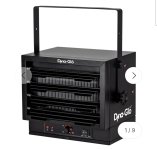
I picked up a used industrial unit, and it has a real thermostat/w sensing bulb that senses inlet air not wiring box temp, and contactors that go "THUNK" when it's called to run. also multiple inline safeties directly above the elements.
whateg01
Well-known member
That's what happened to the first one I used. I bought another just like it. It works fine until I get the mini split installed. It does have the connections for a real thermostat which is better than setting the temperature to 11:15I had one of these and it failed - some of the elements just stopped working. power output dropped low enough the fan would cycle. and of course it's wired to preheat the coils and only go full power when the fan was running, so its utility dropped off a cliff. it was like $100 new and lasted a few years so i guess i got what I paid for.
I picked up a used industrial unit, and it has a real thermostat/w sensing bulb that senses inlet air not wiring box temp, and contactors that go "THUNK" when it's called to run. also multiple inline safeties directly above the elements.
when i set mine to noon it's exactly 44F. it'll go up to the low 60s if I turn it further. oh and the fan actually throws to the floor.That's what happened to the first one I used. I bought another just like it. It works fine until I get the mini split installed. It does have the connections for a real thermostat which is better than setting the temperature to 11:15
I do prefer the minisplit though.
Derekgbruizq
New member
- Joined
- Jun 29, 2026
- Messages
- 1
For peace of mind, try using an arc fault breaker or GFCI. Also, check if your heater's brand has any safety recalls or relevant incident reports that could alert you.