AntiqueBen
Well-known member
- Joined
- Aug 4, 2021
- Messages
- 1,438

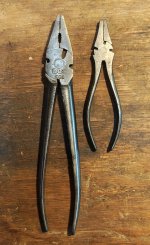
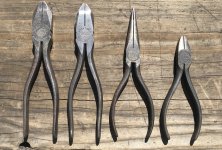
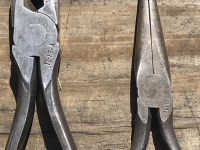
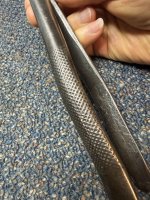
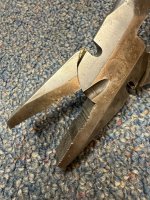
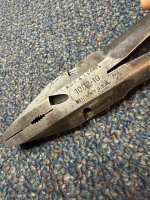
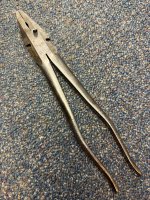
I do not see that model number in Utica catalogs from the 1910s, 1920s or 1930s (suggested by the forged-in 3-diamonds logo inside the handles). Neither “38” nor “1605” fit into any families of pliers I see there. I suspect the model number may indicate custom work for a particular entity (industry, utility or government, which is hopefully how we might learn more). I see two similar model numbers on the internet, one for a pin for heavy equipment and one for a crimping die - neither seems related to your father’s pliers.OK Guys and Gals, I have had these for decades and have never found anyone who could tell me what they are for. They were my Fathers and he was a WWII Vet and would be 101 now. It appears they are stamped 38-Y-1605. He was in the Army Air Corp (P38's) and after that he worked for over 40+ years in a Chemical Plant as a Master Electrician.
I "found" them again today and thought someone here may have an answer to what they were used for. I am stumped.
They do not look "ground down" but more purpose built.
I'm getting older and would like a little clarity.
They are 4 5/8" from top to bottom.
I hate to join a forum and make an ask in my first post but here I am.
Thanks in advance.
He was in the Army Air Corp (P38's)


^ I went through everything I have here (all of which I believe has been posted in this thread) and I didn't find anything even close.I do not see that model number
I have a Nicopress tool for crimping tiny beads on thin wire, # 17-2. these jaws look like a taller skinnier version. Not sure this helps.he worked for over 40+ years in a Chemical Plant as a Master Electrician


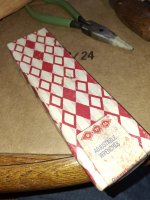

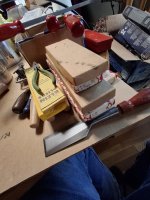
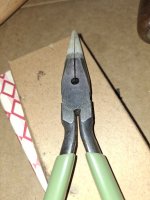
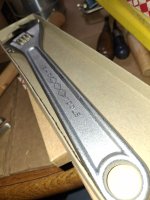
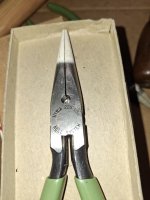


Thanks, four.cycle. They are mentioned on Alloy Artifacts. In the section devoted to Utica's production for other retailers, there's an image of a Ward's Lakeside version of this one. They say the model 1002s were made in the '30s and '40s. Mine appears older - no 3-diamonds stamp and a simple checkered handle pattern.^ I'm not finding a model 1002 in anything that I have or anything at ITCL.
Yes - there are several 1000-10s for sale on eBay. There's even a 1002-10 that appears identical to mine, though the pics are few and not good quality.^ GJ member @LesserSon is the resident expert on those pliers.
I found lots of a model 1000 - marketed as the "Giant Buttons Pliers" - and they're almost identical to yours with the exception of that tapered nose yours has.
@nz44tool
Picked up this pair of 1002-8 UDF&T streamlined wire mill special Button’s pliers this weekend. Introduced as “new” in the 1939 catalog. Would have been “Utica Tools” starting around 1943, and not listed in 1947 catalog.
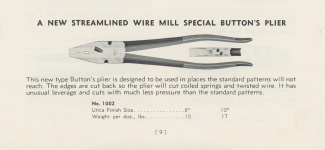
I saw this catalog page, and thought it not relevant because of the number "2001" but failed to notice the "1002" further down on the page. A typo?The three diamonds logo is absent from many pliers models for decade after the late ‘thirties before coming back with laser etching.
Ah yes, so it is. I'm very easily confused.The 2001 is a different model with a different cutter on the same page.
The 2001 is a different model with a different cutter on the same page.
At least I'm in good company...Thanks @LesserSon - can't believe I missed that!
Looks like @nz44tool and I both made the same blunder and glanced right over that one

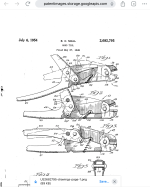
That IS interesting. The mechanical linkage (though not the cutting action) looks similar to Hall’s 1867 patent, but it isn’t that old, and the construction is from folded sheet steel. I think the patent is probably on the manufacturing process, or maybe a design patent.Hey there everyone!
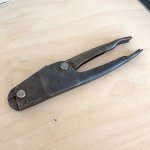
Found an interesting vintage Utica tool helping my folks sort out their garage. They've amassed an interesting assortment of tools over the years from both their parents and friends. Haven't been able to locate anything like it via Google and Ebay searches. I gather its a wire cutter or snipper of sorts. Still works and cuts wire like nobody's business.
Part Identification:
Utica (3 diamonds)
POW'R PLI'RS
450-9
Uthica, N.Y. U.S.A
Patented
Any information would be helpful. Thinking this probably belonged to my mother's old man. Both sides of the family are from NY.

Appreciate your effort, information and picture. Honestly, that's the closet I've seen. Curious if anyone else on here has any clues. It's an oddball for sure but still up to the task.That IS interesting. The mechanical linkage (though not the cutting action) looks similar to Hall’s 1867 patent, but it isn’t that old, and the construction is from folded sheet steel. I think the patent is probably on the manufacturing process, or maybe a design patent.
I don’t see it listed in catalog pdfs I have, BUT I do see it pictured on p23 in a “special display” in the 1967 catalog.

That may have solved the mystery. Many thanks, Private Lugnutz. Cheers!This is a snippet from a 1953 mag.
Sure does! Figured there was a spring in there at some point. That great. Thanks, RTM!
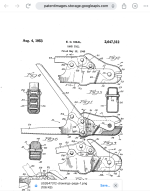
I'll take a closer look at it tomorrow and compare the two. Thanks again, RTM.Or maybe this one, the predecessor
This is my search at USPTO
cam.lpar.
@pd>="19500101"<=19560101
pliers.lpar.
Using AND, only 145 results to poke thru.