To avoid these ads, REGISTER NOW!

What do you think of Saltus Wrenches?

bwringer

Well-known member
Joined
Jan 1, 2013
Messages
10,328
Location
Indianapolis
toptul GAAT0702

7142q7NKWdL._SL1378_.jpg

will have buy online get a good price and probably uk/europe seller .

Ooh, I like that. No, I don't need them. Nobody does, really.


I'll agree there's no reason at all to have the open end.

I might see if I can rustle up one that's a 10/12 mm, or maybe an 8/10 and a 12/14. Or just a 10mm would probably cover 90% of my use cases.
 
To avoid these ads, REGISTER NOW!
OP
I

impactims

Well-known member
Joined
Nov 24, 2011
Messages
1,168
As an engineering type I think you are taking a pretty optimistic read in the situation wrt slop. If you define slop as the angular wiggle you would have till engaging there will be two components in your saltus wrench: the pin joint and the socket that the nut is on. The breaker bar (or roto-ratchet) plus socket will have the same slop contributions plus one additional source the drive anvil going into the socket. ALL off these are going to depend on the specifics of what you own. But I can tell you there is almost no slop in the pin joints of most of my specific breaker bars (and I have a few different lengths and joint styles ... some are likely the same approach as your saltus pivot joint) and they are designed to be robust. The anvil + socket connection has a spring loaded ball that pushes into a corner ... but that probably contributes a few milli-radians of angular slop depending on the specific of what one owns. Unless something is defective, the overwhelming source of slop will be the socket to nut fit and that will depend largely on the bolt and socket relative tolerances, whether 6 pt or 12 pt, and details of the corner engagements. Unless lucky on fits, that is going to contribute much more than a few milli-radians rendering the debate largely irrelevant. So which would "win" would depend on the randomness of the relative deviation from nominal value choices of the socket (which are slightly oversize by design choice) and nut fabrications. The specifics of this socket to nut fit has nothing to do with Saltus style or not.

If you are going to ape on something the wrench/bar can deflect too ... but I am assuming here none of that is done. But if you do, I would much rather choose a heavy breaker bar or select one with a longer arm for the needed torque. Yes, If I stack a lot of extensions and joints I can build up more slop in the breaker bar but if I match the saltus reach and depth there is no need for that so it is just the one anvil connection extra for the breaker bar.

So again, I just do not see this. But if you enjoy using that style, then there is no reason not to do so and I agree trying older styles can be fun. But I do not see it as being a technical advantage. If you work on stuff with 1920s square nuts and want to use old style heavy open end wrenches to be fun, that is also fine. But I very much doubt that is better when working on old stuff than using modern open end wrenches or 4pt square nut sockets on modern socket wrenches.
Ok, no more slop at all in the socket/breaker bar combo. None.

It is still bigger.
 

john.k

Well-known member
Joined
Jun 4, 2024
Messages
1,200
Location
Brisbane Qld Australia
No point in the bigger sizes .....Id like one in 1/4 & 5/16 Whit ,and one in 3/8 & 7/16 Whit...........and just maybe 1/2 & 9/16 W ......buts thats getting too big and clumsy.
 

lund

Well-known member
Joined
Nov 2, 2019
Messages
832
Location
Michigan
Ok, no more slop at all in the socket/breaker bar combo. None.

It is still bigger.
To pose it more simply: You can put both devices on a clamp and use a dial indicator to measure the joint angular slop of the saltus pivot vs breaker bar + socket pivot + anvil , but I think you will find (unless you pick a bad device in either category and our individual selections may all be somewhat different) that you will be down to a modest number of milli-radian level for both. Then it becomes a moot point on which is better because the socket to bolt head fit will be imprecise enough to dominate the net angular slop that you will feel in use. So I think the argument becomes largely irrelevant.

I do not think the head is any bigger since I can tune the socket and if I use a small body roto-ratchet I was mentioning rather than a breaker bar. Then the ratchet head will likely be smaller than the radial extent of the socket it plugs into and I can also choose the depth of socket (deep, shallow, mid, etc) and number of points on the socket if I were to want minimal slop.

But the bottom line is we can all do what we want. We all have our preferences. But for this one I do not see the logic in saying it is better. The saltus style is probably going to be less flexible in configuration than other approaches outlined. But there are plenty of approaches and many can work good enough till one encounters the rare cases where fit and configuration really do need tuning.

No intent to be personal here. I just like to think things through. My first reaction is saltus style wrenches look cool and might be useful but then I started thinking and realized I would not likely gain much by using it other than having a cool looking wrench.
 
Last edited:
OP
I

impactims

Well-known member
Joined
Nov 24, 2011
Messages
1,168
To pose it more simply: You can put both devices on a clamp and use a dial indicator to measure the joint angular slop of the saltus pivot vs breaker bar + socket pivot + anvil , but I think you will find (unless you pick a bad device in either category and our individual selections may all be somewhat different) that you will be down to a modest number of milli-radian level for both. Then it becomes a moot point on which is better because the socket to bolt head fit will be imprecise enough to dominate the net angular slop that you will feel in use. So I think the argument becomes largely irrelevant.

I do not think the head is any bigger since I can tune the socket and if I use a small body roto-ratchet I was mentioning rather than a breaker bar. Then the ratchet head will likely be smaller than the radial extent of the socket it plugs into and I can also choose the depth of socket (deep, shallow, mid, etc) and number of points on the socket if I were to want minimal slop.

But the bottom line is we can all do what we want. We all have our preferences. But for this one I do not see the logic in saying it is better. The saltus style is probably going to be less flexible in configuration than other approaches outlined. But there are plenty of approaches and many can work good enough till one encounters the rare cases where fit and configuration really do need tuning.

No intent to be personal here. I just like to think things through. My first reaction is saltus style wrenches look cool and might be useful but then I started thinking and realized I would not likely gain much by using it other than having a cool looking wrench.
Never seen a breaker bar plus socket that was as tight and slop-free as a saltus.

Ratchets are even more sloppy.

Most of the time, I want a slop free set up if I can get it.

If you think it's a non issue, then that's up to you and the type of work you do.
 

rust in the eye

Well-known member
Joined
Oct 2, 2017
Messages
2,820
Location
Chicagoland

joel63

Well-known member
Joined
Oct 9, 2012
Messages
1,912
Location
Central FL
Ooh, I like that. No, I don't need them. Nobody does, really.


I'll agree there's no reason at all to have the open end.

I might see if I can rustle up one that's a 10/12 mm, or maybe an 8/10 and a 12/14. Or just a 10mm would probably cover 90% of my use cases.
With those three, you're all set for Asian fasteners. :thumbup:
 

64C10

Well-known member
Joined
Mar 12, 2022
Messages
369
Location
Globe, Az
I do not think the head is any bigger since I can tune the socket and if I use a small body roto-ratchet I was mentioning rather than a breaker bar.

While I was far too lazy to drag out a mike or the digital machinist’ approximeter, just eyeballing a 7/8 Mac wrench as an example, there’s about 3/8” height difference between the socket end of the wrench and an equivalent Mac socket/breaker bar. We’re talking hot dog down a hallway clearance difference, not milliradians.

Considering my failure to own a 7/8” socket in 1/4” drive, I can’t make the head any smaller. I guess I could chuck a socket up in the lathe and take it down to make the same clearance.
 

lund

Well-known member
Joined
Nov 2, 2019
Messages
832
Location
Michigan
While I was far too lazy to drag out a mike or the digital machinist’ approximeter, just eyeballing a 7/8 Mac wrench as an example, there’s about 3/8” height difference between the socket end of the wrench and an equivalent Mac socket/breaker bar. We’re talking hot dog down a hallway clearance difference, not milliradians.

Considering my failure to own a 7/8” socket in 1/4” drive, I can’t make the head any smaller. I guess I could chuck a socket up in the lathe and take it down to make the same clearance.
By "angular slop" I am describing the play in the joints when you rotate the handle till engagement, NOT the build of the head. The head height is set by the saltus socket depth so that is not tuneable for the saltus. It will fit or not unless you want to cut your tools. For angular slop in either the saltus or breaker bar + socket: you would clamp the socket immobile and then rotationally wiggle the handle back and forth and see how much play (in degrees +-) till engagement. 1 degree = 17 milliradians. How much you get will depend on many details of the saltus and breaker bar pin + anvil & socket connection. My breaker bar sets do not have a lot of angular slop when plugged into the sockets that I have (older and maybe better quality?). Others may not fit as well or they may have lousy breaker bar pivot joints. BUT, as I pointed out, from the loose fit tolerance of the socket head fit on the bolt head, you will in most cases have considerably more angular slop on that connection (the bolt to socket angular slop will add to the joint slop) when you put the socket on a bolt for either the saltus or the breaker bar + socket. This makes the joint angular slop measures largely irrelevant. If you absolutely have to have min slop (aesthetics?), something rigid and 8 pt (think saltus will be 16 pt) will be best ... like the French L pipe wrenches if they come in 8 pt. But those will also be way less flexible.

I very often use a 3/8 anvil in a 1/4 drive roto-ratchet. My description may not have been clear enough, but THAT is what I was referring to with the ratchet replacing the breaker bar. That setup gives an unusually compact head for a 3/8 drive. In that case the head is similar to smaller than the larger 3/8 drive sockets it plugs into, but not the smaller ones. So sorry, I was guilty of exaggerating for smaller sizes since the head will be the same for all sockets in contrast to the saltus style. But there is also a key difference. The saltus handle only arcs up in one plane. It does not ratchet. The roto-ratchet handle can find any plane to arc up since you can ratchet and you can flip the handle up to spin off. Those features, along with being able to tune socket depth and points and even use extensions, if needed, makes it much more flexible.

Wrenches seem to stimulate much discussion here !! I admit I own enough that it borders on collecting.
 
Last edited:

64C10

Well-known member
Joined
Mar 12, 2022
Messages
369
Location
Globe, Az
My point was that when I am up against a framerail or firewall, I could give a damn about angular slop - I only care about having the clearance to transfer torque to the fastener without modifying a tool and/or my knuckles. There are jobs out there where the Saltus is simply the most effective means of installing/removing a fastener.

No sense in overthinking it, the simplest question is “do you have the tool you need when you need it?”. Anything else is just splitting hairs.
 

Zewnten

Well-known member
Joined
Jun 11, 2017
Messages
1,850
Bought a cheap swedish made set of SAE to try. No point to them just like the the french wrench style wrenches to me. My long flex head 1/4 drive ratchet and semi deep sockets accomplished the same jobs just as easily. Not sure why this was so strongly debated except for a couple people's ego.
 
Last edited:

Retired dozer fixer

Well-known member
Joined
Aug 6, 2022
Messages
351
Location
Leesburg Indiana
When I was still working these wrenches were some of the first ones I would grab when I was in the field working out of a truck. Have a socket and a wrench in one unit = less **** to carry to a machine. By the way mine were Mac and went up to 1 1/8”. Can’t find them that big anymore
 

ChefRex

Well-known member
Joined
Jun 1, 2020
Messages
3,770
Location
NJ
I have one SO that just works for one job I do regularly, I found it at least 35 years ago, would I buy a set, no but that wrench is in my service cart and I would miss it if it found it's way home.
I see no job that I do where a set would do better than what I have.
 
To avoid these ads, REGISTER NOW!

KnurledNut

Well-known member
Joined
Jan 28, 2011
Messages
8,214
Location
n/a
Once upon a time not terribly long ago Snap-on made a specialty double ended flex head wrench for bicycle mechanics that had a metric socket on one end and a metric bit socket on the other. I always wanted a set of these with hex bit sockets on both ends. I think I remember seeing something like that from one of the Japanese tool companies.
 
Last edited:

Zewnten

Well-known member
Joined
Jun 11, 2017
Messages
1,850
Once upon a time not terribly long ago Snap-on made a specialty double ended flex head wrench for bicycle mechanics that had a metric socket on one end and a metric bit socket on the other. I always wanted a set of these with hex bit sockets on both ends. I think I remember seeing something like that from one of the Japanese tool companies.
View attachment 2564590
Now that makes no sense to me, it loses all of the claimed benefits posters touted earlier in the thread.
 

Koolmoose

Active member
Joined
Oct 25, 2013
Messages
32
Location
Cape Cod, MA
When I began to accumulate tools in the mid 1960’s, Sears Craftsman offered tool sets much like today. Saltus and double open end wrenches were usually part of the set. Older guys with experience would tell me these wrenches were fillers to get the piece count up and weren’t useful. A combination wrench, breaker bar, ratchet and sockets:, “That’s all you’ll need,!” So I never bought any, although I always thought they were cool. This was in northeastern Massachusetts BTW.
 

Superdavey

Well-known member
Joined
Apr 23, 2016
Messages
46
Location
Canada
I had picked up a bunch of over time from flea markets , garage sales , etc and they sat in my tools box collecting dust for years until on one job where a 9/16 saltus wrench was the ONLY thing that fit. Haven’t used it since , but you won’t see me get rid of them
 

rust in the eye

Well-known member
Joined
Oct 2, 2017
Messages
2,820
Location
Chicagoland
Bought a cheap swedish made set of SAE to try. No point to them just like the the french wrench style wrenches to me. My long flex head 1/4 drive ratchet and semi deep sockets accomplished the same jobs just as easily. Not sure why this was so strongly debated except for a couple people's ego.
Would you please share the source for these?
 

d42jeep

Well-known member
Joined
Oct 22, 2014
Messages
16,594
Location
Northern California
Found these three at a yard sale over the long weekend. I have used my others on occasion. IMG_8988.jpeg
Fractional Saltus wrenches.IMG_0864.jpeg
13mm Mac.IMG_0866.jpegIMG_0865.jpeg
-Don
 
Last edited:

KnurledNut

Well-known member
Joined
Jan 28, 2011
Messages
8,214
Location
n/a
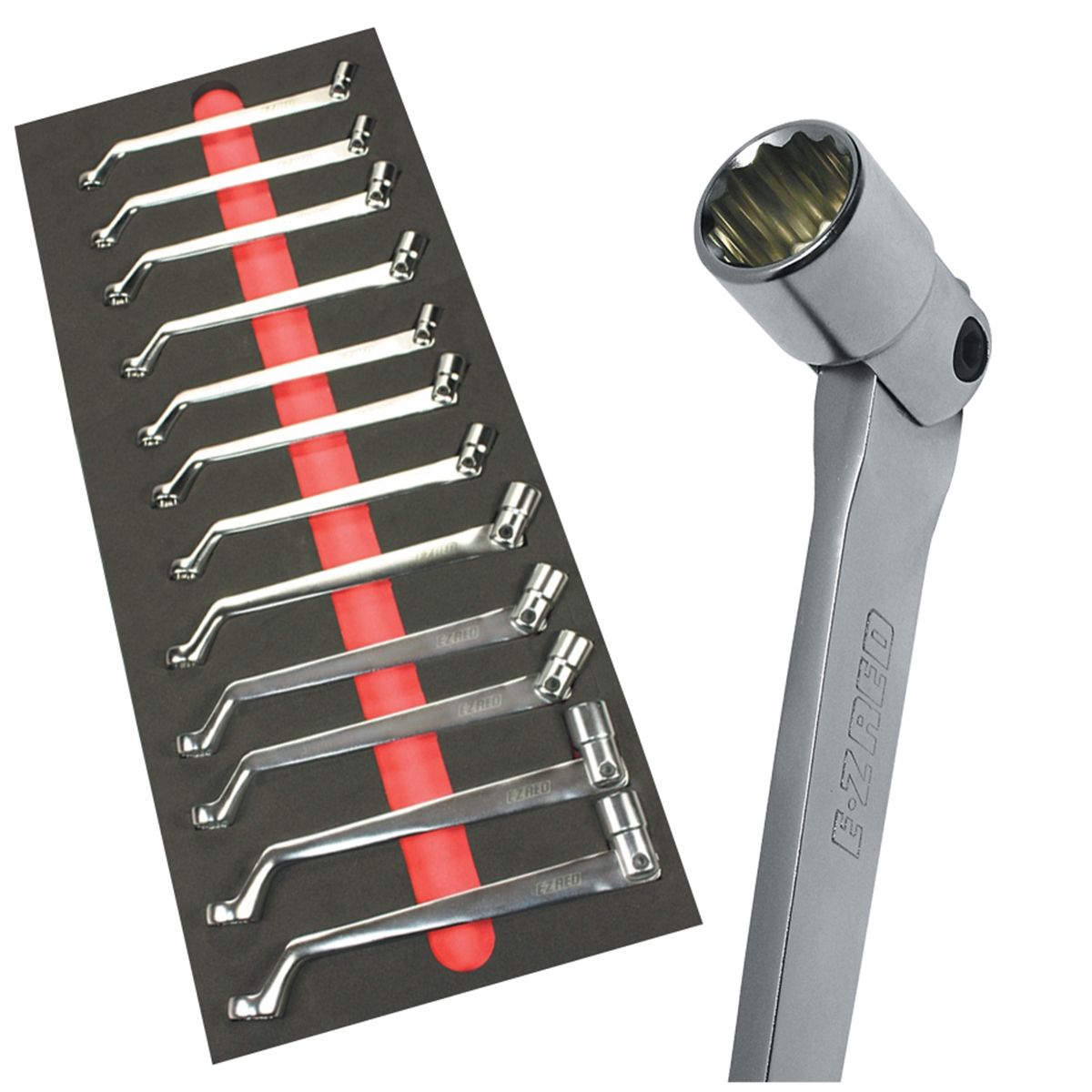
EZ-Red used to offer a unique 75° deep offset + flex head wrench set. The beam was flat for a more comfortable grip.

EZRSSWM_1200Wx1200H.jpg
 

mikey03

Well-known member
Joined
May 17, 2024
Messages
2,168
EZ-Red used to offer a unique 75° deep offset + flex head wrench set. The beam was flat for a more comfortable grip.

EZRSSWM_1200Wx1200H.jpg
Oh damn now that’s honestly real interesting. two types of wrenches you don’t need too often in the same size you can keep at the back if your box and dig out if the main tools don’t work
 
To avoid these ads, REGISTER NOW!
Top Bottom