To avoid these ads, REGISTER NOW!

Wood furnace tie in do-over, critique my plan of attack

skeer

Well-known member
Joined
Sep 14, 2021
Messages
1,049
Location
Standish, MI Area
Requisite background info:
So I am in the process of re-plumbing the wood furnace tie in that we inherited from the previous owners. The furnace in question is an Englander 28-3500, manual link here.
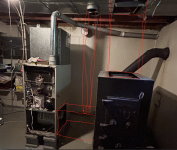
So the previous/original owners of this place had it plumbed incorrectly from the manual, basically the furnace enclosure was in-line with the return air path. They had cut most of the top and a large section on one side out. On the top there was a 14"x24" rectangular duct between the top of the unit at the RA duct/floor joints.

Then the side has a 16"x17" rectangular connecting the furnace to the blower on the propane furnace. Now for reasons I can only guess, this smaller connector had two 6" round ducts bypassing the wood furnace. I assume added later due to the increased static pressure introduced by the wood furnace. *The manual states for the hot air and flue's exit the top of the unit, on my unit the flue is on the back at the very top (unchanged by perv owner).

So as per the manufacturer, the wood furnace should be plumbed to the plenum or trunk via the 8" round top port only. The unit originally came with a smaller push fan mounted to the lower bottom of the rear.

Discussion TIme:
Anyway the way I'm understanding this is that when heat is needed from the wood furnace, it's the job of the units dedicated fan to push that up and into the trunk and distribute it throughout the house.
What's I'm trying to do is not this.. I'd like to utilize the existing blower (Evergreen IM-6005) in the propane furnace to help things out, as it's a larger and more powerful blower. So my operating, and thus least experienced idea, is that if I trigger a smaller blower on the wood furnace, as well as the main blower.. would that work to send the heat from the wood furnace down the truck and into the rooms? Or (if plumbed according to the manual) would the main blower try to force air backwards to the wood furnace overpowering it's smaller blower?
I do have an 8" spring-loaded backdraft damper that will be in place.

So pics.. red is the original ducting, green is the new. The flue stays where it is, exhausting into a dedicated existing chimney. The heat output would enter the trunk immediately downstream to the plenum. The trunk is not large enough to accommodate an entire 8" elbow internally.. so honestly I'm not 100% on how to best do this. A standard tie-off perhaps? Or a tie-off with a curved kind of half shroud allowing for some venturi effect? or maybe an 8" round to like a 2"x14" rectangle elbow inside?

Anyway.. tear my idea apart. I want to remedy this the best I can outside of trying to hire an HVAC place.
 

Attachments

  • Screenshot 2026-07-13 at 12.34.57 PM.png
    Screenshot 2026-07-13 at 12.34.57 PM.png
    2.7 MB · Views: 45
  • Screenshot 2026-07-13 at 12.28.28 PM.png
    Screenshot 2026-07-13 at 12.28.28 PM.png
    2.8 MB · Views: 45
To avoid these ads, REGISTER NOW!
OP
S

skeer

Well-known member
Joined
Sep 14, 2021
Messages
1,049
Location
Standish, MI Area
From what I'm reading further on the blowers.. seems the intention is to ensure the main blower doesn't overpower the wood furnace one. So you are expected to run both blowers during a wood heat call.
 

Jackfre

Well-known member
Joined
Dec 26, 2010
Messages
4,420
Location
N CA
Okay, here goes. I represented Yukon furnaces back in the 80’s and sold many truckloads of combi and straight wood furnaces. They were a great company but building a condensing oil furnace and the to early release of the product put them out of business.
In looking at Englander‘s (a good brand) site they no longer sell “furnaces”. Why?
In looking at their manual it is interesting that they offer nothing on connection other than a picture of the blower. I have seen about every ducting set-up you can imagine and in your case, with the unit mounted blower I would just run a duct up onto the first floor and put a large strong floor grill where it is convenient to duct. You get the forced air from the unit and also any gravity flow. That separates the two units. Yes, you can probably pipe this up yourself, but unless you are a hand at sheetmetal and you will have to be able to determine if the air flows are sufficient. It just isn’t worth doing and on this I know what I’m talking about. You then end up with the controls to deal with and as simple as it sounds you can meet yourself coming around the corner. Hence my suggestion to run them separately. When you build afire the heat will go up into the living space where it will be picked up by the return air on your LP system. Depending upon the output of the wood you may be able to run the lp furnace on fan only.You end up with the wood contribution and you keep your primary system separate. In the future if your lp unit has a problem and you need to call a tech he can simply service the furnace he knows without having to puzzle out your set-up. There is value in that as well.

I would strongly suggest that you not put any effort into this system until you take the jacket off the wood burner and carefully inspect the HX from both inside and out. You have no idea how this thing was run. The Englander manual says inspect the chimney. You can refer to NFPA 211 on this. Your best bet is to hire a chimney sweep who is certified by the Natl Chimney Sweeps Guild. Real sweeps are pros. Careful in your choice here. If the chimney isn’t good it will cost you a pile of dough to get it re-paired/placed.

Your first step here is also to call your insurance agent and be absolutely up front about what you have. Remember, Insurance hire only two types of people. Sales people to sell and lawyers to defend denial of claims and you, sir, are playing with fire.

Happy Heating!
 

brewchief

Well-known member
Joined
Sep 20, 2008
Messages
2,371
Location
Michigan
The vent on the furnace looks bad, appears to be metal then transitions to plastic( plexvent) and goes downhill to boot. Does it go into the chimney or out the sidewall? Plexvent was recalled a long time ago and if that's what it is it needs to go away.
It can be replaced with stainless steel gasketed pipe but honestly probably time to replace the furnace as well.
 
OP
S

skeer

Well-known member
Joined
Sep 14, 2021
Messages
1,049
Location
Standish, MI Area
The vent on the furnace looks bad, appears to be metal then transitions to plastic( plexvent) and goes downhill to boot. Does it go into the chimney or out the sidewall? Plexvent was recalled a long time ago and if that's what it is it needs to go away.
It can be replaced with stainless steel gasketed pipe but honestly probably time to replace the furnace as well.
I mean.. I'm glad to know this but replacing the furnace isn't going to happen. The vent is plumbed directly outside the house.. not into the chimney.
 

Jackfre

Well-known member
Joined
Dec 26, 2010
Messages
4,420
Location
N CA
The vent on the furnace looks bad, appears to be metal then transitions to plastic( plexvent) and goes downhill to boot. Does it go into the chimney or out the sidewall? Plexvent was recalled a long time ago and if that's what it is it needs to go away.
It can be replaced with stainless steel gasketed pipe but honestly probably time to replace the furnace as well.
Good eye! I can’t really tell if it is PV, but certainly worth a look. The CPSC, if it hasn’t been terminated, web-site should give details. That recall was a real fiasco. You had Hart & Cooley selling Ultra-vent which I think is shown and other maunf selling Plex-vent. I represented Metalbestos in the six New England States at that time. With the mandated efficiency increases, appliance category designations and venting changes due to the aforesaid it was a really interesting time in the HVAC business.
 

Jackfre

Well-known member
Joined
Dec 26, 2010
Messages
4,420
Location
N CA
I mean.. I'm glad to know this but replacing the furnace isn't going to happen. The vent is plumbed directly outside the house.. not into the chimney.
The Consumer Products Safety Commission issued a recall on that vent material in around ‘98. Previous owner was lucky. You may not be. If the furnace is Category IV you may be able to replace it with PVC. If it is CATIII you need to use a gasketed SS pipe as offered by Z-Flex. All of this was listed, of course, in the disclosures by the previous owner…right? Ah, the oys of home ownership.
 
To avoid these ads, REGISTER NOW!
OP
S

skeer

Well-known member
Joined
Sep 14, 2021
Messages
1,049
Location
Standish, MI Area
Okay, here goes. I represented Yukon furnaces back in the 80’s and sold many truckloads of combi and straight wood furnaces. They were a great company but building a condensing oil furnace and the to early release of the product put them out of business.
In looking at Englander‘s (a good brand) site they no longer sell “furnaces”. Why?
In looking at their manual it is interesting that they offer nothing on connection other than a picture of the blower. I have seen about every ducting set-up you can imagine and in your case, with the unit mounted blower I would just run a duct up onto the first floor and put a large strong floor grill where it is convenient to duct. You get the forced air from the unit and also any gravity flow. That separates the two units. Yes, you can probably pipe this up yourself, but unless you are a hand at sheetmetal and you will have to be able to determine if the air flows are sufficient. It just isn’t worth doing and on this I know what I’m talking about. You then end up with the controls to deal with and as simple as it sounds you can meet yourself coming around the corner. Hence my suggestion to run them separately. When you build afire the heat will go up into the living space where it will be picked up by the return air on your LP system. Depending upon the output of the wood you may be able to run the lp furnace on fan only.You end up with the wood contribution and you keep your primary system separate. In the future if your lp unit has a problem and you need to call a tech he can simply service the furnace he knows without having to puzzle out your set-up. There is value in that as well.

I would strongly suggest that you not put any effort into this system until you take the jacket off the wood burner and carefully inspect the HX from both inside and out. You have no idea how this thing was run. The Englander manual says inspect the chimney. You can refer to NFPA 211 on this. Your best bet is to hire a chimney sweep who is certified by the Natl Chimney Sweeps Guild. Real sweeps are pros. Careful in your choice here. If the chimney isn’t good it will cost you a pile of dough to get it re-paired/placed.

Your first step here is also to call your insurance agent and be absolutely up front about what you have. Remember, Insurance hire only two types of people. Sales people to sell and lawyers to defend denial of claims and you, sir, are playing with fire.

Happy Heating!
Lots of good info in this.. let me address the parts I can;

I should have prefaced with the fact that this isn't a new house to us.. I've been working with that existing setup for 8 years now. I just finally got the time to start doing something about it. And yeah we've been burning wood every winter.. the chimney condition is fine but I do have a sweep scheduled for labor day.

Dedicated Vent: So cutting a hole in the first floor floor for a dedicated heat vent just won't happen. Honestly there's no good place because this house is laid out a bit weird. In addition to that, my wife would kick me out if I started cutting through the hardwood floors.

Controls: So managing blower turn on points isn't a problem.. even for multiple blowers. When we bought the house the wood furnace had the original almost 1' long, spiral temp switch. it worked.. ok enough the first year or two. Soon it started not wanting to turn off.. I mean it was ~18 years old at that point. It was spliced into the wiring for the original propane blower, not via the heat controls (the board) but directly in the AC path. That's been replaced with a PID controller and a K-type thermosouple two years ago.. I wanted a more precise on/off control, plus current temp readouts.
Controlling two blowers is more complex for sure, but that's the route that I've gotta go for better or worse. When the wood furnace was in the RA path it was very good at heating the entire house but you mentioned my biggest fear; the already very hor air hitting the parts of the propane furnace that aren't meant to ingest hot air caused me a high amount of concern.

Wood Furnace Condition: I am doing just that.. since I have to fab up covers for the top and side I opted to remove the top altogether. There's rust-dust in the bottom so far.. I've gotta vac it out and lay eyes on the remaining three sides of the fire box.
 
OP
S

skeer

Well-known member
Joined
Sep 14, 2021
Messages
1,049
Location
Standish, MI Area
The Consumer Products Safety Commission issued a recall on that vent material in around ‘98. Previous owner was lucky. You may not be. If the furnace is Category IV you may be able to replace it with PVC. If it is CATIII you need to use a gasketed SS pipe as offered by Z-Flex. All of this was listed, of course, in the disclosures by the previous owner…right? Ah, the oys of home ownership.
So the issue with this stuff (it is Hart and Cooley) is that it could crack and leak CO2 yeah?

I had to re-route that exhaust run to allow the new RA duct to clear. I couldn't find anymore of that thin walled plastic exhaust pipe (now I know why, lol) So I went with the metal I could find locally. i did this during winter so an operating furnace was kinda needed. And seeing as that can get like really hot, I opted for steel versus another plastic.

OH! Almost forgot.. it's angled downward slightly to ensure moisture escapes outside.
 
Last edited:

Jackfre

Well-known member
Joined
Dec 26, 2010
Messages
4,420
Location
N CA
Ah, as Paul Harvey used to say, “The rest of the story…” I guess you have it well in hand. I would regularly inspect the metal exhaust pipe. Your furnace is likely a Category III. That calls for a positive pressure vent system and non-condensing. It is in the 80% range efficiency wise. Regularly inspect the metal for corrosion and leakage. Get a good CO detector in the area of the furnace. The issue with the PV and Ultra-vent was that the joints gave out and in some places the pipe would crack/craze. There was a special sealant required for the joints and that sealant was to be given a 24 hr dry time. Good luck with that in the winter. Tell the customer you’d be back in 24 hrs in January to turn on the heat. Installers would use whatever sealant they had and not the spec’d material. I have seen tub and tile caulk used. It was about the most consistently improperly installed product I had seen in almost 60 yrs in the business.
Once the special plastic vent was canned there were very few Cat III appliances made. The cost of the special vent materials put the furnace up at a price that was to close to the 90-95% units. As well as watching the vent I would keep a close eye on the HX on that unit. Your current furnace is in the 30+ yr range with what is a bum vent system. I would suggest that you begin planning on a replacement. If anything goes wrong I would not have much confidence in getting and insurance pay-out.
Sorry to see the smoke problems you are having now. We have experienced the same here over the years and it is anything but pleasant. My daughters family arrived yesterday up at Glen Lake up by Sleeping Bear yesterday. Such nice country. It is hard for me to imagine summers like this in such beautiful country. I thiought the West had a lock on this problem.
 
Last edited:
OP
S

skeer

Well-known member
Joined
Sep 14, 2021
Messages
1,049
Location
Standish, MI Area
Understood.. yeah I did put a CO alarm down here. The reason I decided to angle the exhaust run ever so slightly downhill (towards the exit) was because I found rust when I removed the setup. The hole for the exhaust fan inside the cabinet was, for whatever reason, only about 80% of a full circle. Which created a small ledge and on that ledge was rust. Seeing as how during the winter the exhaust gases being expelled and hitting the cold air definitely condensate. I mean.. it's expected.. but after finding that rust I figured with how short the run is overall, completing the aforementioned partial circle hole.. the fan isn't struggling by any means and I'm entirely safe from any risk of water vapor draining backwards.
I understand why running one downhill is a bad thing though. Yeah the furnace is a good old 80%-er.. would love to replace it sometime but when I do it'll likely be a heat pump.
 

Jackfre

Well-known member
Joined
Dec 26, 2010
Messages
4,420
Location
N CA
Go through a sheet metal catalog. Southwark was one from my area. Look for available fitting that would help you with your tie-in. A 30 or 45* tie in wouldwork and should eliminate BF. I would not use the backdraft damper until it is shown that it is necessary. To much pressure drop. Digital t-mom and manometer will help in analyzing any snafu in air flow. Before you change anything take manometer readings on S/R ducts on the system as is before alterations. If the system is functioning now that info will be your benchmark.
 

Yankeefarmer

Well-known member
Joined
Jul 25, 2011
Messages
1,212
Location
Connecticut
Our house had an oil-fired furnace when we bought it. I installed an add-on wood furnace that I ducted into the oil furnace's discharge plenum. Per the wood furnace's instructions, I also wired it to run the oil furnace's blower whenever the wood furnace's blower was running. ( I assume this was to prevent the heated air from the wood furnace from short circuiting to the cold air side of the oil furnace.) Both furnaces drew air from the basement; neither had any cold air return ducting.

The problem with that control logic was that the wood furnaces heat output was about 1/3 that of the oil furnace, and so it would run almost continually. A good chunk of my heating fuel savings (this was back in the 80's) was being consumed by higher electric costs. I built a counter-weighted damper (similar to a barometric damper) for the oil furnace's cold air inlet, so it was closed unless the oil furnace's blower was running. Worked great for several winters until Mrs. Yankeefarmer said she wasn't going to keep feeding the wood furnace.
 
To avoid these ads, REGISTER NOW!
Top Bottom