To avoid these ads, REGISTER NOW!

Cooling my 6 Car Non-Insulated Garage

perfect

Well-known member
Joined
Mar 2, 2009
Messages
47
Hi GJ!

I am very fortunate to have a 6 car attached garage. Unfortunately, all of the exterior walls are non-insulated as well as the attic directly above most of this garage space. The ceiling height in my garage varies between 12 to 18 feet, great height for my lifts - but that also makes it impractical to tear down the walls to insulate (or cut hundreds of holes for blown-in insulation). I do plan on insulating the attic this winter. I'm located in the midwest, so outside temperatures are in the upper 90's and the garage is regularly in the mid 90's. When the exterior temp cools down overnight, the garage will cool down 80 (but still much higher than the outside 60/70 degree temps). It's 11:30pm right now and my garage is still 92 (while it's 77 outside). For most of the summer, the garage is simply too hot to bother working in.

I do not use my garage everyday, so I'm not looking to keep the garage cooled all of the time. I feel like my best option is to find a way to efficiently replace the hot garage air with the relatively cooler outside air. I have installed a QuietCool QC CL-2250 garage exhaust fan (2250 CFM) at the highest point of the ceiling of the garage (above the 2 post lift in the workshop) (see picture below). If I run this exhaust fan, it will attempt to exhaust the hot air from the garage - but it only works well if I leave my garage doors open to allow cooler air from outside to come in. The coolest air is usually during the middle of the night, so it's not really practical (or safe) for me to keep my garage doors open in the middle of the night.

I am planning to install a wall-mounted inlet fan (3500+ CFM) above a man-door in the garage. This would be turned on (in conjunction with the garage exhaust fan). My thought is to pull in relatively cool outside air (using this inlet fan) into the garage - and then exhausting the relatively warmer garage air out via the ceiling mounted garage exhaust fan.

I'm wondering if I also need a better way to exhaust the attic air using a vent fan or wall-mounted exhaust fan (or like a powered ridge vent fan). The garage exhaust fan is pushing a lot of air into the attic and I'm not certain if the soffit vents are getting overwhelmed trying to push all of that air out of the attic. Would adding an attic / roof vent fan help to expel all of this hot air out of the attic - or does the pressure from the exhaust ceiling fan do this job well enough?

Last resort, I may go with a mini split. I estimate 22,000 cubic feet of garage volume though - so I'm not convinced a mini split would keep up with this large volume of air.

Any advice is appreciated!

I've attached a diagram of my garage and setup of the inlet fan and exhaust ceiling fan.

1784177362242.png
Red walls are non-insulated exterior walls.
Blue wall are insulated interior walls (attached to the house).
The attic exhaust fan is placed as the highest point inside the garage (at the ceiling) and is venting directly into the attic.
The inlet fan would be placed above a man-door and would pull in cooler exterior air into the garage while the attic exhaust fan is running.
 

Attachments

  • 1784177185028.png
    1784177185028.png
    365.9 KB · Views: 3
To avoid these ads, REGISTER NOW!

jack stand

Well-known member
Joined
Feb 29, 2012
Messages
3,363
Location
Lakes Region Maine
You seem to have experience with the air change approach. Do you really think you can "change" enough air to make it worth it?
Without insulating the exterior walls I'd think that you'd be wasting your money and might as well plant some fast growing trees for the shade.
Unless you retard the heat loss/gain by insulating the building envelope the difference between 95 in your garage and 85 with a slight air movement from exhaust fans is not worth the effort.
Insulation then maybe mini splits.👍
 
OP
P

perfect

Well-known member
Joined
Mar 2, 2009
Messages
47
You seem to have experience with the air change approach. Do you really think you can "change" enough air to make it worth it?
Without insulating the exterior walls I'd think that you'd be wasting your money and might as well plant some fast growing trees for the shade.
Unless you retard the heat loss/gain by insulating the building envelope the difference between 95 in your garage and 85 with a slight air movement from exhaust fans is not worth the effort.
Insulation then maybe mini splits.👍
I totally understand that many will tell me to insulate the walls (it's just far too expensive and difficult to pull that off with how my garage is framed).

This morning at 5am my garage was 83 degrees inside, while it was 68 degrees outside. If I could exhaust the hotter garage air - and draw in the cooler outside air - I think it would be much more enjoyable and keep the temperature relatively more comfortable.

Thanks for the guidance!
 

mike93lx

ALLIANCE MEMBER
Joined
Dec 9, 2013
Messages
37,960
Location
Richmond, VA
The sooner you bite the bullet on insulation the happier you will be and you'll wonder why you waited.

Hiring a good insulation contractor to do blown in will make a big difference and they'll get it done faster than you think. Then a good drywall guy to patch it all up

Spending anything on a/c without doing this first will be a waste and just moving air through the space will not make it comfortable. Maybe less bad
 
Last edited:

pembol

Well-known member
Joined
Feb 13, 2014
Messages
276
I totally understand that many will tell me to insulate the walls (it's just far too expensive and difficult to pull that off with how my garage is framed).

This morning at 5am my garage was 83 degrees inside, while it was 68 degrees outside. If I could exhaust the hotter garage air - and draw in the cooler outside air - I think it would be much more enjoyable and keep the temperature relatively more comfortable.

Thanks for the guidance!

I think your ventilation plan is a good one - and it will help the garage be more pleasant in the mornings by having it be closer ambient. But I am not sure it will make a huge difference by the afternoon without insulation to slow down the heat gain. It seems like it would be relatively easy to give it a try.

It is crazy to me that someone would build a garage-mahal like this an not insulate it during construction - the incremental cost to do so during construction while the walls are open is so small compared to the overall cost.
 

txvwnut

Well-known member
Joined
Jan 1, 2015
Messages
7,662
Location
Bedford, Texas
As someone in Texas that had a 2000sqft metal building that was not insulated, you ain't never gonna get it cool enough to stand. Insulation is your best friend in this scenario no matter what you do with intake and exhaust fans. I had two exhaust fans in that old shop and it was still hot in there with both of them running. The idea with the inlet fan might make it bearable until you get in there and get to working but it will need to run 24-7 to be effective and even then I don't think you'd get the results you want.
 

Steve from Socal

Well-known member
Joined
Jan 27, 2009
Messages
3,514
Location
Hutchinson Ks.
I have similar issue on a largr scale. I have a metal building WITH some insulation but nowhere near enough. I put in two 60" 5 HP exhaust fans in the peak of my building. In the late evening when it cools down I will help, days with hot sun they are ineffective. My building has 13~20 ceilings and nearly 30K sq ft.

In the long term I am looking at better insulation of a 10K sq ft section to insulate/condition. The tall ceilings work aganist you in every season.
 

danski0224

Well-known member
Joined
Jan 29, 2005
Messages
13,546
Location
Near Naperville, IL
(it's just far too expensive and difficult to pull that off with how my garage is framed).
Sounds like BS to me.

Drywall is cheap. Tear it off, insulate, put up new drywall.

I know someone that had their garage insulated by blowing it in through a round hole that was patched with a round foam plug. Much less mess than tearing off drywall, but there might be small missed spots due to access issues.

There's also retrofit spray foam injected through a small hole. They take off a strip of siding and/or do it from inside. Still might have missed spots.

Any of these options will be preferred over doing nothing.

Or get a couple of 5 ton units and let it rip as-is.

:dunno:
 

Shiftless

Well-known member
Joined
Mar 9, 2014
Messages
14,600
Location
East Bay SFO
Not a garage, but my house.
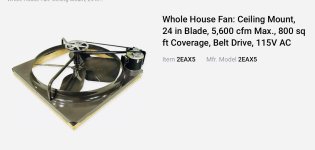
I have a whole house fan... A 24 inch Dayton fan mounted horizontally in the ceiling of our hallway. When the outside air cools, we can open a window or two on the cool side of the house and turn on that fan. Our main floor is 2000 sq. ft. With 8 foot ceilings. That’s 16,000 cubic feet of hot air. The fan ***** that air up and into the attic where it exits trough the attic vents. I added extra venting after installing the fan. The fan on high can exchange all the air in the house every 3 minutes. You don’t need separate powered intake and exhaust. One big fan. It works great.

For your larger space you’ll need the larger size. I have no idea why they say max coverage is 800 sq. ft. The 36 inch Dayton whole house fan moves a bit over 10,000 CFM. Your existing 2300 CFM exhaust fan is inadequate.

But as others have already said… you NEED nsulation.

694C20ED-8754-40AB-8607-42BB6583E0E3.jpeg
 
Last edited:

Shiftless

Well-known member
Joined
Mar 9, 2014
Messages
14,600
Location
East Bay SFO
The attic exhaust fan is placed as the highest point inside the garage (at the ceiling) and is venting directly into the attic.
The attic venting is important. How many square feet of vent area does your attic have? For each 750 CFM you need a total of one square foot of free area of venting so the hot air can escape without too much restriction. Screens restrict the flow of air a bit so you have to adjust.
 
OP
P

perfect

Well-known member
Joined
Mar 2, 2009
Messages
47
It is crazy to me that someone would build a garage-mahal like this an not insulate it during construction - the incremental cost to do so during construction while the walls are open is so small compared to the overall cost.

A miscommunication with the builder and the insulation/drywall crew. It wasn't caught until after closing - but the builder made it right in other ways. It is what it is at this point!

I run a swamp cooler in my 2400sq ft uninsulated shop.

If your in a dry climate they work great. If your in a humid climate they wouldn't work.

I'm in KC - probably too humid for a swamp cooler (but definitely on the consideration list)

Curious, what are these framing conditions?
You're wall (with this morning's temp differential) should really give you an Xray view of it with an infrared camera. (app?)

Curious, what are these framing conditions?
You're wall (with this morning's temp differential) should really give you an Xray view of it with an infrared camera. (app?)

Because of the tall walls and fire-blocking for code - each wall vertical has 2 or 3 sections that will need to be cut into and blown-in. The quotes I received for blown-in insulation a few years ago were eye watering (and that didn't include repairing the drywall). See picture below.

IMG_8510.JPG

Pictures would help but your going to spend a lot of money on energy with no insulation. Don't take this the wrong way but someone with an attached 6 car garage can likely afford to get insulation and won't get much sympathy complaining about the cost.

James

I'm not complaining about the cost, as much as I'm being economical with my budget. This garage was a real treat for myself, but I have others ways I want to spend my money (mostly on all the cars filling the garage). I'm sure a lot of people on GJ can relate.

Here is a picture of the 4-car portion of this garage. You can see that the walls are already finished and painted.

IMG_5904.jpeg

Not a garage, but my house.
I have a whole house fan... A 24 inch Dayton fan mounted horizontally in the ceiling of our hallway. When the outside air cools, we can open a window or two on the cool side of the house and turn on that fan. Our main floor is 2000 sq. ft. With 8 foot ceilings. That’s 16,000 cubic feet of hot air. The fan ***** that air up and into the attic where it exits trough the attic vents. I added extra venting after installing the fan. The fan on high can exchange all the air in the house every 3 minutes. You don’t need separate powered intake and exhaust. One big fan. It works great.

For your larger space you’ll need the larger size. I have no idea why they say max coverage is 800 sq. ft. The 36 inch Dayton whole house fan moves a bit over 10,000 CFM. Your existing 2300 CFM exhaust fan is inadequate.

But as others have already said… you NEED nsulation.

Thanks for the advice - this is definitely a portion of my concern. I'm not trying to refresh the entire garage air (22,500 cubic feet) in just a few minutes. But I would like to get it to cool down to be the same inside temperature as the outside. The garage exhaust fan that I purchased was the larger that QuietCool sells and they specifically worked with me on the size of my garage (and the framing of my rafters) to help with that choice. If I was trying to rapidly cool the garage (to outside ambient), then I agree a larger CFM exhaust fan would be required.

The attic venting is important. How many square feet of vent area does your attic have? For each 750 CFM you need a total of one square foot of free area of venting so the hot air can escape without too much restriction. Screens restrict the flow of air a bit so you have to adjust.

This is good advice and something that I need to figure out. I'm concerned that I'm venting the garage air into the attic, but that attic air isn't adequately flowing back outside. I'm debating an ridge vent fan or something like that to exhaust the hot attic air out of the attic. Great advice!
 
OP
P

perfect

Well-known member
Joined
Mar 2, 2009
Messages
47
I should also add - I mostly do my car wrenching in the morning, so if I can get the garage to be closer to ambient temp (65-70) I would be feeling much better.
 
To avoid these ads, REGISTER NOW!

strength_and_power

Well-known member
Joined
Apr 26, 2015
Messages
1,426
I was talking to a contractor buddy about insulating my attached garage. He recommended using a 4” hole saw at close to the wall/ ceiling connection and blowing in insulation. Rather than taping and texturing the holes, he recommended a 6” trim board around the perimeter to cover the holes. Gives you a nice place to hang banners and such
 
OP
P

perfect

Well-known member
Joined
Mar 2, 2009
Messages
47
I was talking to a contractor buddy about insulating my attached garage. He recommended using a 4” hole saw at close to the wall/ ceiling connection and blowing in insulation. Rather than taping and texturing the holes, he recommended a 6” trim board around the perimeter to cover the holes. Gives you a nice place to hang banners and such

Due to the height of my walls (18') - and the code requirement for fire-blocking, my vertical channels are sectioned into 3 separate pieces. For each "vertical" - I would need to drill 3 holes in order to blow in the insulation... (see picture above of my framing)
 

kngelv

Well-known member
Joined
May 25, 2011
Messages
2,235
Location
Detroit, MI
Yeah, three different sections make blowing in insulation a pain in the *** especially that small blocking that’s about 2/3 of the way up the wall. If it was me, I would just tear open the walls and put Rockwool in there. Then do the ceiling. I know it’s not going to be super cheap to have somebody do it but it’s the only way this garage will be right. All these other things are going to be a waste of time and money.

James
 

danski0224

Well-known member
Joined
Jan 29, 2005
Messages
13,546
Location
Near Naperville, IL
Because of the tall walls and fire-blocking for code - each wall vertical has 2 or 3 sections that will need to be cut into and blown-in. The quotes I received for blown-in insulation a few years ago were eye watering (and that didn't include repairing the drywall). See picture below.

IMG_8510.JPG
You have pictures. Makes it much easier.

A hole saw, foam insulation plugs and a insulation blower will make quick work with relatively little finishing work required.

Or, show the pictures to a retrofit foam insulation contractor.

Either option can probably be done for 5-10k, which is certainly within your means.

Your attic will never vent the air being dumped into it from a big fan.
 

jack stand

Well-known member
Joined
Feb 29, 2012
Messages
3,363
Location
Lakes Region Maine
So;
Brand new home and shop of your dreams. 👍

You mentioned that mistakes were made and you were compensated in some manner.

You're looking at an additional substantial investment for a m/s system. I'd call that good money after bad.

Going backwards with complete demo of your interior truly *****, but that beautiful space being un conditioned and unbearable for a good portion of the year is a huge negative, IMHO that out weighs the pretty paint... by a long shot!
I'd imagine that you'll have linesets and wires running all around your walls inside and out further degrading the situation.
Bite the bullet and strip it.
Call the m/s guy to rough in the mechanicals into the walls and attic. Have the electrian run power to the outside unit(s), again wired in the wall.
Insulate and hang & paint the wallboard and don't look back!👍
I sympathize with your situation but the right way is the only way and only more important with the obvious thought that you have put into this build.
 

duneslider

Well-known member
Joined
Jan 20, 2013
Messages
2,272
Location
Riverton, Utah
I have to be honest, the insulation in walls won't make a significant difference. I am fully insulated and currently my garage is 89 and exterior temp is 75 (8am). By end day it will be hanging at near ambient temp or higher (which looks like 89 today).

If I am going to be working in the garage I open the doors up and the side man door and usually that gets a little air flow in the morning and cools it down to ambient. Then I can close it up and it will hold on for a while, once it starts feeling stuffy I open the doors and get a fan running to get some air movement.

Ceiling insulation made a difference for me, more than walls seemed to. The west side of my garage gets baked in the summer sun and I am working on things to help shade that side to help it a little long term. I think you will see some difference if you have good garage door seals, ceiling insulation, and and AC.

I wouldn't blow air into the attic. If you put a vent in somewhere on one side of the garage and a fan pull air out of the garage on the other side during the night it should cool the garage down to near the ambient temp. Running that fan at other times of the day will just pull in hot air and make it the ambient temp. Use a damper vent and a damper fan, close them when not needed and open them when running. I have done this make shift with my side man door and cracking the big garage door open and setting a box fan at the man door to pull air out.
 

Fav Onefour

Well-known member
Joined
Jul 14, 2022
Messages
725
Location
MN cold and hot
I love using IR temp guns to find hot spots.

The framing stage pictures help a lot. Wall insulation isn't a quick fix. I'm curious to see how your wall temps compare to the rafter portion of the ceiling. Did they at least put insulation in the ceiling cavities where you have joists? I'm assuming you have living space on top of that section. Without insulation, your living space would also be affected by garage temps. Might as well run around inside with the temp gun to see.

It still amazes me that contractors would not revisited the insulation question before drywall. That whole, "I'm just here to do my job", approach creates long term headaches if you're not on top of those guys. Sorry about the rant but dang, we could avoid a pile of hassle with a little extra effort.
 

danski0224

Well-known member
Joined
Jan 29, 2005
Messages
13,546
Location
Near Naperville, IL
It still amazes me that contractors would not revisited the insulation question before drywall.
The subcontractors only do what's on the plans.

Drywall may be required by code, particularly on partition walls.

Insulation will be required by code on partition walls.

If the attic space is divided, Insulation will not be required above the garage.
 

duneslider

Well-known member
Joined
Jan 20, 2013
Messages
2,272
Location
Riverton, Utah
Unless you are camped out on the job 100% of the time it's pretty tough to make sure everything is perfect.

I just happened to be at my house when the insulation contractor was there blowing in the ceiling, even though I had talked to my contractor and he had talked to the insulation sub, the guy at my house didn't know the garage needed to be insulated. If I wouldn't have been there he wouldn't have done it.
 

Shiftless

Well-known member
Joined
Mar 9, 2014
Messages
14,600
Location
East Bay SFO
Your attic will never vent the air being dumped into it from a big fan.
I’m one of the guys suggesting a bigget fan to exhaust hot air into the attic. If you don’t want to install insulation this will help a lot once the outside air cools. But danski is right. Vent area is critical. Putting in more vents is not hard. I did it.
 

duneslider

Well-known member
Joined
Jan 20, 2013
Messages
2,272
Location
Riverton, Utah
I’m one of the guys suggesting a bigget fan to exhaust hot air into the attic. If you don’t want to install insulation this will help a lot once the outside air cools. But danski is right. Vent area is critical. Putting in more vents is not hard. I did it.
Venting to the attic is a bad idea, especially in humid areas. If you are venting, it has to be to outside. Vented roofs are already under vented and adding more input is just going to cause more issues and not help anything. Creating more openings at the top of the roof is even more work and then when you aren't venting the garage you have too much top venting and its gonna try pulling air from inside the house. Viscious circle here. If a fan gets put in it needs to be able to push directly to outdoors and not into the attic space.
 

racecougar

Well-known member
Joined
Jan 26, 2021
Messages
5,190
Location
Missouri
A notable downside to pulling in outside air every morning is that is typically when outdoor humidity is at its highest. No bueno for working, for your tools/equipment, for the cars, and so on.

Insulating the attic will make a significant difference. IMO, start there, add HVAC, and decide if you want to mess with insulating the walls at that point.
 

danski0224

Well-known member
Joined
Jan 29, 2005
Messages
13,546
Location
Near Naperville, IL
I’m one of the guys suggesting a bigget fan to exhaust hot air into the attic.
It will take a lot of free area to passively vent what a mechanical fan is dumping into the attic space. That's why powered attic exhaust fans will pull from the conditioned space and flues before pulling from soffit vents.
 

Yankeefarmer

Well-known member
Joined
Jul 25, 2011
Messages
1,203
Location
Connecticut
The problem with counting on overnight ventilation to cool the building is that there often is not enough temperature difference to extract the heat from the structure and its contents in the hours before daytime heating takes over again. The ventilation will give cooler air, but not cooler building contents. Insulation reduces the daytime heat stored in the drywall, furnishings, and contents.

My shop has R19 fiberglass in the walls and ceiling. You don’t want to be in the loft on a sunny day if the outside temperature is above 60 degrees or so. But we can have a week of temps in the 80’s and 90’s and the inside temperature will stay in the 70’s without AC unless I leave the doors open (I don’t.) I sometimes set the AC to 72 or lower just to get some dehumidification; higher set points keep the AC from coming on.
 
OP
P

perfect

Well-known member
Joined
Mar 2, 2009
Messages
47
I love using IR temp guns to find hot spots.

The framing stage pictures help a lot. Wall insulation isn't a quick fix. I'm curious to see how your wall temps compare to the rafter portion of the ceiling. Did they at least put insulation in the ceiling cavities where you have joists? I'm assuming you have living space on top of that section. Without insulation, your living space would also be affected by garage temps. Might as well run around inside with the temp gun to see.

It still amazes me that contractors would not revisited the insulation question before drywall. That whole, "I'm just here to do my job", approach creates long term headaches if you're not on top of those guys. Sorry about the rant but dang, we could avoid a pile of hassle with a little extra effort.

I have used an IR gun all over the garage (and doors)! For reference, the ceiling is not insulated over the main portion of the garage (it is a standalone roof over this garage - no living quarters above or adjacent). Interestingly, while the attic temp is currently 110, the ceiling is 100, and the west-facing walls (getting sunlight) are 90-95. Of course, everything in the garage is currently 90 (and it's 92 degrees outside).

The lack of insulation in the garage was a misunderstanding of my home builder. They didn't have it in the contract for the garage insulation/drywall crews (and this not surprising, since exterior garage walls / ceilings are not typically insulated). I only realized it after they have completed the finished drywall. They made it right in another part of the house during some changes we requested, so I'm not upset with the build process overall. It was a mistake, so I moved on.
 
OP
P

perfect

Well-known member
Joined
Mar 2, 2009
Messages
47
It will take a lot of free area to passively vent what a mechanical fan is dumping into the attic space. That's why powered attic exhaust fans will pull from the conditioned space and flues before pulling from soffit vents.

I should probably clarify that this attic space above the main garage is not connected to the main house attic space. It physically can't pull in any extra air from inside the house. I'm debating a powered ridge vent vent or some other way to better exhaust the attic air (while simultaneously passing through the hot garage air and cooler outside air).
 

Burt Shaver

Well-known member
Joined
Dec 7, 2023
Messages
1,291
Location
Iroquois, Ontario Canada
Unless you are camped out on the job 100% of the time it's pretty tough to make sure everything is perfect.

I just happened to be at my house when the insulation contractor was there blowing in the ceiling, even though I had talked to my contractor and he had talked to the insulation sub, the guy at my house didn't know the garage needed to be insulated. If I wouldn't have been there he wouldn't have done it.
Where did you find your contractors? Where you the GC? I’ve overseen many Reno’s, I couldn’t imagine going to the home owner and saying “ I’m so sorry, we forgot to have the insulation installed before the drywall was hung taped and finished, sorry about that”
 
To avoid these ads, REGISTER NOW!
Top Bottom