To avoid these ads, REGISTER NOW!

Tool for gripping T40 “cam’d - out” Button Head 6MM Steel Bolt in Aluminum

Leaky88

Well-known member
Joined
Nov 1, 2014
Messages
274
Location
Illinois (Temporarily)
Hello,
I’m at a loss.
If I’ve posted in wrong Forum I apologize in advance.
Im trying to remove subject bolt (there are 2) that holds the Shift Cable Bracket on an “installed” 4L60e Automatic.
Bolt is threaded in Aluminum Boss.
I’m certain Galvanic Corrosion is alive and well.
T40 socket is sloppy when inserted, verified with mirror.
Vice-grips, irregardless of tightening, slip off.
I started with PB Blaster then moved to Kroil. Made repeated applications in course of 7 days, tapping with Hammer.
I repeatedly tried hitting head with center punch.
I was able to drill a hole in the center of the bolt in hopes of reducing pressure.
I’ve tried heating Aluminum threads with MAPP gas.
Any heroic advise is welcomed.
Thanks
Leaky
 

Attachments

  • IMG_6715.jpeg
    IMG_6715.jpeg
    1.5 MB · Views: 180
To avoid these ads, REGISTER NOW!

dffay

Well-known member
Joined
Jul 9, 2015
Messages
445
Any access to hold a hex nut on top? From there a carefully aimed MIG or TIG weld down the center of the nut through to the hogged out area of the burred up screw to solidly fuse them. Then wrench or socket it free.

Plan B would be a taller cap screw to stand on top of it and weld in carefully to the sides to fuse together. Then same unscrewing of them bonded together.
 

YesIHaveAHammer

Well-known member
Joined
Jun 1, 2025
Messages
922
One thing that's worked for me before is to saw a slot in the head for a large screwdriver bit.

Alternatively a hammer impact screwdriver like the Koken Attack, if you have space.
 

Zewnten

Well-known member
Joined
Jun 11, 2017
Messages
1,854
The aluminum and steel have reacted and its now locked in better than red locktite. Propane torch heat it hot hot, then go dind something else to due for a bit while the heat soaks through. Coworker dealt with this a lot and the Grip brand drivers worked the best for this type of job.
 

GeoBruin

Well-known member
Joined
May 5, 2018
Messages
3,754
One thing that's worked for me before is to saw a slot in the head for a large screwdriver bit.

Alternatively a hammer impact screwdriver like the Koken Attack, if you have space.

Yes, either saw/grind a slot and use a flat screw driver bit (ideally with a hand impact driver) or else grind two flats on either side and use an end wrench.
 
OP
L

Leaky88

Well-known member
Joined
Nov 1, 2014
Messages
274
Location
Illinois (Temporarily)
The aluminum and steel have reacted and it’s now locked in better than red locktite. Propane torch heat it hot hot, then go dind something else to due for a bit while the heat soaks through. Coworker dealt with this a lot and the Grip brand drivers worked the best for this type of job.
By heat do you mean the Bolt Head and Aluminum Boss it threaded into? Im also curious about “Grip Brand Drivers” and maker of same. Thanks to you and all who responded.
 

RTM

Well-known member
Joined
May 13, 2019
Messages
13,273
Location
SF Bay Area
I don't have any of the grip edge socket sets yet but from what I understand this is exactly what they are made for.
But I’ve you’ve got galvanic corrosion, this will just make a bigger mess.

If this is galvanic, that sucker is almost welded in there. I’d really try the heat, wax, Kroil, or whatever, before more force on the head. You’ll probably just twist it off the shank.
 

AEAdam

Well-known member
Joined
May 27, 2023
Messages
2,820
Location
SE PA
But I’ve you’ve got galvanic corrosion, this will just make a bigger mess.

If this is galvanic, that sucker is almost welded in there. I’d really try the heat, wax, Kroil, or whatever, before more force on the head. You’ll probably just twist it off the shank.
PURE RAW SPECULATION:
Alloy steel and aluminum are close together galvanically. The corrosion you mention would need help, like a salt spray. And while the head could see that, I doubt there’s significant corrosion in the aluminum threads.

Rather, looking at the picture, I’m seeing the screw thru bent steel, both of which having black oxide finishes. I think he may be stuck steel to steel which tells me, do what @PCustoms said. Heat and some sort of penetrating oil or wax.

Now what to grab it with has been a problem I've had in the past so I’m listening you yalls advice. I have little hardened splines I bought on the snap on truck, but pretty sure snap on didn’t make them. That could be worth a try.

Before we leave this thread, please tell us who made the T40 that did this.
 

signcrafter

Well-known member
Joined
May 9, 2012
Messages
12,542
PURE RAW SPECULATION:
Alloy steel and aluminum are close together galvanically. The corrosion you mention would need help, like a salt spray. And while the head could see that, I doubt there’s significant corrosion in the aluminum threads.

Rather, looking at the picture, I’m seeing the screw thru bent steel, both of which having black oxide finishes. I think he may be stuck steel to steel which tells me, do what @PCustoms said. Heat and some sort of penetrating oil or wax.

Now what to grab it with has been a problem I've had in the past so I’m listening you yalls advice. I have little hardened splines I bought on the snap on truck, but pretty sure snap on didn’t make them. That could be worth a try.

Before we leave this thread, please tell us who made the T40 that did this.


I've ran into lots of steel bolts stuck in aluminum, exhaust manifold studs are one example. Also the bolt hole directly below this one is a through hole. Can't tell from the picture if the one he is working on is also a through hole. I agree that heat is needed.
 

Black300zx

Well-known member
Joined
Apr 8, 2019
Messages
784
Location
Elkton, Md
If you want an excuse to buy new pliers, I've found Knipex TwinGrip to be much better at grabbing fastener heads like that than vice grips. Might be worth a shot on top of applying heat/penetrating oil
 

CJM8515

Well-known member
Joined
Mar 8, 2014
Messages
9,316
Location
NJ
heat the screw, get a crayon and melt it into the gap. then use a slightly larger torx bit you hammer in to get it out
 

Dumber than lumber

Well-known member
Joined
Dec 19, 2015
Messages
1,968
Induction heater and a GripEdge torx socket
I bought an induction heater kit and it solved a couple of frozen/stuck fastener problems that really had me flummoxed. In addition to applying as much heat as I could I used ice water to cool the seized fastener.
Who knows what finally did the trick. But I know how desperate a guy can get over this stuff..
 

KnurledNut

Well-known member
Joined
Jan 28, 2011
Messages
8,225
Location
n/a
@Leaky88
Why are you removing the bracket?
We used to have a 4L60E in our fleet that I have serviced. If you’re just needing to drop the pan, you can do that without removing the bracket.
 
To avoid these ads, REGISTER NOW!
OP
L

Leaky88

Well-known member
Joined
Nov 1, 2014
Messages
274
Location
Illinois (Temporarily)
To answer the question as to who put these 2 T40 6MM Button Head Torx on there in an obscure location:
Credit goes to some General Motors Engineer. Why, is beyond me. Replacements run $7 and some change each and apparently they are now HEX head. (Imagine that?)
I bought vehicle used, and when I went to service transmission I got into this Jackpot. Research revealed countless work-a-rounds for not removing this bracket - not excluding dropping the CAT/exhaust (6 - 10x1.50) well-seasoned nuts) where one is nearly always assured of putting a dormant extractor or tap to immediate use given the 6 chances. And there’s a high chance “bad” words will be screamed out in the process.
I appreciate all inputs very much.
I can assure anyone, HEX head replacements are sitting on the Bench beside the Anti-seize. If I ever get to that point. Leaky
 

Zewnten

Well-known member
Joined
Jun 11, 2017
Messages
1,854
By heat do you mean the Bolt Head and Aluminum Boss it threaded into? Im also curious about “Grip Brand Drivers” and maker of same. Thanks to you and all who responded.
Like PCustom said just the bolt head
 

Ramblin Man

Well-known member
Joined
Jun 13, 2015
Messages
227
Location
Middle Tennessee
If you are only removing these bolts{POS} for pan removal, I have now started just bending that bracket enough to get the pan off and not dealing with them. And bend it back. Worked many times for me.
To answer the question as to who put these 2 T40 6MM Button Head Torx on there in an obscure location:
Credit goes to some General Motors Engineer. Why, is beyond me. Replacements run $7 and some change each and apparently they are now HEX head. (Imagine that?)
I bought vehicle used, and when I went to service transmission I got into this Jackpot. Research revealed countless work-a-rounds for not removing this bracket - not excluding dropping the CAT/exhaust (6 - 10x1.50) well-seasoned nuts) where one is nearly always assured of putting a dormant extractor or tap to immediate use given the 6 chances. And there’s a high chance “bad” words will be screamed out in the process.
I appreciate all inputs very much.
I can assure anyone, HEX head replacements are sitting on the Bench beside the Anti-seize. If I ever get to that point. Leaky
 

NHtoolguy

Well-known member
Joined
Mar 4, 2018
Messages
340
Location
Gilford, NH
I can't tell from the picture, but it looks like you can get a 1/4" drive Turbosocket on it (sufficient clearance above the offending screw). Turbosockets, combined with heat, have worked well for me in similar situations. They grip tightly enough to shear the head off. I bought a 22 piece set to always have the correct size.
 

sk farmer

Well-known member
Joined
Mar 4, 2009
Messages
5,574
Location
nd
i may be stupid, no wait i am stupid.

anyway. i agree on heating the fastener but that being said if you don't heat the surrounding area the bolt heats up, gets larger and actually gets tighter if heated too hot. the trick is to get the outer material hotter than the inner fastener so that it expands more than the inner part creating a gap, however small.
 

drokihazan

Well-known member
Joined
Apr 8, 2018
Messages
295
I'd be using a torch and a GripEdge or RBRT T45. Alternatively, Mayhew square extractor.
If those don't work, welding a nut on gets almost everything out.
 

MOS3522

Well-known member
Joined
Nov 6, 2022
Messages
1,798
Location
Colorado
consider using the Zeon hex screw extractors, they have worked for me in this kind of situation. Bonus points if you combined with an impact driver like the Koken Attack referenced above.

1784607228516.png
 

ChevyEFI

Well-known member
Joined
Sep 2, 2012
Messages
8,804
Location
Phoenix, AZ
Does that hole line up with a pan bolt directly? If so, can the bolt end (bottom) be slotted? If so, can you line an impact screwdriver to clockwise the bolt from below?
 

redwrench60

Well-known member
Joined
Sep 10, 2011
Messages
6,079
Location
East Tennessee
Worked on those 4L60-E’s in Blazers and S10s for years.

Those pan head torx bolts are a sorry *****. I don’t remove them unless I am replacing the trans and need to transfer the bracket to the replacement. In that case I carefully break them loose with an air chisel and a sharp chisel bit then replace them with regular bolts.

To get the pan off without removing that bracket, remove the shift cable as you have done and bend the bracket over as far as you can to clear the pan edge. If it’s 4WD, It helps to unbolt the front driveshaft from the diff and let it hang from the transfer case for extra clearance.

The exhaust will be slightly in the way of removing the pan. You can either unbolt the Y-pipe from the manifolds or just pry the exhaust crossover pipe down using the crossmember to get a fulcrum point. Be careful not to break the 1-2 and 2-3 shift solenoids on the valvebody with the pan as you shimmy the pan out.
 

RoninB4

Well-known member
Joined
Jul 22, 2020
Messages
3,632
Location
Under My House
-Kroil does work well but it can take a lot of time and repeat application to work. It also should be applied directly to the threaded portion, it won't "creep" under the head in enough volume to get at the threads. Is this possible or is the aluminum boss a blind hole so flipping it upside down would allow this? You may need to evaluate whether you can drill/tap that location. I'd try everything else already mentioned by others but if that fastener is indeed locked in there's a good chance the head will just shear off, especially with a hole drilled into the head. Sometimes the repeated attempts at removal just seem to fatigue the metal or the torque needed to break it loose is too much for the fastener itself. Drill/tap is a last resort but it should be estimated what that will require. I didn't win every battle in the machine shop either. Good luck.
 

AEAdam

Well-known member
Joined
May 27, 2023
Messages
2,820
Location
SE PA
i may be stupid, no wait i am stupid.

anyway. i agree on heating the fastener but that being said if you don't heat the surrounding area the bolt heats up, gets larger and actually gets tighter if heated too hot. the trick is to get the outer material hotter than the inner fastener so that it expands more than the inner part creating a gap, however small.
Because the housing and the bolt are different materials, they expand at different rates. In this case the aluminum housing will grow more (2X more) than the bolt due to the difference in their coefficients of thermal expansion.

The reason why this doesn't insta work is we typically heat the bolt, which then conducts heat to the other bigger part, which acts as a heat sink. So its really tough to get both components to the same temperature.

The reason why it works at all or works steel in steel is that the growth from the heat causes some tiny displacement between the parts. Even if the bolt gets bigger in the hole, the relative displacement tends to break loose whatever corrosion has glued the mating parts together. So I think in practice people find it doesn't matter too much which part you heat.
 

Pexto

Well-known member
Joined
May 5, 2018
Messages
644
The reason why it works at all or works steel in steel is that the growth from the heat causes some tiny displacement between the parts. Even if the bolt gets bigger in the hole, the relative displacement tends to break loose whatever corrosion has glued the mating parts together. So I think in practice people find it doesn't matter too much which part you heat.

For the steel-on-steel situation, there's also some chemistry going on. When you heat rust sufficiently, the iron oxides and hydroxides will be converted to iron (III) oxide, aka hematite. The hematite has a smaller volume than the rust. So by heating the rusty threads you can actually create more space within the connection.

I don't know if similar considerations apply to steel/aluminum interfaces.
 

ChevyEFI

Well-known member
Joined
Sep 2, 2012
Messages
8,804
Location
Phoenix, AZ
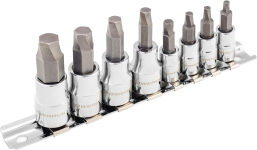
While these are made for rounded off hex head bolts, there's a chance one of them will fit (if there's room side to side). I've found them to be super handy to have around. Maybe worth a try?

I like those, but IME, you gotta go undersize, be able to hammer it on, and they prevent working it back and forth. If there is clearance, they do grip!
 

Al Borland

Well-known member
Joined
Jan 20, 2016
Messages
1,601
Smack the bracket. Try to get it to break loose from any corrosion. If it moves, it will move the bolt.
 

sk farmer

Well-known member
Joined
Mar 4, 2009
Messages
5,574
Location
nd
Because the housing and the bolt are different materials, they expand at different rates. In this case the aluminum housing will grow more (2X more) than the bolt due to the difference in their coefficients of thermal expansion.

The reason why this doesn't insta work is we typically heat the bolt, which then conducts heat to the other bigger part, which acts as a heat sink. So its really tough to get both components to the same temperature.

The reason why it works at all or works steel in steel is that the growth from the heat causes some tiny displacement between the parts. Even if the bolt gets bigger in the hole, the relative displacement tends to break loose whatever corrosion has glued the mating parts together. So I think in practice people find it doesn't matter too much which part you heat.
maybe not in every scenario but on more than one occasion i have seen guys including me heat the bolt red hot and it doesnt move. leave the bolt "cold" and heat the surrounding area and it comes loose.

similar to a cold bearing not moving on a shaft. heat it up and it falls in place or falls off.
 
To avoid these ads, REGISTER NOW!
Top Bottom