To avoid these ads, REGISTER NOW!

Impact Wrench Max Torque of 250 ft lb Recommendations

YoshiMoshi3

Well-known member
Joined
Nov 2, 2022
Messages
520
I see that the Ken Tools torque sticks are calibrated using a 250 ft lb pneumatic impact wrench, 1/2 drive. If you use an impact wrench whose torque is higher, you have to calibrate it to use less power to get closer to 250 ft lb.

So now my question is, can anyone recommend an electric impact wrench whose maximum fastening torque is 250 ft lb so I could just use that please? I know there's that claims from the manufacturer are one thing, vs actual maximum fastening torque. Looked at torque test channel and couldn't find anything that low in 1/2 " drive, but maybe I didn't look hard enough.

Any suggestions on how to get an impact wrench to limit it's torque to 250 ft lb max fastening by changing settings, or finding one whose max fastening torque is actually 250 ft lb?
 
To avoid these ads, REGISTER NOW!
OP
Y

YoshiMoshi3

Well-known member
Joined
Nov 2, 2022
Messages
520
It seems like if I don't want to constantly "calibrate" or to avoid calibrating all together, I need a 1/2 " impact wrench whose max torque is 250 ft lb fastening torque (advertised and actual). I can get one that is higher, and change the speed settings, but then it's still unknown if for example setting is 2 is 250 ft lb or 100 ft lb or nobody knows.

1785288828113.png
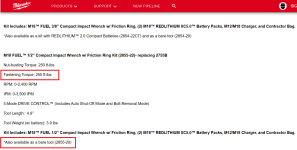
Maybe a Milwaukee 2855-20 whose max fastening torque is 250 ft lb? Not sure if it's worth getting just to use torque sticks though huh?
1785288924873.png

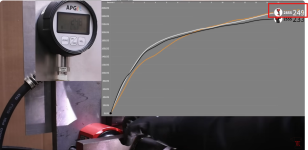
Not sure what battery torque test channel was using, but when they tested it for 15 seconds it got up to 249 ft lb, and not sure if that was fastening or nut busting either.
1785289122473.png
 

Roert42

Well-known member
Joined
Jan 25, 2023
Messages
205
Location
NE Penn
Look at corded electric impacts instead of cordless. Much lower ratings. Milwaukee has theirs rated at 300ft/lbs.


Also consider that the bpm is higher with electric then pneumatic, this effects how the toque sticks work.

You’ll want to find torque sticks that are rated to work with an electric impact not a pneumatic one. Or at the least state the bpm that they are calibrated for.
 

dnschmidt

Well-known member
Joined
Oct 3, 2014
Messages
7,340
Location
Phoenix, AZ
Torque sticks work best with pneumatic impacts. The reason is they have a slower BPM which gives the stick a chance to untwist prior to the next impact. Find yourself an I-R 231 and that solves your problem. I have at least 20 impact wrenches (probably more) most of which are cordless but if you insist on using torque sticks the old school pneumatic can't be beat.
 

Hakeem

Well-known member
Joined
Jan 22, 2024
Messages
1,351
Location
Chicago
Play around with the settings on your impact until the torque sticks get the nuts to about 1/4 turn from end torque.

On my Matco air gun I set it to “one” and hit the lug nuts until they stop moving and my HF torque sticks will get them to the perfect setting 9/10 times
 

AJHD

Well-known member
Joined
Jan 4, 2020
Messages
3,125
Location
AZ
Play around with the settings on your impact until the torque sticks get the nuts to about 1/4 turn from end torque.

On my Matco air gun I set it to “one” and hit the lug nuts until they stop moving and my HF torque sticks will get them to the perfect setting 9/10 times

Question for you, and anyone else, do you verify or final torque them with a torque wrench? I did whenever I was forced to use them.

When I worked at PepBoys for example, we had to use them per company policy. We were issued 2 or 3 different specs and I hated them. But then again we had to do a lot of stupid ****.

At more than 1 shop I worked at we had to have a 2nd person verify wheel torque before a vehicle left the bay regardless.
 

Hakeem

Well-known member
Joined
Jan 22, 2024
Messages
1,351
Location
Chicago
Question for you, and anyone else, do you verify or final torque them with a torque wrench? I did whenever I was forced to use them.

When I worked at PepBoys for example, we had to use them per company policy. We were issued 2 or 3 different specs and I hated them. But then again we had to do a lot of stupid ****.

At more than 1 shop I worked at we had to have a 2nd person verify wheel torque before a vehicle left the bay regardless.
Yes, every time. The torque sticks are just to ensure I don’t overshoot it. I put the wheel(s) on, zip the lug nuts on with the torque sticks, drop the truck on the ground, and torque to spec with a split beam torque wrench. Admittedly, I’m pretty sure I’m the only mechanic who uses a torque wrench on wheels—everyone else just guns them on—but it satisfies my OCD and covers my *** if there’s ever an incident.

I work at a ford light/medium duty dealership so there’s not too many torque specs … if the lug nuts are 19mm it’s 100ftlbs and if they’re 21mm it’s 150ftlbs so I just keep two torque sticks on my cart. About one out of five vehicles I see uses the big 33mm lugs that get torqued to 450ftlbs.

I don’t think it’s a bad idea to have another tech verify the torque on wheels and drain plugs, given the consequences of a wheel coming off or a drain plug that falls out, but it can be burdensome.
 
To avoid these ads, REGISTER NOW!

KnurledNut

Well-known member
Joined
Jan 28, 2011
Messages
8,367
Location
n/a
I work at a ford light/medium duty dealership so there’s not too many torque specs … if the lug nuts are 19mm it’s 100ftlbs and if they’re 21mm it’s 150ftlbs so I just keep two torque sticks on my cart.
Some of the Super Duty M14 nuts I’ve worked with call for 165 lb-ft.
 

johninct

Well-known member
Joined
Dec 21, 2010
Messages
2,611
My old Snap-On 3850 is a little below 250 ft lb and works good with torque sticks but the batteries are getting old. I did get the lowest torque stick I could find (I forget the spec) and want to someday try it with my cordless IR and see the results in case my Snap-On battery dies. The IR is just too powerful for torque sticks meant for 250 ft lb.
 

dnschmidt

Well-known member
Joined
Oct 3, 2014
Messages
7,340
Location
Phoenix, AZ
Hakeem's got it right. Use a torque stick to tighten just below what is specified and finish it off with a torque wrench. Since we are specifically taking about wheels a split beam (I'd suggest the ICON) is the best torque wrench for this job as they can take the most abuse.
 

KnurledNut

Well-known member
Joined
Jan 28, 2011
Messages
8,367
Location
n/a
Sometimes I use my old Makita 3/8 impact wrench for setting lugnuts before torquing. It’s torque potential is much less than most modern brushless versions, but enough to run them up without over tightening.
 
Last edited:

mikedodge

Well-known member
Joined
Jun 27, 2017
Messages
2,965
They require an impact.
Solid torque from an electric isn't going to happen. In addition to what someone else said about the going faster causing issues with those torque sticks the max torque coming out of them largely depends on the battery charge and condition. Just like torque from a pneumatic one can bel all over the place if the air pressure isn't consistent.

Do like most people and either make sure they're tight and call it done or get a proper torque wrench to check them with.
 

Yarpo

Well-known member
Joined
Feb 11, 2017
Messages
1,370
Location
Minnesota
Yes, every time. The torque sticks are just to ensure I don’t overshoot it. I put the wheel(s) on, zip the lug nuts on with the torque sticks, drop the truck on the ground, and torque to spec with a split beam torque wrench. Admittedly, I’m pretty sure I’m the only mechanic who uses a torque wrench on wheels—everyone else just guns them on—but it satisfies my OCD and covers my *** if there’s ever an incident.
Yup this is how I did it. 130 NM (~90 ft pound) torque stick, zip them on, drop the car, final torque with a click torque wrench.
Not sure if I'm OCD, but I am paranoid when working on others vehicles.
 

908Jim

Well-known member
Joined
Aug 1, 2013
Messages
573
Torque sticks work best with pneumatic impacts. The reason is they have a slower BPM which gives the stick a chance to untwist prior to the next impact.
@YoshiMoshi3 - ^This^ is spot on. Torque sticks are not recommended for high speed electric impacts. They don't work effectively.

I am not sure about your exact needs, but my DCF891 has published (approximate) torque limits for each power range. It lists 100ftlbs for Low, 300 ftlbs for medium, and 600ftlbs for high. The smaller DCF921 is 150 ftlbs on setting 1. The 891 on setting 1 is great for lug nuts. If I let off early, I am usually around 75-80 ftlbs and I finish off with a torque wrench.
 

AJHD

Well-known member
Joined
Jan 4, 2020
Messages
3,125
Location
AZ
Yup this is how I did it. 130 NM (~90 ft pound) torque stick, zip them on, drop the car, final torque with a click torque wrench.
Not sure if I'm OCD, but I am paranoid when working on others vehicles.

Not OCD, it's called being a professional.
I use my impact for that initial lug nut tightening, but always go over and check with a torque wrench. They're not always tight or otherwise at final torque.

Mistakes happen. We're all human. But there are steps we can take to ensure our work is done correctly... My current job is not mechanical, but we have a double check and a final check by at least 1 other employee to ensure the forms/process is correct for every customer.

Like I mentioned some of the shops I worked in had similar policies with checking wheels. I think one may of had a drain plug check too.

Thankfully it's never happened to me but people I've worked with had wheel falls off a customers car or bricked an engine because they didn't tighten the drain or forget to refill the engine with oil.

My neighbor literally had a new engine put in her car a few weeks ago. The Walmart oil change didn't tighten the drain plug and if fell out. Thankfully Walmart paid for everything except the rental.
 
To avoid these ads, REGISTER NOW!
Top Bottom