To avoid these ads, REGISTER NOW!

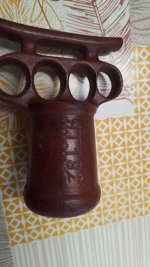
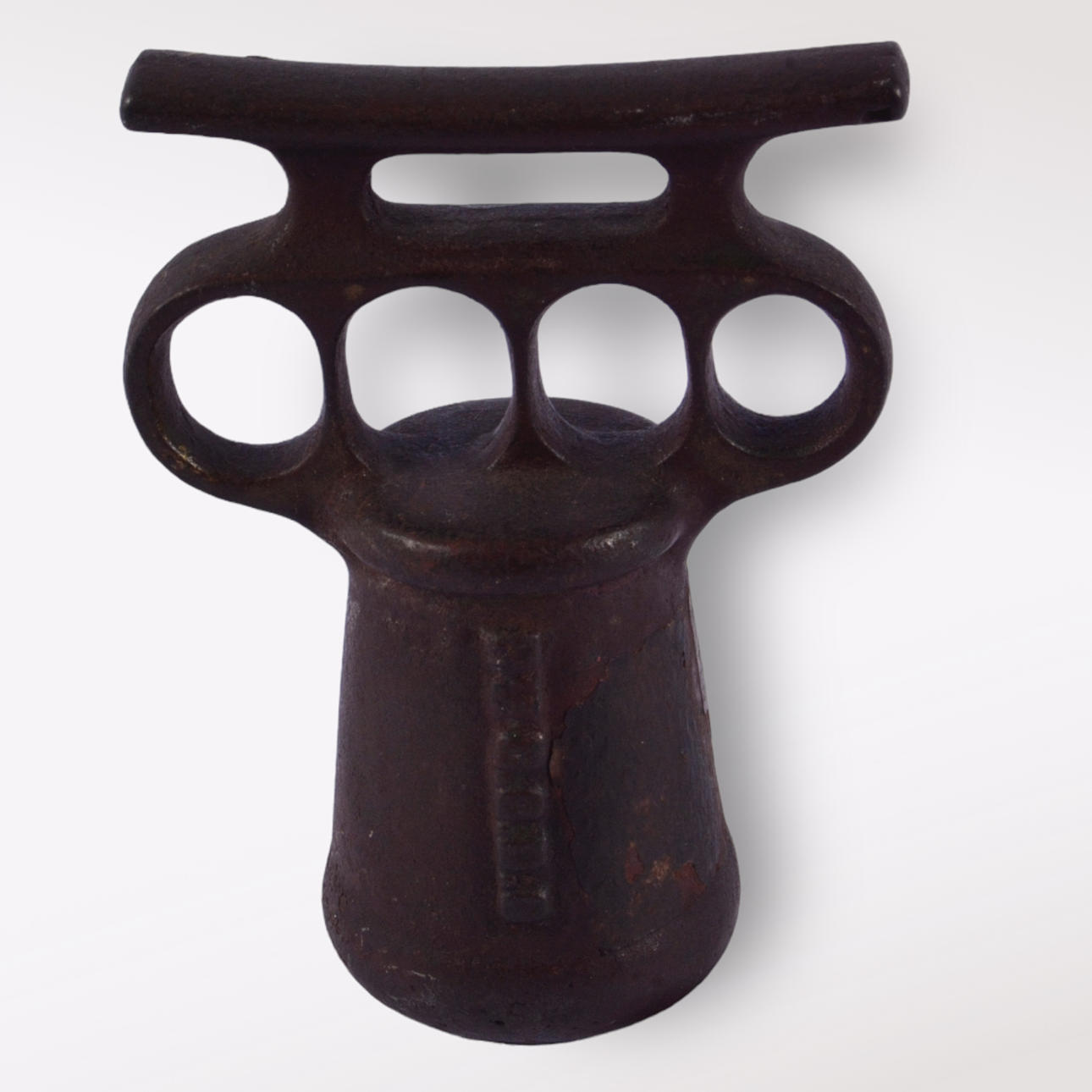
Can anyone identify this old cast iron tool ?

Rauxas

New member
Joined
Jul 28, 2026
Messages
4
Location
France
It weighs about 1 kg or less and is approximately 13 cm tall.
The square opening is about 25 mm across and is lined with old leather.
It has four finger holes probably for grip, a logo that looks like a falling star on one side, and the marking "HT.182" on the other.
I have no idea what it was used for and would appreciate any help identifying it.
 

Attachments

  • P_20260728_205544.jpg
    P_20260728_205544.jpg
    290.3 KB · Views: 110
  • P_20260728_205552.jpg
    P_20260728_205552.jpg
    310.8 KB · Views: 115
  • P_20260728_205604.jpg
    P_20260728_205604.jpg
    389.7 KB · Views: 110
To avoid these ads, REGISTER NOW!

bwringer

Well-known member
Joined
Jan 1, 2013
Messages
10,345
Location
Indianapolis
What country are you in? And is it reasonable to expect it originated there?
Yep, this might be good to know.

And does your city or a city nearby have steam piping, or did it used to have steam piping? A lot of dense urban areas, universities, etc. still use steam heating.

This is all pure speculation, but I'm thinking this might have been a "key" used to control these systems, when the valve was someplace that wasn't monitored. You wouldn't want to have a hand wheel in public where any old joker could turn it. Smaller versions of this square key are used for controlling steam radiators to this day.

The leather in this one leads me to think it would have been used on hot valves, which would not describe gas or water piping. If you need several turns to open or close the valve, then you'd want to insulate the handle. (There's also hot water piping in some kinds of factories, and chilled water used for cooling in many buildings and industries.)

All the locomotive controls I've seen have handles, knobs, etc. -- no separate tools required, since the only people with access to locomotives are (well, should be) the professionals who know how everything works, and they don't have time to fumble around for a tool when they're running a mile a minute.
 

bwringer

Well-known member
Joined
Jan 1, 2013
Messages
10,345
Location
Indianapolis
That's a good line of inquiry @bwringer. Or possibly the leather gasketing is just for fitment and this was just a handle.

Thanks. Interesting. I was thinking agriculture. Pure speculation, though.

I'm also wondering if it's somehow related to gas lighting used in many US and European cities in the 19th century. Seems way too big to be used for a single lamp, but maybe it was related to the distribution system. Perhaps the leather was to keep it from sparking.

Whatever this thing was used to turn, I really like how it's a lot more interesting and beautiful than it needs to be.
 

four.cycle

Well-known member
Joined
Oct 19, 2015
Messages
29,524
Location
Tacoma, Washington
^ well.... according to that website, it is indeed a Swedish corkscrew.
How you get a cork out of a wine bottle with that device is beyond my ability to comprehend.

Maybe you just smash the neck of the bottle with the thing and pour? :unsure:
 
To avoid these ads, REGISTER NOW!

MongoTA

Well-known member
Joined
Mar 10, 2018
Messages
1,025
Location
CT
It may be a version of a "hand cannon", sometimes described as a signal flare launcher. There's a touch hole on the side, near the shooting star, for igniting the powder.

EDIT: I just noticed you're in France! Check this link: Antique
 
Last edited:

Copymutt

Well-known member
Joined
Sep 3, 2016
Messages
3,416
Location
Colorado
Im guessing its a grate shaker for a coal stove.
square stud extends out of the lower portion of the stove, slip this over it and rock it back & forth.
 

Private Lugnutz

Well-known member
Joined
Mar 30, 2012
Messages
30,812
Location
The Authentic Jersey Shore
Full, lengthy page with some references to a hand cannon, and some to a wine bottle capper
The references to "hand cannon" were only made in eliminating it as erroneous and identifying it as a wine bottle capper, with numerous catalog references. Essentially, a collector is debunking the hand cannon claim as apocryphal, which seems to have been attached to the device in the same way we often see on eBait and Worthpoint with some obscure hand tools.

I'm claiming categorical proximity with my agricultural guess. :)

Very nice work, @mrb1 !
 

mrb1

Well-known member
Joined
Aug 20, 2021
Messages
5,624
Location
Miami County, Ohio
About the only part of that page in English....
"The device is a punch capsulator for capping wine bottles with tin/lead caps from the early 1900's.
It was used with a lead/tin capsule to add the crimp on the bottle by rotating the device. Inside the capsulator is a rubber/leather O-ring to crimp the capsule around the neck.
There are three variations I found so far, marked: HT182, Brevetés S.G.D.G. and a third version that is a little different. All of them have some sort of falling star as a logo.
Note from Littlegun: Thanks a lot to Marc for this nice info. Identification is sometimes a very delicate thing!!!"


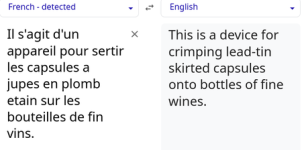
Maybe the hole is for air escaping, or inserting a pick tool to remove a mistake? AI can't translate this page visually. And I'm not entering it word for word :LOL: I did the first sentence from the quote in the below image. Now the real question...Will the OP ever return? :LOL:

Screenshot 2026-07-29 at 05-59-10 et sur l'autre in english - Google Search.png
fffr.png
 
Last edited:

redragoon

Well-known member
Joined
Jun 12, 2018
Messages
298
Location
Greenville SC
About the only part of that page in English....
"The device is a punch capsulator for capping wine bottles with tin/lead caps from the early 1900's.
It was used with a lead/tin capsule to add the crimp on the bottle by rotating the device. Inside the capsulator is a rubber/leather O-ring to crimp the capsule around the neck.
There are three variations I found so far, marked: HT182, Brevetés S.G.D.G. and a third version that is a little different. All of them have some sort of falling star as a logo.
Note from Littlegun: Thanks a lot to Marc for this nice info. Identification is sometimes a very delicate thing!!!"


Maybe the hole is for air escaping, or inserting a pick tool to remove a mistake? AI can't translate this page visually. And I'm not entering it word for word :LOL: I did the first sentence from the quote in the below image. Now the real question...Will the OP ever return? :LOL:
You can try using google translate with the phone camera.
 
OP
R

Rauxas

New member
Joined
Jul 28, 2026
Messages
4
Location
France
Hello, I am truly impressed !
Given how unusual this object is, I honestly didn't expect anyone to identify it.
I had a few ideas, but none of them came close to the correct answer.
I live in a region where agriculture and winemaking are pretty common, yet nobody here in my region recognized it.
If it would be helpful, I can translate the main points of the French article/discussion about this object into English.
Your findings are amazing thank you all !
(I should point out that there's a significant time difference between us, which is why I didn't reply sooner.) :LOL:
 
OP
R

Rauxas

New member
Joined
Jul 28, 2026
Messages
4
Location
France
Below is a summary of the main and most relevant information.

It is an early bottle capper used to apply lead capsules over the corks of wine bottles. Before the widespread use of modern foil capsules, soft lead capsules were fitted over the bottle neck to protect the cork and provide a neat finish.

To use the tool, a bottle with a pre-fitted lead capsule was inserted into the leather-lined socket. The operator then held the tool in one hand and gave it a slight twisting motion. The leather insert gripped the bottle neck while the rotating motion crimped and shaped the soft lead capsule around it without damaging the glass.


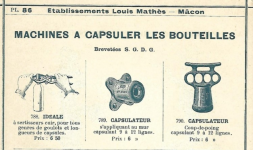
According to the article, this tool appears in a 1910 catalog from Louis Mathas in Mâcon, a supplier to wine merchants and wine cellars. Mâcon is a well-known wine-producing town in France, located only about 1H30 drive from where I live.

Interestingly, the article also explains that collectors debated the purpose of this object for many years. Some believed it was an American-style brass knuckle or simply a cellar accessory, until a French oenologist finally identified it as a bottle capper.
 

mrb1

Well-known member
Joined
Aug 20, 2021
Messages
5,624
Location
Miami County, Ohio
Thanks for the reply and translation @Rauxas ..just joking around about the reply thing. Guessing 80% of new members with a one time post asking for ID never return, or at least never come back to update. Plan on selling? Scores of tabletop, arbor press types on ebay. None at all like yours.
 
OP
R

Rauxas

New member
Joined
Jul 28, 2026
Messages
4
Location
France
I can imagine that very few people come back to give an update, so I didn't take your comment the wrong way at all. :LOL:

The object doesn't actually belong to me. It was found at a "flea market", and it will probably either be kept as a collectible or sold someday. The decision isn't mine personally.

Either way, learning about its history, origin, and how it was used is really fascinating.
I really appreciate everyone taking the time to help identify it and share their knowledge.
 
To avoid these ads, REGISTER NOW!
Top Bottom