
You are using an out of date browser. It may not display this or other websites correctly.
You should upgrade or use an alternative browser.
You should upgrade or use an alternative browser.
H.D. Smith Company, Plantsville, CT
- Thread starter Private Lugnutz
- Start date

OP
Private Lugnutz
Well-known member
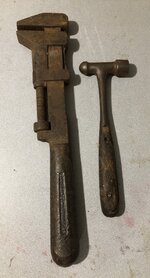
^ That's a helluva "start"! The hammers don't grown on trees. Also, that may be the first "Semper Idem Steel" example on the thread. At least the first that was called out in text that the Search function would be able to pick up. @MR.X mentioned the compositional style branding in a reply to @AreBeeBee about his abbreviated "S.I.S." example here, and @four.cycle includes a "Semper Idem / See H.D. Smith /" entry in his A-Z Mfgrs Index, here. But no further info in the H.D. Smith entry that I can see. That's it. While I have seen them before, I have never seen any ads or trade magazine material for the branding. Thanks for posting.
four.cycle
Well-known member
^ You challenge my memory, sir. Just picked through the entire "H.D. Smith" folder and I can find no "Semper Idem", so I have to assume I got the term either from one of Stan's flicker pages or from an ebay listing. Not seeing it in any of the old catalog pages.
four.cycle
Well-known member
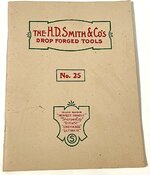
1920 H.D. Smith catalog No. 25 front cover
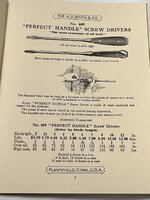
1920 H.D. Smith catalog No. 25 pp 7
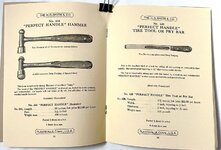
1920 H.D. Smith catalog No. 25 pp 18-19

1920 H.D. Smith catalog No. 25 pp 24
when I run a search on ITCL for "H.D. Smith", the two small *.pdf files attached below do not show up, so here they are (below - click to download them.) (Mark and I have completely different ways of naming files, so that might be why I didn't find them.)
I posted some early catalog pages previously in the thread.
Attachments
Here is a good video on these railroad wrenches. The shorter length all steel handled railroad wrenches use the SIS abbreviation.
Perfect Steel Handle Railroad Wrench
Perfect Steel Handle Railroad Wrench
From the pdf file, I wish I could order this lol
1920 H.D. Smith catalog No. 25 front cover
1920 H.D. Smith catalog No. 25 pp 7
1920 H.D. Smith catalog No. 25 pp 18-19
1920 H.D. Smith catalog No. 25 pp 24
when I run a search on ITCL for "H.D. Smith", the two small *.pdf files attached below do not show up, so here they are (below - click to download them.) (Mark and I have completely different ways of naming files, so that might be why I didn't find them.)
I posted some early catalog pages previously in the thread.
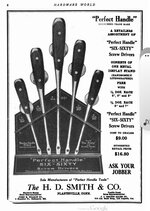
nz44tool
ALLIANCE MEMBER
Just got this H.D. Smith tire iron; it's in rough shape.
I could use some advice, namely leave it alone, or restore it.
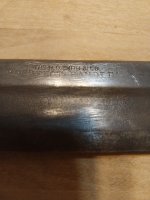
The metal is rusty but not too degraded. The lettering is mostly intact.
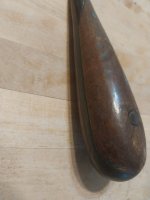
The wood in the "perfect handle" isn't so perfect anymore, and would need to be replaced, at any level of restoration, IMO.
Any thoughts?
I could use some advice, namely leave it alone, or restore it.
The metal is rusty but not too degraded. The lettering is mostly intact.
The wood in the "perfect handle" isn't so perfect anymore, and would need to be replaced, at any level of restoration, IMO.
Any thoughts?
Attachments
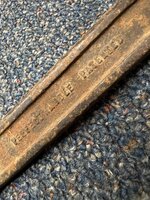


I would wire wheel the metal to get the rust off. Then sand the handle lightly to remove any loose bits of wood. I'd give the wood a good amount of boiled linseed oil and then wipe the metal with a coat as well.Just got this H.D. Smith tire iron; it's in rough shape.
I could use some advice, namely leave it alone, or restore it.
The metal is rusty but not too degraded. The lettering is mostly intact.
The wood in the "perfect handle" isn't so perfect anymore, and would need to be replaced, at any level of restoration, IMO.
Any thoughts?
You can make new wood handle scales, there are several posts where people have done it. I made some new ones for a screwdriver that was missing the scales out of walnut and it looks good.
nz44tool
ALLIANCE MEMBER
Thanks - I appreciate the advice.I would wire wheel the metal to get the rust off. Then sand the handle lightly to remove any loose bits of wood. I'd give the wood a good amount of boiled linseed oil and then wipe the metal with a coat as well.
You can make new wood handle scales, there are several posts where people have done it. I made some new ones for a screwdriver that was missing the scales out of walnut and it looks good.

I found a pair of multi-function nippers like HeelSpur's, only with the addition of a wire cutting notch just above the pivot.6" nippers that needed a serious cleaning.
(Like his, they've got the screwdriver and a tack/nail puller at the ends of the handles.)
Markings: (S in circle) H.D.S & Co. U.S.A.".
They are 6.1 inches overall length.

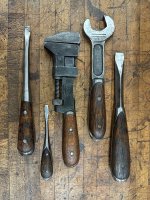
Here are a few more perfect handles for the collection:
1) square-shank H.D. Smith
2) 1” open-end patented H.D. Smith (marked Brown & Sharpe MFG. Co. Providence R.I. U.S.A.)
3) 8 1/2” monkey wrench - H.D. Smith
4) 3/16” x 5” screwdriver
5) 1/4” x 8” new perfect-handle manufacturer that I haven’t seen or collected before = Atlas Tool Co.
1) square-shank H.D. Smith
2) 1” open-end patented H.D. Smith (marked Brown & Sharpe MFG. Co. Providence R.I. U.S.A.)
3) 8 1/2” monkey wrench - H.D. Smith
4) 3/16” x 5” screwdriver
5) 1/4” x 8” new perfect-handle manufacturer that I haven’t seen or collected before = Atlas Tool Co.
Attachments

four.cycle
Well-known member
possibly
Atlas / Atlas Tool Co., New York, NY / pliers, wrench, calipers / https://papawswrench.com/vboard/index.php?topic=8258.0 / https://www.garagejournal.com/forum/threads/atlas-tool-company-new-york.551927/ /
there are a couple more "Atlas" companies, but I think this is the one that made your screwdriver.
Atlas / Atlas Tool Co., New York, NY / pliers, wrench, calipers / https://papawswrench.com/vboard/index.php?topic=8258.0 / https://www.garagejournal.com/forum/threads/atlas-tool-company-new-york.551927/ /
there are a couple more "Atlas" companies, but I think this is the one that made your screwdriver.
OP
Private Lugnutz
Well-known member
I finally joined the relatively prestigious "GITATIT" Club (other members include @RagTopTA and @Fred Knox) at the flea market yesterday!


Mine were unfortunately branded too close to the slip joint holes and the action from the pin being slid from one slot into the other over the years wore much of the right-hand side of the marking into illegibility.

If you search the thread on "offset" or "646" you will see the other examples, all with much better markings than mine, but those patent dates should read "JUNE 9 1914" (which corresponds to the Design Patent D45919) and "FEB 20 1917" (which corresponds to the Utility Patent 1216886).
A PO had wrapped layers upon layers of some kind of stubborn masking tape around the jaws (which you can see in the photo of my entire flea market haul in the thumbnails below), no doubt to blunt the serrations, but I was impressed not only with the depth of those, but the punctuations of diamond knurling in all the smooth surfaces, for even more grip.

Reminder catalog cut below.
Mine were unfortunately branded too close to the slip joint holes and the action from the pin being slid from one slot into the other over the years wore much of the right-hand side of the marking into illegibility.
If you search the thread on "offset" or "646" you will see the other examples, all with much better markings than mine, but those patent dates should read "JUNE 9 1914" (which corresponds to the Design Patent D45919) and "FEB 20 1917" (which corresponds to the Utility Patent 1216886).
A PO had wrapped layers upon layers of some kind of stubborn masking tape around the jaws (which you can see in the photo of my entire flea market haul in the thumbnails below), no doubt to blunt the serrations, but I was impressed not only with the depth of those, but the punctuations of diamond knurling in all the smooth surfaces, for even more grip.
Reminder catalog cut below.
Attachments


OP
Private Lugnutz
Well-known member
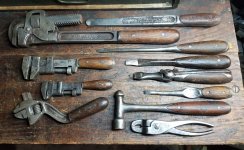
Of the eleven (11) total tools I now have in my H.D. Smith collection, the offset pliers are the only tool that does not have the feature the company was most famous for! Which a photo makes more obvious than words.
d42jeep
Well-known member
Here is the pair I posted in the Plier thread last December. The markings weren’t particularly clear.I finally joined the relatively prestigious "GITATIT" Club (other members include @RagTopTA and @Fred Knox) at the flea market yesterday!
Mine were unfortunately branded too close to the slip joint holes and the action from the pin being slid from one slot into the other over the years wore much of the right-hand side of the marking into illegibility.
If you search the thread on "offset" or "646" you will see the other examples, all with much better markings than mine, but those patent dates should read "JUNE 9 1914" (which corresponds to the Design Patent D45919) and "FEB 20 1917" (which corresponds to the Utility Patent 1216886).
A PO had wrapped layers upon layers of some kind of stubborn masking tape around the jaws (which you can see in the photo of my entire flea market haul in the thumbnails below), no doubt to blunt the serrations, but I was impressed not only with the depth of those, but the punctuations of diamond knurling in all the smooth surfaces, for even more grip.
Reminder catalog cut below.


-Don
What a Kewl looking set of pliers.I finally joined the relatively prestigious "GITATIT" Club (other members include @RagTopTA and @Fred Knox) at the flea market yesterday!
Mine were unfortunately branded too close to the slip joint holes and the action from the pin being slid from one slot into the other over the years wore much of the right-hand side of the marking into illegibility.
If you search the thread on "offset" or "646" you will see the other examples, all with much better markings than mine, but those patent dates should read "JUNE 9 1914" (which corresponds to the Design Patent D45919) and "FEB 20 1917" (which corresponds to the Utility Patent 1216886).
A PO had wrapped layers upon layers of some kind of stubborn masking tape around the jaws (which you can see in the photo of my entire flea market haul in the thumbnails below), no doubt to blunt the serrations, but I was impressed not only with the depth of those, but the punctuations of diamond knurling in all the smooth surfaces, for even more grip.
Reminder catalog cut below.
OP
Private Lugnutz
Well-known member
^ Indeed, and functionally shrewd vs. regular slip joints, equivalent to and working on the same principle as an offset DBE vs. straight pattern DBE in avoiding obstructions and saving skinned knuckles.
nz44tool
ALLIANCE MEMBER
Gosh, I'd love to have a pair of those! Plantsville is just down the road from me; you'd think there'd be some to be found...^ Indeed, and functionally shrewd vs. regular slip joints, equivalent to and working on the same principle as an offset DBE vs. straight pattern DBE in avoiding obstructions and saving skinned knuckles.
Got this today. 6 inch straight adjustable wrench. It didn’t move at all when I got it. Pb blaster, heat, and tapping it back and forth finally got it moving. It had a little bit of twist that I was able to get mostly straight by putting it in the vise and pulling the handle. It's moving much better after that.

OP
Private Lugnutz
Well-known member
Nice!6 inch straight adjustable wrench