To avoid these ads, REGISTER NOW!

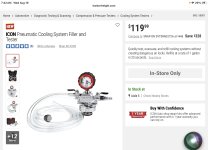
New ICON coolant pressure tester

Hakeem

Well-known member
Joined
Jan 22, 2024
Messages
1,327
Location
Chicago
IMG_2322.jpeg
IMG_2323.jpeg

At $400 for the pressure test kit and $120 for the vacuum filler, it’s not cheap. Much less than the tool trucks, but then again—what isn’t. About twice the cost of the Astro kit, but with all-metal construction, i suppose it’s reasonable. Disappointing to see a 1-year warranty.

Above all, it’s nice to see HF continuing to release new tools for professionals and serious DIYers.
 
To avoid these ads, REGISTER NOW!

Fedwrench

ALLIANCE MEMBER
Joined
Dec 9, 2007
Messages
14,972
Location
Valley of the sun
I agree that it's great to see new products released but, I'm on the fence about these. The price seems a bit high at first until you count up the cost of all of the individual adapters. Then it's a bargain if the adapters are decently made. The vacuum filler set lacks seals or adapters and really isn't a stand alone unit without the adapters included in the pressure test kit unless the vehicle you're working on uses the old style radiator cap. There's a lot of competition and variety in this market segment. Time will tell if this set is a hit or a miss. :dunno:
 

Astro_Pneumatic_Tools

Well-known member
Joined
Oct 30, 2013
Messages
2,127
Location
South El Monte
There is demand for the all metal type caps, and i suppose people like them. Though I'm unsure fully why or if people think the metal parts are doing the sealing. The seal mainly comes down to the gaskets & o-rings mainly, and the quality of thread engagement regardless of what its made from - could be bronze. But its easier to form consistent bur free non overly sharp threads in nylon than steel and aluminum. And nylon seals against plastic, composite and nylon easier than metal does.

People will unscrew the composite cap on their overflow tank that's been leak free for 150k miles and look for a steel and aluminum adapter to thread onto the same tank to test it for 5 mins out of preference for unknown reasons to me.
You also can't get them as tight, as they are round you just turn them. If seal IS an issue for you, the set that has recessed dimples in the top of caps and a wrench that fits it, I'd imagine you'd go that route.
If you are cross threading caps often enough to damage adapters, you'd prefer the adapter to take the hit than use metal to do so on the customers car.

We've had the opportunity to offer them a few times, just haven't found a reason to charge 1.5-2X to our customers on caps that hold vacuum the same 24+ hours as our current ones (the good metal ones, there's poor all metal sets that hold vacuum for about 15 mins)
 
Last edited:
OP
H

Hakeem

Well-known member
Joined
Jan 22, 2024
Messages
1,327
Location
Chicago
I agree that it's great to see new products released but, I'm on the fence about these. The price seems a bit high at first until you count up the cost of all of the individual adapters. Then it's a bargain if the adapters are decently made. The vacuum filler set lacks seals or adapters and really isn't a stand alone unit without the adapters included in the pressure test kit unless the vehicle you're working on uses the old style radiator cap. There's a lot of competition and variety in this market segment. Time will tell if this set is a hit or a miss. :dunno:

The vacuum filler definitely was intended to be an add-on, which isn’t a huge deal to me. A decent move might be to buy the vacuum filler and then buy the adapters from Snapon individually as needed. I think they’d sell more of the vacuum filler if they had the universal adapter like the Airlift…but then they might sell less of the coolant adapter kits.

Looking at it again, the biggest issue I see is a lack of a shop-air pressure tester. Pressurizing the system by hand *****. I have the Astro shop-air pressure tester and it’s amazing. Maybe they’ll be coming out with that in the future.

There is demand for the all metal type caps, and i suppose people like them. Though I'm unsure fully why or if people think the metal parts are doing the sealing. The seal mainly comes down to the gaskets, and the quality of thread engagement regardless of what its made from - could be bronze. But its easier to form consistent bur free non overly sharp threads in nylon than steel and aluminum. And nylon seals against plastic, composite and nylon easier than metal does.

People will unscrew the composite cap on their overflow tank that's been leak free for 150k miles and look for a steel and aluminum adapter to thread onto the same tank to test it for 5 mins out of preference for unknown reasons to me.
You also can't get them as tight, as they are round you just turn them. If seal IS an issue for you, the set that has recessed dimples in the top of caps and a wrench that fits it, I'd imagine you'd go that route.
If you are cross threading caps often enough to damage adapters, you'd prefer the adapter to take the hit than use metal to do so on the customers car.

We've had the opportunity to offer them a few times, just haven't found a reason to charge 1.5-2X to our customers on caps that hold vacuum the same 24+ hours as our current ones (the good metal ones, there's poor all metal sets that hold vacuum for about 15 mins)

Very reasonable. As a consumer, metal just *seems* better, even if there is no real performance benefit. For what it’s worth, I have your pressure tester kit and it’s been great for me.
 

mikedodge

Well-known member
Joined
Jun 27, 2017
Messages
2,922
What market are they aiming for with that? It's high for a DIYer and most professionals wouldn't be buying a tool like that from HF. It would be nice if they had the tester with a couple of the standard attachments for a better price.

The plus about plastic is ones is the metal ones can corrode over time and stop working properly.
 

drokihazan

Well-known member
Joined
Apr 8, 2018
Messages
320
I'm curious if the Icon adapters fit the Snap-On pressure tester I've been using for years, I think made by Stant. I've thought about buying one of these big kits from a different brand just for more adapters rather than paying Snap-On prices for tools I won't use frequently and probably work exactly as well from any brand.
 

Sumboodie

Well-known member
Joined
Mar 20, 2021
Messages
10,960
Location
AK
I have a ~$90 kit off Amazon that has worked for my needs. Recently pressure tested a TDI Jetta and OBS F350 to find tiny leaks that I couldn't find otherwise.
 
To avoid these ads, REGISTER NOW!

Qualitytools

Well-known member
Joined
Apr 30, 2014
Messages
2,872
Location
SOCAL
Unless you need to use these tools on a regular bases, not sure if that’s the best option Is to purchase them. You may want to see what other brands are selling for.

When I need to use those I just get them on loan from my local parts store. Finish the job at hand, clean it and return it for a full refund of the deposit.
 

Callelle

Well-known member
Joined
Feb 3, 2022
Messages
665
Location
Depew NY
I have the snap on dual venturi HD refiller because I'm working on semis, otherwise I'd run either this or the astro set up. I personally prefer the metal adapters, they feel more durable, especially when you're using one individual cap on multiple vehicles every day.
 

lbhsbz

Well-known member
Joined
Jan 13, 2010
Messages
1,186
Location
Long Beach CA
just start the car and let it warm up and pressurize the cooling system....then see where it's leaking. I have a Stant pressure tester, with a bunch of adapters, but always giggle when I go to use it because it does the same thing as running the car for 10 minutes lol
 

Twisted Sid

Well-known member
Joined
May 23, 2013
Messages
786
Location
CA
just start the car and let it warm up and pressurize the cooling system....then see where it's leaking. I have a Stant pressure tester, with a bunch of adapters, but always giggle when I go to use it because it does the same thing as running the car for 10 minutes lol
Except when you pressurize it and have a leak, you're not then working on a 200° engine or waiting for it to cool down enough to work on it
 

MushCreek

Well-known member
Joined
Jan 14, 2015
Messages
9,951
Location
Upstate South Carolina
I just put a pressure gauge where the overflow hose goes and put 15 psi on the system. Found three leaks right away. Fixed them all, and it's still leaking coolant somewhere.
 
To avoid these ads, REGISTER NOW!
Top Bottom