BlackdogGS
Well-known member
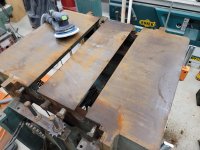
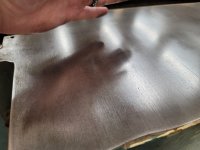
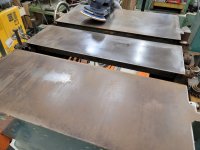
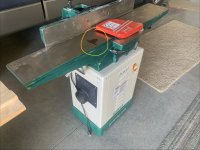
I have a spot of rust on my jointer surface. I plane on sanding it off but I’m not sure what grit to start and end with. Any ideas?

NO, don't do this on a jointer surface! It's way too aggressive.3M makes a red paint/varnish removing disk that is about 4 to 4.5 inches in diameter and is made from a coarser scotchbrite material. I use these in an angle die grinder to remove rust.
? Where are you coming from? You say do not use red scotchbrite and then turn around and recommend red scotchbrite? Did you perhaps ignore the fact that I said "red" and assume I was referring to the way too aggressive black paint/varnish removers? I have used the red on all types of tools including tablesaw and drill press table with great success.NO, don't do this on a jointer surface! It's way too aggressive.
OP, one of the best methods for your circumstance is an orbital sander with progressively finer grits from 320 - 600 wet/dry disks. Also, if the sander has an hook and loop attachment for the pad, you can use a piece of red Scotch Brite. Either method will work better with a little WD40 applied.
Big difference in a rotary disk for use in a drill and the the random orbit and slower speed of a sander. The stripping disk can potentially create a non-flat surface. Too easy for an inexperienced user to create problems. The random orbit sander works well and prevents issues that could otherwise occur.? Where are you coming from? You say do not use red scotchbrite and then turn around and recommend red scotchbrite? Did you perhaps ignore the fact that I said "red" and assume I was referring to the way too aggressive black paint/varnish removers? I have used the red on all types of tools including tablesaw and drill press table with great success.
There's a gel version, it work ok?How about soaking a washcloth in evap-o-rust, laying it over the rusted area, and then covering it with plastic (to keep it wet longer)? A couple 24-hour treatments will probably be pretty effective.
I use a NEW razor blade with very thin oil to start. Used razor blades can have small nicks and scratch the surface.Fresh Razor blade to scrape most of the rust off, then maroon scotch brite. Clean with solvent of some kind, then apply and buff a thin coat of paste wax or a specialized product like Glide cote or Dyna glide.
An old printers trick is to burnish/ease the front corners on a VERY fine sharpening stone to keep the sharp points from digging in.Fresh Razor blade to scrape most of the rust off, then maroon scotch brite. Clean with solvent of some kind, then apply and buff a thin coat of paste wax or a specialized product like Glide cote or Dyna glide.
You would be lucky to take .0001" off with sandpaper, if the beds are within .005" from the factory, you would be lucky.sandpaper? no- never. it'll never be flat again.
Nothing coarser than 1/0 !Personally, I would try steel wool first
Roloc Scotch Brite Disc. Blue is Fine. Gray is Very Fine.edit: Another idea is to use a scotchbrite pad. I like the white ones but the green ones are more aggressive. It all depends on how particular you are about how your jointer table looks.
Just to keep the razor blade theory going, I try to use it as a scraper first, very vertical. Easing the edges will help prevent scratches.An old printers trick is to burnish/ease the front corners on a VERY fine sharpening stone to keep the sharp points from digging in.
I NEVER use any type of abrasive on a machined cast iron surface.
Afterwards I wax it and have had good luck over the last 35 years.
Wow, that’s very different from what I find. This is closer to my understanding.FYI, 3M Scotch-Brite pads are:
Maroon/red 7447 is ~320-400 grit.
Green kitchen is ~600 grit.
Light gray 7448 is ~600-800 grit.
White 7445 is ~1200-1500 grit.