To avoid these ads, REGISTER NOW!

Carrier/Bryant circuit board question - Any HVAC techs able to help?

danski0224

Well-known member
Joined
Jan 29, 2005
Messages
13,863
Location
Near Naperville, IL
Was replacing the module or a component in the module not an option for OP in this case?

I mean if the motor spins and works on certain calls then wouldn't it be the module itself and not the motor?
Idk. Just curious.
You can't always buy just the part with the electronics.

And even if it is possible, there's at least one good reason to not do it.

When this type of repair is being done for a paying customer, there is some added risk in just replacing the controller part. What if there really is something going on in the motor part, and the new controller gets fried? Possible, maybe not likely.

Why would one put a new controller on old motor bearings? This one, absolutely.

It just isn't worth the possibility of a callback (free parts and labor at that point).
 
To avoid these ads, REGISTER NOW!
OP
S

ScaldedDog

Well-known member
Joined
Jan 15, 2008
Messages
1,078
Location
Sedalia, CO/NSB, FL
I had some issues with my variable speed ecm fan motor a few years ago.
I was able to replace "I think" a capacitor inside the control module housing. ?
The whole unit has since been replaced due to other problems of being 17 years old, but I robbed the blower and motor out of it and they hauled off the rest.
It makes for a nice fan in the shop , though a little heavy to lug around.

Was replacing the module or a component in the module not an option for OP in this case?

I mean if the motor spins and works on certain calls then wouldn't it be the module itself and not the motor?
Idk. Just curious.
It's a good question, and one I considered, albeit briefly. Others have addressed the idea from the perspective of a contractor, and I agree with them. I'll address if from the perspective of a poor slob who just wants his AC to work. :ROFLMAO:

From what I can tell, the Genteq motors often have controller modules available separately, but the Broad-Ocean motors Carrier/Bryant uses do not. The HVAC outfit told me this, and I was never able to find a controller module for my fan motor, so I believe it's true.

With regard to repairing mine, that wouldn't have been wise for our situation. We are away from this home for months at a time in the summer, when the climate causes to mold to grow like a Chia-Pet, and I couldn't take the chance my repair would fail. (Not that a new motor can't, of course.)

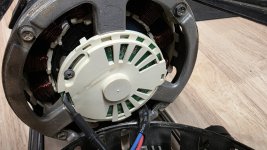
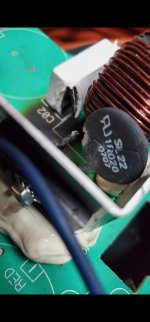
As it turned out, the problem with the controller was not obvious, anyway. The resistor that often fails (green disk in the upper right of the first photo below) seemed fine, and well attached. No other components looked burnt, loose, or elsewise faulty to my untrained eye. The second photo is of the circuit board on the back of the motor, itself. If any of you want to school me on what the components are that might have been the issue, I'd love it. (Remember the symptoms were intermittently failing individual speeds, that became permanently failed speeds.) It's just for my own education at this point, though, so don't spend a bunch of time.

20251220_133020.jpg

20251220_133050.jpg

Mark
 

Codyboy

Well-known member
Joined
Jan 31, 2019
Messages
1,781
Location
S.E. TEXAS
It's a good question, and one I considered, albeit briefly. Others have addressed the idea from the perspective of a contractor, and I agree with them. I'll address if from the perspective of a poor slob who just wants his AC to work. :ROFLMAO:

From what I can tell, the Genteq motors often have controller modules available separately, but the Broad-Ocean motors Carrier/Bryant uses do not. The HVAC outfit told me this, and I was never able to find a controller module for my fan motor, so I believe it's true.

With regard to repairing mine, that wouldn't have been wise for our situation. We are away from this home for months at a time in the summer, when the climate causes to mold to grow like a Chia-Pet, and I couldn't take the chance my repair would fail. (Not that a new motor can't, of course.)

As it turned out, the problem with the controller was not obvious, anyway. The resistor that often fails (green disk in the upper right of the first photo below) seemed fine, and well attached. No other components looked burnt, loose, or elsewise faulty to my untrained eye. The second photo is of the circuit board on the back of the motor, itself. If any of you want to school me on what the components are that might have been the issue, I'd love it. (Remember the symptoms were intermittently failing individual speeds, that became permanently failed speeds.) It's just for my own education at this point, though, so don't spend a bunch of time.

20251220_133020.jpg

20251220_133050.jpg

Mark
Mine looked very similar and I think one of these failed and took the other one out.
Replaced them and worked like new again.
 

Attachments

  • Screenshot_20251227_093347_Gallery.jpg
    Screenshot_20251227_093347_Gallery.jpg
    1.2 MB · Views: 15

dscheidt

Well-known member
Joined
Apr 26, 2017
Messages
2,969
It's a good question, and one I considered, albeit briefly. Others have addressed the idea from the perspective of a contractor, and I agree with them. I'll address if from the perspective of a poor slob who just wants his AC to work. :ROFLMAO:

From what I can tell, the Genteq motors often have controller modules available separately, but the Broad-Ocean motors Carrier/Bryant uses do not. The HVAC outfit told me this, and I was never able to find a controller module for my fan motor, so I believe it's true.

With regard to repairing mine, that wouldn't have been wise for our situation. We are away from this home for months at a time in the summer, when the climate causes to mold to grow like a Chia-Pet, and I couldn't take the chance my repair would fail. (Not that a new motor can't, of course.)

As it turned out, the problem with the controller was not obvious, anyway. The resistor that often fails (green disk in the upper right of the first photo below) seemed fine, and well attached. No other components looked burnt, loose, or elsewise faulty to my untrained eye. The second photo is of the circuit board on the back of the motor, itself. If any of you want to school me on what the components are that might have been the issue, I'd love it. (Remember the symptoms were intermittently failing individual speeds, that became permanently failed speeds.) It's just for my own education at this point, though, so don't spend a bunch of time.

20251220_133020.jpg

20251220_133050.jpg

Mark

probably a failure of one or more of the transistors or thyristors on the board in the first picture. failure could be design, bad power quality (either from the wall, or the power supply feeding them), or it could be a system design problem (fan works too hard). It's likely a straightforward repair, if you had someone who does board rework.

the HVAC guy the landlord of my former office did fix things like this -- he'd swap it out, and then have the part he removed fixed by an electronics tech. The landlord has a bunch of buildings, and has a couple thousand systems, the vast majority of which were one of three or four models, so lots of experience with how it broke, and an understanding that stuff can break again, but it's still cheaper to fix rather than replace.
 

American Locomotive

Well-known member
Joined
Jan 8, 2017
Messages
11,163
Location
Rhode Island
I love the idea of ECM motors, but their OEM replacement cost is pretty much criminal. The biggest problem is that none of the furnace manufacturers wanted to drastically change their controls. So they worked with the motor manufacturers to make ECM motors with pre-programmed speeds, and they just fed the motor the same Speed 1/2/3 signals as they would a PSC motor. Of course that locks you into a manufacturer-specific motor, if you want one with the correct programming. So now they can charge whatever they want for what is a $200 motor.

In an ideal world, the furnace/air handler would have a sensor to measure air flow, and send a variable 0-10v signal to the motor to maintain a desired flow. Then you could basically swap in any motor, and it'd all work the same. But that would reduce parts profit, require a $5 flow sensor, force the furnace manufacturers to re-design their 20-year-old control boards, and maybe even collaborate with a competitor. Can't have that.

This sort of thing is why I feel no sympathy for U.S. HVAC companies. Marking up replacement motors by 500%+ is just wrong.

There does appear to be some relief though: It looks like U.S. Motors now offers a line of "Rescue" ECM motors at very reasonable prices, including pre-programmed ones https://www.supplyhouse.com/US-Moto...ive-Blower-Motor-115-208-230V-3-4-HP-1075-RPM and ones you can program with a free bluetooth-connected app on your phone: https://www.supplyhouse.com/US-Moto...e-ECM-Blower-Motor-115-208-230V-1-HP-1075-RPM.
 
OP
S

ScaldedDog

Well-known member
Joined
Jan 15, 2008
Messages
1,078
Location
Sedalia, CO/NSB, FL
The furnace in our CO place failed this evening, so I looked back at this thread before diving into it tomorrow. The fan I bought for our place in FL that arrived at my door in November for $860 is now $1500 before taxes. I better die young, 'cause I don't think I saved enough money to stay retired long...

Mark
 

WildBill

ALLIANCE MEMBER
Joined
Aug 20, 2021
Messages
2,077
Location
PNW
This might help someone who finds this thread when going through the original problem ScaldedDog had. My old Carrier setup has failed twice the same way and I did the following to figure out where the issue was. I'm sure there are reasons why doing this is unsafe or bad, but it has worked twice for me.

The first time I was able to verify the motor was getting 120v, then used a separate 24v power supply (old "wall wart" from something) to feed ground and then power to each speed wire individually, with them all disconnected from the main control board. They all turned the fan on at different speeds, so I was pretty sure it was the main control board and not the one on the back of the motor. I got a used one off eBay for $50 which fixed the issue, has worked fine for 5-6 years now.

The second time sucked because it was around or below zero degrees out and the fan stopped working again, so no heat. I did the same testing but this time the motor never turned on, so I was pretty sure it was the motor control board. I pulled it and while it was mostly covered with epoxy I could see a pair of big MOVs (metal oxide varisters) being used as protection against power spikes on the main power in. I know those fatigue over time and eventually can fail, or fail if they get a big spike. One looked a little crispy and tested open. So about $5 from Digikey later I replaced them both and my fan worked again, that was probably 3 years ago. The motor is 22 years old so I am sure it will fail eventually, but so far is holding on. I bought a spare one so i can fix it quickly when it does

Here is some information on varisters if anyone is curious. They are used in pretty much every type of surge suppression circuit, probably most commonly in power strips. https://www.electronics-tutorials.ws/resistor/varistor.html
 

danski0224

Well-known member
Joined
Jan 29, 2005
Messages
13,863
Location
Near Naperville, IL
Here is some information on varisters if anyone is curious.
This kind of repair is sketchy at best for a customer paying an hourly rate. I wouldn't do it. Customer will expect a warranty and there's the "eversinceya".

Better off swapping in a regular PSC motor.

They also fail when the TESP is too high.
 
To avoid these ads, REGISTER NOW!
OP
S

ScaldedDog

Well-known member
Joined
Jan 15, 2008
Messages
1,078
Location
Sedalia, CO/NSB, FL
What failed?

How old?
It's a 22 year old Carrier. When I came home last night the power to the unit was completely off, but the 15a amp and 50a breakers were not tripped. No power to the thermostat, nothing.

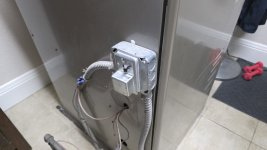
This morning I figured I'd start tracing power from where it entered the unit, and found the issue right away. The switch shown below on the side of the unit was getting 120v, and was passing 120v when in the on position, but there's a "fustat" in the little box on the side, and it was not. Though it looked good, I replaced it with the spare the previous owner had left (bless him!), and power was immediately restored.

20260904_152057.jpg

The fustat:

20260904_152107.jpg

I didn't realize the compressor won't start for the first five minutes after system startup. (The Honeywell thermostat flashing 'Cool on" signals this, but I didn't know it at the time.) So, I kept looking for a problem. The only real one I found was the blue wire from the board had shorted against the system case, as shown below:

20260904_115527.jpg

I don't think that would have blown a fuse on the 120v side, but I guess it could have. Anyway, I fixed that, checked the 16 year old capacitor (it was fine) and tried to check my condensate drain overflow switch. It turns out I don't have one, which I thought was odd, but it eliminated it as a source of the problem.

Anyway, I finally googled the flashing "cool on" message, and saw the five minute lock-out. Once I just left it on and stopped looking for problems, it started right up. My spare fustat will be here next week. :ROFLMAO:

Mark
 

danski0224

Well-known member
Joined
Jan 29, 2005
Messages
13,863
Location
Near Naperville, IL
This morning I figured I'd start tracing power from where it entered the unit, and found the issue right away. The switch shown below on the side of the unit was getting 120v, and was passing 120v when in the on position, but there's a "fustat" in the little box on the side, and it was not. Though it looked good, I replaced it with the spare the previous owner had left (bless him!), and power was immediately restored.
I haven't seen one of those things for a long time- on an existing install. I've never installed one.

Obviously (or not :) ) there's a reason why it popped. That thermostat wire is 24v at best, and it will pop the fuse on the control board long before that aux fuse by the switch. The little 3A fuse looks popped.

A guess is the blower motor is drawing more amps than it should. That's probably the only thing in there that would normally draw enough amps, another guess is a short somewhere on the 120V side. Or that round fuse spun and backed out a little on its own due to vibration... bad contact... did you test it?
 
OP
S

ScaldedDog

Well-known member
Joined
Jan 15, 2008
Messages
1,078
Location
Sedalia, CO/NSB, FL
It tests bad, in that it shows no continuity between the contact on the bottom and the brass "spring". Interestingly, it isn't "blown" in the place where it is intended to blow. I assume continuity is broken down inside, but I haven't taken it apart yet.

20260904_162708.jpg

Yes, the 3a fuse is blown. I did that when testing the thermostat by jumping R to Y during the timeout period. Not sure why that caused it to blow, but it did. New spare 3a fuse is inbound, as well...

Mark
 

Bert_

Well-known member
Joined
Dec 24, 2016
Messages
9,918
Location
NW Iowa
The thin part of the link is what blows on short circuit.

If you look through the window way down by the base you will see where it is disconnected. That part of the fuse is held together with some sort of solder. When it melts the spring pulls up on it and disconnects the circuit. That is what will normally blow on a small overload that lasts long enough
 
OP
S

ScaldedDog

Well-known member
Joined
Jan 15, 2008
Messages
1,078
Location
Sedalia, CO/NSB, FL
The thin part of the link is what blows on short circuit.

If you look through the window way down by the base you will see where it is disconnected. That part of the fuse is held together with some sort of solder. When it melts the spring pulls up on it and disconnects the circuit. That is what will normally blow on a small overload that lasts long enough
Ahh, OK. So, to @danski0224 's point, above, that begs the question as to why it blew? Pending issue with the fan motor? Too low a rating for the fustat? (12a seems a little light for a 20a fan circuit. Or is it?) 30 year old fuse (11/96 manufacture date) that just plum wore out after a long hot summer? Something else?

FWIW, the fan has run like a... well... like a ScaldedDog for hours today on the new one.

Mark
 

dscheidt

Well-known member
Joined
Apr 26, 2017
Messages
2,969
Ahh, OK. So, to @danski0224 's point, above, that begs the question as to why it blew? Pending issue with the fan motor? Too low a rating for the fustat? (12a seems a little light for a 20a fan circuit. Or is it?) 30 year old fuse (11/96 manufacture date) that just plum wore out after a long hot summer? Something else?

FWIW, the fan has run like a... well... like a ScaldedDog for hours today on the new one.

Mark
Fuses don’t wear out from age, but vibration sometimes kills them.

Is your fan variable speed? It’s possible one of the speeds is drawing excessive current intermittently or at startup. Do you have a current meter? If you do you can clamp the motor leads, and check.
 
OP
S

ScaldedDog

Well-known member
Joined
Jan 15, 2008
Messages
1,078
Location
Sedalia, CO/NSB, FL
Fuses don’t wear out from age, but vibration sometimes kills them.

Is your fan variable speed? It’s possible one of the speeds is drawing excessive current intermittently or at startup. Do you have a current meter? If you do you can clamp the motor leads, and check.
I think the fan has multiple speeds, as I noticed it ran slower when "fan" was selected at the thermostat than if "cool" was selected. However, it's run on nothing but the "cool" speed for months.

I took the bad fustat apart, hoping to be able to tell of the solder had melted, or just cracked. It's hard to say, but this is how it looked:

20260905_193323.jpg

The "crook" in the wire was embedded in solder at the bottom, and I could see where it had pulled out. It didn't look obviously melted, but that opinion is not definitive. Here's what it looked like at the bottom, though the photo isn't great:

20260905_193502.jpg

I'm thinking the fan's cool speed is not requiring so many amps as to melt the solder, as it ran pretty much non-stop yesterday for several hours, and ran a lot today, too. Am I right in thinking the solder would melt in minutes or hours, if that amp draw exceeded the rating of the fustat for that length of time?

Of course, if the new one blows in the next few days I'll know the answer.

Mark
 
OP
S

ScaldedDog

Well-known member
Joined
Jan 15, 2008
Messages
1,078
Location
Sedalia, CO/NSB, FL
Amount over the rating will determine how long it holds.

Put an amp meter on it and you will know for sure what is going on
You mean I get to buy another tool?? In true Garage Journal fashion, I'm all over that!

What might cause a blower motor to apparently work fine, but draw more amps than it used to? Might it me as simple as dirt on the blades causing more (air) resistance? What else might?

The only other "symptom" I've noticed this summer - and I'm not even sure of this - is a snap sound from the inside unit when the AC starts. Maybe it has always done this, but I think it's louder than it used to be. It sounds like a relay, but a loud one.

It seems to me that if inrush current at fan start is what caused the fustat to fail, it would have failed at the fuse part, not the time delay part. Safe assumption?

Thanks again @danski0224 and @Bert_ . You guys have made this thread.

Mark
 
To avoid these ads, REGISTER NOW!
Top Bottom