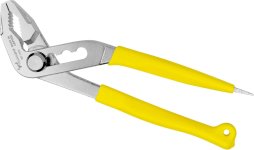
You're correct about the British spelling. However, in the USA, vice and vise have two very different meanings, and spelling it to mean a tool for holding something tightly should be "vise." If you're writing for a British or old British Empire audience, then you can spell it "vice," but it's probably better to stick with the US spelling on US internet forums (fora?). We do have some spelling differences here, compared to the British standard, but our English is not British English.Ha. I suppose they’ve been guilty of many offences against innocent nuts and bolts. But if you’re gently poking fun at a perceived misspelling, vice is just how Brits (and most of the English-speaking world) spell vise. Apologies if you know this.


You are using an out of date browser. It may not display this or other websites correctly.
You should upgrade or use an alternative browser.
You should upgrade or use an alternative browser.
Pliers That I Find Useful and Some I Don't. Tell Me Your Preferences
- Thread starter Garcky
- Start date
Joe Reed
Well-known member
Newacalox is the brand on them. Here's a link to a set on Amazon for ~$30.Joe, who made that pliers set? It looks quite useful
https://www.amazon.com/dp/B07PZ58BWJ/?tag=atomicindus08-20
Dave455
Well-known member
For what it’s worth, I don’t get too hung up on this.You're correct about the British spelling. However, in the USA, vice and vise have two very different meanings, and spelling it to mean a tool for holding something tightly should be "vise." If you're writing for a British or old British Empire audience, then you can spell it "vice," but it's probably better to stick with the US spelling on US internet forums (fora?). We do have some spelling differences here, compared to the British standard, but our English is not British English.
While this forum is international, the majority of the members are in the U.S. so I try to adjust my terminology accordingly. I try to refer to a “wrench” rather than a “spanner” and so on. If I’m replying to a fellow Brit it might be different.
I must admit I tend to use my native spellings, so a vice is a “vice” not a “vise”. I think most folks get the idea.
“Vise Grip’s” are different, as that’s a trade name, so I’d spell it as they do.
I just think... Well, with any pliers, when you press on them hard they flex. On the 'knipex design' (though I doubt Knipex invented it, it's used by everyone...), the flex makes the sides press on eachother, which may be bad for friction (but fine tolerances and nice machining probably makes it negligible), but makes them act almost without any sideways bending torque. The Snap On design meanwhile does not only want to shear the pin, but also bend it. As I said, I'm sure Snap On did it right, but it just seems like a cheaper and more failure prone design.I haven’t seen the FEA or whatever that might answer these questions properly, but I think this new hinge / lever design (actually used by Snap-on for a long time in other pliers and anyway ancient: https://en.wikipedia.org/wiki/Pliers#/media/File:Kneifzange_HH-Harburg.jpg ) must have higher handle stiffness where it counts, near the pivot where bending forces from the squeezing hand are greatest.
Maybe that stiffness (and strength too) beats any increase in strength from the greater abutting area of the classic Knipex-style design that you mention?
I doubt strength is the problem, as you say (it’s Snap-on, so they’ve done the hard engineering). Rather, a problem with the Snap-on design is that the handles have a travelling pinch zone as they close.
With the Knipex style, the handles can also pinch a finger, of course, but there is no scissor action as they close to catch the unaware. So it’s more obvious where to avoid putting a finger.
Of course no adult who uses pliers regularly (all readers) would be unaware of this risk, but Knipex probably worries more than Snap-on about non-expert tool users or children using their products.
Similarly, I really like how the Cobra plier halves have a fork-and-blade design around the hinge. Really none of the forces go into bending the pin due to that. That's why the 'twin grip' pliers from Knipex seem like the best slip joint design to me too.
Well, ordered those (the long version), along with waaay too many stuff. The Fuyija MP9-110 seem to be small but similarly are a short tapered plier design.Ahh, so I see!
These are actually quite a unique pattern of tool - a sort of taper jaw.
To be honest, these are something that has been needed for a while. Sometimes I need a narrow tip, but with a bit of strength, rather than long delicate jaws.
The only similar tools I can think of are the Merry Y75. I have a pair on my wish list but it’s looking like the Knipex need to be considered!

Dave455
Well-known member
Great! Can you report back when you receive them.Well, ordered those (the long version), along with waaay too many stuff. The Fuyija MP9-110 seem to be small but similarly are a short tapered plier design.
Are you in the U.S? I know Merry have a U.S. distributor so they are easy to obtain, but in the U.K. I have to order from Japan.
Bit of a shame, as I can get other Japanese pliers, such as Tsunoda, at a good price from Amazon, and my local electrical supplier keeps them as well
I'm from Slovenia. I also ordered through the Japanese Amazon. I will post when I receive them, probably this following week.Great! Can you report back when you receive them.
Are you in the U.S? I know Merry have a U.S. distributor so they are easy to obtain, but in the U.K. I have to order from Japan.
Bit of a shame, as I can get other Japanese pliers, such as Tsunoda, at a good price from Amazon, and my local electrical supplier keeps them as well
mslim
Well-known member
Yeah I keep a pair of the large ones in my RV for taking off the sewer dump cap. I have arthritis in my thumbs so it comes in handy.Oil filter pliers made by channel lock. I don't think they get a lot of attention on garage journal. You can use them on water filters around the house ,etc.
Last edited:
I like them for the nut on kitchen sink strainers.Yeah I keep a pair of the large ones in my RV for taking off the sewer dump camp. I have arthritis in my thumbs so it comes in handy.
I was wondering why the Fujiya was so much cheaper. Haven't actually checked the sizes I was ordering. But I had mid-size needle nose pliers already, so this was great. The Merry pliers are beastly! Already came in useful today. Really happy with all my purchases - with the Japanese, what you order is what you get, no tricks or gimmicks...
Tsunodas feel very high quality too. I also ordered some "victor" pliers that are okay (also made in japan). And I really like the Fujiya duck nose pliers, those will be very useful for something specific (on a Puch MS50, realigning the alloy fins on the engine fan cover).
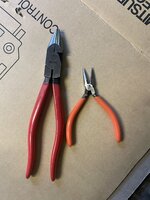


Tsunodas feel very high quality too. I also ordered some "victor" pliers that are okay (also made in japan). And I really like the Fujiya duck nose pliers, those will be very useful for something specific (on a Puch MS50, realigning the alloy fins on the engine fan cover).
dallastide
Active member
I've had those Tsunoda LRP-280s on my amazon wishlist for months. Might be time to pull the trigger...
Really impressed with them, no slop despite the length. Can't wait for an oppurtunity to use themI've had those Tsunoda LRP-280s on my amazon wishlist for months. Might be time to pull the trigger...

I’m curious about the Fujiya 360A-150 jaw tips. They look exceedingly thin. The Fujiya catalogue shows an image suggesting each jaw is 7 × 0.5 mm at the tip. Are they really that thin just inboard of any small bevelled edges, say, 1 mm from the end? I see the tips are rounded as seen from above (in the plane of the handles), which makes the 7 mm measurement a big vague.
(I find it hard to describe pliers nomenclature or understand other people’s descriptions. Is there an accepted top and bottom, etc.?)
By comparison, the Tsunoda DBP-200 has claimed jaw tips of 6 × 1.5 mm. And they do look chunkier. The jaws are also serrated. Hard to say which of those two pliers would be more useful to me for assembling or disassembling small things.
Speaking of small things, Tsunda makes something called the King TTC SNP-150. (Is King TTC a sub-brand of Tsunoda?) There’s an English-language review of these pliers on Amazon Japan by one Patric Cohen. He uploaded a photo of the pliers holding an American penny by the protruding lip. That impressed me, though I haven’t actually tried it to see if any of my existing pliers might manage it.
I think this link should take you roughly there.
(I find it hard to describe pliers nomenclature or understand other people’s descriptions. Is there an accepted top and bottom, etc.?)
By comparison, the Tsunoda DBP-200 has claimed jaw tips of 6 × 1.5 mm. And they do look chunkier. The jaws are also serrated. Hard to say which of those two pliers would be more useful to me for assembling or disassembling small things.
Speaking of small things, Tsunda makes something called the King TTC SNP-150. (Is King TTC a sub-brand of Tsunoda?) There’s an English-language review of these pliers on Amazon Japan by one Patric Cohen. He uploaded a photo of the pliers holding an American penny by the protruding lip. That impressed me, though I haven’t actually tried it to see if any of my existing pliers might manage it.
I think this link should take you roughly there.
I’m not sure what is meant in the original post by the distinction between the loathsome slip-joint pliers and the Channellock or water pump pliers of which we are instructed to have many.
Surely water pump pliers have a type of slip joint, no? So what’s the important difference here, and why do we use this confusing nomenclature?
Surely water pump pliers have a type of slip joint, no? So what’s the important difference here, and why do we use this confusing nomenclature?
On the topic of pliers usefulness:
I have several Facom pliers that look about like this (various ages, sizes, jaw shapes, and handle styles).
The hinge design is one thing (apparently a big deal for many people).
But the bigger problem is that the jaws are angled relative to the handles. Obviously this is on purpose. No doubt it makes them a better wrench, for the same reason an open-ended spanner has 15° angled jaws, but I try harder than most people not to use pliers as a wrench. And the angled jaws make them terrible general-purpose pliers.
That goes for all the pliers with a similar rough shape – whatever you call them – that many Americans seem to use as general-purpose pliers, too. (Correct me if I’m wrong on the common pliers over there.)
Very often I use pliers to grab and pull something with more force than I can with my opposable thumbs. A cable, a fat zip tie, a strip or sheet of metal, a nail or screw, a tight pin from a hole, a component out of an assembly, whatever.
With pliers whose jaws are in line with the handles, it’s easy and natural to pull those things.
With water pump style pliers, pulling in line with the handles (the natural way) kinks or wants to bend the item where it emerges from the angled jaws. To avoid that, you have to pull with the handles angled (to align the jaws with the axis of the pull), so that you’re not only pulling but resisting a large force trying to turn the handles, because your hand is offset from the pulling axis. That puts a twisting load on the hand and wrist, greatly reducing how hard you can pull and needlessly tiring you the rest of the time.
Very often, too, I want to twist something with the pliers end-on – a nail out of a post (around the nail’s axis; not bending the nail) for the sake of this description. That’s easy and natural if the jaws are in line with the handles. But with angled jaws your hand has to describe a complex, 3-D, space-consuming shape in the air to do this simple gesture. All the while you’re guessing that exact path and wasting force bending the item to the extent your guess is off – or worse, actually bending or breaking the item.
I have several Facom pliers that look about like this (various ages, sizes, jaw shapes, and handle styles).
The hinge design is one thing (apparently a big deal for many people).
But the bigger problem is that the jaws are angled relative to the handles. Obviously this is on purpose. No doubt it makes them a better wrench, for the same reason an open-ended spanner has 15° angled jaws, but I try harder than most people not to use pliers as a wrench. And the angled jaws make them terrible general-purpose pliers.
That goes for all the pliers with a similar rough shape – whatever you call them – that many Americans seem to use as general-purpose pliers, too. (Correct me if I’m wrong on the common pliers over there.)
Very often I use pliers to grab and pull something with more force than I can with my opposable thumbs. A cable, a fat zip tie, a strip or sheet of metal, a nail or screw, a tight pin from a hole, a component out of an assembly, whatever.
With pliers whose jaws are in line with the handles, it’s easy and natural to pull those things.
With water pump style pliers, pulling in line with the handles (the natural way) kinks or wants to bend the item where it emerges from the angled jaws. To avoid that, you have to pull with the handles angled (to align the jaws with the axis of the pull), so that you’re not only pulling but resisting a large force trying to turn the handles, because your hand is offset from the pulling axis. That puts a twisting load on the hand and wrist, greatly reducing how hard you can pull and needlessly tiring you the rest of the time.
Very often, too, I want to twist something with the pliers end-on – a nail out of a post (around the nail’s axis; not bending the nail) for the sake of this description. That’s easy and natural if the jaws are in line with the handles. But with angled jaws your hand has to describe a complex, 3-D, space-consuming shape in the air to do this simple gesture. All the while you’re guessing that exact path and wasting force bending the item to the extent your guess is off – or worse, actually bending or breaking the item.
pooterguy
Well-known member
Reaffirmed by Project Farm with a couple of caveats, one of which has long been my second choice:In all of existence, there are only two (2) types of pliers:
1. Knipex
2. Other
Saw the Garky avatar and got excited for a minute, thinking he was unbanned. Alas …
That PF video is odd to me, I didn’t know people used those pliers to cut. I thought they were just for pulling nails, hence the rounded shape.
That PF video is odd to me, I didn’t know people used those pliers to cut. I thought they were just for pulling nails, hence the rounded shape.
Knipex, among others, makes what knipex calls carpenters pliers, which are really good at pulling stuff out. I don’t put 100 lbs force on the handles of 8 inch pliers, so some of the PF results are not relevant to me.
Buckgnarly
Well-known member
Huh, I saw it and hoped all his **** would be deleted or at least locked?.....Saw the Garky avatar and got excited for a minute, thinking he was unbanned. Alas …
That PF video is odd to me, I didn’t know people used those pliers to cut. I thought they were just for pulling nails, hence the rounded shape.
Which 4?Grip strength at 9:18. 151.8 lbs.
Not bad.
I admit that if I had to start all over again, I'd only own about 4 pairs of pliers. They might as well be Snap-on or Knipex since it's a one and done kind of thing in that case.
Oh, probably just one of those automotive/utility sets. Cutter, slip joint, needle nose, water pump. I could make do with that I think. Maybe some good wire strippers.Which 4?
Drunkonunleaded
Well-known member
Side note: did Garcky leave GJ? He hasn't made a thread in months and you receive an error when clicking on his profile.
manwithtools
ALLIANCE MEMBER
Banned...Side note: did Garcky leave GJ? He hasn't made a thread in months and you receive an error when clicking on his profile.
Banned...
OK, I missed when that happened. What was it for?
manwithtools
ALLIANCE MEMBER
From one of the moderators:OK, I missed when that happened. What was it for?
He had a knack of starting threads, getting people going and then just bowing out of his thread.... like trolling.
I thought I’d killed this thread a few replies and a year ago. Maybe there will still be some discussion about the topics I raised then.
There has to be more to it than that, surely.
Though I’ve never seen moderation that didn’t eventually end in abuse of power. That’s not to say that moderation doesn’t sometimes help, just that I’ve never seen the benefit be greater than the downside. But I’m young yet …
He had a knack of starting threads, getting people going and then just bowing out of his thread.... like trolling.
There has to be more to it than that, surely.
Though I’ve never seen moderation that didn’t eventually end in abuse of power. That’s not to say that moderation doesn’t sometimes help, just that I’ve never seen the benefit be greater than the downside. But I’m young yet …
We don't do religion, politics and you can leave your drama elsewhere. Almost everyone here knows this basic principal about this forum. This place practically runs itself with the great membership here.I thought I’d killed this thread a few replies and a year ago. Maybe there will still be some discussion about the topics I raised then.
There has to be more to it than that, surely.
Though I’ve never seen moderation that didn’t eventually end in abuse of power. That’s not to say that moderation doesn’t sometimes help, just that I’ve never seen the benefit be greater than the downside. But I’m young yet …
It's open to the public, free of charge but just follow some simple rules set forth by the owner.
Some have pushed the edge, walked a fine line and others have seen the ban applied. @Ryan is a fair guy, get banned, email him, plead your case and accept the terms or you're gone.
I told the man back in 2013 if I didn't conform to what he wanted as a Moderator, he was more than free to revoke that title, no hard feelings.
I spend a lot of time on this site and being part of the staff to help run it, is peanuts compared to what I have learned, what I have helped others with and just some relaxation, along with a few laughs. If the Boss says I am done, I'm done, fair enough.
Now, let's get back on topic.
Anarchist much?I thought I’d killed this thread a few replies and a year ago. Maybe there will still be some discussion about the topics I raised then.
There has to be more to it than that, surely.
Though I’ve never seen moderation that didn’t eventually end in abuse of power. That’s not to say that moderation doesn’t sometimes help, just that I’ve never seen the benefit be greater than the downside. But I’m young yet …
four.cycle
Well-known member
For removing teeth, I've used different models, but found the small 90-degree-angle jaw needle-nose with serrated jaws seem to work best. The 10-inch Wilde "Flush Fastener" model most certainly provides a more than adequate grip.Go to 1:42
Attachments

AntiqueBen
Well-known member
- Joined
- Aug 4, 2021
- Messages
- 1,442


four.cycle
Well-known member


roofdweller49
Well-known member
- Joined
- Jan 22, 2023
- Messages
- 196
Do people actually use the grooves on pliers that are meant to turn nuts?
I guess it's there as a bonus, but also invites people to try and turn nuts they have no business turning
I guess it's there as a bonus, but also invites people to try and turn nuts they have no business turning
All y'all should try a pair of these, speaking of Tsunoda: WP-150D. They're pocket-sized, with a tight joint, good jaws and a nifty flat-blade on one handle. I think they're fun. Tsunoda is amazing value and they've got some clever ideas. Their crimping needlenose pliers are excellent too.