To avoid these ads, REGISTER NOW!

2 Post Lift Install - Anchors or Epoxy? Other Tips???

OldNeons

Well-known member
Joined
Dec 27, 2011
Messages
462
Location
Midwest
Getting ready to install our 2 post Direct Lift. The slab is above spec for depth, PSI rating, etc. The lift mfg supplied 3/4" expanding anchors. I've seen these slip out before? I install alot of commercial poles and we use the Hilti epoxy system with studs and nuts.

Do the lift pros here prefer one system over the other?

Also if you use the expandable anchors do you recommend drilling through the slab so you can punch them through if the lift is ever abandoned - or do they hold better when drilled to an exact depth and properly cleaned before install?

Do you recommend templating and drilling or placing posts and drilling holes with posts in place?

Any other tips and tricks for smooth install are greatly appreciated.
thanks!
 
To avoid these ads, REGISTER NOW!

FatFenderBowTie

Well-known member
Joined
Aug 16, 2010
Messages
273
Location
Manitoba boonies
When the installer did mine he squared up the complete hoist system, drilled the holes with the uprights in place, used expanding anchors and blew out the holes after drilling prior to installing the anchors. He torqued them down then told me to check them after a few uses, then again in a month, they were the same torque setting both times I checked.

He told me in most cases if a hoist is removed he cuts the anchor bolts flush with the floor.
 
OP
O

OldNeons

Well-known member
Joined
Dec 27, 2011
Messages
462
Location
Midwest
Bob, thanks for your input. While, I think I understand the direction you are going - but I tend to have more faith in today's highly engineered epoxies than a Chinese made expansion anchor that is supplied by lift manufacturers since it is quick and easy for most DIY'ers who don't have experience with epoxies or the special dispensing tools required, etc.. I was just curious what those who installed lifts all day did - they see hundreds of lifts a year versus my one.
 
OP
O

OldNeons

Well-known member
Joined
Dec 27, 2011
Messages
462
Location
Midwest
Thanks Bob - cheers back to you- didn't realize you were providing the kind of real life experience I sought. Do you recommend drilling through the slab completely or just to necessary depth for anchor? Thanks again!
 

Bob C

Well-known member
Joined
Jul 17, 2012
Messages
572
I prefer to drill thru completely simply due to moving a lift. I found the customer would rather fill the old holes with a concrete product rather than look at cut off steel bolts.
 

fflintstone

Well-known member
Joined
Jul 18, 2010
Messages
2,722
Location
MOFnowhere Mi.
Although someone here will tell me its wrong, I used epoxie with the supplied anchor bolts. I was told to by the CEO of the company.

I also plumbed and triple checked the posts before drilling the holes in place.
I drilled out the holes all the way but I will be dead before the lift leaves here.
 

wssix99

Well-known member
Joined
Mar 2, 2011
Messages
5,156
Location
Chicago, IL
Use what was sent with the lift. There is a reason engineers pick those bolts. They hold. I would not trust glue when a diesel truck is over my head.

+ 1

but I tend to have more faith in today's highly engineered epoxies than a Chinese made expansion anchor that is supplied by lift manufacturers since it is quick and easy for most DIY'ers who don't have experience with epoxies or the special dispensing tools required, etc..

Epoxies are generally poor for resisting pull-out forces. If you read the fine print from epoxy manufacturers, almost all are not approved for overhead use because of this. Just ask some folks from Boston about how well epoxy did holding up the roof of their tunnels...

The mechanical anchors need friction against the concrete surface to work. Unless special epoxy and special anchors are used, going this route could be a much weaker install. (last time I checked, this stuff was really expensive)
 

Ign

Well-known member
Joined
Jul 7, 2006
Messages
12,769
Location
Butte Peak ND
I used the Hilti epoxy with my Bendpak, but I used the anchors they provided. I cut off the expanding wings (which the wife used for metal art), cut some shallow grooves around the circumference for the epoxy to grab. Many diesel crew cabs over my head and I'm still here, FWIW. Today's good epoxies are not glue.

To me epoxy makes way more sense as it can flow into every little crevice and imperfection, meaning 100% surface contact or close to it. In contrast, an expanding anchor is just a few pressure points pushing against concrete which is inherently brittle and can chip/crack. I'm NO engineer, just a hack machinist so, again, FWIW!!!
 

wssix99

Well-known member
Joined
Mar 2, 2011
Messages
5,156
Location
Chicago, IL
To me epoxy makes way more sense as it can flow into every little crevice and imperfection, meaning 100% surface contact or close to it.

It's easy to see how this makes sense, but it can also isolate the anchor from making physical contact with the concrete. When an inferior epoxy fails, it will shear between those two mechanical contact points and act like grease.

That being said, some epoxies perform well in this way. Most do not. I'm sure Hilti makes epoxies for this purpose. Probably the easiest way to confirm you have the correct one is to contact a Hilti rep. (Probably not the guy at the store who sells it.)


In contrast, an expanding anchor is just a few pressure points pushing against concrete which is inherently brittle and can chip/crack.

Concrete is extremely strong in compression and when the expanding anchor builds up enough outward force, they are incredibly strong and will "lock" in to the irregularities of the aggregate. If the anchor isn't installed correctly or the hole is to big, the anchor will not hold well. For example, a 1/2" Simpson Wedge-All Mechanical anchor in 3000 psi Concrete set to a 3 3/8" depth will support (with safety factors built in by the manufacturer - in reality it will hold much more) about one ton of pull-out force.
 

sean Buick 76

Well-known member
Joined
May 7, 2013
Messages
3,221
Location
Edmonton Alberta
Bringing up this old post... In planning for a 2 post lift in my new garage I asked for a 2 foot wide, 12 foot long, by 2 foot deep section of concrete. So there will be 2 foot deep of concrete under the lift, Extra rebar etc all poured at the same time as the rest of the slab. My thinking is that if I wanted to go overkill on the fastening of the lift then I could do 1 foot deep holes with epoxy and anchors. It seems using expanding 6 inch fasteners would not be taking advantage of the extra depth I have to utilize.

Of course this is overkill but heck why not right?
 

mcbane

Well-known member
Joined
Jul 23, 2017
Messages
794
Location
California
Either type of anchor can be installed incorrectly and both are made in china so the concerns about made in china are misplaced. For most code-regulated purposes, special inspection is required for epoxy anchors. I suspect that is because cheapskates put about 1/5 as much of the expensive chinese-made epoxy into the hole as they should. The code is pretty forgiving with the chinese-made expansion anchors because there is no financial incentive to install them incorrectly.
 

22george

Well-known member
Joined
Jan 26, 2011
Messages
1,634
Location
SW Ohio
When I installed my lift, I trashed the 4" anchor bolts that came with the lift. I have 8 inch thick concrete. I replaced them with American made 8 inch anchor bolts from Fastenall. I used epoxy from Fastenall also in the holes with the anchor bolts.
 

6768rogues

Banned
Joined
Nov 28, 2007
Messages
4,524
Location
Western NY
I used the anchors supplied with the lift. The engineers did the thinking and included the anchoring system that best suited the situation. My lift is certified to 9000 lbs. and they were tested to 27,000 lbs. I have no reason to think that I am smarter making the decision about anchors than they are.
Mine had the anchor with the nut installed with the thread fully in the nut but not protruding, tapped into the hole. Then they were torqued to (I think, by memory) 100 foot lbs. with a torque wrench. Then a car was put on the lift, about a half dozen raise/lower cycles were done, and the anchors were torqued again. If an inch or more of threads was showing above the nut, the anchor was failing and it should not be used. Mine had a few threads showing. 20 years later, all is well.
Why would you deviate from what the factory engineered for the purpose? If you are a licensed professional engineer and you have done calculations to verify that another anchoring system will work, go ahead. I am not a licensed engineer. I don't want to be the dead guy squashed under a car with reports saying that the idiot installed his lift with anchors he thought would work better than the engineered system.
 
Last edited:

jkeyser14

Well-known member
Joined
Dec 19, 2008
Messages
1,816
Location
(rural) Maryland
It's easy to see how this makes sense, but it can also isolate the anchor from making physical contact with the concrete. When an inferior epoxy fails, it will shear between those two mechanical contact points and act like grease.

That being said, some epoxies perform well in this way. Most do not. I'm sure Hilti makes epoxies for this purpose. Probably the easiest way to confirm you have the correct one is to contact a Hilti rep. (Probably not the guy at the store who sells it.)


Concrete is extremely strong in compression and when the expanding anchor builds up enough outward force, they are incredibly strong and will "lock" in to the irregularities of the aggregate. If the anchor isn't installed correctly or the hole is to big, the anchor will not hold well. For example, a 1/2" Simpson Wedge-All Mechanical anchor in 3000 psi Concrete set to a 3 3/8" depth will support (with safety factors built in by the manufacturer - in reality it will hold much more) about one ton of pull-out force.

A proper epoxy meant for concrete will be just as strong as the concrete. It should also have almost zero thickness because a properly torqued anchor will have squeezed out all of the excess. Because it will be so thin, it will fill all the imperfections and will not act like a layer of "grease" after it cures, I don't understand where you got that idea from.
 
To avoid these ads, REGISTER NOW!

wssix99

Well-known member
Joined
Mar 2, 2011
Messages
5,156
Location
Chicago, IL
A proper epoxy meant for concrete will be just as strong as the concrete. It should also have almost zero thickness because a properly torqued anchor will have squeezed out all of the excess. Because it will be so thin, it will fill all the imperfections and will not act like a layer of "grease" after it cures, I don't understand where you got that idea from.

When we torque bolts, they stretch and elongate under tension and thin out in their mid section. (So, pressure does not increase against the walls of the hole.)

Epoxy has a number of issues. (See mcbane's comment about inspection.) Epoxy requires a clean hole so the dust doesn't contaminate the epoxy bond with the hole. (Professionals have enough of a challenge getting these holes clean and the problem compounds when inexperienced installers use this material.) Epoxy also has a property known as "creep", which needs to be carefully managed when these bolts are put under tension. (Like in an application for a lift.)

http://www.washingtonpost.com/wp-dyn/content/article/2007/07/10/AR2007071000588.html?noredirect=on
 

walrus

Well-known member
Joined
Nov 12, 2008
Messages
11,674
Location
Maine
Bringing up this old post... In planning for a 2 post lift in my new garage I asked for a 2 foot wide, 12 foot long, by 2 foot deep section of concrete. So there will be 2 foot deep of concrete under the lift, Extra rebar etc all poured at the same time as the rest of the slab. My thinking is that if I wanted to go overkill on the fastening of the lift then I could do 1 foot deep holes with epoxy and anchors. It seems using expanding 6 inch fasteners would not be taking advantage of the extra depth I have to utilize.

Of course this is overkill but heck why not right?

You can get longer anchors if that makes you feel better
 

wssix99

Well-known member
Joined
Mar 2, 2011
Messages
5,156
Location
Chicago, IL
You can get longer anchors if that makes you feel better

+1 Great suggestion. Going deeper has an exponential effect on strength. (It's not linear because the stresses from the bolt are distributed in the shape of a cone.)


Bringing up this old post... In planning for a 2 post lift in my new garage I asked for a 2 foot wide, 12 foot long, by 2 foot deep section of concrete. So there will be 2 foot deep of concrete under the lift, Extra rebar etc all poured at the same time as the rest of the slab.

This will actually make your floor weaker and prone to crack around the perimeter of that deep section of concrete. (We've discussed this in other threads.)

Your lift engineers call for a homogeneous flat slab for new construction for a number of reasons. They also should allow for a "retrofit slab" option for suspect, thin, or damaged slabs. In the "retrofit" scenario, you would build a thickened box/section. However, it is physically separated from the rest of the slab but mechanically keyed to it. < Both can't be done at the same time safely.

Is there something you hope to achieve by having the thicker section? (The lift is structurally designed to work with a single section thin slab, so there shoudn't be any concern if the floor is poured to spec.)
 

86turbodsl

Well-known member
Joined
Jul 1, 2005
Messages
6,554
Location
Michigan
I have a wallowed out bolt hole on my 1957 tractor. It's the hole for the drawbar pin on the 3pt. I coat the bolt/pin in JB weld and put in the wallowed out hole. Hold it in place with cribbing until set. When cured, i go out and plow with it. It lasts for years. Done it about 3-4 times in 18 years. And that's side loaded even, and about 2 inch by 3/4 in bolt dia area. And JB is one of the weaker epoxies. There's also stuff like Devcon Plastic steel and others even stronger. Now use a lot of epoxy in a much longer hole, in tension, where it is a better application, and there's more fasteners. Epoxy is just fine in this application. With a clean hole. My brother is a concrete parking structure engineer and he even recommended epoxy as a fine alternative to the expanding anchors. Just a data point.
 

N_Jay

Well-known member
Joined
Nov 1, 2016
Messages
1,153
Stumbled across this thread while doing so research for my garage slab and lift planning.

Seems most credible sources show (proper) chemical (epoxy) anchors as having better strength and durability than expansion anchors.
That doesn't mean a backyard mechanic swapping out the factory expansion anchors with the epoxy he thinks is right will be stronger.

As for the "engineered" anchors are best, Yes in general, but the anchors "engineered" may also have compromises due to changes since the original engineering and possible substandard parts being supplied to the lift manufacturer.

Right now my thinking is going back and forth.
a) New "Name Brand" expanding anchors of the same diameter and spec as those in the kit.
Possibly longer, to take advantage of a pad thicker then the specified 4" minimum.
b) Chemical anchors from a "Name Brand" as recommended by them for replacement of a the expanding anchor supplied.

My original thought was to put a footer under the lift location, but more reading is needed as I see that can contribute to cracking.
A second thought was to slightly thicken the slab and put some rebar in the area of the posts and running between them, so any cracking that occurs later is likely not to cross the lift supports.
I al looking for knowledgeable input on this?
 

matt_i

Well-known member
Joined
Mar 14, 2008
Messages
10,723
Location
SE Michigan
Imo, the epoxied anchors are *far* superior in terms of actual engineering performance if the prep is followed to a T.

Reason: considerably higher confidence items like jib cranes can only be installed on a flat floor of appropriate thickness with epoxied anchors. Wedges will not do. Also dynamic loads like industrial robots are only installed with epoxied anchors. Wedges will not do.

There's probably 15 posts per calendar year on this forum of people who installed their lift and how have a spinning anchor and a bunch of bad choices to fix it.

The epoxy needs a full 24 hour cure at 70F before it can support loads. Keep that in mind from a pro installer's point-of-view that they'd need 2 trips to complete an install vs. a wham-bam one-shot trip. They would also recommend the wedge anchor 100% of the time as it puts all liability on the OEM and not their preparation to multi-iterate on blow+brush the hole with a pipette until all dust is cleared.

If I ever installed my own vehicle lift those wedge anchors would go straight to the scrap pile and Grade B7 threaded rods would be used. I've had many instances of good performance with Sika AnchorFix2.
 

N_Jay

Well-known member
Joined
Nov 1, 2016
Messages
1,153
Yes, all the information I found pointed to the superiority of chemical anchors "properly installed".
Hilti has anchor bolts with spiral grooves that are supposed to help eliminate the issues with slightly imperfectly cleaned holes.

I am planning on installing it myself, so I may start with "good" expansion anchors and if any lose torque, change them to chemically bonded.

The lift company has a option/accessory for a base plate extension. I might put it on from the start just for safety.

1626145612935.png
 

Walkers

Well-known member
Joined
May 17, 2021
Messages
3,912
Location
Cave Creek Az
Yes, all the information I found pointed to the superiority of chemical anchors "properly installed".
Hilti has anchor bolts with spiral grooves that are supposed to help eliminate the issues with slightly imperfectly cleaned holes.

I am planning on installing it myself, so I may start with "good" expansion anchors and if any lose torque, change them to chemically bonded.

The lift company has a option/accessory for a base plate extension. I might put it on from the start just for safety.

1626145612935.png
The problem with your theory of using expansion anchors and changing them out is that they don’t like to come out
because they have expanded.
Just use Titen HDs, made by Simpson. I have a box of 3/4 x 5” IIRC, that I used on my lift when relocating it. Better specs than expansion anchors. I have also used Siks and Hilti anchoring epoxy with great success.
 

N_Jay

Well-known member
Joined
Nov 1, 2016
Messages
1,153
I think I would skip trying screw in anchors like the Titan HD.
I am not sure what spec is better the expanding anchors.
I am also not sure what spec is critical, but did notice that "Pry Out" is not even evaluated, and I would think that might be the primary failure mode in this application.
 

wssix99

Well-known member
Joined
Mar 2, 2011
Messages
5,156
Location
Chicago, IL
Imo, the epoxied anchors are *far* superior in terms of actual engineering performance if the prep is followed to a T.
The only way to know if this has been done is to gest the anchors and most people here aren't going to have the capacity to do that. Even if they follow the instructions.

Reason: considerably higher confidence items like jib cranes can only be installed on a flat floor of appropriate thickness with epoxied anchors. Wedges will not do. Also dynamic loads like industrial robots are only installed with epoxied anchors. Wedges will not do.
These pieces of equipment encounter different dynamic and forces and vibrations than an automotive lift. There are different engineering considerations and this doesn't mean that an epoxy application is "better."
 

wssix99

Well-known member
Joined
Mar 2, 2011
Messages
5,156
Location
Chicago, IL
Just use Titen HDs, made by Simpson. I have a box of 3/4 x 5” IIRC, that I used on my lift when relocating it. Better specs than expansion anchors.

This is really dangerous advise. These anchors pullout more often and don't develop strength from the concrete along the full depth like other anchors do. (So they can't be simply swapped out one-for-one.)

suco201700221-fig-0001-m.jpg
 

wssix99

Well-known member
Joined
Mar 2, 2011
Messages
5,156
Location
Chicago, IL
Right now my thinking is going back and forth.
a) New "Name Brand" expanding anchors of the same diameter and spec as those in the kit.
Possibly longer, to take advantage of a pad thicker then the specified 4" minimum.
b) Chemical anchors from a "Name Brand" as recommended by them for replacement of a the expanding anchor supplied.

My original thought was to put a footer under the lift location, but more reading is needed as I see that can contribute to cracking.
A second thought was to slightly thicken the slab and put some rebar in the area of the posts and running between them, so any cracking that occurs later is likely not to cross the lift supports.
I al looking for knowledgeable input on this?
There's nothing magic about the "name brand" anchors. They may not even make their own parts. (They could be made by another company and just sold with the "name brand" on them.) Something with a name you see on commercials could even be manufactured to an inferior spec than the parts included with your lift. The anchors with your lift will be made and tested to the correct spec.

Modern lifts do not require or use footers. There are two options for the install: A) A new flat slab. B) A cut-out "repair slab" to compensate for a flat slab of inferior thickness or quality. Many people confuse a "repair slab" with a footer because its deeper than the original slab - but it's not a footer and doesn't mechanically function as one. It's a thickened section that keys into the remaining parts of the inferior slab.

Dramatically thickening the slab, adding inconsistent reinforcing in the slab (only in select areas) or doing other things inconsistent with the (very specific) repair slab techniques will lead to differential shrinking in the slab when it cures. <- This causes the cracking; and it will happen in the places where you don't want it to be for your lift.

If you want a quality slab, paying attention to regular fundamentals of concrete placement will get you the best and strongest slab for a lift. (Go up on the cement content, add a little thickness, reinforce the whole thing, put your saw cut joints in the right places, make your saw cut joints at the right time, etc.)

I am planning on installing it myself, so I may start with "good" expansion anchors and if any lose torque, change them to chemically bonded.
This is a good plan. If you have problems, just call the manufacturer and they will help you with this.
 

N_Jay

Well-known member
Joined
Nov 1, 2016
Messages
1,153
I agree that the fasteners can come from any source. You don't know who the OEM is.
However I trust Hilti and others to be on top of the QA of their OEMs much better than "White Box" fasteners coming in the installation kit of a Chinese OEM made lift. (I have been on OEM Product Manager).


It is a whole new slab, with footers around the edge and one running the length. (30X40 bldg. with a 12x40 lean-to on one side)
My guess is it will need a stress relief cut where the mid-slab footer is.

I have a good concrete guy, so will discuss with him.

I can see how transitions in thickness and differences in reinforcing could change stresses and maybe show a crack where one might not have otherwise occurred, but considering the size of the area that the lift is in (14' x 3') adding thickness and reinforcing should not bring any cracks into that area, and should prevent any in that area.
 

wssix99

Well-known member
Joined
Mar 2, 2011
Messages
5,156
Location
Chicago, IL
Now you are headed right into the heart of where the challenges are. Lifts generally go in the center of the room, which is where the greatest shrinkage stresses are concentrated in the slab...

It is a whole new slab, with footers around the edge and one running the length. (30X40 bldg. with a 12x40 lean-to on one side)
My guess is it will need a stress relief cut where the mid-slab footer is.

I have a good concrete guy, so will discuss with him.
I'm not sure what you are talking about here, but it sounds like you will have a thickened edge slab with a grade beam running through the center of the building? Will the slab be post-tensioned? If so, you should consult your engineer before planning a lift.

If the slab will not be post-tensioned and if you will have saw cut joints, you definitely want to discuss that with your concrete installer as they could be planning to run one to split the 30' dimension (in the middle) right where you want to put the lift. In this case, you would need them to plan for two cuts and split that dimension in to 10' sections to give you a clear pad in the middle for the lift.

I can see how transitions in thickness and differences in reinforcing could change stresses and maybe show a crack where one might not have otherwise occurred, but considering the size of the area that the lift is in (14' x 3') adding thickness and reinforcing should not bring any cracks into that area, and should prevent any in that area.
The greatest stresses build up the center of the slab. When you add thickness or reinforcing in that area, the cracks form at the first place of weakness they can find, which is right around the reinforcing and/or the thickened sections. This is why you won't find any of this in any concrete design books or design guides.
 

N_Jay

Well-known member
Joined
Nov 1, 2016
Messages
1,153
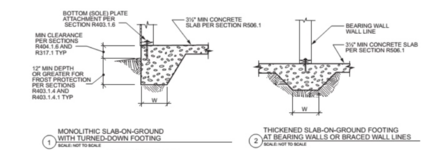
The building is a light steel building which sets on the edges of the slab. I don't know if it gets "real footers" around the edge or is just thickened edges.
Since the building has a Lean-to on one side, there the "Center-building" edge comes down 12 feet in and I believe that this also needs a footer. (Since it is in effect a bearing wall)
So that slab is 42X40 (12x40 under the lean-to and 30x40 under the main building)
The lift in in the main section one post about 3 feet form the lean-to side 14 feet in, and the second post is about 14 feet from the lean-to side 14 feet in.

It does seem that they use a thickened slab under bearing walls.
1626206709157.png

My thought was to do something similar under the lift area, running from a foot or more around each post and even width between the posts (about 3X14)
 
Last edited:

wssix99

Well-known member
Joined
Mar 2, 2011
Messages
5,156
Location
Chicago, IL
That looks like typical slab on grade construction then. Those thickened areas should have reinforcing that ties them all together. That and being dug in will make them essentially like an "anchor" in the ground. (Makes sense - because you don't want the walls to move.)

So, you can think of your floor as being two separate "slabs" on either side of that bearing wall separating the interior from the outside covered by the lean-to.

As long as you aren't post-tensioned, your contractor should have a plan for saw cut joints. If you plan those out ahead of time so they maintain the required "crack distance" required by your lift manufacturer (cracks develop in the cuts) and make sure that you have the required depth in the slab, then you are golden. No fancy stuff required.


If I was to do my lift all over again, I would have put stakes on the ground in the area around and between the lift posts to help my finishers get everything closer to perfectly level. (They take the stakes out as they go.) The lifts have procedures for dealing with being on a slab that's slightly sloped, but it's still a PITA to deal with.
 

Walkers

Well-known member
Joined
May 17, 2021
Messages
3,912
Location
Cave Creek Az
This is really dangerous advise. These anchors pullout more often and don't develop strength from the concrete along the full depth like other anchors do. (So they can't be simply swapped out one-for-one.)

suco201700221-fig-0001-m.jpg
I have been using them for decades and have not had one pull out. I used sleeve and wedge anchors prior and I couldn’t count the amount of failures I had.
Where are you seeing data showing them pulling out?
 

matt_i

Well-known member
Joined
Mar 14, 2008
Messages
10,723
Location
SE Michigan
My experience with those thread-cutting anchors is they develop minimal clampload to the floor. The spiral is relatively "fast" and has to be in order to not strip the internal threads in the concrete, but directionally wrong for converting torque to clampload. I use those on things for light duty fastening on things I know are likely to be relocated in the future as its easy to remove, and the fastener can be reused in the new location as well.

I'd argue that the jib crane is a very good static approximation of what's happening in a vehicle lift... if you have a certain style of Mohawk lift you essentially have two of them without the upper tie-bar between the columns...
 

PotvinV8

Member
Joined
Nov 21, 2020
Messages
14
Location
California
Compare the area of the lift's footings with the contact patch area of the vehicle's tires. Does the vehicle collapse the concrete when pulled into the garage? Then the weight of it on the lift is no different, hence no need for 2-foot deep footings. In fact, it's probably spread out more so than when the weight is on the contact patch of the tire.

Longer anchors, epoxy, etc. might be cheap insurance, but if you're putting yourself in a position where the lift may be pulled from the slab, you've made a significant mistake in loading the vehicle on the lift (asymmetrical load, removing weight creating an imbalance, etc.). Two-post lifts aren't designed to be loaded in a manner where there might be uplift in any direction. That's a user error. Loaded properly and the fasteners shouldn't be an issue.
 

N_Jay

Well-known member
Joined
Nov 1, 2016
Messages
1,153
That looks like typical slab on grade construction then. Those thickened areas should have reinforcing that ties them all together. That and being dug in will make them essentially like an "anchor" in the ground. (Makes sense - because you don't want the walls to move.)

So, you can think of your floor as being two separate "slabs" on either side of that bearing wall separating the interior from the outside covered by the lean-to.

As long as you aren't post-tensioned, your contractor should have a plan for saw cut joints. If you plan those out ahead of time so they maintain the required "crack distance" required by your lift manufacturer (cracks develop in the cuts) and make sure that you have the required depth in the slab, then you are golden. No fancy stuff required.


If I was to do my lift all over again, I would have put stakes on the ground in the area around and between the lift posts to help my finishers get everything closer to perfectly level. (They take the stakes out as they go.) The lifts have procedures for dealing with being on a slab that's slightly sloped, but it's still a PITA to deal with.
The concrete guy said he can get the pad as level as I want (Laser leveled).
We are going to add some slope towards the door and some towards a central floor drain.
I have the area of the lift marked to be dead flat.

Yes, the cuts will be well away from the lift area.
 
To avoid these ads, REGISTER NOW!
Top Bottom