To avoid these ads, REGISTER NOW!

Building a steel workbench

shamrock12

Well-known member
Joined
Dec 26, 2007
Messages
958
Location
South Dakota
I'm in the design phase of 30" x 120" workbench that will be made entirely out of steel. The majority of frame will be made with 2.5" square tubes, 3/16" thick. The top would be made out of 3/8" plate. My only concern is that the top will extend 2.5" past the edge of square frame in front and sides (to allow for clamping of workpiece). If I were to hammer/beat something at the edge of steel top then it might deform. I'm not sure how much the 3/8" top might deform ... is this something I should be concerned about? It's not like I'm going to be swinging 10 pounds sledgehammer at full extension.

If it is a concern, would adding 1/4" thick angle iron under the steel top and against the square tube frame help reduce potential deformation? It would basically make the top 5/8" thick in front.

Also, would it be ideal to finish the bench with 16 gauge stainless steel top for a cleaner working surface?

Thanks in advance!
 
Last edited:
To avoid these ads, REGISTER NOW!

akdiesel

Well-known member
Joined
Aug 8, 2008
Messages
2,617
Location
Wasilla, AK
What exactly are you doing on this bench. To put on a skin of stainless, I would think you want to have a nice looking bench but be strong at the same time. So saying that I don't imagine you dropping heavy items onto the bench in fear of damaging the stainless, unless of course you have lots to replace it with.
So back to the material in question. The stuff you are wanting to use is used primarily for welding or machine work and those are benches one would want to have mobile so they could access all sides. A stationary bench can be made very strong out of 12 gauge material or certain wood. And the same can be done for the top as well.
I have a 32" x 127" bench out of 12 gauge unistrutn with a 12 gauge top supported and sound deadening with double 3/4" plywood. This is strong enough to work on a big block engine if I really wanted to.
I also have a 2" receiver tube frame and a 1/2" top for a mobile welding table. This table can support approx 2000# but there is no way I could lift it up there.
I did not mean to avoid the question but I thought I would give you some options.
As for the over hang, I feel it gets in the way for drawer access, especially if you have drawers that do not open to full depth.
 

Always_Thinkin

Well-known member
Joined
Aug 14, 2012
Messages
300
Location
Illinois
It depends on how you are supporting the 3/8 surface. I would recommend building a frame that supports the entire perimeter of the 3/8 steel top. This woulf eliminate your concern depending on what your span is between your uprights. I would think a leg at eachend and one in the middel would work. I would definately build the table with an overhang for clamping purposes.
 

Buckgnarly

Well-known member
Joined
Oct 8, 2010
Messages
7,651
Location
VT
My table has a 6" overhang, and if planning on welding you absolutely need a overhang for clamping purposes. My top plate is 1/2" though, and I have wailed on that thing. Go thicker on the top, I actually woud have gone thicker looking back.
 
OP
S

shamrock12

Well-known member
Joined
Dec 26, 2007
Messages
958
Location
South Dakota
My plan is to put stainless skin over the 3/8" steel top. I don't think that would be a problem, would it? There would be a horizontal support member every 18" or so under the top.

As for overhang, I just revised and made it 3" in front, 2" on the sides. I feel that would be adequate for my purpose as a general workbench including welding. The bench will be stationary so no overhang in the back. There actually would be a backsplash which I am yet to add. I gave it some more thought and have decided that I would add 1/2" thick flat under the overhang, flush to the steel top. I would be grinding them into V-bevel at the edge so they can be joined together with weld. This would make the overhang 7/8" thick, sounds good? I would think the thickness of 1/2" flat would be able to help resist the bending at the overhang.

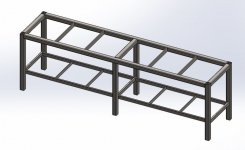
Attach is the frame I have designed so far. The rectangle voids between the upper members are 22" x 18" ... should that be adequate for supporting 3/8" steel top without too much deformation from working on it? The upper horizontal plates are 3/8" thick which should allow me to weld 3/16" both sides on each end which is the same thickness of the square tube members.
 

Attachments

  • workbench frame.JPG
    workbench frame.JPG
    63.7 KB · Views: 184
Last edited:

AMCguy

Well-known member
Joined
Dec 23, 2009
Messages
2,022
Location
Sunshine Coast, BC Canada
That sounds like it's going to be a beast of a workbench.

My advice would be to build it heavy duty enough for what you mostly do. Do your heavy beating on something designed for just that. I'd skip the stainless.

Mine has an 11 gauge hot rolled, mild steel top that sits on a sheet of 3/4'' mdf. You need to do that to deaden the sound otherwise it will clang like a big bell. About the only thing I don't do is weld or beat on it. The top just wipes clean with a rag. Some times I treat it to a squirt of oil.

100_1844.jpg
 

04fivefour

Well-known member
Joined
Apr 26, 2013
Messages
221
Location
Perry Township, OH
is this gonna be a welding bench or an all purpose bench? From my experience its usually best to have a separate welding bench/area. have one you can clamp to but doesnt get beat on and a framed one that can take the abuse.

just my .02
 
OP
S

shamrock12

Well-known member
Joined
Dec 26, 2007
Messages
958
Location
South Dakota
It would be the main bench in the shop, and I would like to be able to weld on it too. I don't weld often enough to justify a dedicated welding table.
 

ilovevocs

Well-known member
Joined
Jun 26, 2009
Messages
1,966
Location
Toledo, Ohio
I would go half inch if your going to beat on it, but if your really deforming the 3/8, you either have one heck of a hammer and huge forearms, or your not using common sense. What is it that your pounding on that you have to use the edge of the table? Personally I try to avoid pounding on things, but that just me.
 
OP
S

shamrock12

Well-known member
Joined
Dec 26, 2007
Messages
958
Location
South Dakota
A good example I could think of pounding on the edge is to straighten out something or to bend something at 90 degree angle or so. Again, it's not like I'm going to throw a sledgehammer with all my mighty but that doesn't mean I'm going to beat on something like a girl.

I guess maybe I should look into adding some piece of wood under the top to deaden the clanging sound of steel. Is it really going to be that bad? If I do that, then perhaps I could use 1/4" steel top with 3/4" MDF under it? However at the same time, I won't be able to weld it to the frame. I probably will have to weld some angle iron under the top and then drill/tap through the side of angle iron and the front of horizontal square tubes frame and then bolt them together.
 

Jack Olsen

Super Moderator
Staff member
Joined
Mar 22, 2009
Messages
6,678
Location
Los Angeles
It's hard to say much without knowing the specific use you're planning, but...

I think you've over-designed the base and under-designed the top. Go thinner wall on the square tubing and thicker on the plate. Not sure the stainless is the best idea. If the bench is going to get a lot of hard use, you'll appreciate that you can sand out the scars. Thin stainless is going to get divots and scratches.

Sandwiching top materials invites moisture, oil and other **** to creep into the space. Half inch steel will not 'clang' very much -- there's too much mass. I wouldn't worry about sound dampening at all.

If you have a local supplier that sells remnants, I'd suggest keeping an eye out on anything in the range of 1/2" plate in the size you want, and then build it from there.

My favorite bench to work on is this one. It's 1" plate on a 12-gauge cabinet. It is not loud at all. And it's stout as a tank.

Comp-Lyon-H.jpg
 
OP
S

shamrock12

Well-known member
Joined
Dec 26, 2007
Messages
958
Location
South Dakota
Yes, I am aware that the base is over-designed; however, I did it on purpose for added weight. I need the bench to remain stationary especially when I need to break something free on a large 6 1/2" Wilton vise. I've turned around a 600-700 lbs bench before :D

It seems alot of you are saying to avoid stainless skin. I'm curious how you can keep mild steel top nice and clean? I know it is a bench to be worked on; however, sometime you need a clean surface for a certain task. I'm not thinking of doing it for the look ... just the function of it.

I am designing a general purpose bench. It would be the main bench in the shop which is why I am making it 10 feet long. It would be used for just about anything. I might consider building a welding table someday in the future but for now, I just need a workbench in the shop but I'd like to do this once and right ;)

If I am understanding correctly, I should go with thinner plate with wood under it as a general purpose table ... and thicker plate (no wood) as a welding table? Is that what you are implying?

This has been helpful so far ... please keep it coming. Thanks!!
 
To avoid these ads, REGISTER NOW!
OP
S

shamrock12

Well-known member
Joined
Dec 26, 2007
Messages
958
Location
South Dakota
Jack, that is a very nice bench. That vise looks very similar to mine ... is that Wilton 1765? :thumbup:

I could try and consider going to 1/2" plate but have no mean to lift anything that heavy. The bench I am designing would have 25 square feet of working surface ... so that would be over 500 lbs :eyecrazy: Not to mention that it would get crazy expensive quickly.

Do you think the clanging sound on 3/8 would be just as "good" as the 1/2" plate?
 

akdiesel

Well-known member
Joined
Aug 8, 2008
Messages
2,617
Location
Wasilla, AK
3/8" or 1/2" plate is going to make noise with a hammer no matter how much wood you put under it. It will also transfer the blows to the concrete and depending on how well they compacted the soil you will get an echo sound as well.
Any stationary bench should be bolted to the wall and / or the floor for stability This will also correct any wobble due to heating of the metal when welding.
 

nickleone

Well-known member
Joined
Sep 29, 2007
Messages
193
Why not make the bench all steel and then make a wood and stainless cover for part of it. That would take care of the clean surface. Make the wood and stainless section hinge at the back so you could lift it off and secure to the wall. Or make a storage shelf under the table close to the top so you could slide it off and push it under.

Nick
 

Always_Thinkin

Well-known member
Joined
Aug 14, 2012
Messages
300
Location
Illinois
Just a thought here...after reading some of the comments. I think we are venturing into analysis paralysis. We might be over thinking things.
 

Chaz

Well-known member
Joined
Apr 3, 2006
Messages
806
Location
Missoula, MT
benchframe.jpg


benchfoot.jpg


benchdone.jpg


Mine is 20 ft long with a 2" square tube frame... Adjustable feet for leveling.
It has a 1/2 inch thick top, and I've had it for 5 years. It'll never bend. I'm assuming 3/8 inch would behave similarly.
 
Last edited:

Jack Olsen

Super Moderator
Staff member
Joined
Mar 22, 2009
Messages
6,678
Location
Los Angeles
Well, in my opinion 3/8 is going to be too thin, especially if you're making the bottom stout to withstand twisting/bending forces on the material you'll be working on. Cost is the reason I suggested building around a remnant instead of paying full ticket for the steel top. I got a discount on my 1" piece because one side was cosmetically damaged. It weighs 510 pounds, and I was able to get it out of the back of my Jeep and into position with some dowels, some rectangle tubing, rope and a car jack.

If 1/2" is going to be too heavy and/or too costly for 10' of bench, then I'd think about doing it half in steel and half wood. You could use the same substructure for both so long as you accommodated the thicker wood top so that the two would end up level.

But again, unless we know what you plan to use the bench for, this is all academic.
 

Zeke

Well-known member
Joined
Aug 13, 2009
Messages
17,176
Location
Long Beach CA, the sewer by the sea.
.............................................
It seems alot of you are saying to avoid stainless skin. I'm curious how you can keep mild steel top nice and clean? I know it is a bench to be worked on; however, sometime you need a clean surface for a certain task. I'm not thinking of doing it for the look ... just the function of it.
.......................................................
Wipe it down with phosphoric acid once and week and hit it with a belt sander now and then.
 
OP
S

shamrock12

Well-known member
Joined
Dec 26, 2007
Messages
958
Location
South Dakota
But again, unless we know what you plan to use the bench for, this is all academic.

Jack, it would be all-purpose workbench ... and be used for just about anything like repairing, fabricating, etc. It is not going to be a dedicated bench for specific task.

Chaz ... I really like that idea of leveling bolt ... did you weld a piece of steel inside the tube and then drilled/tapped for the bolt? I might have to do something like that especially after the concrete crew screwed up the floor last summer. It was a HOT day ... near 100 degrees F and the crew were short handed. Ended up with uneven area where two pours meet because it was setting faster than they could keep up. Of course, it has to be where the workbench will be going! :mad:

Thanks for the tip on preserving the steel top, Zeke.
 

Chaz

Well-known member
Joined
Apr 3, 2006
Messages
806
Location
Missoula, MT
The bottom plate of the leg has a nut welded on the inside. It really worked out nicely for us. Just like leveling a washing machine.
 

rick carpenter

Well-known member
Joined
Jan 20, 2011
Messages
3,771
Location
Huntsville, East Texas
As far as edge deflection goes, you could weld in triangular supports. If you're worried about a bare steel top clanging, you could spray foam insulation or other sound deadening from the underside.
 

PCO6

Well-known member
Joined
Dec 25, 2008
Messages
4,573
Location
Newmarket, Ontario
shamrock12 - My main work bench is the same dimensions as what you are planning to build (30" x 120"). The structure is simply pallet racking and it's as strong I will ever need. The top is 1/8" steel resting on 2"x10" lumber. It's a general purpose bench. I've rebuilt small engines and transmissions on it, welded on it, cut and pounded metal on it, etc. The only thing it's missing is a lip for clamping but I have another bench for that.

I've had it in 2 garages over the last 35 years or so. When I moved it to its current location 22 years ago it took about 30 minutes to take apart and the same to reassemble it. It hasn't budged since.


To avoid these ads, REGISTER NOW!
Top Bottom