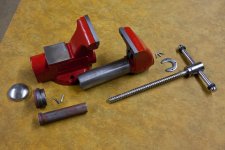
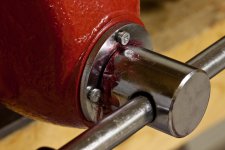
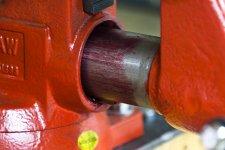
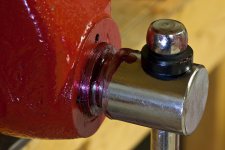
Everything you wanted to know about the Craftsman Professional 4 1/2" vise  I’ve started this thread to help organize the available information in this forum, and to contribute information I have learned from research, purchase, and ownership. The short version is “yes it’s a good one: Find a good copy, then disassemble, clean and re-lube, and expect to re-paint it some day.” For the long version, read on
Background
First of all, recognition goes to GJ member kythri, who did a nice restoration on his Craftsman Pro vise (after only 3 or so years in operation), as well member slip_kid, who provided some disassembly information from his Wilton 1745. Those discussions can be found here:
http://garagejournal.com/forum/showthread.php?t=126958
http://garagejournal.com/forum/showthread.php?t=123880
Additional background information has been provided by GJ member Obie and outlander800, for example connecting historical dots relative to the heritage of the Craftsman:
http://garagejournal.com/forum/showthread.php?t=124833
ToolGuyd http://toolguyd.com/best-bench-vise-craftsman-professional/ has posted a small write-up on this vise, although this page appears to have the goal of generating hits to both amazon and sears reseller sites.
Apologies in advance for any omissions; I’m happy to correct/Edit this post as required. The information below I have gleaned from others (such as the above) and obtained from my personal journey from investigation through purchase and ownership.
Rationale and positioning of the Craftsman Professional vise in today’s market
When I surveyed the marketplace for a sub-$150 vise, I found that all except the Craftsman Pro were uniformly horrible, suffering from some or all of the following deficiencies:
a. Exposed lead screw, making it vulnerable to debris and rust
b. Thin/weak casting material
c. Excessive jaw movement when not clamped, indicating wide tolerances and a sloppy fit between the dynamic and static assemblies.
d. Light weight lead screw and screw assembly (what accepts the lead screw) indicating a low clamping force capability
e. Poor fitment and/or lubrication of the mating/moving parts esp the lead screw.
f. Poor jaw fitment
Essentially a Chinese copy of the US-made Wilton 1745 tradesman vise, the Craftsman Professional 4-1/2” vise (sears item #item #00951888000) addresses all of the issues above at an attractive price. its only drawback is manufacturing consistency and carelessness, which of course I describe how to fix later in this thread!
The copy is so good, in fact, it makes one conclude that this vise is a step above the other imports at similar prices points and even above. To wit:
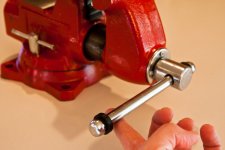
a. The lead screw is enclosed
b. The casting material claims to be 60,000 psi, supporting high clamping forces
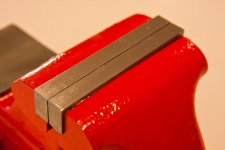
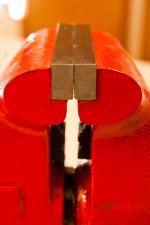
c. The dynamic and static assemblies fit together nicely, producing very little jaw slop
d. The lead screw and screw assembly is very robust, indicating a high clamping force capability
e. With the vise supported only by its own weight (not bolted down), you can operate the jaws nicely with one finger on the handle -- without it moving around on the table
f. Jaw fitment is precise
more in part 2...
I’ve started this thread to help organize the available information in this forum, and to contribute information I have learned from research, purchase, and ownership. The short version is “yes it’s a good one: Find a good copy, then disassemble, clean and re-lube, and expect to re-paint it some day.” For the long version, read on Background
First of all, recognition goes to GJ member kythri, who did a nice restoration on his Craftsman Pro vise (after only 3 or so years in operation), as well member slip_kid, who provided some disassembly information from his Wilton 1745. Those discussions can be found here:
http://garagejournal.com/forum/showthread.php?t=126958
http://garagejournal.com/forum/showthread.php?t=123880
Additional background information has been provided by GJ member Obie and outlander800, for example connecting historical dots relative to the heritage of the Craftsman:
http://garagejournal.com/forum/showthread.php?t=124833
ToolGuyd http://toolguyd.com/best-bench-vise-craftsman-professional/ has posted a small write-up on this vise, although this page appears to have the goal of generating hits to both amazon and sears reseller sites.
Apologies in advance for any omissions; I’m happy to correct/Edit this post as required. The information below I have gleaned from others (such as the above) and obtained from my personal journey from investigation through purchase and ownership.
Rationale and positioning of the Craftsman Professional vise in today’s market
When I surveyed the marketplace for a sub-$150 vise, I found that all except the Craftsman Pro were uniformly horrible, suffering from some or all of the following deficiencies:
a. Exposed lead screw, making it vulnerable to debris and rust
b. Thin/weak casting material
c. Excessive jaw movement when not clamped, indicating wide tolerances and a sloppy fit between the dynamic and static assemblies.
d. Light weight lead screw and screw assembly (what accepts the lead screw) indicating a low clamping force capability
e. Poor fitment and/or lubrication of the mating/moving parts esp the lead screw.
f. Poor jaw fitment
Essentially a Chinese copy of the US-made Wilton 1745 tradesman vise, the Craftsman Professional 4-1/2” vise (sears item #item #00951888000) addresses all of the issues above at an attractive price. its only drawback is manufacturing consistency and carelessness, which of course I describe how to fix later in this thread!
The copy is so good, in fact, it makes one conclude that this vise is a step above the other imports at similar prices points and even above. To wit:
a. The lead screw is enclosed
b. The casting material claims to be 60,000 psi, supporting high clamping forces
c. The dynamic and static assemblies fit together nicely, producing very little jaw slop
d. The lead screw and screw assembly is very robust, indicating a high clamping force capability
e. With the vise supported only by its own weight (not bolted down), you can operate the jaws nicely with one finger on the handle -- without it moving around on the table
f. Jaw fitment is precise
more in part 2...
Last edited: