Mister Moose
Well-known member
- Joined
- May 24, 2012
- Messages
- 131
I don't have any 6 point sockets, and thinking of getting some. Is there any reason why I shouldn't just get an impact set? Why would you need both?
Thanks.
Thanks.


Buy the chrome ones, and use them on your impact

if there is any chance you using them on an impact, buy impact sockets. i've NEVER had a problem getting my 3/8 impact sockets to fasteners that switching to chrome made the difference.
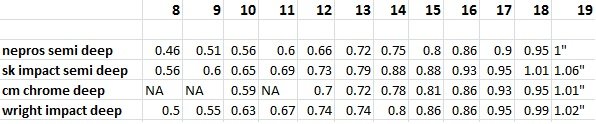
i just went and measured two sets of chrome (nepros semi deep & craftsman deep) and two sets of impact (sk semi deep & wright deep). here are the results - the size socket measured across the top, 1 brand/set per row, and the diameter in fractions of an inch (sorry, US micrometer was at hand):
8 9 10 11 12 13 14 15 16 17 18 19
nep .46 .51 .56 .60 .66 .72 .75 .80 .86 .90 .95 1"
sk .56 .60 .65 .69 .73 .79 .88 .88 .93 .95 1.01 1.06"
cm .59 .70 .72 .78 .81 .86 .93 .95 1.01"
wrt .5 .55 .63 .67 .74 .74 .80 .86 .86 .95 .99 1.02"
while it is clear the impact sockets are larger in diameter, the wrights (a higher quality socket than the SK IMO) are all less than a tenth of an inch bigger, and in most cases are 5 hundredths or less larger.
how many spaces for a socket are clearanced to less than half a tenth? none that i've found...
ahm

A problem with Impact over chrome is that they are softer. Just like a chrome may explode on a Impact gun, an impact on a breaker bar may just split. A lot of people think a Impact is a "super" socket, but its not, depending on the application its worse. A Hardened Chrome Socket is made to take a constant strain without Malforming, and an Impact is a soft metal thats made for a lot of force, but only at inconsistent blows.
Because its softer you it takes the high energy blow and sends it down the line to the fastener, almost like a recoil. Force Hits drive end, impact transfers for to fastener, force leaves impact. I don't want to say its springy, but that's really the best word coming to mind.
A piece of tempered glass can take more force without flexing than plastic, but if you implement a "striking blow" it will fail much, easier then plastic. But you can smash 2 pieces of plastic together, possibly make much more energy without failure because soft materials absorb some of the harshness.
I have personally tested impacts for different wear, and an Impact socket that can last plenty in a Gun, will fail very easy with a breaker bar with little to no effort.
You can use Impacts in light duty stuff, but you will have a bad time if you use a big breaker bar on them. An Impact just is too soft for that constant strain, and will most likely split.
Everyone cheats, but it doesn't mean its safe, or cost effective.
A problem with Impact over chrome is that they are softer. Just like a chrome may explode on a Impact gun, an impact on a breaker bar may just split. A lot of people think a Impact is a "super" socket, but its not, depending on the application its worse. A Hardened Chrome Socket is made to take a constant strain without Malforming, and an Impact is a soft metal thats made for a lot of force, but only at inconsistent blows.
Because its softer you it takes the high energy blow and sends it down the line to the fastener, almost like a recoil. Force Hits drive end, impact transfers for to fastener, force leaves impact. I don't want to say its springy, but that's really the best word coming to mind.
A piece of tempered glass can take more force without flexing than plastic, but if you implement a "striking blow" it will fail much, easier then plastic. But you can smash 2 pieces of plastic together, possibly make much more energy without failure because soft materials absorb some of the harshness.
I have personally tested impacts for different wear, and an Impact socket that can last plenty in a Gun, will fail very easy with a breaker bar with little to no effort.
You can use Impacts in light duty stuff, but you will have a bad time if you use a big breaker bar on them. An Impact just is too soft for that constant strain, and will most likely split.
Everyone cheats, but it doesn't mean its safe, or cost effective.
A problem with Impact over chrome is that they are softer. Just like a chrome may explode on a Impact gun, an impact on a breaker bar may just split. A lot of people think a Impact is a "super" socket, but its not, depending on the application its worse. A Hardened Chrome Socket is made to take a constant strain without Malforming, and an Impact is a soft metal thats made for a lot of force, but only at inconsistent blows.
Because its softer you it takes the high energy blow and sends it down the line to the fastener, almost like a recoil. Force Hits drive end, impact transfers for to fastener, force leaves impact. I don't want to say its springy, but that's really the best word coming to mind.
A piece of tempered glass can take more force without flexing than plastic, but if you implement a "striking blow" it will fail much, easier then plastic. But you can smash 2 pieces of plastic together, possibly make much more energy without failure because soft materials absorb some of the harshness.
I have personally tested impacts for different wear, and an Impact socket that can last plenty in a Gun, will fail very easy with a breaker bar with little to no effort.
You can use Impacts in light duty stuff, but you will have a bad time if you use a big breaker bar on them. An Impact just is too soft for that constant strain, and will most likely split.
Everyone cheats, but it doesn't mean its safe, or cost effective.
When a Chrome socket on an impact fails, it explodes. When an impact goes it splits/tears. Manufactors put disclaimers to protect them. An exploding socket is a big deal, a split one is inconvenient at most. I know you can use them on a bar, but I'm saying its not the designed idea. I wouldn't have the opinion I do, if not for that I test this stuff for a living and just did impact sockets about a month ago. The fail rate of an impact is greatly less in ft. lbs if its a constant strain, vs a hammering motion. I tested some small adaptors that wouldn't break with my IR gun, but I could break with a bar at 150 ft. Lbs. And that's a digitally measured number, not just my assumption. I'm not trying to pick fights, just give the guy some help.
Too often these discussions turn into a mud fight, I love to help where I can with the trade knowledge I have but I am representing a company and can't stick around too long after it starts getting messy, I know you can use whatever you like, I'm just saying what the design and potential outcome is.
and now it sounds like not a single impact socket failed within your measurement capabilities.I have personally tested impacts for different wear, and an Impact socket that can last plenty in a Gun, will fail very easy with a breaker bar with little to no effort.
In terms of metallurgy toughness and malleable are the same, they are softer, and thicker, to make up for the loss in tensile strength. If you were to watch a high speed of an impact socket in use, you'd see it "twist" with each blow, delivering the torque. That is what let's then take the abuse. The spring of the material, but just like a spring if you pulled it constantly without allowing it recoil it would fatigue and fail. I'm not saying they will fail everytime, just saying the design. If you look at a failed impact you almost always just have a ripped side when the strain caused it to stretch and blow out.
You can use a flat blade screwdriver as pry, and a ratchet head as a hammer, but it working isn't an idicator of its design.
I'm getting butchered for supplying information here, the ft lbs of an impact grade socket under constant strain is far less than the potential torque output of a gun.
sorry guys. I will try to go with the flow more, and assume that because somethig works, that it must be what it was designed for.
Toughness is the resistance of cracking or fracturing, and mallebility is the ability to resist vcracking after deforming.... That is the same thing. Toughness is a generic term used based on wear. Deformation without fractures is a measure of that. Hardness is strength without deforming.
A hardened chrome socket is not by metallurgy standards tougher than impacts.
Each is designed to a purpose is my point. Chrome Sockets, don't wear, Impacts do, that shows how the softness of a metal effects it. Look at a heavily used impact and the drive end will be distorted at least a little. A chrome socket would fail well before distortion. Obviously there are a lot of variables, and I don't have all the necessary information to answer that, but as a rule of thumb, an Impact socket will fail at a lower ft lbs when used under constant load vs brief High energy impacts.
I'm trying my best to present facts without being offensive. So please offer me the same.
I have no idea with constructive discussion, but sometimes I'm getting hammered for answering. I like to actively discuss this stuff because I work for a tool company as there "tester" and I went to trade school for machine tool/ metallurgy.
I can't disclose what brands I have tested, but I can tell you that the quality and strength is Carbon > Chrome Vanadium > and Chrome Moly, with moly being more wearable, but the overall strength isn't a ton more that CR-V. The brands I tested were Home Owner / Hobby Mechanic stuff, as thats my market. No truck brands.
I have 2 guns, and I used both. Being IR I'm sure I'm getting good power. The reason I had the bolts welded is most Guns put out peak power in reverse, That's why the "Break away" torque is always rated more.
The machinery to test very high foot pounds is expensive and I am still trying to procure one. I do have to bench mark a lot of things, but it still provides good information.
I do want to make it clear, that I am a guy that works on cars. I am not just a lab rat, so a lot of times I test things in more real world ways, cheater pipes, hammering on and so forth, because in the real world nobody follows the rules.
Also I am representing a company so the its "bs" posts are hard for me to reply to because I'm not going to endorse trolling, I'm just trying to help you guys out. I completely understand that you can use impacts, All I was saying is, you may get let down.
I really enjoy these discussions, as a "tool guy" its fun for me to talk about, but getting blasted on things that I personally have tested gets frustrating fast.
I did not imply impacts are weak... I am saying that is not the ideal use based on design. Yea the IR may be exaggerated a little bit. But I'm sure its still well over 500 ft lbs. Breaking an impact with less then body weight on only a 24 inch bar indicates something.
Lets keep it informative and fun, nothing wrong with a good talk.
The chrome sockets did not break with the bar, I know this isn't a real stat, but the bar that broke the impacts, I broke 4 of the heads off trying on the chromes.
Each is designed to a purpose is my point. Chrome Sockets, don't wear, Impacts do, that shows how the softness of a metal effects it. Look at a heavily used impact and the drive end will be distorted at least a little. A chrome socket would fail well before distortion. Obviously there are a lot of variables, and I don't have all the necessary information to answer that, but as a rule of thumb, an Impact socket will fail at a lower ft lbs when used under constant load vs brief High energy impacts.
Toughness does not mean to not deform, its deformation without fracture. So yes an Impact is "tougher" than a chrome.
An impact will stretch and deform, where as a hardened chrome will shatter. Your associating toughness as tensile strength. Toughness is the measure of wear without failure.
The problem is toughness is a misused word in metallurgy. Strength and toughness are similar in idea, but not function.
I'm not saying that impacts are made of butter, You agree chromes are harder, but not that impacts are softer? I guess that's where I am losing you.
Chrome is hardened, and Impact's are annealed to be softer. The reason impacts are black oxide is they flex in use and that would flake off the chrome.