To avoid these ads, REGISTER NOW!

Garage Master Plan – general Overall plan with specific focus on the electrical layou

Parke

Active member
Joined
Jan 10, 2013
Messages
33
Location
Ringwood, NJ
Garage Master Plan – Update Work started CB question

Garage Master Plan – general Overall plan with specific focus on the electrical layout

I am in the process of upgrading the garage electrical service via a new subpanel to be located in the garage. I posted this in a thread last winter and got good feedback. The longer term goal is a detached garage/shop that would get electric service from the existing garage. As I got closer to starting on the subpanel work, the more I realized I needed to plan out everything I wanted to do more thoroughly first.

Well, I think I have done that now. After reading a lot of threads on the Garage Journal, I have put together my plan. The following is basically my “Blue Book” final. I willingly submit it to you for critique and evaluation. All comments are welcomed.

Summary

The house is a raised ranch, with 200 Amp service via in ground cable. The subpanel is a Square D model (matches the main panel) with 12 slots and 125 Amp max service. I am running 2-2-2-4 AL SER from the main panel to the subpanel.

The Master Plan is to first upgrade the current garage which is woefully lacking in several departments, and then ideally, building a detached garage/shop. The detached garage is a bit of a long shot for various reasons that I’ll get into later. The main purpose for the garage upgrade is to support my growing wood working addiction. I currently have a decent table saw, miter saw, drill press, planer along with numerous hand tools, routers, sanders and a weak *** dust collection unit. Everything is on mobile bases, including my work benches. There are several foreseeable acquisitions running around in my head. There is also a daughter in college, and thus there are priorities.

I am also already committed to demo’ing the garage ceiling in order to replace the woefully lacking insulation (estimated to be 1974 R7) with R-21. So running new wire in the ceiling joists for lights and power is a non-issue drywall-wise.

Current Situation

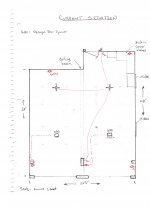
The attached garage is a two car affair with approximately 624 sqft. It has two, single bulb porcelain light fixtures, and two garage door openers (GDO), one of which has two light bulbs. Total light output for the garage is under 3,000 lumens (~5 lumens/sqft – yay!). There are two electrical outlets which provide the only real plug in abilities, which are located near the exterior. The GDO’s are also plugged into these outlets, killing half of the receptacles. I’ve previously added a GFCI outlet on the wall opposite of the bathroom, which is on the bath circuit. The overhead lights, remaining outlets (and GDOs) are all on the same 15 amp circuit. The master bdrm, master bdrm bath and half of a second bdrm are also all this same circuit. If anyone is doing anything upstairs while I’m running one of the bigger machines, it is lights out for everyone.

Current garage electrical diagram:

View media item 32775
Garage Modification Plan

• Install a 100 amp service subpanel in the garage.
• Keep existing overhead light circuit as is for egress and quick trips in/out of garage.
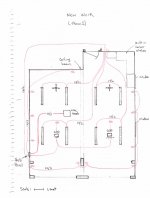
• Add (8) 2-light 4 ft fluorescent wraparound surface mount fixtures, wired to four individual switches for energy efficiency.
• (16) T8 4100k 2800 lumen CRI 85 tubes will produce 44,000 lumens, assuming 90% efficiency, these will yield ~100+ lumens/sqft for my work areas.
• Remove outlets from common upstairs circuit.
• Install two new outlet circuits from subpanel, using 12/3 NM wire, splitting the top and bottom receptacles. Rather than deal with the less than popular GFCI receptacles, and the need for four of them (?) with my set up, I am going with (4) Square D 20 Amp single-pole GFCI circuit breakers ($36 a pop – ouch).
• Separate 15 amp circuit for garage door openers with extra outlet on ceiling in each bay. I’m thinking it is probably more useful to use outlets for the GDOs rather than hard wiring. I haven’t a clue as to whether most openers come with a power cord or not.
• I’ll be hanging a Jet 1000 air filter in the near future, utilizing one of those ceiling receptacles.
• Lastly, I just got a 5000 watt, 240 V electric heater, which will require a 30 amp circuit using 10/3 cable. I have already heard the recommendations for a kerosene or propane heater for cost reasons, but I am not a fan.

This is the proposed electrical work diagram:

View media item 32776
The 2-2-2-4 AL SER will run through the insulated upstairs walls through the attic and back down to the garage. Total run length is about 100 feet, with 16 feet in insulated walls.

Future Work

Ultimately, I would love a detached garage. Besides the obvious reasons that resulted in a Garage Forum in the first place (man cave, because it is a garage, because you built it yourself, …) the detached garage would greatly expand my shop area, allow the cars back into the current garage, and allow me to move my glider trailer indoors.

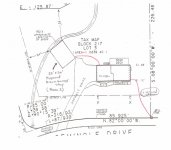
The plan is for a 25’ x 36’ x 9’ building with 80 amp service running off the garage subpanel, via a ~ 70 foot buried cable. The proposed subpanel location yields the simplest route for the detached garage service.


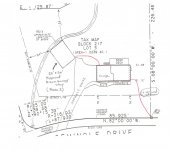
Property Plot:

View media item 32777
Note that the service run from the house to the proposed detached garage is also proposed (doesn’t exist).

The new shop would make the majority of the main garage improvements superfluous, but I can live with that. I also figure with doing the majority of the work myself, it will run about $20,000. Did I mention the daughter in college? What will make this work financially is that I am in the process of starting a small business idea (woodworking based) which will either pay off handsomely or else just allow me to deduct the cost of my tools. If it succeeds, I’ll (maybe) get my shop. If it doesn’t, I’ll be settling for a 12’ x 18’ shed.

The other hurdle is that the local township apparently has a restriction of building within 150’ of water. Any water. As shown in the property plot, there is a stream running through the property. It’s a seasonal stream that is supplied mainly from rain runoff from the surrounding hillside and snow melt. In theory is the house were to be built now, it wouldn’t pass. However, there are numerous outbuildings up and down the road sitting very close to year round streams, so I have hope. In the meantime, I am taking out permits for projects to build up a report with the building inspector. Fingers crossed.

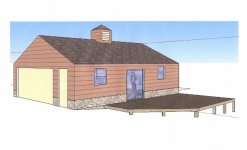
Meanwhile, here’s an early effort via Sketchup of what the detached garage would look like.

View media item 32774
The 36’ length will allow getting a 5’ x 29’ glider trailer parked on the left side. The shop area would be about 18’ x 25’ (425 sqft) in the back right corner. Yes, I’ve got a 6’ sliding glass door opening up to a deck. (One must pay some homage to the man cave dream.) I have thoughts of adding a small bathroom, but were on a septic system that is uphill from the proposed shop, requiring a pump. That, and it opens another can of worms with the building inspector. Though, for the record, it isn’t the number of bathrooms, but the number of bedrooms that specifies septic system capacity. The deal here is to convince the permit office that you are not secretly adding another bedroom, which apparently isn’t easy.

So there you have it. Comments, suggestions, critiques welcomed. Pictures of my current hall of shame garage to follow. Hopefully, this thread gets transitioned to the Garage Gallery forum in a year or so.

Thanks.
 

Attachments

  • Garage current (465x640).jpg
    Garage current (465x640).jpg
    83.1 KB · Views: 36
  • garage mod 002 (487x640).jpg
    garage mod 002 (487x640).jpg
    112.9 KB · Views: 42
  • Garage mod 003 (640x562).jpg
    Garage mod 003 (640x562).jpg
    131.4 KB · Views: 35
  • detached garage 001 (640x390).jpg
    detached garage 001 (640x390).jpg
    112.5 KB · Views: 25
Last edited:
To avoid these ads, REGISTER NOW!
OP
P

Parke

Active member
Joined
Jan 10, 2013
Messages
33
Location
Ringwood, NJ
Hmm, first attempt at posting images: C+

Got the right answer with pattenp's help.
 

Attachments

  • detached garage 001.jpg
    detached garage 001.jpg
    145.8 KB · Views: 22
  • Garage current.jpg
    Garage current.jpg
    115.3 KB · Views: 20
  • garage mod 002.jpg
    garage mod 002.jpg
    120.6 KB · Views: 20
  • Garage mod 003.jpg
    Garage mod 003.jpg
    122.9 KB · Views: 18
Last edited:

pattenp

Well-known member
Joined
Jun 4, 2008
Messages
10,175
Location
Virginia - USA
You can create an album in your profile to put the pictures in and then copy and paste the BB code that's listed below the image into the post. I know.. clear as mud. The image will show as large like this.....

But whow that's big.

(Deleted the Image because it was huge)


Still not there. How does one post full size pics within the post???
 
Last edited:
OP
P

Parke

Active member
Joined
Jan 10, 2013
Messages
33
Location
Ringwood, NJ
Thanks. Will do.

Definitely BIG. The second attempt,I posted the full size image to see it would go through. Apparently it will.
 

pattenp

Well-known member
Joined
Jun 4, 2008
Messages
10,175
Location
Virginia - USA
If I understand you correctly you are creating 2 multiwire branch circuits (MWBC) for your outlets. If that's the case then you need 2 double pole gfci breakers. A MWBC need to have the breaker handles tied together.

Edit: I need to add that I think gfci breakers don't work correctly with MWBC's.
 
Last edited:
OP
P

Parke

Active member
Joined
Jan 10, 2013
Messages
33
Location
Ringwood, NJ
'Edit: I need to add that I think gfci breakers don't work correctly with MWBC's. '


Hmm, I'm trying to wire split circuit receptacles, which would enable running say two 15 amp machines from the same outlet. I may have an assistant in the future which makes this a possible scenario.

It would be no problem to do this with NM 12/3 sans the GCFI requirement, I would think that there should be a way to accomplish this layout with a GFCI of some sort. Having read enough threads on this forum, I am shying away from the GFCI receptacles due to relatively reduced lifespans. I'd rather pay once upfront for a suitable GFCI circuit breaker.
 

sands35

Well-known member
Joined
May 29, 2012
Messages
936
Location
St. Joseph, MI
Why do you want to split receptacles? Do you have a specific layout for shop equipment?

It takes some effort for one guy doing typical shop stuff to over load a 20 amp 120 outlet. If you have woodworking tools, then why not run a few 30 amp 240 circuit for the stationary tools, then use the 120 for hand tools?

or

Just skip outlets, not split them top/bottom, that way you can use $15 GFCI outlets for that duty and place them closer so you can run a stationary off one and a hand tool off the other.

For fixed stuff like a dust collector, run a dedicated 240 circuit and think about a douple pole wall switch.

All this implies that you've thought through an equipment layout and shop workflow before you start thinking about outlet placement. The simply way is to make scale paper cut-outs and move them around to find the layout you like.
 
OP
P

Parke

Active member
Joined
Jan 10, 2013
Messages
33
Location
Ringwood, NJ
The reason for the split receptacles is that there is a good possibility that there could be two people working simultaneously. Code requires a GFCI for garage outlests here in NJ. One option I suppose is two run (2) 14/2 cables and alternate outlets along the wall with a GFCI breaker or a GFCI outlet located first on each run.

I already have the dust collector, its wired for 120V and runs on a 15 amp circuit just fine.

The garage is a multi-use space, so I don't really have permanent locations for machines. All my equipment is mobile, including work benches. The bigger issue is that there just isn't that manuy places to put things. Most of the big stuff will be confined to one garage bay, though, with the other dedicated to a finishing area.
 
To avoid these ads, REGISTER NOW!

sands35

Well-known member
Joined
May 29, 2012
Messages
936
Location
St. Joseph, MI
If you want to alternate circuits, then do it by outlet, don't split each outlet top and bottom. More complicated then it needs to be. Problem solved for GFCI and alternate 120 outlets.

The fixed equipment will run fine on 120, but if you do some 30 amp 220 outlets you side step the GFCI requirment and you essentially get a 3rd, but higher amp, outlet set. Problem solved with amp draw.

Basically I'm suggesting that you are making it more complicated than it needs to be by:
A) splitting outlets
And
B) not running the heavier stuff of 30amp 220

You can also do a pair of duplex outlets and use 12/3 that way. I'd put in a quad every 6' at least for a wood shop. Cost is trivially incremental. I don't think there are enough on your drawing. Especially for 2 people.
 
Last edited:

2ManyProjects

Well-known member
Joined
Jul 18, 2013
Messages
757
Garage Master Plan – general Overall plan with specific focus on the electrical layout

I am in the process of upgrading the garage electrical service via a new subpanel to be located in the garage. I posted this in a thread last winter and got good feedback. The longer term goal is a detached garage/shop that would get electric service from the existing garage. As I got closer to starting on the subpanel work, the more I realized I needed to plan out everything I wanted to do more thoroughly first.

Well, I think I have done that now. After reading a lot of threads on the Garage Journal, I have put together my plan. The following is basically my “Blue Book” final. I willingly submit it to you for critique and evaluation. All comments are welcomed.

Whew! Quite a lot to chew on there; and I didn't see your earlier thread, so I'm attempting to digest it all at once, with no "prior art" context to put it into. That said, here are a few semi-random thoughts (I'll probably miss at least some salient points along the way)...

First and foremost: Ever since Superstorm Sandy, TPTB in New Jersey have started getting REALLY Draconian about building codes vis-a-vis possible flooding. I realize you aren't anywhere near the coastal areas; but when it comes to bureaucracies, such distinctions often tend to get discarded (along with most common sense). Given this, I am rather skeptical regarding your chances of being able to "squeak by" building your new "Dream Shop" closer to that stream than whatever setback the local municipality has decreed, notwithstanding that there may be dozens (or hundreds) of other non-conforming structures already in place on your neighbors' properties, and regardless of whether that setback is even "reasonable" (which is always a matter of opinion anyway; and yours, as the property owner, is inherently worth less than that of the local self-important bureaucrats -- at least in their minds).

So, before doing ANY work, including your "Phase 1" rehab of the existing garage, I would strongly urge you to re-think the entire project based on the assumption that you will almost certainly not be able to put that shop where you want it, and you MAY not be able to build it at all. In which case, whatever you do in the existing garage will need to be "good enough" to see you through for the long term. And given that, you may want to be quite a bit more ambitious about that rehab -- perhaps even to the point of enlarging its footprint by adding an extra bay or two on the back side of the house.

I would also suggest that, ASAP, you buy an hour or so of time from a good lawyer who specializes in real estate development issues, to discuss your project plans, and to see where you REALLY stand vis-a-vis the local regulations. It might even turn out that your best option would be to skip the rehab of the existing garage entirely, at least for now, and press on as quickly as possible with the new building. The theory here is, IF you have any chance of getting it approved, now would be the time, as opposed to after they tighten things up even more. Even if (for cost reasons) all you actually do at first is lay in the foundation and put up the exterior shell, that would likely be enough to get it "grandfathered in" with respect to any future legislation and/or regulation changes.

OK, with that out of the way, on to your specific plans...

Summary

The house is a raised ranch, with 200 Amp service via in ground cable. The subpanel is a Square D model (matches the main panel) with 12 slots and 125 Amp max service. I am running 2-2-2-4 AL SER from the main panel to the subpanel.

Twelve branch-circuit slots doesn't seem like all that much to support everything you've mentioned, especially if/when you daisy-chain yet another sub-panel off of it to feed the new shop. Remember, you'll be chewing them up two at a time to support any 240V circuits (of which I suspect you will have several, at least eventually).

And with specific regard to the current rating, 125A is no doubt plenty to support your garage; but it's definitely NOT "plenty" to support both the garage AND the shop, once both are fully fitted out to support all the cool toys. Granted, once you have the "new" shop completed and are fully up & running there, you probably won't be doing all that much in the garage. But if the "facilities" (lighting, outlets, HVAC, etc.) are still in place and available for use, you'll need to retain the breakers to support them, even if they aren't actually in use. Your alternative would be to tear all that out when you go to build the new shop; and that seems silly in the extreme.

The Master Plan is to first upgrade the current garage which is woefully lacking in several departments, and then ideally, building a detached garage/shop.

Are you also planning to park cars in the garage, either before, during, or after the period when it serves as your "shop"?

The detached garage is a bit of a long shot for various reasons that I’ll get into later. The main purpose for the garage upgrade is to support my growing wood working addiction. I currently have a decent table saw, miter saw, drill press, planer along with numerous hand tools, routers, sanders and a weak *** dust collection unit. Everything is on mobile bases, including my work benches. There are several foreseeable acquisitions running around in my head.

Several of the things you mention seem like good candidates for "permanent" installation (as opposed to being on rolling carts). The table saw and miter saw in particular would benefit from rock-steady mounting/leveling; and especially in the latter case, some generously sized "built-in" in-feed/out-feed tables (the table saw can more easily get by with portable/rolling feed tables). However, this would obviously play hob with keeping the space also usable for car-parking, which is why I asked about that.

If you do go with permanent mounting for some of the larger tools (and perhaps even if you don't), you should count on (or at least prepare for) feeding them with 240V circuits. This will not only keep your tool-upgrade options more open, it will likely be more efficient from a wiring POV. Don't forget things like heating & air conditioning, a NON-"weak ***" dust collection system, an air compressor, etc.

There is also a daughter in college, and thus there are priorities.

There are ALWAYS such "priorities". ;)

I am also already committed to demo’ing the garage ceiling in order to replace the woefully lacking insulation (estimated to be 1974 R7) with R-21. So running new wire in the ceiling joists for lights and power is a non-issue drywall-wise.

Good.

But this brings up another set of questions... How is the home currently heated/cooled? This will bear on your decision on whether to extend the existing system(s) to handle the garage, or to install completely independent system(s). And please don't make the mistake of thinking you can get by without SOME form of HVAC in that garage. At the very least, you'll need to protect stored materials from freezing and extreme humidity changes. But beyond that, if the space is to be usable as a workshop (and thus justify the expense of the upgrades you're contemplating), it needs to be comfortable enough to actually enjoy working in regardless of what the weather is doing that day.

Garage Modification Plan

• Install a 100 amp service subpanel in the garage.

See comments above re: panel sizing.

• Keep existing overhead light circuit as is for egress and quick trips in/out of garage.

Do you mean to also keep it fed directly off the home's main panel? Or do you simply mean keep the same existing loads on that branch circuit, but feed it from the new sub-panel?

Also, how old are your existing GDOs? For that matter, how old are the existing garage doors themselves? If you think that either or both of these items will be ripe for replacement within the next several years, you might want to include them in your initial rehab plan. Your obvious desire to improve the insulation of that space should not stop at the ceiling; you can get some BIG gains by going to double-walled doors with 2-inch thick polyisocyanurate insulation between the panels.

Also, this will open up the possibility of using (if you don't already have) a torsion-type counterbalance spring, which in turn permits the use of an opener which mounts off to the side of the garage door, such as (for example) the LiftMaster 8500 series http://www.liftmaster.com/lmcv2/pages/productmodeldetail.aspx?modelId=19724. This makes for a much neater installation, with no need for a separate belt/chain track consuming a ton of ceiling space. That in turn opens up storage-space possibilities -- think racks for long-ish lengths (or large-ish panels) of lumber, held in reserve for "when needed".


[The BBS software is nattering at me that the message is too long. So I'm breaking it here. Continued in next message...]


2ManyProjects

Well-known member
Joined
Jul 18, 2013
Messages
757
[...Continued from previous message.]

• Add (8) 2-light 4 ft fluorescent wraparound surface mount fixtures, wired to four individual switches for energy efficiency.
• (16) T8 4100k 2800 lumen CRI 85 tubes will produce 44,000 lumens, assuming 90% efficiency, these will yield ~100+ lumens/sqft for my work areas.

I like this plan. It should work quite well for general illumination. It might even be a bit on the overkill side; but as long as you split it up into multiple banks as you propose, that should not be a problem.

That said, don't forget task lighting at individual workstations, such as over your main workbench. The point is not so much to increase the overall brightness, but to eliminate shadows. Think about it: Your workbench (or miter saw, or lathe, or whatever) is along a wall, probably with some cabinets on the upper part of that same wall. As you're working, you have your back to the main lighting sources, creating your own shadows.

• Remove outlets from common upstairs circuit.

I'm going to lump this in with a general recommendation to completely divorce EVERYTHING in the garage (except the feed to the sub-panel, of course) from the existing breaker panel.

• Install two new outlet circuits from subpanel, using 12/3 NM wire, splitting the top and bottom receptacles. Rather than deal with the less than popular GFCI receptacles, and the need for four of them (?) with my set up, I am going with (4) Square D 20 Amp single-pole GFCI circuit breakers ($36 a pop – ouch).

I'm with "Sands35" on this one. Don't bother splitting the duplexes; just use double-gang boxes wherever you want 120V outlets, and feed each duplex in that box from a separate run of 12/2 NM-B. There are multiple reasons for this recommendation:

-- No matter what you think is "adequate" now, you WILL want still more outlets at some point down the line.

-- With the ongoing proliferation of various devices & gadgets which use "wall wart" type power supplies, many of which are polarized (so that they only fit in the socket one way), you'll likely be burning up a LOT of "bottom" sockets on your duplexes. But, these devices being what they generally are, they will never add up to all that much load en toto. So it would follow that all of your various higher-draw "stuff" will wind up plugged into the various "top" sockets of your duplexes. While it may not be a critical issue, the resulting likely "imbalance" is undesirable on general principles.

-- I'm not a fan of MWBCs feeding split duplexes, especially when inductive and/or capacitive loads are involved. But I don't want to start that argument again, so leave it at that.

Finally, your comment above exhibits a bit of self-contradiction. You said "two new outlet circuits", but mentioned FOUR 20A GFCI circuit breakers. In any event, I would consider two general-purpose outlet circuits to be the absolute dead minimum; and even then, ONLY if your larger stationary loads (table saw, surface planer, air compressor, dust-collection system, etc.) are all running off their own dedicated 240V circuits. If you plan to even temporarily (i..e, before you upgrade your tools) run ANY of this stuff off 120V, then you definitely need more circuits.

Also, do your local codes require GFCI protection for outlets in a garage/shop area, presuming it is not specifically a "wet" location (such as near a slop sink or similar)? If not, you'll likely be better off just using regular breakers. GFCIs sometimes react oddly to motor loads.

• Separate 15 amp circuit for garage door openers with extra outlet on ceiling in each bay. I’m thinking it is probably more useful to use outlets for the GDOs rather than hard wiring. I haven’t a clue as to whether most openers come with a power cord or not.

At least most do have (NEMA 5-15P) plugs. And even if you happen to find one which doesn't, a plug can be presumably installed on the cable. OTOH, once the GDOs are installed, they're not going anywhere; so hard-wiring would be perfectly appropriate (and MAY be required by your local codes -- best to check on this).

• I’ll be hanging a Jet 1000 air filter in the near future, utilizing one of those ceiling receptacles.

A word of caution here: A friend of mine has a similar device (not sure of make/model, but it looks VERY similar) in his dedicated above-the-garage wood shop. He swears at it a LOT more than he swears by it. In fact, as close as I can quote him from memory is: "Useless piece of ****..." and "Complete waste of money." In addition, a quick Google search brings up, among other things, this:

http://forums.finewoodworking.com/f...inery/very-scary-jet-air-filtration-afs-1000b

• Lastly, I just got a 5000 watt, 240 V electric heater, which will require a 30 amp circuit using 10/3 cable. I have already heard the recommendations for a kerosene or propane heater for cost reasons, but I am not a fan.

Ah, ha. I missed this on my first read-through.

I agree with you about the undesirability of either kerosene or propane (or anything else which uses local combustion to make heat) in that application. Beyond the obvious sawdust-inspired fire/explosion risk, the products of combustion have to go SOMEWHERE; and for the sake of your health, that "somewhere" should not be the interior of the shop. That means a more elaborate and expensive installation of any such heater.

Still, I'm not at all sure that a large single-point electric space heater is the best choice, either. I prefer to keep the heat source(s) as spread out and evenly distributed as possible, and to NOT require Beaufort Force 9 airflow to distribute the heat. :rolleyes2

For your "new" shop, the obvious first choice would in-floor hydronic heating; but that's likely to be impractical for retrofitting into your existing garage. Is there any hope of being able to use water-based baseboard heat, possibly tapped off the home's existing heating system? Failing that, how about electric or hybrid electric/hydronic baseboard? Among the advantages would be that, since it uses convection to distribute the heat, it is much quieter; and without a big honkin' fan blowing the air around, you also aren't blowing dust everywhere. The down side is that it would somewhat inhibit placement of base cabinets and such; and you might need to periodically vacuum out the sawdust and other collected debris, in order to keep the efficiency up.

Also, don't ignore reverse-cycle air conditioning, which can easily provide at least part of your heating needs AND provide for some air exchange in the process. You'll probably want the air conditioning for those hot Summer days anyway.

The 2-2-2-4 AL SER will run through the insulated upstairs walls through the attic and back down to the garage. Total run length is about 100 feet, with 16 feet in insulated walls.

That's likely to be a PITA; but since so much depends on the peculiarities of the specific job, not much more to say here.

Future Work

Ultimately, I would love a detached garage. Besides the obvious reasons that resulted in a Garage Forum in the first place (man cave, because it is a garage, because you built it yourself, …) the detached garage would greatly expand my shop area, allow the cars back into the current garage, and allow me to move my glider trailer indoors.

All good reasons for the detached shop. But given everything else which is currently on the table, and how far off this part of "The Plan" probably is, and how long this verbiage has run on already, I think this part of it probably ought to be left as a separate discussion, save for the idea expressed above that (due to bureaucratic considerations), you MIGHT want to put the new shop on the front burner. If/when that happens, revisit the topic at that time.


pattenp

Well-known member
Joined
Jun 4, 2008
Messages
10,175
Location
Virginia - USA
Parke, I missed this in your details. But because of the portion of the SER being run within an insulated wall the amp capacity needs to be reduced to the 60 deg C level which means the #2 Al will only be good for 75 amps max. 2011 NEC 338.10 (B) (4) (a) and 310.15 (A) (2)

Quote:
The 2-2-2-4 AL SER will run through the insulated upstairs walls through the attic and back down to the garage. Total run length is about 100 feet, with 16 feet in insulated walls.
 
OP
P

Parke

Active member
Joined
Jan 10, 2013
Messages
33
Location
Ringwood, NJ
This is a brief summary of the above discussion and progression of my thinking/plans.

1) The lighting plan seems to be generally accepted, so I'll leave as is. (1 circuit, 15 amps).

2) I like the outlet suggestions with 4-plexes. I'll run two NM 12/2 cables, supplying the left and right side of each receptacle box (I hope that makes sense). I got the "need" for GFCI outlets from one of my reference books (Visual Handbook of Building and Remodeling, by Charlie Wing) from their code discussion for wiring garages. I'll check with the local building inspector next week to see what they want and go with that with regards to GFCI.
(4 circuits, 20 amps, 12/2 cable).

3) It has been made clear to me that the proposed plan for the subpanel location/service run will cost amps. I can relocate the sub panel to between the garage windows. This was the suggestion of a union electrician friend of mine, but I was reluctant as it means tearing up the plywood ceiling of the exterior entrance overhang. I am so much more comfortable working with drywall. But, it is what it is.

Tradeoffs: The service run is only 40' and no attic work vs questionable if I can run service to the potential detached garage/shop from this location. (I'd have to trench through a lot of driveway.) Also, After powering the sub panel, I'll only have one slot left in the main panel (vs 4 in the sub panel). I assume the main panel can be ammended by using a tandem breaker?

4) Let's drop discussion on how to work through the approval process for the detached garage. That is probably a full time thread on its own.


Lastly, I love reading about all the mega garages and shops with all the huge equipment (600 pound Bridgeports), but that's not me. I am still on the modest end of the spectrum with modest dreams. I like the discussion on 220V, 20 or 30 amp circuits, but for the current garage I think it is overkill. If my business plan works out and the business pays for the detached garage, I would definitely incorporate the higher capacity in the new structure. For now, I have two tools that could be rewired for 240V (table saw, band saw), but I don't have high usage demand currently.

I have pictures to post on the current garage and equipment, but they need to be shrunk first. For now, though, it's time to take the daughter to New Hampshire and back to school.

Thanks

Parke
 

2ManyProjects

Well-known member
Joined
Jul 18, 2013
Messages
757
This is a brief summary of the above discussion and progression of my thinking/plans.

I told you I'd probably miss some stuff. This summary reminds me of a couple...

1) The lighting plan seems to be generally accepted, so I'll leave as is. (1 circuit, 15 amps).

While you surely won't need it from a load/capacity point of view, you nonetheless might want to split the lighting across at least two circuits/breakers. The main reason for this is, if/when you do pop a breaker (or need to manually throw it in order to work on something), you won't be left completely in the dark.

2) I like the outlet suggestions with 4-plexes. I'll run two NM 12/2 cables, supplying the left and right side of each receptacle box (I hope that makes sense).

Good move. And yes, that makes sense.

I got the "need" for GFCI outlets from one of my reference books (Visual Handbook of Building and Remodeling, by Charlie Wing) from their code discussion for wiring garages. I'll check with the local building inspector next week to see what they want and go with that with regards to GFCI.
(4 circuits, 20 amps, 12/2 cable).

Sounds good. If your local inspector indicates he "wants" GFCI on those general-purpose duplex outlets in "dry" locations, ask him why; maybe even ask him to cite the relevant section of the code (tho' I'd try to soft-pedal that, in the interest of maintaining "friendly" relations with inspector and those behind him -- remember, you have bigger fish to fry in the form of that future detached shop).

3) It has been made clear to me that the proposed plan for the subpanel location/service run will cost amps. I can relocate the sub panel to between the garage windows.

Would that not still be an insulated wall? That's what you're trying to avoid.

This was the suggestion of a union electrician friend of mine, but I was reluctant as it means tearing up the plywood ceiling of the exterior entrance overhang. I am so much more comfortable working with drywall. But, it is what it is.

Tradeoffs: The service run is only 40' and no attic work vs questionable if I can run service to the potential detached garage/shop from this location. (I'd have to trench through a lot of driveway.)

If push comes to shove, you could put the sub-panel where you originally intended, and simply upsize the feeder cable, which will then "derate" to the capacity you really wanted in the first place. This adds a bit of materials cost, and a fatter cable will be more of a PITA to muscle into place; but it might be the easiest approach in the long run. Remember too, for any given AWG, copper carries (and is rated for) a lot more current than Aluminum is; so that's another way you can get back some flexibility and ease-of-installation.

Also, After powering the sub panel, I'll only have one slot left in the main panel (vs 4 in the sub panel). I assume the main panel can be ammended by using a tandem breaker?

Well... You CAN; but it's best avoided if reasonably possible (and no, "siamesing" two branch circuits onto a single breaker is NOT "reasonable", despite being all too common in practice). Early on, you said that all of the existing garage electrical was tacked onto a circuit which also powers some bedroom stuff. Assuming you move the garage loads to the new sub-panel, those BR circuits should now have plenty of (or at least "adequate") capacity as-is, so no need to double-up on the breakers there. Was there something else you planned to run off the main panel?

You also said something about keeping the existing garage lighting circuits as-is. I took that to mean keep it as a separate circuit from the "main" (i.e., "new") lighting circuit (presumably in part for the same "anti-blackout" reason I mentioned above). But I was also assuming that this "old" circuit would now be sourced from the new sub-panel. Regardless of which way you "meant it", I strongly recommend that you do it this latter way.

As for the number of open breaker slots in the new sub-panel... Why is this an issue? You haven't bought the panel yet, have you? So just get a (physically) larger one, if need be. Nothing says that you can't put (for example) a 100A main breaker into a so-called "200A" panel. (On second thought... Since this is an attached garage, I don't think you need a "Main" breaker/disconnect in the sub-panel at all. So it becomes simply a matter of how many branch slots the panel provides.)

4) Let's drop discussion on how to work through the approval process for the detached garage. That is probably a full time thread on its own.

Probably so. But for the reasons I mentioned previously, I would urge you to go ahead and do your homework on this ASAP, including consulting with a good attorney. Many/most of them will provide an initial consultation gratis; but even if not, a few hundred bucks spent now might save you thousands (or even tens of thousands) -- and a LOT of grief -- later.

Lastly, I love reading about all the mega garages and shops with all the huge equipment (600 pound Bridgeports), but that's not me. I am still on the modest end of the spectrum with modest dreams. I like the discussion on 220V, 20 or 30 amp circuits, but for the current garage I think it is overkill. If my business plan works out and the business pays for the detached garage, I would definitely incorporate the higher capacity in the new structure. For now, I have two tools that could be rewired for 240V (table saw, band saw), but I don't have high usage demand currently.

I understand your reluctance to "go overboard" on things you're not sure you need. But given the nature of this project, and the strong possibility that the new detached structure might NEVER get built, I think you really do need to look further into the future. It is immensely cheaper to make at least basic provisions (such as selecting a sub-panel with plenty of breaker slots, for example) for the "serious" tools now, than to retrofit that capability later after installing an inadequate system. I'm not trying to make the case that you're going to go out and buy a half-dozen "King Kong" machines tomorrow. But it's always better to keep your options open.

I have pictures to post on the current garage and equipment, but they need to be shrunk first. For now, though, it's time to take the daughter to New Hampshire and back to school.

Have a good trip!

 
OP
P

Parke

Active member
Joined
Jan 10, 2013
Messages
33
Location
Ringwood, NJ
So, the garage is underway. Drywall pulled down, upside down (useless) R-11 insulation cleared out and new wires run. Wiring for new overhead lights run with no problem. Wiring for "two" runs of fourplex outlets run with 12/3, with the intention of splitting the right and left side receptacles on separate hots (red -right. black - left) for a total of 4 actual circuits. The intention is to terminate these to four - 20 amp GFCI breakers. But here is where I think I may have screwed up.

I bought 4 single pole Square D GFCI breakers and a package of Square D ties so that one shuts off both circuits in a run when one wants the power off. I pigtailed the neutral and ground in each box to supply each receptacle. I am now wiring the subpanel. Each GFCI requires a neutral. With the 12/3 the only solution is to pigtail each neutral in the subpanel with a wire nut and supply each of the tied CBs in turn. Is that kosher???

Looking back at the previous posts, I had concluded last year to run two 12/2 lines to each box, which would have eliminated the neutral issue and would only require the CB tie in the sub panel. Incredibly, I a) didn't remember that from last year and b) didn't re-read the thread before I resumed activity this year. How unusual on both counts (/sarc).

My gut is telling me I screwed up. Fallback would most likely be a true two pole GFCI breaker which runs $95 (x2) or so from HD (and I thought the single pole Sq D breakers were bad).

Can someone shine a light here and help how the early onset demented???

Thanks.
 
OP
P

Parke

Active member
Joined
Jan 10, 2013
Messages
33
Location
Ringwood, NJ
Color me demented. I should have reread my own thread. Extensive reading on this forum and elsewhere on the web, and shallow dives into the NEC is conclusive that you can't share a common neutral between a pair of single pole GFCI breakers.

There is the above mentioned bailout - two-pole GFCI breakers, but they run about $100 each. Supposedly they run on a common neutral in multi wire circuits, but I don't have definitive proof from the pruduct website.

On the other hand, since I have the 12/3 in place, another 250 ft of 12-2 Romex is $66 at HD, I could snip the black leads in the boxes and subpanel, leaving the red hot for a degraded 12-2, and run new 12-2 to supply the black hot for the fourplex receptacles. The electrical inspector will probably give me a raised eyebrow, or two, but it is essentially the same concept as the original plan.

Wire is cheaper, labor is "free", and the single pole breakers are already sitting in the subpanel, so I'm going with the second option. Very happy that I went with new work, large plastic boxes for the fourplex outlets, it's goin' to get crowded.
 

Charles (in GA)

Well-known member
Joined
Jan 11, 2006
Messages
12,489
Location
50 mi south of Atlanta
Forget the 12/3 and "split" circuits (properly known as Multi-wire Branch Circuits or MWBC). For a building no larger than 24x36 you are not saving enough wire to be worth the hassles. For general use receptacle circuits its a waste of time and effort. Spend a few bucks and some more wire and run two separate circuits if you feel you need to. All of my receptacle circuits are separate circuits, no shared neutral. Two receptacles in a deep 4x4 box, one on one circuit and one on the other.

I did my lighting as MWBC, but the runs were long, and the loads fixed and unchanging, and no GFCI to contend with, but I realized up front that doing that on receptacles was a waste of time and a hassle.

Charles
 

sands35

Well-known member
Joined
May 29, 2012
Messages
936
Location
St. Joseph, MI
^^ What he said.

I still think you are making this more complicated than it needs to be.

If you want multiple outlet circuits, then simply have one per wall or something simple like that.

Two circuits in a two gang box gets crowded fast - even if it makes box fill requirements.

Next step up would be a separate 220 VAC circuit for fixed power tools - if only to get extra current capacity.
 
Last edited:
To avoid these ads, REGISTER NOW!
Top Bottom