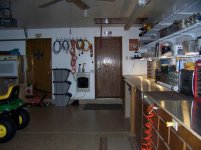
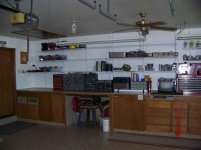
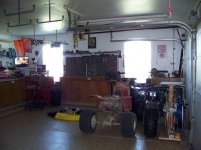
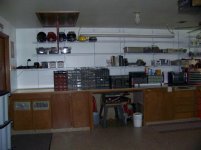
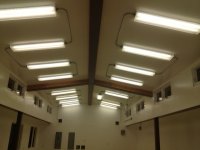
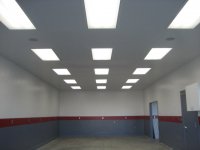
I have a three car garage with single garage door and a double garage door. I'd like to upgrade the lights from the current which is two, single bulb lights.
I'm thinking five 8ft T8 lights. The thing I'm struggling with is placing them in a way in which the doors don't block all my light when they are open. Being in Texas, I do work with the doors open a lot of the time.
Attached is a drawing of the basic layout of the garage and how I'm thinking about running the lights. I have one additional running the opposite direction between the two bays and that is because it is directly over my workbench.
Work in the garage includes wood working, basic automotive, and general things that need to be done for the house.
A few hopefully relevant thoughts, in no particular order:
-- As a very general rule, more light is always better than less light, as long as you are not forced to always use everything, all at once (see below for more on that last point). "Overkill" doesn't really set in nearly as quickly as you might guess.
-- Four-foot fixtures are generally far more flexible in terms of both placement and switching than eight-foot fixtures, even if the latter use (twice as many) four-foot tubes. They can still be similarly economical, if you shop carefully. They will of course require somewhat more extensive/elaborate wiring; but that trade-off is MORE than worthwhile, IMCO.
-- Unless your ceilings are VERY high (12-15 feet, at minimum; more would be better), you do
NOT want anything designated "High Bay". You probably also want fixtures with no more than two T-8 or T-5 (
NOT "T-5HO") tubes in each. The reason for this is, in typical garage applications the biggest challenge is distributing the light effectively, rather than having "enough" raw brightness at the light source(s).
-- The details of how the space is constructed and finished can have a MUCH larger impact than you might initially guess. For example, an open (rafters/trusses showing) ceiling with unpainted OSB walls will probably require upwards of twice as much (maybe even more) raw lighting power as having both the walls and ceiling finished with drywall (or similar) and painted bright white. (And the latter scenario will also help on the "even distribution" front.)
-- Regardless of what type fixtures/bulbs/tubes you choose for your "main" lighting, you'll want to arrange them and wire them such that they are in at least two (possibly three or more) separately switched "banks". Ideally, the largest bank will comprise about twice as much raw lighting power as the next-largest bank, so as to effectively provide THREE different selectable brightness levels. Obviously, this also implies that the individual fixtures comprising each of these "banks" are more-or-less evenly distributed around the space. If you also want to do "zoning" (such as only lighting up those red- or green-demarced areas if you're actually working there), then still more switching is in order.
-- In addition to whatever you choose for the "Main" lighting, you'll want an additional (but VERY modest; perhaps one or two four-foot two-tube fixtures, total) separately switched bank (which might also be triggered by either or both garage door openers) to serve as your "walk through" lighting. These are the lights you use when just casually entering the garage to grab a screwdriver, or unload the groceries, or whatever. In such instances, you do NOT want your only choices to be switching on multiple hundreds ("thousands"?) of watts-worth of light, or stumbling around in the dark.
-- You will no doubt ALSO want separate (and generously sized) "task lighting" in such places as your work bench, and over/near any stationary power tools (such as table/miter saws, lathes, etc.). This task lighting should be chosen on its own merits, as applied to the particular job at hand (IOW, it's essentially a separate discussion).
-- In addition to the (quite valid) issue you mentioned of having the overhead doors blocking the lights when open, there is another frequently overlooked placement issue: If (as seems to happen far too often) the lights are mounted more-or-less directly over where the vehicles park, they will do an outstanding job of illuminating the roofs of those vehicles -- and very little else. Hence, if you're trying to work under or directly beside those vehicles (such as, for example, changing wheels, or working on the brakes, or tending to stone chips low on the doors), you'll find yourself in a giant shadow -- not fun. At least a partial solution to this problem is to mount as much of your main lighting as possible on the walls, not the ceiling. As long a you have at least 8-9 feet of ceiling height, you should be able to get the fixtures far enough up to be both out of the way (hence, somewhat protected from accidental impacts) and in a position where they can project their output mostly in a useful direction. If you MUST mount to (or hang from) the ceiling, such as might be the case for the area between those two "bays", do so as far outside of the "footprint" made by each vehicle as possible.
-- Bare-tube (or bare tube with reflector) fixtures will be the most efficient, in terms of lumens/watt; but are probably NOT the best choice for a typical low-ceiling garage application. Something with a simple clear diffuser/lens will do a better job of distributing the light evenly, AND provide additional impact protection, while imposing little enough penalty in terms of raw output to be more than worth the trade-off. I have pointed to these several times before:
http://www.homedepot.com/p/Lithonia-Lighting-2-Light-Utility-Light-3348-2L32W-WRAP/100654395
They're cheap; they look half-decent; they can be strung together in more-or-less continuous "strips" when appropriate; the polycarbonate lens both helps to evenly distribute the light and provides some impact protection; and the 4-foot size makes placing them where you really need them relatively easy. There's also a matching two-foot version:
http://www.homedepot.com/p/Lithonia...hite-Fluorescent-Light-Fixture-3324/202192968
if you need to fit into really tight spots, or fill out a specific-length run.
I'm liking CFLs more and more. Particularly
these.
I have to disagree with this. High-output CFLs such as the ones you cite are in essence the very antithesis of "even distribution". Yes, they put out a lot of light (tho' generally still not as much, per watt, as linear fluorescents); but it's concentrated in a single point-source, which makes for very "spotty" uneven lighting, unless you use so many of them that you ARE well into "overkill" territory. The potential exception here is
IF you have very high ceilings, and can find fixtures with a very efficient reflector; in that case, CFLs can start to become competitive again. But in most "normal" applications, they are far from ideal.