

You are using an out of date browser. It may not display this or other websites correctly.
You should upgrade or use an alternative browser.
You should upgrade or use an alternative browser.
Foundation walls under garage entrance
- Thread starter dnwong
- Start date
matt_i
Well-known member
I did, but for continuity of the wall and the rebar that runs thru it. (iow I felt it was higher strength)
I did a block-out with some wood in the wall forms, poured up to the bottom of that, let it sit for 15-20 minutes to firm up a little bit, then poured the rest up to the top. Approx 14" height of the blockout.
I suppose one could argue that that part of the slab is actually supported by concrete and thus it won't "float" with the rest of the slab which is basically supported by earth & stone.
In my case I have approx. 16" between the garage door opening and the man door opening, so there is another block-out with same depth, just shorter width. Without the continuous wall underneath there would be a narrow weak pillar not supported by very much.
Were I to do it again, I would do the same. The wall has rebar 16" OC in both vertical and horizontal directions, so hopefully will do the job.
I think you are probably saving 1 yard of concrete (8" thick wall x 42" deep x 12ft wide) and the fact that the wall form people don't necessarily have to make the forms lineup. They can't just turn the corner and not worry about the rest, if they are forming continuously. If you don't do a continuous form, I'd make sure to pull my own string line from the corner across the open space to the other corner to make sure they put the 2 pieces of wall in the same plane.
I did a block-out with some wood in the wall forms, poured up to the bottom of that, let it sit for 15-20 minutes to firm up a little bit, then poured the rest up to the top. Approx 14" height of the blockout.
I suppose one could argue that that part of the slab is actually supported by concrete and thus it won't "float" with the rest of the slab which is basically supported by earth & stone.
In my case I have approx. 16" between the garage door opening and the man door opening, so there is another block-out with same depth, just shorter width. Without the continuous wall underneath there would be a narrow weak pillar not supported by very much.
Were I to do it again, I would do the same. The wall has rebar 16" OC in both vertical and horizontal directions, so hopefully will do the job.
I think you are probably saving 1 yard of concrete (8" thick wall x 42" deep x 12ft wide) and the fact that the wall form people don't necessarily have to make the forms lineup. They can't just turn the corner and not worry about the rest, if they are forming continuously. If you don't do a continuous form, I'd make sure to pull my own string line from the corner across the open space to the other corner to make sure they put the 2 pieces of wall in the same plane.
Last edited:
I generally drop the foundation wall at the opening approximately equal to slab thickness and pour over it. Slab is then supported by the foundation and no worries about heaving or substandard compaction at a critical spot. Also necessary to meet code.
pstnbly
Well-known member
If you live in a zone with frost, you absolutely need a stemwall at any grade openings. That's why they call them "frost walls".
Cyberbear
Well-known member
It's my firm opinion that all garage openings that are driven on should have a footing and rebar underneath to help prevent cracking at that weak point on the slab. Simply pouring over unstable rock or dirt may not always be enough, and once a crack appears it never goes away.
larry4406
Well-known member
We have no idea where the OP is located so not even clear if freezing is a concern. OP - please update your location (state). We also have no idea what type of construction is being used - slab on grade, monolithic pour, stem wall with structural slab, etc.
Assuming freezing is a concern, yes it is quite common to NOT have a foundation wall under the garage slab at the entrance and this is not a hack practice as has been alluded.
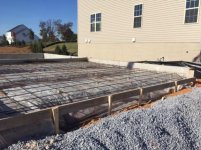
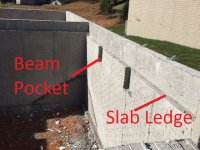
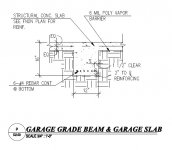
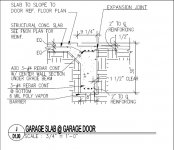
Attached are plan excerpts of a garage detail using stem walls and structural slab. This is the method used here in Northern VA and MD by most production home builders. The three perimeter walls all have a slab ledge on the inside and pockets for grade beams. At the garage door entrance, there are foundation "wing walls" which are poured low. The structural slab has thickened reinforced sections that become beams which span from wall to wall and engage/bare on the pockets. They are commonly called grade beams as the uncompacted loose backfill ("grade") is used as the form. At the front of the slab, there is a reinforced turndown section which spans from wing wall to wing wall. The turndown is dropped below the local frost line which in my area is 24".
Hopefully this sheds some insight as to what your contractor may be proposing.
Assuming freezing is a concern, yes it is quite common to NOT have a foundation wall under the garage slab at the entrance and this is not a hack practice as has been alluded.
Attached are plan excerpts of a garage detail using stem walls and structural slab. This is the method used here in Northern VA and MD by most production home builders. The three perimeter walls all have a slab ledge on the inside and pockets for grade beams. At the garage door entrance, there are foundation "wing walls" which are poured low. The structural slab has thickened reinforced sections that become beams which span from wall to wall and engage/bare on the pockets. They are commonly called grade beams as the uncompacted loose backfill ("grade") is used as the form. At the front of the slab, there is a reinforced turndown section which spans from wing wall to wing wall. The turndown is dropped below the local frost line which in my area is 24".
Hopefully this sheds some insight as to what your contractor may be proposing.
Attachments
-
 2-car front load garage.jpg82.2 KB · Views: 129
 -
 Structural Slab Prepped.jpg63.1 KB · Views: 116
 -
 Structural Slab Grade Beam Detail.jpg130.6 KB · Views: 103
 -
 Garage Walls.jpg130.4 KB · Views: 116
 -
 Slab Grade Beam.jpg54.7 KB · Views: 114
 -
 Slab Turn Down.jpg76.7 KB · Views: 127
 -
 2-car garage cross section.jpg77.8 KB · Views: 126
readhead
Well-known member
You can pour it with the slab or pour it with the stem wall but you still have a footing under the garage entrance. The section that you show simply continues the stem wall with the slab pour. Seems like a harder way to do it. It's not right or wrong but you contradicted your own statement of not having a foundation wall under the garage entrance. I agree that the owner may be getting bad advice.
That being said we don't know where he is. This may be common practice if he lives in Panama but would be unacceptable in Iceland.
That being said we don't know where he is. This may be common practice if he lives in Panama but would be unacceptable in Iceland.
Thanks for the comments, I live in Northern VA. This is add-on garage to my existing home. It shares 1/2 of a common wall with the house.
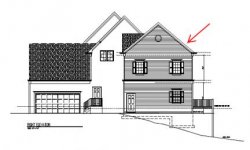
Here is the foundation details that was sent for permitting which I believe show a full footer and wall under the garage opening?
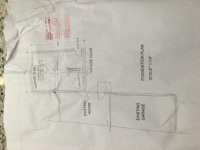
View attachment Foundation 24x36 scale_noname.pdf
Given, that there is a second floor, I feel like that stem wall would add some rigidity from settling. But the contractor indicates that this was not necessary and since the slab floats on packed dirt/stone.
Here is the foundation details that was sent for permitting which I believe show a full footer and wall under the garage opening?
View attachment Foundation 24x36 scale_noname.pdf
Given, that there is a second floor, I feel like that stem wall would add some rigidity from settling. But the contractor indicates that this was not necessary and since the slab floats on packed dirt/stone.
Last edited:
From these drawings, it looks like that slab is supported by the wall. I thought that slab floats on the packed soil/stone. Is that a practice by mass home builders vs a small custom builder. The drawings I had done did not spec that. I separately hired the engineer to do the drawings to avoid conflicts of interest (instead of using a Design/Build firm).We have no idea where the OP is located so not even clear if freezing is a concern. OP - please update your location (state). We also have no idea what type of construction is being used - slab on grade, monolithic pour, stem wall with structural slab, etc.
Assuming freezing is a concern, yes it is quite common to NOT have a foundation wall under the garage slab at the entrance and this is not a hack practice as has been alluded.
Attached are plan excerpts of a garage detail using stem walls and structural slab. This is the method used here in Northern VA and MD by most production home builders. The three perimeter walls all have a slab ledge on the inside and pockets for grade beams. At the garage door entrance, there are foundation "wing walls" which are poured low. The structural slab has thickened reinforced sections that become beams which span from wall to wall and engage/bare on the pockets. They are commonly called grade beams as the uncompacted loose backfill ("grade") is used as the form. At the front of the slab, there is a reinforced turndown section which spans from wing wall to wing wall. The turndown is dropped below the local frost line which in my area is 24".
Hopefully this sheds some insight as to what your contractor may be proposing.
readhead
Well-known member
Your foundation plan shows the footing and stemwall continuous around the entire building. The concrete contractor is required to follow the approved, permitted plans unless you get the change approved by the building department.
Sounds like he may have under bid the project and is trying to make up the short fall. Even if you agree to his suggestion it will all go out the window when the inspector shows up and turns it down.
Sounds like he may have under bid the project and is trying to make up the short fall. Even if you agree to his suggestion it will all go out the window when the inspector shows up and turns it down.
Your foundation plan shows the footing and stemwall continuous around the entire building. The concrete contractor is required to follow the approved, permitted plans unless you get the change approved by the building department.
Sounds like he may have under bid the project and is trying to make up the short fall. Even if you agree to his suggestion it will all go out the window when the inspector shows up and turns it down.
That was what I saw too (was not sure due to lack of exp). I will point that out with the contractor. Thanks.
WNYflyer
Well-known member
Maybe I am missing something but I don't see how you get a permit with the drawings pictured.
Foundation plan shows 4" slab with WWF (wire fabric) but also #8 (1" dia) rebar @16" and #4 (1/2") rebar @ 12" o.c..? I am completely confused.
I see a whole lot wrong with the drawings you pictured, not enough detail that are perhaps on additional drawings not pictured ?
Since you had an engineer do the drawings are they PE stamped ? At this time I would just talk to contractor's and gather your concerns/questions and run them through your engineer and have him give the go or no go, have him educate you within reason. Make him responsible for the final approved design. Also like I said I am not understanding a lot shown on the drawings pictured.
Foundation plan shows 4" slab with WWF (wire fabric) but also #8 (1" dia) rebar @16" and #4 (1/2") rebar @ 12" o.c..? I am completely confused.
I see a whole lot wrong with the drawings you pictured, not enough detail that are perhaps on additional drawings not pictured ?
Since you had an engineer do the drawings are they PE stamped ? At this time I would just talk to contractor's and gather your concerns/questions and run them through your engineer and have him give the go or no go, have him educate you within reason. Make him responsible for the final approved design. Also like I said I am not understanding a lot shown on the drawings pictured.
larry4406
Well-known member
You can pour it with the slab or pour it with the stem wall but you still have a footing under the garage entrance. The section that you show simply continues the stem wall with the slab pour. Seems like a harder way to do it. It's not right or wrong but you contradicted your own statement of not having a foundation wall under the garage entrance. I agree that the owner may be getting bad advice.
That being said we don't know where he is. This may be common practice if he lives in Panama but would be unacceptable in Iceland.
There IS NOT a footing under the garage entrance using the method I showed and if you meant me, I did not contradict myself. The 24" depth of the turn down is to eliminate frost heave potential and not to act as a stem wall continuation. The stem walls in my company's case are often 8' or 9' tall as shown in the foundation picture yet the top of slab is often only 8-12" down from top of wall (this often occurs as the excavated house pad is to accommodate the basement and poor soils often prevent a jumped pad for the garage which would then still require 4' or 5' garage stem walls. The garage slab is structural spanning the opening. The soil is not compacted in this area and is considered to have ZERO bearing capacity.
JoeFin
Well-known member
If you live in a zone with frost, you absolutely need a stemwall at any grade openings. That's why they call them "frost walls".
Out West they are required as well - and for some pretty obvious reasons
You might need a different contractor. That's not just short cutting, its a recipe for disaster
larry4406
Well-known member
The OP's foundation drawing is shown with gravel fill. That would allow him to have a slab on grade design if filled properly. In the houses I build, we do not backfill with gravel as this gets expensive real fast and structural slabs become more cost effective. With his addition, and reduced depth for excavation, maybe the gravel is cost effective.
The OP's design is not clear on the reinforcement bars - are these to be grade beams? Normally the grade beams span the short dimension. Also, I agree with the other posts that critical slab details are missing. I would also be concerned regarding how the new walls are tied to the existing walls - I would want the horizontal steel bars drilled and doweled with epoxy into the existing house foundation.
OP - where your excavate close to your house, you will encounter the original overdig for the house and subsequent loose soils. That said, you are likely to need full height walls to match the house in this area to get back to virgin ground. As your get further away and into virgin soils, you may be able to step your footings upward. This has the benefit of reducing stem wall costs (4' wall cheaper than say a 9' wall) and will reduce your gravel costs if you truly plan on backfilling with gravel. Also be mindful to not damage your home's perimeter drainage system. The loose soils in the house's overdig would concern me for slab support in the new addition, hence my vote for a structural slab.
I see you are in Aldie Va. I drive down RT15 twice a day thru Haymarket and past Leesburg on my way to/from work in Clarksburg MD. Depending on how far off the beaten path you are, I would be happy to stop by. PM me if interested.
The OP's design is not clear on the reinforcement bars - are these to be grade beams? Normally the grade beams span the short dimension. Also, I agree with the other posts that critical slab details are missing. I would also be concerned regarding how the new walls are tied to the existing walls - I would want the horizontal steel bars drilled and doweled with epoxy into the existing house foundation.
OP - where your excavate close to your house, you will encounter the original overdig for the house and subsequent loose soils. That said, you are likely to need full height walls to match the house in this area to get back to virgin ground. As your get further away and into virgin soils, you may be able to step your footings upward. This has the benefit of reducing stem wall costs (4' wall cheaper than say a 9' wall) and will reduce your gravel costs if you truly plan on backfilling with gravel. Also be mindful to not damage your home's perimeter drainage system. The loose soils in the house's overdig would concern me for slab support in the new addition, hence my vote for a structural slab.
I see you are in Aldie Va. I drive down RT15 twice a day thru Haymarket and past Leesburg on my way to/from work in Clarksburg MD. Depending on how far off the beaten path you are, I would be happy to stop by. PM me if interested.
WNYflyer
Well-known member
The OP's foundation drawing is shown with gravel fill. That would allow him to have a slab on grade design if filled properly. In the houses I build, we do not backfill with gravel as this gets expensive real fast and structural slabs become more cost effective. With his addition, and reduced depth for excavation, maybe the gravel is cost effective.
The OP's design is not clear on the reinforcement bars - are these to be grade beams? Normally the grade beams span the short dimension. Also, I agree with the other posts that critical slab details are missing. I would also be concerned regarding how the new walls are tied to the existing walls - I would want the horizontal steel bars drilled and doweled with epoxy into the existing house foundation.
OP - where your excavate close to your house, you will encounter the original overdig for the house and subsequent loose soils. That said, you are likely to need full height walls to match the house in this area to get back to virgin ground. As your get further away and into virgin soils, you may be able to step your footings upward. This has the benefit of reducing stem wall costs (4' wall cheaper than say a 9' wall) and will reduce your gravel costs if you truly plan on backfilling with gravel. Also be mindful to not damage your home's perimeter drainage system. The loose soils in the house's overdig would concern me for slab support in the new addition, hence my vote for a structural slab.
I see you are in Aldie Va. I drive down RT15 twice a day thru Haymarket and past Leesburg on my way to/from work in Clarksburg MD. Depending on how far off the beaten path you are, I would be happy to stop by. PM me if interested.
All good points.
On the one cross section it looks like grade drops off towards the rear and the bottom of foundation is above grade ? Drawing is not clear. Perhaps some backfilling is occurring to get back up to bottom of footing ? Perhaps backfilling is occurring exterior and interior to balance the soil forces ? maybe the re-bar in the slab ties the top of the upper wall back such that you don't need to backfill as much on the exterior. Looks like a whole lot of stuff is going on relative to a "typical" build/construction.
Kpaige
Well-known member
Yes as ther needs to be a ledge for the pad to sit on.
larry4406
Well-known member
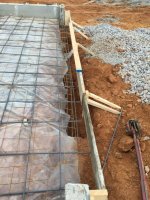
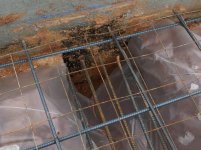
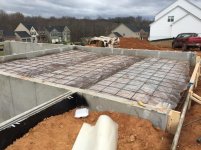
Here are some more typical details of a structural slab prior to and after pour. Clarksburg MD so same climate as the OP.
This is a fully excavated 9' basement with attached garage. Garage stem walls are 9' tall as we could not jump the pad due bad soils. Loose back fill in the garage, about 8' total. Stem walls have slab ledge and grade beam pockets. Wingwalls at entrance. Slab has reinforced grade beams and turn down per stamped approved plans. Stamped approved plans for walls and geotech inspection as well for steel placement and soil bearing of footings under stem walls. All legit and standard practice for this area.
Note the pictures of the slab prep turndown at the entrance into the loose fill. The purpose of the loose fill is only a one time use as a mold. If you were so inclined, you could remove all of the fill afterwards and have a suspended slab. I have done custom houses where carpenters built plywood forms and bracing to support the underside of the structural slab; these were later removed and the customer has full room space under the slab.
This is a fully excavated 9' basement with attached garage. Garage stem walls are 9' tall as we could not jump the pad due bad soils. Loose back fill in the garage, about 8' total. Stem walls have slab ledge and grade beam pockets. Wingwalls at entrance. Slab has reinforced grade beams and turn down per stamped approved plans. Stamped approved plans for walls and geotech inspection as well for steel placement and soil bearing of footings under stem walls. All legit and standard practice for this area.
Note the pictures of the slab prep turndown at the entrance into the loose fill. The purpose of the loose fill is only a one time use as a mold. If you were so inclined, you could remove all of the fill afterwards and have a suspended slab. I have done custom houses where carpenters built plywood forms and bracing to support the underside of the structural slab; these were later removed and the customer has full room space under the slab.
Attachments
-
 Finished Garage Slab.JPG128.6 KB · Views: 74
 -
 Slab turn down.jpg140.7 KB · Views: 60
 -
 Grade beam end at pocket.jpg119.6 KB · Views: 58
 -
 Grade Beams.jpg149.3 KB · Views: 65
 -
 Slab ledge closeup.jpg122.9 KB · Views: 60
 -
 Slab ledge.jpg137.8 KB · Views: 63
 -
 Structural slab prepped.jpg127.7 KB · Views: 62
larry4406
Well-known member
On the one cross section it looks like grade drops off towards the rear and the bottom of foundation is above grade ? Drawing is not clear. Perhaps some backfilling is occurring to get back up to bottom of footing ? Perhaps backfilling is occurring exterior and interior to balance the soil forces ? maybe the re-bar in the slab ties the top of the upper wall back such that you don't need to backfill as much on the exterior. Looks like a whole lot of stuff is going on relative to a "typical" build/construction.
I agree the drawing is poor. I interpreted that as stepping the footing as needed. Once excavation begins, the loose fill and virgin soil will become apparent to the GC and more importantly to the geotech doing the inspection. At that time, dropped footings, subwalls, and/or increased height of stem walls will all be determined. We encounter this all the time in the houses I build.
JoeFin
Well-known member
Yes as ther needs to be a ledge for the pad to sit on.
Out West it would not be nearly as important as a means to prevent Liquefaction and Ground water from undermining the slab itself. Especially on a sloping lot.
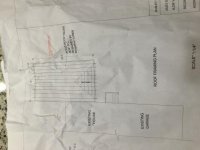
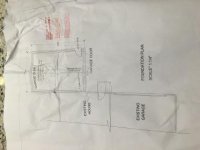
Here are the rest of the drawings that were used for permitting. I went to the country inspector and met him before submitting, and this what he told I needed.
Attachments



readhead
Well-known member
The OP's original question was about bearing for the slab at the door opening. The drawings show a continuous footing and stemwall with the slab poured through over the stemwall. The drawings don't indicate any sections through the assembly. I would hope that there are some sections on another sheet. If not it makes me wonder how a permit was issued.
As far as Larry 's point of a structural slab. We could argue if the turndown is bearing. The details indicate that they are bearing I think. (The details did not read well and I could not enlarge them) . Opinions will vary but for the turndown to be a gradebeam I would expect to see a void form below. Loose fill could expand under certain conditions. I don't disagree with the methods they are using at all. It will provide a serviceable assembly. It does however not match the OP 's plans.
The plans, as incomplete as they are, I believe are clear as to the intent at the door opening. The concrete guy wants to deviate from the plans. This thread and many others like it point out that there are regional means and methods that become common practice. An example occurring here is a general contractor from Minnesota that is remodeling the Ford dealership. They are sheathing the exterior framing with plywood then gold drywall. I haven't seen plywood used here in twenty five years but it must be common practice where they come from. That isn't right or wrong but just different.
As far as Larry 's point of a structural slab. We could argue if the turndown is bearing. The details indicate that they are bearing I think. (The details did not read well and I could not enlarge them) . Opinions will vary but for the turndown to be a gradebeam I would expect to see a void form below. Loose fill could expand under certain conditions. I don't disagree with the methods they are using at all. It will provide a serviceable assembly. It does however not match the OP 's plans.
The plans, as incomplete as they are, I believe are clear as to the intent at the door opening. The concrete guy wants to deviate from the plans. This thread and many others like it point out that there are regional means and methods that become common practice. An example occurring here is a general contractor from Minnesota that is remodeling the Ford dealership. They are sheathing the exterior framing with plywood then gold drywall. I haven't seen plywood used here in twenty five years but it must be common practice where they come from. That isn't right or wrong but just different.
Actually the foundation and footers go below grade. The elevation view is more conceptual.All good points.
On the one cross section it looks like grade drops off towards the rear and the bottom of foundation is above grade ? Drawing is not clear. Perhaps some backfilling is occurring to get back up to bottom of footing ? Perhaps backfilling is occurring exterior and interior to balance the soil forces ? maybe the re-bar in the slab ties the top of the upper wall back such that you don't need to backfill as much on the exterior. Looks like a whole lot of stuff is going on relative to a "typical" build/construction.
I agree the drawing is poor. I interpreted that as stepping the footing as needed. Once excavation begins, the loose fill and virgin soil will become apparent to the GC and more importantly to the geotech doing the inspection. At that time, dropped footings, subwalls, and/or increased height of stem walls will all be determined. We encounter this all the time in the houses I build.
Yes, you are correct. A lot of the details are being determined at build. Not having done this before, I was trying to get second opinions.
WNYflyer
Well-known member
That section A-A explains things more clearly from a design concept. Looks like they are indeed using the slab rebar to tie back the top of the foundation wall due to the unbalanced backfill towards the rear. At least it looks to me like there is no fill built up on the exterior towards the rear
I would think they would have to brace the foundation wall on the outside to backfill and compact the interior. Then only remove bracing once the slab is installed and properly tying back the top of the wall. Seems kind of iffy from a construction sequence standpoint especially for residential construction. Looks like the type of construction that would have to be watched pretty closely. Hopefully no one tries to replace the floor in the future.
Concerning the foundation wall going across the door opening, the drawings show it and your probably want it tying the two sides together. The foundation design looks to be a different animal than the typical foundations most of us are used to seeing.
My opinion and I have been wrong before !
I would think they would have to brace the foundation wall on the outside to backfill and compact the interior. Then only remove bracing once the slab is installed and properly tying back the top of the wall. Seems kind of iffy from a construction sequence standpoint especially for residential construction. Looks like the type of construction that would have to be watched pretty closely. Hopefully no one tries to replace the floor in the future.
Concerning the foundation wall going across the door opening, the drawings show it and your probably want it tying the two sides together. The foundation design looks to be a different animal than the typical foundations most of us are used to seeing.
My opinion and I have been wrong before !