To avoid these ads, REGISTER NOW!

Portable generator bonded neutral questions

Hondaracer2oo4

Well-known member
Joined
Feb 22, 2016
Messages
229
Location
Canterbury NH
Ok the background is that I have a 5000 watt portable generator that I have used for years to power my house when we lose power. I have powered the house by back feeding a 30 amp 220 breaker in my main panel dedicated for the generator, I have a twist lock 30 amp receptacle in a box mounted on the side of the house which is where I plug in to. Now I know this isn't "code" because my breaker that I am back feeding doesn't have a generator lock out switch attached to it which throws the main breaker off if you turn the generator breaker on. My panel doesn't accept one of these lock out switches so I am diligent in first turning off the main and then turning on my generator breaker.

So my questions are two fold

First is that I discovered the other day that my generator cord is 10/2. I am not sure where I got this cord, I discovers this because I was changing out a plug end to a twist lock 30 amp and found I only had three conductors in the wire. My question is can someone educate me so that I can wrap my head around the neutral bonded set up that the generator has and the need for a "ground" wire in my generator cord. I am assuming that I need to replace this generator cord with a 10/3.

Second question has to do with hooking my generator up to back feed throw my sub panel in the garage. I built my garage this year and hooked up the sub panel via the Mhf feeder route widely recommended on here. I have a 90 amp breaker in the house main feeding a 100 amp sub panel in the garage with a 2/2/4/6 Mhf. Is there any reason I can't utilize a dedicated breaker in the garage sub panel to back feed the house the same way I have always done? I realize that this isn't "code" because there is no way to force the house panel main off first to prevent back feeding to the street.
 
To avoid these ads, REGISTER NOW!

theoldwizard1

Well-known member
Joined
Feb 22, 2011
Messages
43,123
Location
SE MI
In a electrical "system" (like your home) you only want a single point where ground and neutral ar connected (bonded). By convention (?) this is in the first disconnect AFTER the meter. This is also were ground is actually connect to the earth with ground rods.

Portable generator may of may NOT be internally bonded. If you are using it on a job site or via and extension cord to power a few appliance you want it to be bonded. If you are connecting your portable generator up to your house via something like this

Capture.JPG

then you do NOT want your generator to be bonded.

For a portable generator, it is better to have it be non-bonded. You can quickly bond it when needed with a bonding plug. (A plug with a short jumper from neutral to ground.)
 

wyliesdiesels

Well-known member
Joined
Aug 14, 2012
Messages
19,994
Location
Modesto, CA
What brand of panel do u have?

Have u thought of doing a transfer switch?

If a lineman discovers your illegal setup, they may cut your drop...

For replacement cord u need 10/4. Cordage nomenclature includes the ground wire whereas building wire cables do not (10/4 cordage amd 10/3 nm-b have the same # of conductors). 10/2 is 2 total conductors which isnt what u have.

The wizard covered the bonding!!
 
Last edited:

dougf

Well-known member
Joined
Feb 22, 2013
Messages
402
Location
Missouri
Go to harbor freight and get a 10/4 twistlock generator extension cord and call it done. This is what I use connected to a 30a 220 outlet and it works like a charm. Make sure the only time ground and neutral are bonded is at your main panel and you will be fine. This will be visible as your grounding/neutral bars being connected, and it's ok the mix grounds and neutrals at this junction only.
 
Last edited:
OP
H

Hondaracer2oo4

Well-known member
Joined
Feb 22, 2016
Messages
229
Location
Canterbury NH
Thank you guys. I don't want to do the cheapo transfer switch because it only allows for a few circuits to be powered. My panel doesn't accept a generator lock out kit. Besides all this, although not "code" because of the fact that neither a transfer panel or lock out switch would work remotely through my garage sub which is where I want to connect in. Thanks for the education on the nm-b vs the cordage listing the number of wires differently. I will be sure to get 10/4. For the "bonded nuetral" I will removed the ground wire that hooks down to the frame of the generator then. If I understand correctly this would be used connected in the case of hooking up your corded drill to the generator to give the system a ground. Since the house already had a ground then te generator ground is not needed.
 

ForceFed70

Well-known member
Joined
Apr 27, 2010
Messages
3,441
Location
BC, Canada
To answer your questions:

- 10/2 (as identified it's actually 10/3) is fine for a 5000W generator. 10/3 would support up to 30A whereas 5000W at 240V is only 21A.

- No reason you couldn't backfeed through your garage sub.

As mentioned and as you already clearly know - it's not to code and there are reasons that the code is in place. Lack of a transfer switch/lockout is a concern.

Bonding is NOT A CONCERN. You don't want the bonding therefor you don't want to change the cable. Internally - your generator can bond the neutral to god knows what but unless "god knows what" is actually connected to your household power system the 2 aren't actually bonded. In a 240V circuit You need 4 conductors to end up bonding the household ground and neutral. Without 4 conductors it's impossible to do. Stick with your 3 conductor cable and you'll be sure to avoid bonding concerns.
 
Last edited:

wyliesdiesels

Well-known member
Joined
Aug 14, 2012
Messages
19,994
Location
Modesto, CA
Thank you guys. I don't want to do the cheapo transfer switch because it only allows for a few circuits to be powered. My panel doesn't accept a generator lock out kit. Besides all this, although not "code" because of the fact that neither a transfer panel or lock out switch would work remotely through my garage sub which is where I want to connect in. Thanks for the education on the nm-b vs the cordage listing the number of wires differently. I will be sure to get 10/4. For the "bonded nuetral" I will removed the ground wire that hooks down to the frame of the generator then. If I understand correctly this would be used connected in the case of hooking up your corded drill to the generator to give the system a ground. Since the house already had a ground then te generator ground is not needed.

DO NOT remove the frame ground bonding.

All metal parts need to be bonded to ground. This is for safety reqsons should the frame ever become energized the breaker would trip. If u remove the frame bonding the breaker wont trip.

U need to find the neutral to ground bond inside the generator.

And how many circuits do u really need in a power outage? U can get a whole house transfer switch of transfer switches that do quite a few circuits.

What brand of panel do u have?
 

wyliesdiesels

Well-known member
Joined
Aug 14, 2012
Messages
19,994
Location
Modesto, CA
To actually answer your questions:

- 10/2 (as identified it's actually 10/3) is fine for a 5000W generator. 10/3 would support up to 30A whereas 5000W at 240V is only 21A.

- No reason you couldn't backfeed through your garage sub.

As mentioned and as you already clearly know - it's not to code and there are reasons that the code is in place. Lack of a transfer switch/lockout is a concern.

Bonding is NOT A CONCERN. From what I've seen, most basic portable generators don't end up bonding your household neutral to ground. Yours clearly doesn't. How do I know? Because there is no ground conductor connecting your household ground to the generator ground. Internally - your generator can bond the neutral to god knows what but unless "god knows what" is actually connected to your household power system the 2 aren't actually bonded. In a 240V circuit You need 4 conductors to end up bonding the household ground and neutral. Without 4 conductors it's impossible to do.

4-wire is required since u need to have a seperate EGC and neutral between generator and panel.

Generators come with either NEMA 6-** (3-wire 240v) or NEMA 14-** (4-wire 120/240v). U wont find an old style dryer nema 10-30 or range NEMA 10-50 (both 120/240 3-wire) on a generator.
 

ForceFed70

Well-known member
Joined
Apr 27, 2010
Messages
3,441
Location
BC, Canada
4-wire is required since u need to have a seperate EGC and neutral between generator and panel.

That's the point. The OP doesn't gave a EGC between the generator and the panel. He's using a 3 conductor cable.

Code may say it's required which would introduce bonding problems, but that's a different subject.
 
Last edited:
OP
H

Hondaracer2oo4

Well-known member
Joined
Feb 22, 2016
Messages
229
Location
Canterbury NH
Sorry guys. I misunderstood the bonding. I will not remove anything on the generator then. There seems to be some conflicting info here on the 3 wire cords( no ground) and the 4 wire cord. I currently have a 3 wire cord. The generator has a four prong nema 30 amp twist lock. So what's the right answer here on ground between the generator and panel or not. I will check on my panel brand in the am. Panel is circa late 80s or early 90s I believe. I do plan on upgrading it at some point.
 

ForceFed70

Well-known member
Joined
Apr 27, 2010
Messages
3,441
Location
BC, Canada
No matter what you do here you're facing a code violation.

Either you provide a ground circuit to the generator and introduce a code violation (only allowed to bond neutral to ground at service entrance). Or you avoid connecting the ground conductors which is also a code violation for a household backup generator.

Both of these code violations I would consider "minor" in your scenario. If I had to pick a violation - I'd violate the code around grounding the generator. It's effectively already grounded through the internal neutral to ground bonding and your household neutral to ground bonding. Plus that's how you already have it setup.

Again - a reminder that there are codes for a reason.
 
Last edited:

wyliesdiesels

Well-known member
Joined
Aug 14, 2012
Messages
19,994
Location
Modesto, CA
That's the point. The OP doesn't gave a EGC between the generator and the panel. He's using a 3 conductor cable.

Code may say it's required which would introduce bonding problems, but that's a different subject.

Yeah hes using a 3 conductor cable on a 4 wire outlet. Thats an issue right there.

Sorry guys. I misunderstood the bonding. I will not remove anything on the generator then. There seems to be some conflicting info here on the 3 wire cords(no ground) and the 4 wire cord. I currently have a 3 wire cord. The generator has a four prong nema 30 amp twist lock. So what's the right answer here on ground between the generator and panel or not. I will check on my panel brand in the am. Panel is circa late 80s or early 90s I believe. I do plan on upgrading it at some point.

U need a 4-wire cord. U do need to check (and remove if found) the neutral to ground bond which is different than the chassis ground bond when using this to power your house.

What is the make and model of your generator?

No matter what you do here you're facing a code violation.

Either you provide a ground circuit to the generator and introduce a code violation (only allowed to bond neutral to ground at service entrance). Or you avoid connecting the ground conductors which is also a code violation for a household backup generator.

Both of these code violations I would consider "minor" in your scenario. If I had to pick a violation - I'd violate the code around grounding the generator. It's effectively already grounded through the internal neutral to ground bonding and your household neutral to ground bonding. Plus that's how you already have it setup.

Again - a reminder that there are codes for a reason.

Do u realize the issue with having a neutral to ground bond in 2 places?

Seeing as youre from Canada the codes are different up there than here in the states.
 
OP
H

Hondaracer2oo4

Well-known member
Joined
Feb 22, 2016
Messages
229
Location
Canterbury NH
The generator is a Briggs and Stratton elite series 5500 running watts model. So obviously conflicting opinions on the ground from generator to panel or not. Could you explain why or why not you would want the ground running from the generator to the panel?
 

jdieter

Well-known member
Joined
Nov 17, 2007
Messages
320
Location
Northern Indiana
Check for continuity between the generator chassis and the generator neutral. If they are bonded find the connection and separate it. Then use a 4 wire circuit and bond the generator chassis to the EGC at the main panel with green wire. If you are going to use a tail panel make sure it is fed with a 4 wire circuit and the neutral bar is NOT bonded to the tail panel case. In this situation the white wire attached to the floating neutral bar and the green (or bond) wire attaches to bonding bar that is electrically bonded to the panel case. Also fix the back-feed issue, a mistake could cost somebody their life not to mention the liability you will incur.
 
OP
H

Hondaracer2oo4

Well-known member
Joined
Feb 22, 2016
Messages
229
Location
Canterbury NH
I will check the generator and see if the neutral has continuity to the chassis.

So you are saying if I run directly into the main panel through back feeding a breaker like I used to do I should run a 4 wire line and run a separate ground wire from the generator chassis to the ground rod located at the main?

Since I am back feeding via the sub panel I do not have the option of running a separate ground wire to the house ground rod.

My sub panel in the garage is fed with 4 wires. It is a 2/2/4/6 Mhf. Inside the panel the neutral and the ground are separated, the neutral line is separated from the panel body and only connected to the neutral wire coming from the house main panel. The ground wire from the house panel feeding the sub panel connects only to a separate grounding bar attached to the panel body.
 

David Paul

Well-known member
Joined
Jul 11, 2014
Messages
677
Location
Western New Jersey
In a electrical "system" (like your home) you only want a single point where ground and neutral ar connected (bonded). By convention (?) this is in the first disconnect AFTER the meter. This is also were ground is actually connect to the earth with ground rods.

Portable generator may of may NOT be internally bonded. If you are using it on a job site or via and extension cord to power a few appliance you want it to be bonded. If you are connecting your portable generator up to your house via something like this

Capture.JPG

then you do NOT want your generator to be bonded.

For a portable generator, it is better to have it be non-bonded. You can quickly bond it when needed with a bonding plug. (A plug with a short jumper from neutral to ground.)

Thank you wizard, this is the most concise and easiest description on generator bonding that I have ever seen. Just checked my generator (non bonded) and I'm using a transfer switch so I'm good to go. Thanks again.
 
Last edited:

pattenp

Well-known member
Joined
Jun 4, 2008
Messages
10,175
Location
Virginia - USA
Think of the generator as the same as the main panel feeder to the subpanel. There are 4 wires feeding the sub panel, 2 hot, 1 neutral, and 1 equipment ground. The same goes for the wires that connect the generator to the panel. The 240V outlet on the generator that you use should be 4 prong and the connecting cord to the power inlet should be 4 wire. The neutral to equipment ground bond if existing at the generator should be removed internally in the generator. The grounding electrode conductor from the generator chasses to a ground rod is not an absolute need. If the generator is a permanent install and not being removed when not in use then driving a ground rod by the generator can be done. The ground rod is for lighting strike protection, it is not for fault current protection.
 
Last edited:
OP
H

Hondaracer2oo4

Well-known member
Joined
Feb 22, 2016
Messages
229
Location
Canterbury NH
Ok so I just checked the generator. I had continuity to the chassis through all connections( both hots on the twist lock, the neutral and the ground) I opened up the plug box on the generator. I found the jumper wire connecting the ground on the last plug to the neutral on the last plug. I removed the jumper and put the box back together. I then checked for continuity again. Now I only have continuity to the ground lug on the chassis through the ground on th plugs. The hots and the neutral no longer have continuity to the chassis. This sounds correct? I will pick up the 4 wire line and other than the transfer switch or interlock I should be safe. Thank you for everyone's help.
 
To avoid these ads, REGISTER NOW!

wyliesdiesels

Well-known member
Joined
Aug 14, 2012
Messages
19,994
Location
Modesto, CA
I will check the generator and see if the neutral has continuity to the chassis.

So you are saying if I run directly into the main panel through back feeding a breaker like I used to do I should run a 4 wire line and run a separate ground wire from the generator chassis to the ground rod located at the main?

Since I am back feeding via the sub panel I do not have the option of running a separate ground wire to the house ground rod.


My sub panel in the garage is fed with 4 wires. It is a 2/2/4/6 Mhf. Inside the panel the neutral and the ground are separated, the neutral line is separated from the panel body and only connected to the neutral wire coming from the house main panel. The ground wire from the house panel feeding the sub panel connects only to a separate grounding bar attached to the panel body.

No one said anything about running a seperate wire to a ground rod.

All that is required is the 4-wires to the panel.
 

wyliesdiesels

Well-known member
Joined
Aug 14, 2012
Messages
19,994
Location
Modesto, CA
Ok so I just checked the generator. I had continuity to the chassis through all connections( both hots on the twist lock, the neutral and the ground) I opened up the plug box on the generator. I found the jumper wire connecting the ground on the last plug to the neutral on the last plug. I removed the jumper and put the box back together. I then checked for continuity again. Now I only have continuity to the ground lug on the chassis through the ground on th plugs. The hots and the neutral no longer have continuity to the chassis. This sounds correct? I will pick up the 4 wire line and other than the transfer switch or interlock I should be safe. Thank you for everyone's help.

Yes that is correct.
 
OP
H

Hondaracer2oo4

Well-known member
Joined
Feb 22, 2016
Messages
229
Location
Canterbury NH
Check for continuity between the generator chassis and the generator neutral. If they are bonded find the connection and separate it. Then use a 4 wire circuit and bond the generator chassis to the EGC at the main panel with green wire. If you are going to use a tail panel make sure it is fed with a 4 wire circuit and the neutral bar is NOT bonded to the tail panel case. In this situation the white wire attached to the floating neutral bar and the green (or bond) wire attaches to bonding bar that is electrically bonded to the panel case. Also fix the back-feed issue, a mistake could cost somebody their life not to mention the liability you will incur.

When he said "bond the generator chassis to the Ecg" I thought he was saying to run a separate copper wire from gen chassis to house panel ground rod.
 

theoldwizard1

Well-known member
Joined
Feb 22, 2011
Messages
43,123
Location
SE MI
The generator is a Briggs and Stratton elite series 5500 running watts model. So obviously conflicting opinions on the ground from generator to panel or not. Could you explain why or why not you would want the ground running from the generator to the panel?

First to confirm if the generator is internally bonded, withe the generator turned off and NOT connected to anything, put you DMM on "continuity" or low ohm and test from ground on any outlet to any other hole on the same outlet. If there is no continuity, there is no bond.

YOU ALWAYS WANT TO USE A 4 WIRE CORD FROM THE GENERATOR TO YOUR HOUSE.

If you have a bonded generator, you need to find the bonding wire and remove it. Use a bonding plug adapter when you are using your generator standalone.
 

kd3pc

Well-known member
Joined
Aug 10, 2013
Messages
3,630
Location
Northern Neck
Grounding Requirements for Portable and Vehicle-mounted Generators Under the following conditions, OSHA directs (29 CFR 1926.404(f)(3)(i)) that the frame of a portable generator need not be grounded (connected to earth) and that the frame may serve as the ground (in place of the earth):

The generator supplies only equipment mounted on the generator and/or cord and plug-connected equipment through receptacles mounted on the generator, § 1926.404(f)(3)(i)(A), and

The noncurrent-carrying metal parts of equipment (such as the fuel tank, the internal combustion engine, and the generator’s housing) are bonded to the generator frame, and the equipment grounding conductor terminals (of the power receptacles that are a part of [mounted on] the generator) are bonded to the generator frame, § 1926.404(f)(3)(i)(B).

Thus, rather than connect to a grounding electrode system, such as a driven ground rod, the generator’s frame replaces the grounding electrode. If these conditions do not exist, then a grounding electrode, such as a ground rod, is required. If the portable generator is providing electric power to a structure by connection via a transfer switch to a structure (home, office, shop, trailer, or similar) it must be connected to a grounding electrode system, such as a driven ground rod.
 
OP
H

Hondaracer2oo4

Well-known member
Joined
Feb 22, 2016
Messages
229
Location
Canterbury NH
I found this http://members.rennlist.org/warren/gt5000c.html

Under Briggs and Stratton that is my exact generator and mine was wired the same. I removed that green with a yellow trace wire and placed it in a male plug end which I can plug into one of the 120 plugs to convert back to a bonded neutral for portable operations.

I picked up a length of 10/4 wire today so that problem is rectified.

@kd3pc. Are you saying I need to use a separate ground rod to the generator chassis or not?
 
Last edited:

pattenp

Well-known member
Joined
Jun 4, 2008
Messages
10,175
Location
Virginia - USA
I say no.

Hondaracer2oo4, I believe the house electrode system is all that is needed and driving another rod at the generator provides minimal added grounding safety. If you use a transfer switch that also switches the neutral then I believe the generator grounding electrode is needed. OSHA is always to the extreme side of safety. I have researched this subject when hooking up my portable generator to my house until I was blue in the face and came to the conclusion not having a ground rod at the generator was not a big deal. So use a rod at the generator if it makes you feel safer.
 
OP
H

Hondaracer2oo4

Well-known member
Joined
Feb 22, 2016
Messages
229
Location
Canterbury NH
Thank you @ pattenp. I will forgo the grounding rod. Lots of info flying around about this stuff, everyone seems to have a different angle.
 

wyliesdiesels

Well-known member
Joined
Aug 14, 2012
Messages
19,994
Location
Modesto, CA
When he said "bond the generator chassis to the Ecg" I thought he was saying to run a separate copper wire from gen chassis to house panel ground rod.

What u have to wrap your mind around is there is different types of bonding. Bonding neutral to ground, bonding EGC(equipment grounding conductor) to chassis or other metal parts, are different bonding.

Neutral to ground bonding is for providing the connection for the low impedance pathway for fault current and allows the breaker to trip when a hot ungrounded wire shorts to a grounded metal object such as the generator chassis or motor.

U dont want more than one neutral to ground connection/bond.

Bonding the EGC to the chassis and or other metal pathways just assures that these metal parts cant become energized. The metal plumbing in your house should be bonded to ground.

Now, EGCs and grounds are different than grounding electrodes aka ground rods which do not provide a low impedance fault current pathway but rather ground lightning to earth, limit the voltage to ground levels and shunts higher primary voltage to ground such as when high voltage primary lines short to lower voltage secondary lines such as the service that connects to your house.

I found this http://members.rennlist.org/warren/gt5000c.html

Under Briggs and Stratton that is my exact generator and mine was wired the same. I removed that green with a yellow trace wire and placed it in a male plug end which I can plug into one of the 120 plugs to convert back to a bonded neutral for portable operations.

I picked up a length of 10/4 wire today so that problem is rectified.

@kd3pc. Are you saying I need to use a separate ground rod to the generator chassis or not?

Using a 4-wire cord properly hooked up on both ends(generator 4-wire outlet and house panel) WILL connect your generators grounds to the house's GES(grounding electrode system) via either the neutral bar in the main panel or the ground bar in a subpanel.
 
Last edited:

larry4406

Well-known member
Joined
Jan 27, 2006
Messages
19,114
Location
Northern Virginia
Very informative thread gentlemen! Thank you very much.

Now I need to check my generator to ensure neutral and ground are not bonded. I like the simple idea of taking a plug with a jumper between neutral and ground and plugging it in to a generator outlet for the rare occasion when I use the generator in a standalone source not powering the house.
 
OP
H

Hondaracer2oo4

Well-known member
Joined
Feb 22, 2016
Messages
229
Location
Canterbury NH
I agree, very informative. A lot of misinformation out there on this subject. I think we got it all nailed down pretty good. Thanks again.
 

larry4406

Well-known member
Joined
Jan 27, 2006
Messages
19,114
Location
Northern Virginia
Resurrecting this thread.

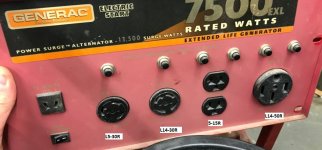
I have a Generac 7500XL, probably 10+ years old.

I studied the wiring diagram and opened up the panel. There is a jumper 22 on the 5-15R duplex outlet connecting the neutral to the ground and also a ground wire to this outlet only. I used an analog VOM and confirmed continuity between the chassis and the grounds on all of the outlets (nothing plugged in, machine off). None of the other outlets have a ground wire connected, so they clearly become grounded thru the construction of the outlet and the mechanical fastening of the outlets to the chassis.

After removing this jumper so I can feed the house with 4 wire feed, rather than make a bonding plug for the 5-15R (internally jumper the neutral and ground on a spare plug), is there any issue with me using a L5-30 plug and making it the bonding plug? Occasionally I use the generator in a standalone mode using the 5-15R outlets and never use the L5-30 plug so i would rather not lose one 5-15R plug to the bonding plug when in stand alone mode.

Should I move the hard ground connection to the L5-30 if i use it as the manual bonding location (I think it is back stabbed).
 

Attachments

  • Generac 7500XL Internal Neutral Bond.jpg
    Generac 7500XL Internal Neutral Bond.jpg
    98.2 KB · Views: 49
  • Genarac 7500XL Panel Outlets - Front.jpg
    Genarac 7500XL Panel Outlets - Front.jpg
    137.8 KB · Views: 35
  • Genarac 7500XL Panel Outlets - Rear.jpg
    Genarac 7500XL Panel Outlets - Rear.jpg
    67.7 KB · Views: 39
  • Generac 7500XL Internal Neutral Bond - jumper on duplex outlet.jpg
    Generac 7500XL Internal Neutral Bond - jumper on duplex outlet.jpg
    101.9 KB · Views: 40
Last edited:

pattenp

Well-known member
Joined
Jun 4, 2008
Messages
10,175
Location
Virginia - USA
You don't need to move the hard ground. All you need to do is have a way to re-establish the neutral ground bond and that can be done using the 120V 30A outlet.
 

larry4406

Well-known member
Joined
Jan 27, 2006
Messages
19,114
Location
Northern Virginia
You don't need to move the hard ground. All you need to do is have a way to re-establish the neutral ground bond and that can be done using the 120V 30A outlet.

Thanks PattenP. I was hoping you would chime in.

Any reason a switch could not be used equally as well to go from bonded to floating neutral? I could label the switch throws as "Standby" and "Portable". I'm assuming that since the factory jumper is on the 15A outlet I could get by with 14g wire and a 15A switch.
 

pattenp

Well-known member
Joined
Jun 4, 2008
Messages
10,175
Location
Virginia - USA
I see no problem with the switch to establish the bond other than it may not be as obvious the bond is connected as when using a bonding plug.
 

larry4406

Well-known member
Joined
Jan 27, 2006
Messages
19,114
Location
Northern Virginia
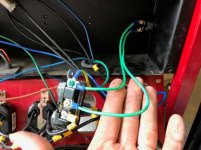
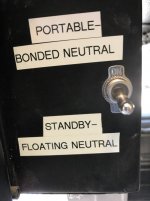
Well I added a toggle switch to enable/disable the neutral bond for portable and standby operations respectively on my Generac 7500EXL. I was concerned that I would lose the bonding plug if I went that route.

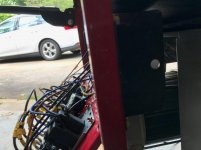
Disconnected the factory purple jumper 22 which was 14g stranded. I used 14g stranded wire and crimp terminals like the factory used. Wanted purple wire insulation to match the original, but Home Depot did not have it, so settled on the green. Located the switch on the right side of the enclosure box towards the rear so as to not conflict with the 50A outlet. The switch is tucked in under the frame so not apt to be hit.

The switch is a Gardner Bender toggle on/off GSW110:
Specifications: 10 A 277 V AC / 20 A 125 V AC / 3/4 HP 125-250 VAC
75°C max. temperature rating
Terminal Type: 'O' Ring & Screw
Standard nut size, 15/32 - 32 inch.

I wrapped the switch terminals with electrical tape prior to closing everything up (not shown in picture).

This thread has been very informative as is this site! Been using this generator for 10+ years during outages, have not ever had an issue with the internal bonding and 4-wire feed to the house (that I am aware of), but I guess I've been lucky.
 

Attachments

  • Generac 7500XL Internal Neutral Bond - jumper on duplex outlet.jpg
    Generac 7500XL Internal Neutral Bond - jumper on duplex outlet.jpg
    101.9 KB · Views: 56
  • Neutral Bonding Switch Wiring.jpg
    Neutral Bonding Switch Wiring.jpg
    97.1 KB · Views: 59
  • Side Panel Hole for Bonding Switch.jpg
    Side Panel Hole for Bonding Switch.jpg
    72.6 KB · Views: 55
  • Neutral Bonding Switch and Labels.jpg
    Neutral Bonding Switch and Labels.jpg
    62.7 KB · Views: 52
To avoid these ads, REGISTER NOW!
Top Bottom