Bobioz1
Well-known member
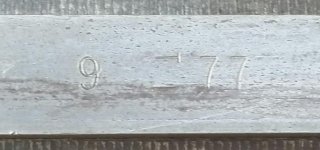
Date on slide.

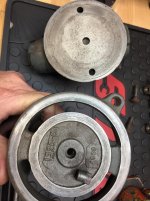
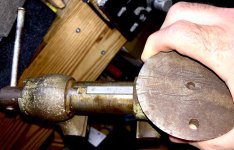
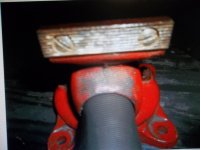
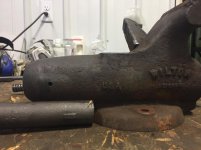
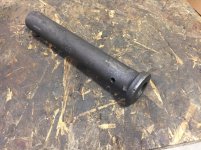
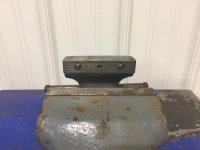
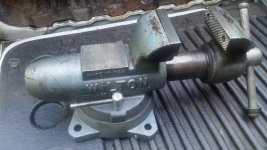
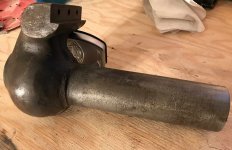
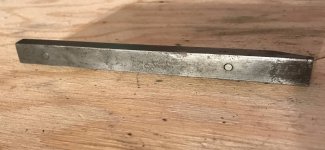
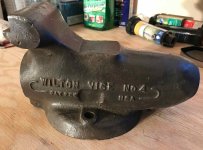
A few more pics for close comparison.---Don't let the 5th pic confuse you.---I just set the lock-down bar on top of the base, but it actually goes down inside of the base and as you can see the body has an offset/step-down, that goes down to meet the bar.



![WP_20170527_026[33219].jpg](/forum/data/attachments/554/554807-cb304c865f372e5525bd4918283df406.jpg)
![WP_20170524_009[32787].jpg](/forum/data/attachments/554/554764-9d4c35b7bd6f20aedc208f8c1f29612d.jpg)
![WP_20170524_011[32789].jpg](/forum/data/attachments/554/554751-4d8165700e3407d34b00bbb491cf9742.jpg)
![WP_20170421_014[30538].jpg](/forum/data/attachments/554/554712-d5f470e65d7452e145d41959860ba37c.jpg)
![WP_20170421_013[30537].jpg](/forum/data/attachments/554/554669-ccfe77511917d9a90797de5bdd849b93.jpg)
![WP_20170421_015[30539].jpg](/forum/data/attachments/554/554631-8aae88d0bff556a6fe66808deaf27f1c.jpg)
![WP_20170421_012[30536].jpg](/forum/data/attachments/554/554597-050df265c13e548d1b703e1e12239abf.jpg)
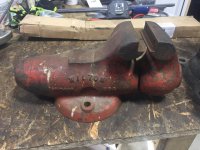
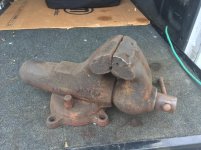
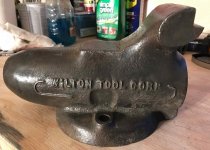
Picked this up today. No date stamp that I can find. Any ideas on age?
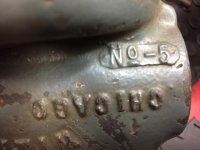
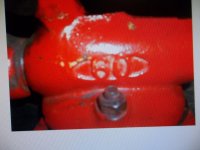
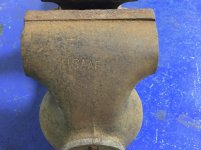
Also just noticed it has a "No 5" cast upside down on it????
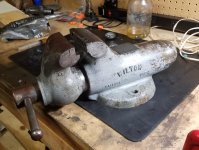
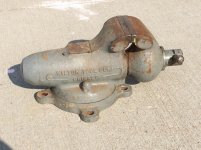
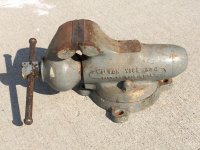
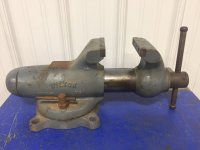
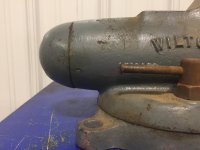
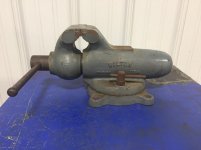
Hey guys. Here are some interesting notes on a newly acquired 4" Wilton with simple "HD" stamps on the articulating jaw and body. I'm trying to date it. Shown here are also some comparisons to my 1946 No. 4 which has a date stamp.
Here are the vitals on the HD vise...
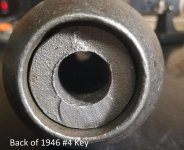
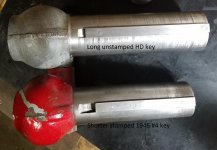
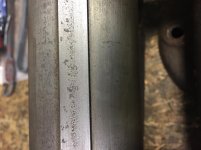
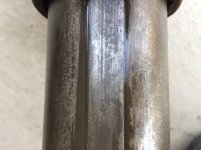
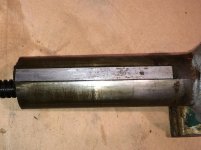
No date stamp on the key. Key is also longer than the '46. See comparison pic.
No model number stamping on vise body. "HD" only.
Original old-style jaws with straight serrations
Low-drilled straight through single pin nut retainer. (This is interesting. All post-war Wiltons I've seen including my '46 have two nut retainer pins that are drilled higher on the vise. The HD nut passes all the way through the vise body and notches the bottom of the nut. See pic. I am taking a guess and saying this HD vise in a very early '45 or '44.

I always thought the first Wilton's built had the straight serrations until they figured out the setup for cutting 30 degree cross cut serrations. I always thought this was considered the first generation bullets. I fit a set of jaws on a #6 fish hook Wilton yesterday, the 6 x 1 x 5/8 thick jaws had the 4" Center to Center screw holes just like the 1760 Tradesman. These jaws also fit the 6" Paramo.
Interesting! Does your 935 have the longer key?
KM, I think the first Wiltons were, (as they say about kinfolk), just first cousin York's, once removed.---Pun intended.
I forgot about that, but got lucky with the pics. If you look at the photo above of the 4" HD, you can see the 935 slide upside down in the background. It has the key with just a small amount of grove left unfilled, so it does seem to have a longer key like your unmarked vise.
Yep. I see that now. So I guess we can surmise a few things about War Wiltons. Regardless of the presence of a Patent Pending casting you'll see a single low-mount nut retainer pin, a longer often undated key and original jaws with straight serrations. I would be interested to see how the consistency of these observations holds up. I'm debating a restoration on this vise but my gut is telling me to leave it.
Still, it's clearly a 1945 vise with two pins, so that helps.
What's the back of that 750 stamped nut look like?Still, it's clearly a 1945 vise with two pins, so that helps.


What's the back of that 750 stamped nut look like?
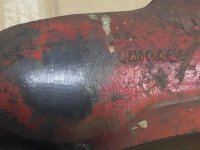
The newest addition is a No. 4 with no date stamp on the key, and a little special something stamped on the front of the dynamic. It has USAAF which stands for U.S. Army Air Forces, so it's a true WWII veteran!
Since the Wilton patent was issued in March 1942 (correct me if I'm wrong there) that means this vise was made in the first year of production. It also fits because of the prior comments about Wilton production going to the military or war contract work from 1941 to 1945.
To say I was a bit more than shocked when I saw the stamped letters is an understatement. I honestly wonder if this might be something for the USAF Museum, or similar?