You are using an out of date browser. It may not display this or other websites correctly.
You should upgrade or use an alternative browser.
You should upgrade or use an alternative browser.
VISE REPAIR 101 all vise repairs, lubricants, sources for parts and the tricks to fix
- Thread starter drivesitfar
- Start date
KMScott
Well-known member
Drive, Demoman says his Simplex 81S is 239 lbs..---But the 81SP kind of alludes me.---Has anyone got a pic of an 81SP or have I missed a previously posted pic of one?
How about a 81P, Joe picked one up a month ago. On the 81SP what is the difference?
https://www.garagejournal.com/forum/showpost.php?p=6912162&postcount=204
va.grouseman
Well-known member
KM, I'm going to take a stab at these an-acronyms and then yaw can correct me.---I am going to say that S in Demo's big 81S means swivel base.---Joe's 81P means 81 with pipe jaws.---And the CP in Movin/on's 61CP as we now know it is, means combination pipe.---And now to stand corrected.
I tell you, I do love those big Desmond combos.---I sure wished I had one.
I tell you, I do love those big Desmond combos.---I sure wished I had one.
Last edited:
OP
drivesitfar
Well-known member
MOVIN: i sold my big Desmond 61 (NO PIPE JAWS) to a young GJ member that lives close to me a few years ago cause he needed a BIG VISE and since yours has pipe jaws i'm guessing it still weights north of 160 or 170 pounds so BEE CAREFUL.
i'd probably remove the dynamic jaw then remove the swivel handles and pull off the static off the base so now you have it in three sections to inspect it. if you see something that's an easy fix great and if not take a few pictures and post and ask questions.
is yours missing one or two of the 3 pipe jaws?
good luck
VA: i have a Desmond (or Simplex I guess is the name on the side) Coachmaker and i think it's got a 4.5 inch wide jaw and maybe a 26 inch long dynamic slide. IT'S A BEAST of a vise so your white whale Desmond or Simplex 81 CP or 81 SP should be a winner if you can get it home.
GET: yep I don't envy you trying to eliminate back lash or even restoring those big 250+ pound monsters even if you have a few lifting tools to help you.
i'd probably remove the dynamic jaw then remove the swivel handles and pull off the static off the base so now you have it in three sections to inspect it. if you see something that's an easy fix great and if not take a few pictures and post and ask questions.
is yours missing one or two of the 3 pipe jaws?
good luck
VA: i have a Desmond (or Simplex I guess is the name on the side) Coachmaker and i think it's got a 4.5 inch wide jaw and maybe a 26 inch long dynamic slide. IT'S A BEAST of a vise so your white whale Desmond or Simplex 81 CP or 81 SP should be a winner if you can get it home.
GET: yep I don't envy you trying to eliminate back lash or even restoring those big 250+ pound monsters even if you have a few lifting tools to help you.
Movin/on
Well-known member
GETRIDAONE got me to thinking about the teeth on the adjustment hold downs. So I sprayed some PBblaster on the hold downs and with the "nuts" backed off I tapped them with a brass hammer, not hard at all, and they dropped down and the swivel is now working. They must have been stuck in the up position. I didn't have to tip the vise.
Thanks for the "advise".
Richard >>> Movin/on
Thanks for the "advise".
Richard >>> Movin/on
BMR24
Well-known member
Movin if the lockdown nuts were stuck you should problibly take the static jaw out and clean and grease the mainscrew. You don't want rust and stuff in there acting as an abrasive
OP
drivesitfar
Well-known member
Movin: GREAT. i like BMR'S suggestion too when you have time. if you don't want to paint it or spend a lot of time cleaning it up even a light cleaning and rubbing on some BLO will help keep the rust at bay since you are so close to the ocean.
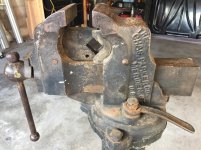
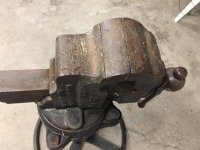
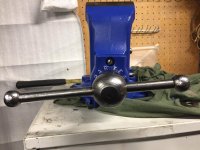
Thanks to you all for getting me interested in an old, quality vise. I can see my pocket book getting much lighter down the road! I found a Chas Parker #37 locally. I was stoked because it came with a heavy stand and the poster stated it worked great. Unfortunately I was so excited that I failed to look at it closely when I bought it. When I got it home I discovered that part of it was broken (end of slide). Otherwise it works well though.
Any suggestions on how to fix the broken part (pic 1)? I will post up pictures of the refurbish process as I go.
Thanks,
Any suggestions on how to fix the broken part (pic 1)? I will post up pictures of the refurbish process as I go.
Thanks,
Attachments

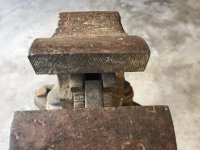
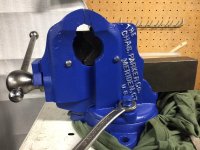
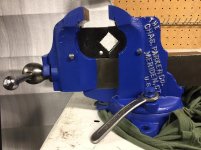
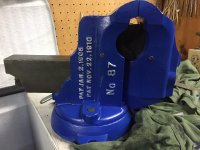
Added some pics after I cleaned with simple green and wire brush. Later I used a wire wheel with a drill to clean up further. Next is to dissemble and continue on. Thanks for all the info everyone! Lastly, finished pics. I wanted to change the vise jaws but they are too speedy for a vise like this. Someday...
Attachments
Last edited:
OP
drivesitfar
Well-known member
TACO: looks like you found about 100 year old Parker vise and it's got it's pipe jaws that are usually missing. you also have decent jaws that are not loose or damaged other than normal use and the wrench on the swivel's base that also is usually missing.
how handy are you and how important is fixing that damage to the dynamic slide to you? i've been on this thread from the start and i don't recall anybody actually repairing a slide with a chunk missing from it. i know members have asked and some have mentioned it might be fixable so if you have the skills and can do it i'm here to learn and watch.
i'm guessing with that damage the vise probably fell on the cement floor maybe while sitting on that stand you have in the picture. if the fall was hard enough to break the slide how does the main screw and vise nut look and work?
since that damage to the slide shouldn't hinder the vise's ability to work another idea is to cut it so it maybe has a little more curvy look to it and maybe cut a similar piece out of the other side? or just clean it up and use it.
ask questions if you have any as far as taking it apart and take plenty of pictures if you are asking about possible damage or repair ideas. I'm also not 100% knowledgeable about Parker's model #'s, but i think yours is an #87 and not a #37.
good luck and nice find!!
how handy are you and how important is fixing that damage to the dynamic slide to you? i've been on this thread from the start and i don't recall anybody actually repairing a slide with a chunk missing from it. i know members have asked and some have mentioned it might be fixable so if you have the skills and can do it i'm here to learn and watch.
i'm guessing with that damage the vise probably fell on the cement floor maybe while sitting on that stand you have in the picture. if the fall was hard enough to break the slide how does the main screw and vise nut look and work?
since that damage to the slide shouldn't hinder the vise's ability to work another idea is to cut it so it maybe has a little more curvy look to it and maybe cut a similar piece out of the other side? or just clean it up and use it.
ask questions if you have any as far as taking it apart and take plenty of pictures if you are asking about possible damage or repair ideas. I'm also not 100% knowledgeable about Parker's model #'s, but i think yours is an #87 and not a #37.
good luck and nice find!!
Drives: You are possibly correct on the model number. Being so dirty, its hard to see. I will probably not mess with the broken piece if I cannot find someone who has had success. I don't think it affects the performance much, especially for the small projects that I will have for it. Everything looks good and tight so far. I'll update here as I go. It will be a slow process. Thanks for the insight.
OP
drivesitfar
Well-known member
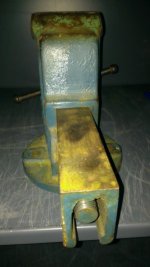
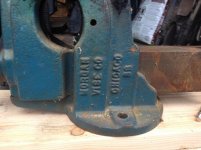
Taco: Morgan and I think OSWEGO also made a vise similar to your Parker so if you might find one of those with a good slide and a busted static it might work to make you a 100 year old FRANKENVISE, but i'm not 100% those other company's parts will match up to your Parker.
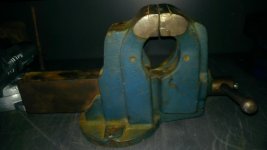
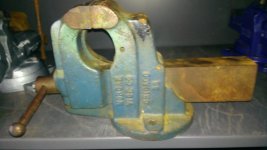
here's my Morgan 88 that is not only missing the swivel wrench, but the swivel's base and of course the pipe jaws are missing.
good luck and even if you don't get to cleaning it up right away it looks like it might be usable so enjoy.
here's my Morgan 88 that is not only missing the swivel wrench, but the swivel's base and of course the pipe jaws are missing.
good luck and even if you don't get to cleaning it up right away it looks like it might be usable so enjoy.
Attachments
gman007
Well-known member
Drives: You are possibly correct on the model number. Being so dirty, its hard to see. I will probably not mess with the broken piece if I cannot find someone who has had success. I don't think it affects the performance much, especially for the small projects that I will have for it. Everything looks good and tight so far. I'll update here as I go. It will be a slow process. Thanks for the insight.
Taco
I think you are in luck! Check this out
https://www.ebay.com/itm/Parker-No-87-Vise-Drawbar-ONLY-3-1-2-Wide-Pipe-Style-Patd-1910-NICE-PV10-21-17/401427997799?hash=item5d76f92467:g
 ocAAOSwOA1Z6613:sc:USPSPriority!49009!US!-1
Parker No.87 Vise Drawbar(ONLY)3-1/2"Wide,Pipe Style,Pat'd 1910~NICE #PV10.21.17
I have dealt with vendor oldtoolnut and he is a nice guy and is interested in helping restore old vises.
Best of luck
007
va.grouseman
Well-known member
Taco, I've also bought from Oldtoolnut.---I bought a swivel base and lock-down for a Morgan 140 Star.---It was one fifth the price of going strait to the Milwaukee Tool & Equipment Co., who sell Morgan vises.---He's alright.
akasrick
Well-known member
MOVIN: (NO PIPE JAWS)
Apparently Prentiss (from a catalog of theirs) had a fix for this.
What I see is that they were attached to the top off the jaws I would imagine that holes were drilled. Pretty interesting.
akasrick
Attachments

va.grouseman
Well-known member
Akasrick, I don't think it was a fix for lost pipe-jaws as much as an added option for conventional machinist vises.---Of course this is JMO.
I have a couple of pairs, Outlaw has a couple I think, B100 has a couple, and ain't no telling how many Zoomie has.
I have a couple of pairs, Outlaw has a couple I think, B100 has a couple, and ain't no telling how many Zoomie has.
Attachments



akasrick
Well-known member
Akasrick, I don't think it was a fix for lost pipe-jaws as much as an added option for conventional machinist vises.---Of course this is JMO.
I have a couple of pairs, Outlaw has a couple I think, B100 has a couple, and ain't no telling how many Zoomie has.
Even more interesting to see they exist. Wheew 1879
Thank you!
akasrick
Outlawmws
Well-known member
Taco
I think you are in luck! Check this out
https://www.ebay.com/itm/Parker-No-87-Vise-Drawbar-ONLY-3-1-2-Wide-Pipe-Style-Patd-1910-NICE-PV10-21-17/401427997799?hash=item5d76f92467:g
Parker No.87 Vise Drawbar(ONLY)3-1/2"Wide,Pipe Style,Pat'd 1910~NICE #PV10.21.17
I have dealt with vendor oldtoolnut and he is a nice guy and is interested in helping restore old vises.
Best of luck
007
Taco, that is a reasonable deal for unobtanium!
That said, that missing chunk won't affect the usability of the vise as that part of the slide sees no strain. This was discussed in detail recently, I'm pretty sure in this thread.
Outlawmws
Well-known member
Akasrick, I don't think it was a fix for lost pipe-jaws as much as an added option for conventional machinist vises.---Of course this is JMO.
I have a couple of pairs, Outlaw has a couple I think, B100 has a couple, and ain't no telling how many Zoomie has.
Actually I don't have any of those. I think you are thinking of the flex jaw pieces where I think you and I each had one, but different ones? (number of "teeth"?). And Zoomie, Yeah Zoomie...
va.grouseman
Well-known member
Yea Outlaw, I guess I was thinking of the jaws for odd shapes.---But they are just as cool and not to easy to find either.
gman007
Well-known member
Taco, that is a reasonable deal for unobtanium!
That said, that missing chunk won't affect the usability of the vise as that part of the slide sees no strain. This was discussed in detail recently, I'm pretty sure in this thread.
Outlaw
Some people like me who might have OCD
 like their vises intact and that is not necessarily related to diminished functionality but just for esthetics reasons. Then again an issue with the vise like this one might not at all mater to others. To each his own
007
Provincial
Well-known member
I took on a challenge recently. It is a Reed 305 1/2 fixed-base, swivel-jaw vise that had been buried in mud beneath a fallen-down barn for many years. Judging from the condition, at least a decade. Every moving part was stuck solid, and there was a thick coat of rust on almost every surface. The one exception was the screw, which was somewhat protected, but which had some rust showing.
To start the disassembly, I made a nest of fire bricks to hold the heat from a propane weedburner torch aroung the vise. I directed the torch at the screw and nut through the tail end of the slide
![GALLERY]](http://[GALLERY=media, 78673][/GALLERY])
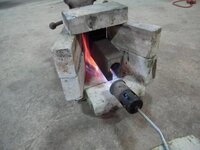
Once the screw freed up, I heated the main casting to about 600° which broke the rust bond at the parting lines between the slide and the main casting.
![GALLERY]](http://[GALLERY=media, 78674][/GALLERY])
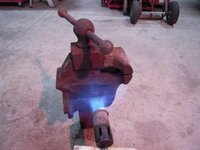

![GALLERY]](http://[GALLERY=media, 78675][/GALLERY])
It did the same for the joint between the main casting and the swivel jaw.
View media item 78676
I cleaned up the slide surfaces with a wire cup wheel, followed by a Scotch Brite stripping pad on a 4-1/2" grinder. This was to prevent friction between the slide and the main casting when the slide was forced out. I heated the end of the screw and beat on the end of the handle with a 2-pound copper-faced hammer to free it up. I had to work it back and forth while cleaning the rust off the exposed surfaces to get it freed up.
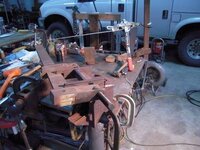
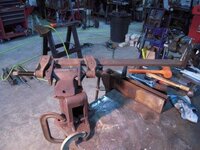
My setup for removing the slide was a 10-ton short porta-power ram in a puller configuration. I used scrap and salvaged material to build the parts. Two pieces of 1/4x2 angle iron formed the arms, with 3/4-10 redi-rod for adjustment and 3" long pieces of 1x2 flat bar for the "jaws" of the puller. I had built a strongback from 4" U-channel previously that I use for pressing. I use it with my 30-ton rams, so I made it adjustable for the gap so I can use it with up to 1-1/4" redi-rod. I narrowed it for the 3/4 rod in this application. Pieces of scrap plate spread the pressure of the ram against the strongback and the end of the vise slide. I put an estimated 6 tons of force on the ram and then heated the main casting with the weedburner.
![GALLERY]](http://[GALLERY=media, 78677][/GALLERY])

It again took about 600° to break the slide loose, but it started moving. I had taken up the backlash in the screw, so I wasn't pushing against it. Once it started moving, the weight of the handle caused the screw to unscrew. When I set up the puller, I used wood blocks to support everything in position until I put pressure on the ram. Once under pressure, I removed the blocks because of the torch heat.
View media item 78678
The C-clamp on the "jaws" is to keep them from spreading in case there was flex in the setup. Notice that the redi-rod is almost perfectly in line with the pressure point of the "jaws" to help prevent slippage. You can also see how the plate washers transfer the pressure to the strongback. The nuts and washers were the only new parts of the setup.
![GALLERY]](http://[GALLERY=media, 78679][/GALLERY])
To be continued.
To start the disassembly, I made a nest of fire bricks to hold the heat from a propane weedburner torch aroung the vise. I directed the torch at the screw and nut through the tail end of the slide
Once the screw freed up, I heated the main casting to about 600° which broke the rust bond at the parting lines between the slide and the main casting.
It did the same for the joint between the main casting and the swivel jaw.
View media item 78676
I cleaned up the slide surfaces with a wire cup wheel, followed by a Scotch Brite stripping pad on a 4-1/2" grinder. This was to prevent friction between the slide and the main casting when the slide was forced out. I heated the end of the screw and beat on the end of the handle with a 2-pound copper-faced hammer to free it up. I had to work it back and forth while cleaning the rust off the exposed surfaces to get it freed up.
My setup for removing the slide was a 10-ton short porta-power ram in a puller configuration. I used scrap and salvaged material to build the parts. Two pieces of 1/4x2 angle iron formed the arms, with 3/4-10 redi-rod for adjustment and 3" long pieces of 1x2 flat bar for the "jaws" of the puller. I had built a strongback from 4" U-channel previously that I use for pressing. I use it with my 30-ton rams, so I made it adjustable for the gap so I can use it with up to 1-1/4" redi-rod. I narrowed it for the 3/4 rod in this application. Pieces of scrap plate spread the pressure of the ram against the strongback and the end of the vise slide. I put an estimated 6 tons of force on the ram and then heated the main casting with the weedburner.
It again took about 600° to break the slide loose, but it started moving. I had taken up the backlash in the screw, so I wasn't pushing against it. Once it started moving, the weight of the handle caused the screw to unscrew. When I set up the puller, I used wood blocks to support everything in position until I put pressure on the ram. Once under pressure, I removed the blocks because of the torch heat.
View media item 78678
The C-clamp on the "jaws" is to keep them from spreading in case there was flex in the setup. Notice that the redi-rod is almost perfectly in line with the pressure point of the "jaws" to help prevent slippage. You can also see how the plate washers transfer the pressure to the strongback. The nuts and washers were the only new parts of the setup.
To be continued.
Last edited:
Provincial
Well-known member
I pushed the slide of the Reed 305 1/2 vise out of the main casting, unscrewing the screw as I went. Once the cleaned surface of the slide was fully in the main housing, it moved easily. The rust on the screw threads did not cause any noticable resistance. In this photo you can see the very old brazed repair on the dynamic jaw. It was well done, and the jaws line up perfectly.
View media item 78728
This photo shows how the "jaws" engaged the flat surface on the front of the main casting. This casting had contours from the swivel jaw feature that reduced the area that I could contact with the jaws, but they had plenty of surface area in contact to spread out the pressure.
View media item 78729
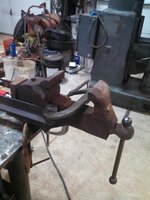
Once the slide was removed, I moved on to the swivel jaw. I again heated the castings to about 600° and used the copper-faced hammer on the rear part of the swivel to get it moving. I used a large bar clamp to apply pressure to rotate the swivel jaw, combined with the impact of the hammer. You can see the shiny spot on the swivel jaw casting where the hammer was contacting. I moved the jaw back and forth, not just in one direction.
View media item 78730
To apply pressure to the bar clamp, I rigged up a come-along and carefully applied tension. I did not try to pull it as tight as I could, and used the impact of the copper-faced hammer to break the friction of the rust. You can see the hammer on the table behind the vise.
![GALLERY]](http://[GALLERY=media, 78731][/GALLERY])
As the jaw rotated, I was able to use the bar clamp by hand to finish turning it out enough to remove it.
![GALLERY]](http://[GALLERY=media, 78732][/GALLERY])
After cleaning up the jaw surfaces, I had to hand fit the jaw back to the main body. I suspect that there was some distortion of the castings in the last hundred years, and all the heating could have released stresses in the castings.
The only destructive action I had to take in disassembling the vise was to drill out the screw holding the collar to the main screw. I was able to do that without damaging the threads.
I will be using this vise in my shop to hold irregular parts. I don't intend to put much pressure on the old repair, so it should be fine. I have other vises to use for serious work. I haven't decided what to do for a finish on the vise. I will wax the slide, but may just leave the oxidized coating on the castings after wire brushing off the built-up rust. The rear top of the slide had been used extensively as an "anvil" and has many marks to prove it. This will never be a display vise!
View media item 78728
This photo shows how the "jaws" engaged the flat surface on the front of the main casting. This casting had contours from the swivel jaw feature that reduced the area that I could contact with the jaws, but they had plenty of surface area in contact to spread out the pressure.
View media item 78729
Once the slide was removed, I moved on to the swivel jaw. I again heated the castings to about 600° and used the copper-faced hammer on the rear part of the swivel to get it moving. I used a large bar clamp to apply pressure to rotate the swivel jaw, combined with the impact of the hammer. You can see the shiny spot on the swivel jaw casting where the hammer was contacting. I moved the jaw back and forth, not just in one direction.
View media item 78730
To apply pressure to the bar clamp, I rigged up a come-along and carefully applied tension. I did not try to pull it as tight as I could, and used the impact of the copper-faced hammer to break the friction of the rust. You can see the hammer on the table behind the vise.
As the jaw rotated, I was able to use the bar clamp by hand to finish turning it out enough to remove it.
After cleaning up the jaw surfaces, I had to hand fit the jaw back to the main body. I suspect that there was some distortion of the castings in the last hundred years, and all the heating could have released stresses in the castings.
The only destructive action I had to take in disassembling the vise was to drill out the screw holding the collar to the main screw. I was able to do that without damaging the threads.
I will be using this vise in my shop to hold irregular parts. I don't intend to put much pressure on the old repair, so it should be fine. I have other vises to use for serious work. I haven't decided what to do for a finish on the vise. I will wax the slide, but may just leave the oxidized coating on the castings after wire brushing off the built-up rust. The rear top of the slide had been used extensively as an "anvil" and has many marks to prove it. This will never be a display vise!
Last edited:
gman007
Well-known member
ProvAfter cleaning up the jaw surfaces, I had to hand fit the jaw back to the main body. I suspect that there was some distortion of the castings in the last hundred years, and all the heating could have released stresses in the castings.
The only destructive action I had to take in disassembling the vise was to drill out the screw holding the collar to the main screw. I was able to do that without damaging the threads.
I will be using this vise in my shop to hold irregular parts. I don't intend to put much pressure on the old repair, so it should be fine. I have other vises to use for serious work. I haven't decided what to do for a finish on the vise. I will wax the slide, but may just leave the oxidized coating on the castings after wire brushing off the built-up rust. The rear top of the slide had been used extensively as an "anvil" and has many marks to prove it. This will never be a display vise!
That is a fantastic setup and great job that you did.
Now I do not want to start another debate here as sometimes ago we had a heated discussions between members about the best way to remove rust and free rusty siezed parts.
I am just curious if you considered say first use a wire wheel to remove some of the rust (to help the accelerate the next step) followed by electrolysis or evporust soaking. Granted given the ultra rusty shape of this vise it might have taken weeks if these methods even worked in the first place.
In any case , congrats on accomplishing this Herculean task of bring this completely siezes vise back to life
007
Last edited:
Mark in Indiana
Well-known member
Prov:
Thanks for your detailed pictures and description. I learned a lot.

Thanks for your detailed pictures and description. I learned a lot.
KMScott
Well-known member
Nice job Provincial, heat is such a good friend in vise repair and dissemble. Thanks for sharing your work.
Provincial
Well-known member
007- Electrolysis was discussed, but the overall condition of the vise was so bad that there was little point in trying to minimize the impact of rust removal. The dynamic jaw/slide has major damage from being used as an anvil, plus has a brazed repair to put the jaw back on the slide. The swivel jaw has chunks broken out of the rear skirt. The main screw has major rust pits (fortunately not in the area where the nut runs in normal use. The handle has huge rust pits. There was no reason not to use the Scotch Brite disc on the slide surfaces. BTW, the machining marks from the original manufacture are still evident, so there was not much material removed.
Provincial
Well-known member
I forgot to mention that I removed the swivel pin using a flat 4-ton porta-power cylinder pushing on a piece of 1/2" steel rod I had lying around. It shot 20 feet in the air when it let loose.
va.grouseman
Well-known member
Brilliant info Provincial, and a very well prepared progressive demo.---It's a testimony to innovation and determination when a person sets their mind to something.---The average person would have tossed that vise onto the pickup with all the other scrap metal and off to pick up a few recycling bucks.---Well done.
Outlawmws
Well-known member
Well done and great tutorial Prov!
Shiftless
Well-known member
Provential:
Thanks for sharing all the details of your project. Good work
Someday I will get around to freeing up the old post mount Reed in similar condition that I rescued from a dumpster.
Thanks for sharing all the details of your project. Good work
Someday I will get around to freeing up the old post mount Reed in similar condition that I rescued from a dumpster.
Last edited:
OP
drivesitfar
Well-known member
PROVI: looks like the old REED RILEY pulled across the field from that old barn found a great place to live out it's life. and also a very handy guy to bring it back to life.
thanks for all the pictures and information and time you spent doing this. that REED 405.5 is a great vise and i heard it had an old repair, but don't recall seeing it in the pictures so good luck and hope it works in your shop like you plan.
just curious if you might have a picture of that flat 4-ton porta-power cylinder that popped that pin out cause i've got more than a few swivel jaw vises with stuck pins that the little nut press might not do the job. Sounds like you don't want to be above it when it lets loose either.
CONGRATS on getting it apart and thanks again for sharing all your cool ways you did it. amazing the creativity a guy can do in his shop with some skills, some heat and a few old tools and pieces of steel laying around.
HAPPY NEW YEAR to all of you that participate on this thread cause it's still one of my favorites. one of these days I might be handy as a few of you and until then i'll just keep learning and watching so please keep posting up pictures and your vise projects.
cheers
thanks for all the pictures and information and time you spent doing this. that REED 405.5 is a great vise and i heard it had an old repair, but don't recall seeing it in the pictures so good luck and hope it works in your shop like you plan.
just curious if you might have a picture of that flat 4-ton porta-power cylinder that popped that pin out cause i've got more than a few swivel jaw vises with stuck pins that the little nut press might not do the job. Sounds like you don't want to be above it when it lets loose either.
CONGRATS on getting it apart and thanks again for sharing all your cool ways you did it. amazing the creativity a guy can do in his shop with some skills, some heat and a few old tools and pieces of steel laying around.
HAPPY NEW YEAR to all of you that participate on this thread cause it's still one of my favorites. one of these days I might be handy as a few of you and until then i'll just keep learning and watching so please keep posting up pictures and your vise projects.
cheers
Provincial
Well-known member
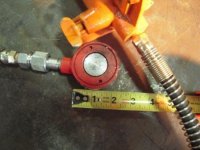
Drives, here are some photos of the short ram. It came in the Harbor Freight kit number 94681, which is still sold. The height range is rated as 1.6 to 2.2 inches. I have used several parts of this set in the last few years, including the 5-ton pullback ram, the 10-ton medium ram, and the 4-ton long ram, in additon to this 4-ton short ram. I use the pump from my HF 10-ton unit.
Attachments

OP
drivesitfar
Well-known member
PROVI: with all the hydraulic pressure applied to this 70 ish year old REED cast iron vise were you EVER WORRIED about the cast cracking or flying apart? i'm guessing since the vise already had a repair done to it your concern level might have been lower than working on a rusted pristine vise?
thanks for showing me the little PIN REMOVAL HELPER too.
thanks for showing me the little PIN REMOVAL HELPER too.
Provincial
Well-known member
I didn't put full pressure on the hydraulics. I was going by feel, but it was a gut feeling of what I felt I could push and what the I felt the vise parts could stand. I didn't fear for breaking the casting with the small ram, but the 10-ton could have done some damage if the setup had applied a concetrated pressure.
Notice that the setup on the slide applied pressure in compression to all the vise parts. Cast iron is very strong in compression, but not so much in tension. Also, I spread out the contact area as much as possible. I suspect that there was only a few thousand psi applied to the most concentrated point of the vise because of that.
One suggestion for pin removal would be to place a heavy piece of flexible material over the pin in order to restrain it when it pops loose. I didn't because I was using heat and also rapping the area near the pin with the copper-faced hammer. The pin popped loose after a hammer blow, and I believe it kept me from having to use more hydraulic pressure. I was careful not to hit the casting in such a manner as to cause a shock load on the hydraulic cylinder, which might have overstressed the seals. The pin went 20 feet in the air, so either restrain it or wear a hard hat and don't get any body parts directly over the pin when pressing!
Notice that the setup on the slide applied pressure in compression to all the vise parts. Cast iron is very strong in compression, but not so much in tension. Also, I spread out the contact area as much as possible. I suspect that there was only a few thousand psi applied to the most concentrated point of the vise because of that.
One suggestion for pin removal would be to place a heavy piece of flexible material over the pin in order to restrain it when it pops loose. I didn't because I was using heat and also rapping the area near the pin with the copper-faced hammer. The pin popped loose after a hammer blow, and I believe it kept me from having to use more hydraulic pressure. I was careful not to hit the casting in such a manner as to cause a shock load on the hydraulic cylinder, which might have overstressed the seals. The pin went 20 feet in the air, so either restrain it or wear a hard hat and don't get any body parts directly over the pin when pressing!
Provincial
Well-known member
On further research, I find that HF #95979 10-ton ram is the same dimensions as my 4-ton unit. It just is rated at 9250 psi, as the 4-ton is rated at 5700 psi. The current price is $39.99 and it is eligible for the current 25% off coupon.
The 4-ton unit is only available as part of the 94681 kit, which is priced at $179.99.
The 4-ton unit is only available as part of the 94681 kit, which is priced at $179.99.
OP
drivesitfar
Well-known member
Provi: thanks for posting your thoughts on what you were thinking with all that creative tooling you made to get your old Reed 405.5 apart.
yep even the cheap HF tools can make stuff move and i'll have to DEVELOP a touch or feel.
speaking of that how many CAST IRON OR STEEL pieces or parts have you broke while DEVELOPING YOUR FEEL?
ALL: here's to another great year here on GJ!!
yep even the cheap HF tools can make stuff move and i'll have to DEVELOP a touch or feel.
speaking of that how many CAST IRON OR STEEL pieces or parts have you broke while DEVELOPING YOUR FEEL?
ALL: here's to another great year here on GJ!!
Provincial
Well-known member
No parts broken in training. I've been pretty cautious. I try to use finesse instead of brute force, hence the propane torch on this project.
Shiftless
Well-known member
No parts broken in training. I've been pretty cautious. I try to use finesse instead of brute force, hence the propane torch on this project.
Caution is good. Finesse is good where possible. The 500,000 ? BTU propane blaster was an interesting tool.
What methods would you guys suggest for this Prentiss No95? I wire wheeled the majority of the rust off of it, but there is some I would still like to get off. Its soaking in a vinegar bath and depending on how it turns out, either leave the finish as is protected with BLO or some type of oil.
How long should I keep the vise in the vinegar bath? I have a utility sink that will fit the either the dynamic or static part of the vise. So I bought 4 jugs of vinegar and then added water until the vise was submerged. Bubble bubble bubble.
How long should I keep the vise in the vinegar bath? I have a utility sink that will fit the either the dynamic or static part of the vise. So I bought 4 jugs of vinegar and then added water until the vise was submerged. Bubble bubble bubble.