
You are using an out of date browser. It may not display this or other websites correctly.
You should upgrade or use an alternative browser.
You should upgrade or use an alternative browser.
My New 40x50 Shop!
- Thread starter nahansmsu
- Start date

Fasthotrod
Well-known member
Alright...it's me again as I continue the build. I spent time contemplating what Mr. FastHotRod had to say, and read his post about 20 times. Very informative and I learned a ton! Super thankful!
Glad I could help!

After going through my expected load pull I think I'm going to go with my idea of just putting a 125amp double pole breaker. I don't see needing to ever pull much over 100 even if I'm hosting a symphony of welders and tools at the same time. besides it will save on costs from the lug, smaller gauge wire, smaller conduit, smaller subpanel, and easier to pull it all together. Here's the plan...check me for insanity please:
125amp BR double pole
https://www.amazon.com/gp/product/B0009XAXJQ/ref=ppx_yo_dt_b_asin_title_o00__o00_s00?ie=UTF8&psc=1
Going to run:
#1 THHN x 3 for the two hots and neutral
#6 THHN for the ground
The only challenge is none of the big boxes carry it in stock....I may call around to some of the local sparky shops tomorrow, but I found it here for fairly cheap
https://www.wireandcableyourway.com/1-awg-thhn-building-wire.html
You are on the right path... but you probably don't want to 'guess' as to what your loads will actually be. There is a process that you can follow to help determine what size breaker/wiring that you need, then you can go from there. Article 220 of the NEC covers it.
Here's some articles that explain it better than I could:
https://iaeimagazine.org/magazine/2...anch-circuit-feeder-and-service-calculations/
http://www.codebookcity.com/codearticles/nec/necarticle220.htm
https://www.ecmweb.com/nec/sizing-circuit-protection-and-conductors-part-1
https://www.ecmweb.com/content/middle-wire-isnt-its-end
So I'd take a look at your loads in your shop and determine what is considered continuous and what is considered the maximum.
So assuming that you did that, then you would look to the NEC and see that for circuits under 800A, you can size the conductor based on the ampere rating you actually need, and can use the next higher standard rating of over current protection device (OCPD) if the one you need does not exist.
So for example, if you had it calculated out that you needed 60A continuous, (60 * 125% = 75A) and that you'll have a maximum of 105A you could run a #2 that is rated at 115A. (assuming 75 degrees C) Per the Code, you could feed that #2 with a 125A breaker because they don't make a 105A or a 115A breaker. (100A typically jumps to 125A)
I'm making assumptions in my examples here... so I would recommend that you take a look at Article 220 and your loads, and do a little homework if you want to nail it down correctly. You may find that while you have a lot of cool tools like welders, plasma cutters, etc... you may not use all of them at the same time, so your actual ampacity requirements may be lower than you initially thought.
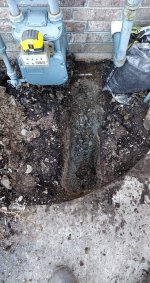
I plan to make a 6-7ft run of Schedule 80 along the wall of the brick house that the main service is on....90 it down 18-20 inches below the ground, under my sidewalk, and then the short 3-4 feet distance to an LB on the bottom of the shop. I went ahead and dug out the trench from the house to the sidewalk to see what I would be up against....Wasn't much fun as I had base from the house foundation to deal with, but eventually got there.
Since I'm only talking about a 15-18ft run would you just stick with sch80 all the way? or should I convert to 40 under the ground? I'm just assuming I have to use 80 since it's exposed on my house, and then will be when it comes out of the ground to the LB at the shop.
For the price of schedule 80 for such a short run, I'd not worry about it. Your Authority Having Jurisdiction (AHJ) may say that schedule 40 is acceptable if there isn't a chance for impact damage... so you might want to reach out to your local AHJ (Code compliance folks) to see what they say about it if cost is a factor.
I was also planning on 2inch....I know it handles it from a fill standpoint, but thought it might be a tad easier to pull the cables through.
Correct. 2" would technically be good for more than that, too. So if you found that you have a bunch of friends over and were using so much equipment that you were popping the breaker, or added more cool tools and needed more ampacity, you would be able to re-pull larger conductors and swap the breaker based on your new loads.
You might consider dropping in an additional 3/4" or 1" in the trench for future use... security system, networking, etc... PVC is relatively cheap, and I'd rather have it and not need it, than need it and have to dig it out again.
I'll post a pick of my first trench.
Thoughts/suggestions/words of encouragement as I tunnel under the sidewalk are encouraged! lol
Best of luck you you... Please remember to call 811 before you dig. You never know what's in the area and how the lines are run, so try and avoid a costly mistake if you can. (Might be too late for that, but it's always good advice anyway.)
Mark
Last edited:
Jim greengo
Well-known member
Nice looking building.First, I just found ya'll a few weeks back and what a treasure trove of information! Awesome to see how friendly people are and the great information being shared. My shop just finished up (Minus the garage door which is coming in a week or so) and I'm thinking through lighting and such. It's a 40x50 red iron with 14ft sidewalls and a 3:12 pitch giving me 20ft centers. I plan on doing all the electrical work my self. Here are a few pics of the shop...


I was originally going to with these linkable units:
https://www.amazon.com/gp/product/B01N9AO7VI/ref=ask_ql_qh_dp_hza?fbclid=IwAR2mdOVMoBIr44hoTtP7jqAVWQ-qCFRRJMLBD3rkPArt_1-7irTncEgcuQo
But...after reading these threads I don't think those will cut it.
Here is my purlins layout:

I'm thinking about going with theses High Bay 2ft/4ft varieties. My question comes should I go from a lower wattage (110) around the perimeter where the roof is 15-16ft and then to the 165watts and finish it off with maybe 2 4ft 325w directly over center? I've played with the Visual Interior Tool, but not sure if I'm using it correctly? Can you have it compensate for the roof pitch?
Thanks in advance!
Jim- Thank you! We are very please with the color combo.
FastHotRod - Very interesting...I've started a list of all my current and future equipment...breaking them out into continuous and non-continuous loads. My quick estimate/guess is coming in around 30-40 continuous (lights, water heater, mini-split hvac) and around 40-60 non-continuous. I'll finish off my list and do the appropriate math.
I called around today and found that my local electric supply house has #1 Thnn for $1.25/ft smoking the big boxes and even the web address I listed above. They even beat the big boxes on the Sch 80. I went ahead and picked up 2' sched 80 and then some 3/4 sched 40 for an alternative run like you suggested above. I'll get either #1 or #2 after I get my math done on the loads. I think the difference is only about $25 so nothing to fret about.
I finished my digging...ran into a bigger "mess" than expected. I'll post another reply from my phone with the picture.....asking for advice.
FastHotRod - Very interesting...I've started a list of all my current and future equipment...breaking them out into continuous and non-continuous loads. My quick estimate/guess is coming in around 30-40 continuous (lights, water heater, mini-split hvac) and around 40-60 non-continuous. I'll finish off my list and do the appropriate math.
I called around today and found that my local electric supply house has #1 Thnn for $1.25/ft smoking the big boxes and even the web address I listed above. They even beat the big boxes on the Sch 80. I went ahead and picked up 2' sched 80 and then some 3/4 sched 40 for an alternative run like you suggested above. I'll get either #1 or #2 after I get my math done on the loads. I think the difference is only about $25 so nothing to fret about.
I finished my digging...ran into a bigger "mess" than expected. I'll post another reply from my phone with the picture.....asking for advice.
Last edited:
I knew I had some overflow from the pad to break through.....Just above the foundation is where I plan on putting my LB's. What I didn't expect was 8-10 inches of it! I broke out my little 4' masonry saw and started cross hatching and chiseling it out, but after about 30mins realized this is going to take days.
Should I rent a jackhammer? Rent a concrete saw? Run the pvc up and around it?
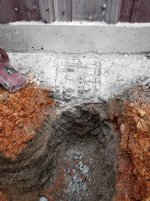
Should I rent a jackhammer? Rent a concrete saw? Run the pvc up and around it?
Last edited:
Fasthotrod
Well-known member
I bought a diamond concrete blade for my regular old circular saw... it's good for wet or dry cutting, and makes it easier for cutting concrete vs. a chisel.
I recently cut out part of our sidewalk for the electrical and gas run between the house and shop. You can see my cheap circular saw laying there... just take it slow, wear glasses and a mask to keep from breathing the dust and you'll be okay.
I also have an inexpensive rotary hammer that we used as a jackhammer to bust up that section of concrete... worked great!
Mark


Sent from my Phone using Tapatalk
I recently cut out part of our sidewalk for the electrical and gas run between the house and shop. You can see my cheap circular saw laying there... just take it slow, wear glasses and a mask to keep from breathing the dust and you'll be okay.
I also have an inexpensive rotary hammer that we used as a jackhammer to bust up that section of concrete... worked great!
Mark
Sent from my Phone using Tapatalk
Attachments


terabitdan
Well-known member
- Joined
- Jul 16, 2016
- Messages
- 152
With your gas meter right there i would consider bringing a gas line into the shop at the same time.
Depending on your local regulations it may need to be separated from the electric conduit by a minimum distance. I’ve read anywhere from 12 to 30” deep.
Sent from my iPhone using The Garage Journal mobile app
Depending on your local regulations it may need to be separated from the electric conduit by a minimum distance. I’ve read anywhere from 12 to 30” deep.
Sent from my iPhone using The Garage Journal mobile app
I've actually thought about that! I'm planning on running 4' sch 40 under the sidewalk as a sleeve. I don't think the NEC cares about gas/electric proximity, but I figured I would call my gas company and get their thoughts. Ideally I could run my 2' sch 80 electric and then in the same sleeve my gas line. I'm betting they won't like that...
Fasthotrod
Well-known member
Correct... NEC doesn't specifically say anything about it as far as I know, but the Residential Building Code might. I'd talk to my AHJ and Building Inspector to see what they think.
I think you'd want to have some kind of separation no matter what... think about what would happen if there was an accident and they just so happened to hit the gas and electric lines at the same time. Snap/pop/BOOM! Scary thought for sure.
I think you'd want to have some kind of separation no matter what... think about what would happen if there was an accident and they just so happened to hit the gas and electric lines at the same time. Snap/pop/BOOM! Scary thought for sure.
So...How did you spend your Saturday? Mine was spent covered in concrete dust with goggles, mask, and hearing protection on. I bought an air hammer from HF and was amazed. I still had to make a few cuts with my small 4' masonry saw, but that hammer chiseled it away pretty good. The problem is I'm dealing with more like 1.5 ft of over spill.
As you can see I still can't get my 90 in there...I'm going to chisel away some more tomorrow. I picked up a few 45's tonight. Do you think inspection will care if the PVC coming up to the LB isn't directly down? As in if I bring it up at a 45'?
https://www.harborfreight.com/air-tools/hammers/air-impact-hammer-kit-92037.html

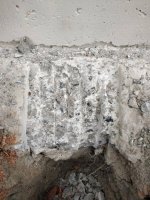
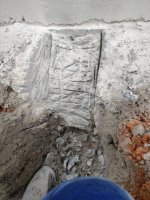
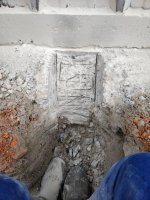
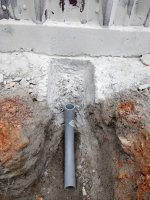

As you can see I still can't get my 90 in there...I'm going to chisel away some more tomorrow. I picked up a few 45's tonight. Do you think inspection will care if the PVC coming up to the LB isn't directly down? As in if I bring it up at a 45'?
https://www.harborfreight.com/air-tools/hammers/air-impact-hammer-kit-92037.html
Last edited:
Fasthotrod
Well-known member
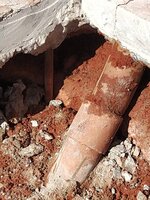
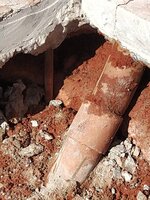
I would mount a piece of unistrut to the upper part of the foundation to anchor the conduit, depending on how close you are now would make the choice between thin and thick strut. This will bring your LB off the wall slightly but thats not a big deal.
Sent from my SM-G965U using Tapatalk
Sent from my SM-G965U using Tapatalk
Thanks to both of you.....I have some unistrut laying around. I'm going to cut/chisel a tad more...it's just getting so deep/thick I can't get my masonry saw in there any more. I'm leaning towards the 45 with a support like ya'll mentioned. We'll see what the day brings..
Toomanytools?
Well-known member
So...How did you spend your Saturday? Mine was spent covered in concrete dust with goggles, mask, and hearing protection on. I bought an air hammer from HF and was amazed. I still had to make a few cuts with my small 4' masonry saw, but that hammer chiseled it away pretty good. The problem is I'm dealing with more like 1.5 ft of over spill.
As you can see I still can't get my 90 in there...I'm going to chisel away some more tomorrow. I picked up a few 45's tonight. Do you think inspection will care if the PVC coming up to the LB isn't directly down? As in if I bring it up at a 45'?
https://www.harborfreight.com/air-tools/hammers/air-impact-hammer-kit-92037.html
That doesn't look too bad, you can heat up that 90* with a propane heater or torch and get it to bend a bit closer to the wall.
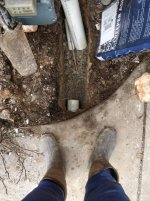
Well..here is where I ended today. I was able to get my 4' sch 40 sleeve under the sidewalk. I started with a 2', filed down the end and kept taking core samples. Then went to a 3' and finally the 4'.
I chiseled away a bit more, but ended up going with a 45'. it would have been near impossible to get the LB flush....I'm not 100% pleased with the angle, but I plan on hiding with some landscape/bush anyways. Nothing is cemented...Still some fine tuning to do.
I need to repeat with my 3/4 sch 40 for my data line....

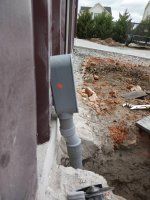

I chiseled away a bit more, but ended up going with a 45'. it would have been near impossible to get the LB flush....I'm not 100% pleased with the angle, but I plan on hiding with some landscape/bush anyways. Nothing is cemented...Still some fine tuning to do.
I need to repeat with my 3/4 sch 40 for my data line....
Last edited:
redheelerdog
Well-known member
I like your shop, love the color and design. I just finished my 100 amp panel in my shop last fall. I know exactly how you feel. 
Not sure if the pic below helps much because yours is much lower, but this is what I did: added a couple of pieces of unistrut to clamp the conduit to.
I like your work man! Keep on going!
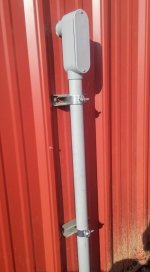
Not sure if the pic below helps much because yours is much lower, but this is what I did: added a couple of pieces of unistrut to clamp the conduit to.
I like your work man! Keep on going!
Thanks! I wanted to keep it as low as possible since this is right on the front of the building next to the walk door. I think I may do like you did and just push the internal pipe connecting to the LB out an inch or so and purposely not try to make the LB flush.
What are ya'll sealing the outside with? Clear silicone?
What are ya'll sealing the outside with? Clear silicone?
redheelerdog
Well-known member
I used what I had and ran a couple 5P beads on it.

Fasthotrod
Well-known member
Looks like you're making progress... it's nice to see things getting done.
Just my unsolicited two cents: If it were me, I'd extend the length of the ****** through the wall such that the LB would sit plumb with the siding/concrete. Then I'd ditch the offset and replace it with two 45 degree elbows. That way your pipe is straight down, then kicks out away from the concrete below grade into the 90 degree elbow.
Just remember: The NEC only allows for up to 360 degrees of elbows/turns/kicks before you have to put in a pull box/junction box.
Ultimately, it's your shop and your money so our opinions don't really matter... and if it's covered up and you never see it then it probably won't matter in the long run. But I'm pretty particular about how I do things so I have a tendency to be a bit critical about stuff like this when I don't need to be. So just take it with a grain of salt.
Mark
Just my unsolicited two cents: If it were me, I'd extend the length of the ****** through the wall such that the LB would sit plumb with the siding/concrete. Then I'd ditch the offset and replace it with two 45 degree elbows. That way your pipe is straight down, then kicks out away from the concrete below grade into the 90 degree elbow.
Just remember: The NEC only allows for up to 360 degrees of elbows/turns/kicks before you have to put in a pull box/junction box.
Ultimately, it's your shop and your money so our opinions don't really matter... and if it's covered up and you never see it then it probably won't matter in the long run. But I'm pretty particular about how I do things so I have a tendency to be a bit critical about stuff like this when I don't need to be. So just take it with a grain of salt.
Mark
I like your suggestion. I'm going to skip out of work a tad early (warm day here in the upper 60's) and play around with the angles again. The more I look at it I want to have the LB parallel with the building instead of it being angled. I will have to have a support (as mentioned above), but that's fine.
I read about the NEC 360 rule....I have another LB/Junction that I plan to mount on the side of the house before I head down under the ground. That will remove a 90 from the overall math and bring me in between 225-270. Still a ton of angles, but should code out for me.
I read about the NEC 360 rule....I have another LB/Junction that I plan to mount on the side of the house before I head down under the ground. That will remove a 90 from the overall math and bring me in between 225-270. Still a ton of angles, but should code out for me.
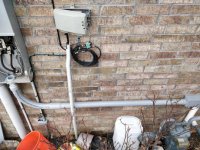
Alright...need your thoughts. I started the run from the main service down the wall of my house to my trench. Should I go behind the phone line or in front of it. Any code violations either way? Aesthetically I like it it in front of it, but when it runs behind it's closer to the wall. Either way I can't really get a standard 2' pipe support to get close enough to the wall to screw it in. I'll have to figure out some other form of a strap....Maybe get a 3' and use that..


Or

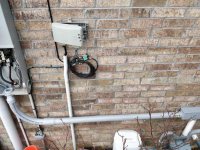

Ignore the white piece of sch40 below the LB on the wall...Just using it as a placeholder for now.
Or
Ignore the white piece of sch40 below the LB on the wall...Just using it as a placeholder for now.
Last edited:
Fasthotrod
Well-known member
I like the phone line behind the electrical conduit... looks cleaner to me.
Could you use a PVC conduit double clamp to secure the PVC conduit and simply use some bushings and longer screws to keep the spacing between the brick and the conduit equal? What about a half thick piece of Unistrut?
I'm thinking of a couple of these little dudes:
https://www.lowes.com/pd/CARLON-2-i...ule-80-PVC-Compatible-Conduit-Fitting/3565486
With something like this between the clamp and the wall:
https://www.lowes.com/pd/Hillman-1-2-in-x-3-16-in-x-1-in-Nylon-Spacers/3012438
They have them in steel, nylon, aluminum... you name it. (My local Ace Hardware has a pretty good selection.)
Mark
Could you use a PVC conduit double clamp to secure the PVC conduit and simply use some bushings and longer screws to keep the spacing between the brick and the conduit equal? What about a half thick piece of Unistrut?
I'm thinking of a couple of these little dudes:
https://www.lowes.com/pd/CARLON-2-i...ule-80-PVC-Compatible-Conduit-Fitting/3565486
With something like this between the clamp and the wall:
https://www.lowes.com/pd/Hillman-1-2-in-x-3-16-in-x-1-in-Nylon-Spacers/3012438
They have them in steel, nylon, aluminum... you name it. (My local Ace Hardware has a pretty good selection.)
Mark
Farmallboy15
Well-known member
You could use Unistrut to space it off.
Bigblockyeti
Banned
Little late to the lighting party but did you look at these folks before deciding on what lighting to go with: https://www.omniraylighting.com/ ? I bought 4 of their 5472 lumen 4' fixtures for my 580sqft. garage and it's working out well for $83 but I didn't know if anyone else had heard of them. I think I originally found them from one of a huge number of posts on CL. You could have gotten 25 of the 8' fixtures for just under $500 delivered but that means nothing if they're **** long term.
Edit: Ok, I missed post #20, and I concur, the lights are good, the cords are too short and the thin clips are too fragile.
Edit: Ok, I missed post #20, and I concur, the lights are good, the cords are too short and the thin clips are too fragile.
Last edited:
Fasthotrod
Well-known member
I just ordered another box of 25 8' LED lights from Omni-Ray... some friends stopped by and checked them out and wanted to get some, so I figured I'd order a bunch and pass on the savings to everyone.
I'll have to report back as time goes on to let everyone know if they are worth a **** or not. So far, I've been pretty happy with them as far as the lighting goes, but the clips leave a bit to be desired and the 10" pigtail isn't really much to work with. (They sell longer length pigtails on their website if anyone is interested.)
Mark
I'll have to report back as time goes on to let everyone know if they are worth a **** or not. So far, I've been pretty happy with them as far as the lighting goes, but the clips leave a bit to be desired and the 10" pigtail isn't really much to work with. (They sell longer length pigtails on their website if anyone is interested.)
Mark
The weather cleared a bit and I was finally able to make some more progress.
Secured and cemented up the 2' main electrical run. Not the latest photo as I took the suggestion above with the strut/pipe strap. This picture doesn't have the strap....I can tell you that thing is attached really solid!
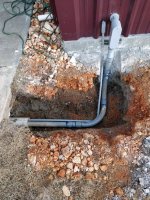
Also ran my data/auxiliary line...not the lastest picture as I have it terminating just above the junction box on the house.

I also was able to get my 200amp panel installed in the shop. I decided to go a bit overboard and bought a 125amp breaker to feed the 200amp shop. My calculations don't ever show me needing that much, but figured for a few bucks more to just go for it. I"ll be pulling 3 strands of #1 THHN and 1 strand of #6 THHN for the ground.

Now for some more questions...and a bit of small problem.
1. You can see in my panel photo on the right side is a grounding rod I had installed in the concrete when they poured it. I'll have a ground wire going back to the main panel on the house. I'm assuming I just need to run a ground cable from my subpanel ground bar to this grounding rod? You can see the rod is right near one of my horizontal side beams. Can I secure the rod to that?
2. I started pulling my wires this afternoon. The first was the ground wire (#6 THHN) from the main panel. The local electric supply shop either cut it 3 feet short, or my measurements were wrong. Should I just **** it up and buy a new run completely, or am I "allowed" to buy a few more feet and splice/solder/attach the two together? The splice would be in a junction box if that makes a difference....
Maybe using something like this: https://www.homedepot.com/p/2-STR-to-14-AWG-Dual-Rated-Type-ASE-ALCUL-Splicer-Reducer-with-Solid-Barrier-Wire-Stop-2-Pack-ASR0214-B2-10/100172350
Thanks again for the advice and following my journey!
Secured and cemented up the 2' main electrical run. Not the latest photo as I took the suggestion above with the strut/pipe strap. This picture doesn't have the strap....I can tell you that thing is attached really solid!
Also ran my data/auxiliary line...not the lastest picture as I have it terminating just above the junction box on the house.
I also was able to get my 200amp panel installed in the shop. I decided to go a bit overboard and bought a 125amp breaker to feed the 200amp shop. My calculations don't ever show me needing that much, but figured for a few bucks more to just go for it. I"ll be pulling 3 strands of #1 THHN and 1 strand of #6 THHN for the ground.
Now for some more questions...and a bit of small problem.
1. You can see in my panel photo on the right side is a grounding rod I had installed in the concrete when they poured it. I'll have a ground wire going back to the main panel on the house. I'm assuming I just need to run a ground cable from my subpanel ground bar to this grounding rod? You can see the rod is right near one of my horizontal side beams. Can I secure the rod to that?
2. I started pulling my wires this afternoon. The first was the ground wire (#6 THHN) from the main panel. The local electric supply shop either cut it 3 feet short, or my measurements were wrong. Should I just **** it up and buy a new run completely, or am I "allowed" to buy a few more feet and splice/solder/attach the two together? The splice would be in a junction box if that makes a difference....
Maybe using something like this: https://www.homedepot.com/p/2-STR-to-14-AWG-Dual-Rated-Type-ASE-ALCUL-Splicer-Reducer-with-Solid-Barrier-Wire-Stop-2-Pack-ASR0214-B2-10/100172350
Thanks again for the advice and following my journey!
Last edited:
Fasthotrod
Well-known member
Got those 8' LED lights from Omni Ray installed this weekend... 30 total. It's stupid bright in there now...
Mark



Mark
Attachments



@FastHotRod - Nice and clean....thank god for a lift huh! How big is your room? I'm going to be building pretty much the same thing...mine will be 14x20. It's more of a clean room for my "clean hobbies" lol...RC plans, drones, 3d printer..etc. My wife will also do some of her stuff in there as well getting us out of the house. I wasn't going to put stairs/railing up top. I'm going to extend the outer walls to the ceiling, and then leave one side with a sliding barn door or something. Maybe get creative and build a gantry/lift. I plan on using the upstairs for storage as the attic in the house is rather small.
Pulled all my wires today and hooked them up to the subpanel. I left a bit extra in the bottom just-in-case...not as clean, but may need it someday. I haven't installed the breaker in the main yet....need to wait for a good time to "take an outage" on the house. I plan on doing it this week.
My question from earlier still stands. Am I within code on running the ground to the rod in my concrete? What about the exposed ground wire? Should I have that in EMT or MC or something?
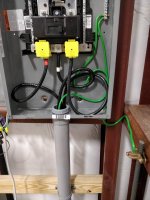
My question from earlier still stands. Am I within code on running the ground to the rod in my concrete? What about the exposed ground wire? Should I have that in EMT or MC or something?
Last edited:
Fasthotrod
Well-known member
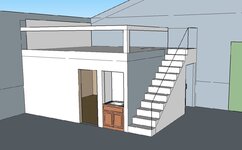
Office is 15' 4" x 12' 4" inside. It also has a closet that is 3' deep and 5' wide, plus a half bath (stool and sink) with a pocket door. Opposite the 1/2 bath sink is a sink in the shop area.
Under the stairs is a water closet and an area for an air compressor.
Conceptual drawings are below, along with a few pics of the progress.
Mark
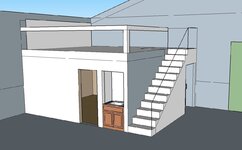
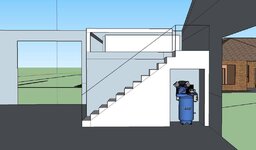


Under the stairs is a water closet and an area for an air compressor.
Conceptual drawings are below, along with a few pics of the progress.
Mark
Attachments
-
 f6b6417f514c71cdb514ba83fa26305b.jpg61.3 KB · Views: 1
 -
 77b4fb15808434bce5a98072c5e9b0ba.jpg70.9 KB · Views: 1
 -
 3f74d0dd00aa9a9be2db3218054a29be.jpg73.3 KB · Views: 1
 -
 6287ccfbed3713ff355ecbc24ae468a4.jpg49 KB · Views: 1
 -
 644543e5acf685483ccfe7029aa2b0e6.jpg36.4 KB · Views: 1
 -
 3e422d9981d1b01dccae0f5b15d6ee61.jpg73.6 KB · Views: 1
 -
 f101a017e3c54f07747389ea1bd0e348.jpg51.1 KB · Views: 1
 -
 4acbde53f14393c0ea13b155471c4a57.jpg42.9 KB · Views: 1
 -
 83d85a7e336760328d5dd0b97f7bd3dc.jpg74.5 KB · Views: 1
Fasthotrod
Well-known member
As far as I know, the ground wire needs to be a solid conductor (not stranded) but doesn't need to be in a conduit.Pulled all my wires today and hooked them up to the subpanel. I left a bit extra in the bottom just-in-case...not as clean, but may need it someday. I haven't installed the breaker in the main yet....need to wait for a good time to "take an outage" on the house. I plan on doing it this week.
My question from earlier still stands. Am I within code on running the ground to the rod in my concrete? What about the exposed ground wire? Should I have that in EMT or MC or something?
Good info here:
https://www.ecmweb.com/code-basics/grounding-and-bonding-part-3-3
Hope this helps.
Mark
Fasthotrod
Well-known member
Google has a free drawing package called SketchUp, which is what I used for planning out my shop. There are a lot of videos out there that explain how to use it, but if you're a tech guy that's into drones and 3D printing, I suspect you won't have much trouble with the learning curve.Excellent...what did you use for your drawings? I guess I better sketch/plan it out instead of my rough paper drawings! I'm sure I'll more questions at ya when I get closer to starting the build.
One thing I like about the software is that you can import things into your drawings. So for example, I looked in the depository and see that someone had drawn a full scale Chevy Silverado. I grabbed it, then placed it around the shop at various angles to see how my clearances looked.
I also was able to use Google maps to grab a top down satellite view of my property. I copied it as a jpg and imported it into SketchUp, then scaled it so that my property lines were right on the money. It made it real easy to figure out exactly where I wanted my shop in relation to my house, the well, driveway, while meeting my setbacks required for the permit. It also made it handy for showing the electrical/water/gas/phone lines as marked by 811.
I printed off a few pages of the top down view and 3D model of my project and submitted them to the town when I got my permit. The lady that took my paperwork seemed surprised that I had put in that much effort, and my permit was approved in about a day, no problem.
My office will serve the same propose as yours... very similar hobbies. I'm also into home/mobile audio so I'm sure I'll be doing some speaker projects, building computers, etc.. Clean work in the office, dirty work in the shop.
Mark
Finally got back to some progress.....I now officially have switched power in the shop!

Now on to how I want to mount outlets...here is exhibit A. There is a girt 36' around the entire shop. I played around with mounting it like this on top of a 2x4. I could always rip them down to flush with the metal...
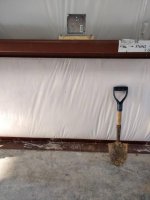
The benefit is I don't have an outlet sticking out from the steel in case I ever decide to put plywood up. It's pretty much a flush mount with the girt...
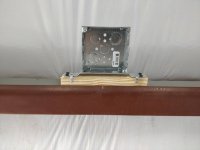
The negative is the outlet isn't very rigid. I thought about putting a vertical 2x4 behind the outlet and screw it to the base 2x4 the outlet is on. Screwing the back of the outlet into this vertical 2x4 would give it further support. Essentially an inverted "T"

How would you do it? Looking for suggestions! Thanks in advance!

Now on to how I want to mount outlets...here is exhibit A. There is a girt 36' around the entire shop. I played around with mounting it like this on top of a 2x4. I could always rip them down to flush with the metal...
The benefit is I don't have an outlet sticking out from the steel in case I ever decide to put plywood up. It's pretty much a flush mount with the girt...
The negative is the outlet isn't very rigid. I thought about putting a vertical 2x4 behind the outlet and screw it to the base 2x4 the outlet is on. Screwing the back of the outlet into this vertical 2x4 would give it further support. Essentially an inverted "T"
How would you do it? Looking for suggestions! Thanks in advance!
Last edited:
So here is my first go at getting an outlet installed. I'm not sure if this what I'll go with around the remainder of the shop or not, but I'm pretty pleased with it.

I ripped the 2x4 down to flush with the girt. I'll probably swap out the screws I have through the girt for some flush style.

I put a vertical 2x4 behind it and it made it really rigid
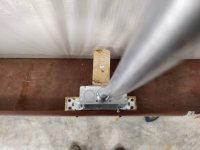
I finally now have an outlet in the shop...feels great to be able to ditch the extension cord from the house for good! I went ahead and put these on the same 20amp circuit even though the remainder of the shop I'll play the A/B game.
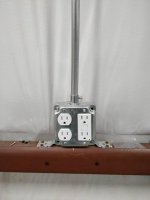
Still open to thoughts/suggestions!
I ripped the 2x4 down to flush with the girt. I'll probably swap out the screws I have through the girt for some flush style.
I put a vertical 2x4 behind it and it made it really rigid
I finally now have an outlet in the shop...feels great to be able to ditch the extension cord from the house for good! I went ahead and put these on the same 20amp circuit even though the remainder of the shop I'll play the A/B game.
Still open to thoughts/suggestions!
Last edited:
Bigblockyeti
Banned
Got those 8' LED lights from Omni Ray installed this weekend... 30 total. It's stupid bright in there now...
Mark
I hope your light are still holding up well for you, I wish I could say the same of mine that I ordered from Omni-Ray. My first failure was right out of the box in January. I still haven't received a promised replacement light from the one that arrived faulty and only today received a very condescending email from the owner. In addition I've had another failure, one of the unacceptably thin gauge clips that hold the fixtures has broken so I had to take it down to keep it from falling. I'm now at a 50% failure rate and have zero resolution so far. I would recommend not doing business with Omni-Ray lighting, if you have a failure they will not stand behind their product in a timely manner!