To avoid these ads, REGISTER NOW!

World's First Ever Detachable Crowfoot Wrenches?

Private Lugnutz

Well-known member
Joined
Mar 30, 2012
Messages
30,477
Location
The Authentic Jersey Shore
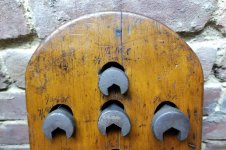
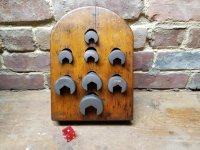
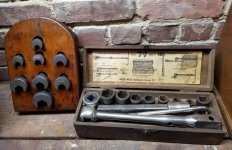
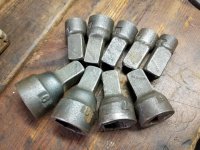
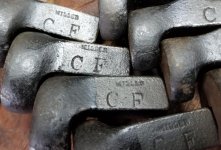
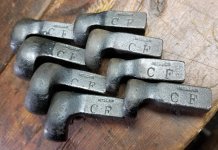
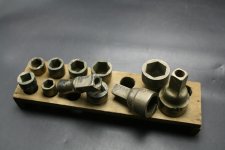
I recently acquired this set of primitive detachable crowfoot wrenches from a gent in New Jersey who found them at an estate sale.

attachment.php


I have no way of knowing if they originally came from the factory with this little coffin-shaped rack, but I suspect homemade on that. Either way it is easily as old as the wrenches.

attachment.php


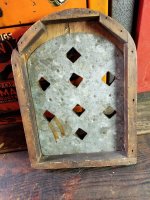
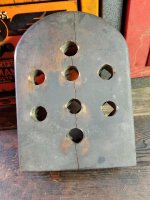
It was caked with shop grime and nicotine residue when I got it. You can see where the wrenches left impressions from having hung there for so long. The construction is interesting, with a galvanized sheet steel backing.

attachment.php


attachment.php


attachment.php


Cleaning the grime off the wood took a good hour of gentle rubbing with Murphy’s, revealing that a previous owner made little crib notes about the sizes of the wrenches on the wood next to each square opening. More on that below.

attachment.php


attachment.php


I have a lot more to post, so bear with me...

(Post 1 of 7)
 

Attachments

  • Miller CF 1.jpg
    Miller CF 1.jpg
    149.4 KB · Views: 776
  • Miller CF 7.jpg
    Miller CF 7.jpg
    148.3 KB · Views: 750
  • Miller CF 6.jpg
    Miller CF 6.jpg
    156.3 KB · Views: 752
  • Miller CF 5.jpg
    Miller CF 5.jpg
    82.3 KB · Views: 752
  • Miller CF 4.jpg
    Miller CF 4.jpg
    128.7 KB · Views: 755
  • Miller CF 3.jpg
    Miller CF 3.jpg
    94.3 KB · Views: 755
  • Miller CF 2.jpg
    Miller CF 2.jpg
    152.7 KB · Views: 759
To avoid these ads, REGISTER NOW!
OP
P

Private Lugnutz

Well-known member
Joined
Mar 30, 2012
Messages
30,477
Location
The Authentic Jersey Shore
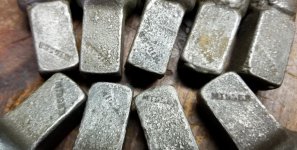
The guy who found them is an antiques dealer who does not normally carry tools. He was advertising it as “C.F. MILLER crowfoot wrenches,” but I found it odd that the “MILLER” stamping was above the “C.” and the “F.” on each piece, and much smaller, reading more naturally like “MILLER C.F.” to me.

attachment.php


attachment.php


I thought I recognized the “MILLER” stamping as the same "MILLER" stamping that is on the sockets that the Charles Miller Company made later in notable tools inventor Charles Miller’s career, well after his first venture (Miller Combination Tool), second venture (C.M.B. Wrench), and his licensing arrangement with Syracuse Wrench Company, which allowed Syracuse to use his 1907 ratchet (845,716) and T-handle (845,717) patents for royalties.

attachment.php


attachment.php


attachment.php


Also, Miller never used a middle initial, “F.” or any other letter, on any labels or in any business literature or official capacity. It was always either Charles Miller or just Miller.

attachment.php


attachment.php


Post 2 of 7
 

Attachments

  • Miller CF 13.2.jpg
    Miller CF 13.2.jpg
    57.9 KB · Views: 665
  • Miller CF 13.1.jpg
    Miller CF 13.1.jpg
    155.5 KB · Views: 672
  • Miller CF 12.jpg
    Miller CF 12.jpg
    150.9 KB · Views: 678
  • Miller CF 11.jpg
    Miller CF 11.jpg
    154 KB · Views: 676
  • Miller CF 10.jpg
    Miller CF 10.jpg
    154.3 KB · Views: 681
  • Miller CF 9.jpg
    Miller CF 9.jpg
    155.6 KB · Views: 696
  • Miller CF 8.jpg
    Miller CF 8.jpg
    155 KB · Views: 705
OP
P

Private Lugnutz

Well-known member
Joined
Mar 30, 2012
Messages
30,477
Location
The Authentic Jersey Shore
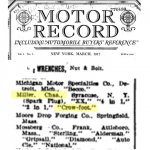
Based on all of the above, and some ads I found for Charles Miller Crow Foot wrenches in very early (1915 and 1917) trade journals…

attachment.php


attachment.php


…I have a high degree of confidence that the “MILLER C.F.” marking on each wrench signifies Miller Crow Foot.

It seems almost too obvious to be true, but it’s the only explanation that makes sense, which was supported by some deep research I did into the origins of these wrenches.

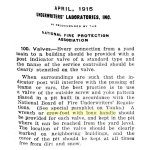
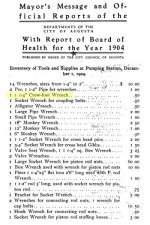
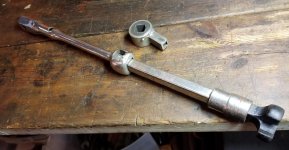
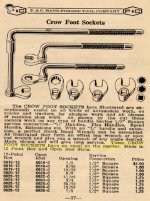
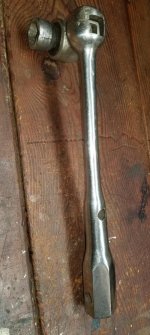
As most of you guys already know, these wrenches typically came with the jaw welded or forged onto the end of a long shank in an offset position meant for reaching into tight spaces in and around pipes and apparatuses in the railroad and power industries. I found numerous examples in early trade journals and other literature. Note that the term for the wrench was either written as two words (“Crow Foot”) or hyphenated (“Crow-Foot”). It doesn’t seem to have evolved and been standardized as one word (“Crowfoot”) until much later.

attachment.php


attachment.php


attachment.php


attachment.php


attachment.php


Post 3 of 7
 

Attachments

  • 1915 Underwriters blurb Crow-Foot.jpg
    1915 Underwriters blurb Crow-Foot.jpg
    122.5 KB · Views: 649
  • 1909 Power and Engineer.jpg
    1909 Power and Engineer.jpg
    119.7 KB · Views: 650
  • 1906 Calumet Chicago Railway Supplies.jpg
    1906 Calumet Chicago Railway Supplies.jpg
    75 KB · Views: 648
  • 1904 Augusta GA Pump Station Report.jpg
    1904 Augusta GA Pump Station Report.jpg
    110.3 KB · Views: 651
  • 1901 Iron Age.jpg
    1901 Iron Age.jpg
    126.5 KB · Views: 653
  • Chas Miller Crowfoot MR 1917.jpg
    Chas Miller Crowfoot MR 1917.jpg
    105.3 KB · Views: 651
  • Chas Miller Crowfoot Eng Dir 1915.jpg
    Chas Miller Crowfoot Eng Dir 1915.jpg
    133.3 KB · Views: 657
Last edited:
OP
P

Private Lugnutz

Well-known member
Joined
Mar 30, 2012
Messages
30,477
Location
The Authentic Jersey Shore
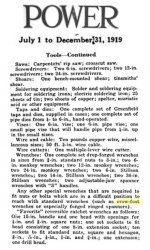
Here are some more. I really like the wrench in the first ad. The Crowfoot ends are fixed on the ends of the shank, but the handle is adjustable. Also throwing in an ad for a Charles Miller wrenches catalog from 1919, only a few years after the 1915 and 1917 ads, implying these were probably made into the early 20's.

attachment.php


attachment.php


attachment.php
 

Attachments

  • 1919 Miller Catalog ad.jpg
    1919 Miller Catalog ad.jpg
    84.9 KB · Views: 639
  • 1919 Power.jpg
    1919 Power.jpg
    111.4 KB · Views: 639
  • 1916 Railway Brake Wrench.jpg
    1916 Railway Brake Wrench.jpg
    91.1 KB · Views: 641
OP
P

Private Lugnutz

Well-known member
Joined
Mar 30, 2012
Messages
30,477
Location
The Authentic Jersey Shore
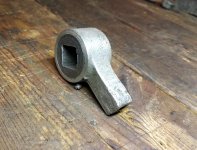
These early detachable crowfoot attachments operate on the same principle as the sockets that Charles Miller made, with 5/8-inch square male drive tangs. That allows them to be used with any combination of the Charles Miller handle, extension, and ratchet head, which are all 5/8-inch square female drive.

attachment.php


attachment.php


attachment.php


attachment.php


Post 5 of 7
 

Attachments

  • Miller CF 14.jpg
    Miller CF 14.jpg
    152.2 KB · Views: 629
  • Miller CF 15.jpg
    Miller CF 15.jpg
    151.4 KB · Views: 630
  • Miller CF 16.jpg
    Miller CF 16.jpg
    150.3 KB · Views: 631
  • Miller CF 17.jpg
    Miller CF 17.jpg
    150.7 KB · Views: 628
OP
P

Private Lugnutz

Well-known member
Joined
Mar 30, 2012
Messages
30,477
Location
The Authentic Jersey Shore
I haven’t been able to locate the Miller patent yet, or any other patent for a detachable crowfoot in this early detachable era (pressed steel, cast, and machined). But I haven’t found any other detachable crowfoot drive tool attachments this old, from this early detachable era.

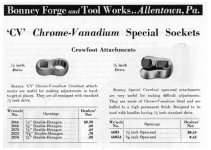
The earliest catalog I have found with detachable crowfoot wrenches from a major manufacturer of hot-forged tools is Plomb Catalog 9 (1929).

attachment.php


Bonney seems to have introduced them in 1932.

attachment.php


Interestingly, at this time, Snap-on was still making the more conventional Crowfoot wrenches, but they were hinging them on the end of a long shank with a cross-bar. I know they were making detachable crowfoot wrenches during WWII, because I have them, but I can't seem to find them in a catalog until 1946 - and those were the flarenut boxockets.

attachment.php


OPEN QUESTION #1: Has anyone seen detachable Crowfoot wrenches that can be dated to earlier than 1915? Has anyone seen detachable Crowfoot wrenches in a major manufacturers’ catalog earlier than 1929? If so, please chime in.

Post 6 of 7
 

Attachments

  • 1932 Snap-on Cat I.jpg
    1932 Snap-on Cat I.jpg
    104.2 KB · Views: 628
  • 1932 Bonney Catalog.jpg
    1932 Bonney Catalog.jpg
    111.8 KB · Views: 627
  • 1929 Plomb Cat 9.jpg
    1929 Plomb Cat 9.jpg
    64.8 KB · Views: 626
Last edited:
OP
P

Private Lugnutz

Well-known member
Joined
Mar 30, 2012
Messages
30,477
Location
The Authentic Jersey Shore
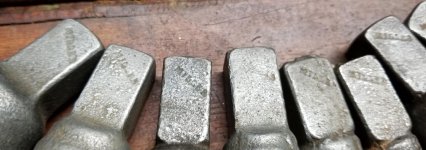
The MILLER crowfoot wrenches have some very interesting size markings, all followed by either a “C” or an “N.” (Also, this is the best view for seeing how they've been dipped in black enamel.)

attachment.php


None of the fractions on any of the wrenches are the milled opening sizes, they are the nut and bolt sizes the crowfoot attachment is meant to turn. As you can see, there are two (2) wrenches marked “1/4”, two (2) marked “3/8”, and two (2) marked “1/2”, followed by either a “C” or an “N”, but the wrenches are not duplicates. They have different size openings. And then there's a 5/16 N and a 7/16 N. My immediate hunch was that one of the wrenches were sized for U.S.S. and the other for S.A.E./Am.Std./Hex Cap nut and bolt standards, and I was correct. I made a little chart to summarize the situation.

attachment.php


But OPEN QUESTION #2 is, What does the “N” signify with respect to U.S.S.? And what does the “C” signify with respect to S.A.E./Am Std/Hex Cap? National? Coarse? Has anyone ever seen a “C” or an “N” suffix on any wrench size marking?

Post 7 of 7
 

Attachments

  • Miller CF 19.jpg
    Miller CF 19.jpg
    135.6 KB · Views: 623
  • Miller CF 20.jpg
    Miller CF 20.jpg
    77.8 KB · Views: 620
Last edited:
OP
P

Private Lugnutz

Well-known member
Joined
Mar 30, 2012
Messages
30,477
Location
The Authentic Jersey Shore
Would this be the same Miller who made tools for Chrysler/Dodge/Plymouth/Desoto transmissions in the '50s?
No. That was Miller Manufacturing Company in Detroit. They made specialty service tools for just about everybody, including the Ordnance Dept during WWII. And they ever so briefly owned Bonney! This Miller was in Syracuse his whole life. Started three different companies between 1900 and 1920's, based on his patents, and spawned a fourth (Syracuse). Tools known for male drive tangs, made of malleable iron, cast steel, and briefly, "silver metal" (a bronze-like composition). And now cool-*** detachable crowfoot wrenches! In 19 freaking 15!! :bowdown:
 

4xdog

Well-known member
Joined
Aug 18, 2012
Messages
5,595
Location
Santa Fe, NM
That's an informative and interesting discussion, Lugz. Thanks for it.

I don't have any crowfoot wrenches or attachments, even after 40+ years of accumulating my own tools, and inheriting all my father's and brother's. In fact, I may have only used them a couple of times in that period, and the name crowfoot never quite made sense to me, thinking of them only as attachments. The origin of the term is perfectly logical seeing some of those old catalog illustrations.
 

r_olson_06

Well-known member
Joined
Feb 12, 2012
Messages
4,076
Location
SD
That's an informative and interesting discussion, Lugz. Thanks for it.

I don't have any crowfoot wrenches or attachments, even after 40+ years of accumulating my own tools, and inheriting all my father's and brother's. In fact, I may have only used them a couple of times in that period, and the name crowfoot never quite made sense to me, thinking of them only as attachments. The origin of the term is perfectly logical seeing some of those old catalog illustrations.
I was in the same boat on the name until I seen the early picture and said well that makes perfect sense.
I recently acquired this set of primitive detachable crowfoot wrenches from a gent in New Jersey who found them at an estate sale.

attachment.php


I have no way of knowing if they originally came from the factory with this little coffin-shaped rack, but I suspect homemade on that. Either way it is easily as old as the wrenches.

attachment.php


It was caked with shop grime and nicotine residue when I got it. You can see where the wrenches left impressions from having hung there for so long. The construction is interesting, with a galvanized sheet steel backing.

attachment.php


attachment.php


attachment.php


Cleaning the grime off the wood took a good hour of gentle rubbing with Murphy’s, revealing that a previous owner made little crib notes about the sizes of the wrenches on the wood next to each square opening. More on that below.

attachment.php


attachment.php


I have a lot more to post, so bear with me...

(Post 1 of 7)
Nice write up Lugz. Very unique early tools.

Looking for the following Plomb Pebbles Wrench 3061
 

MR.X

Well-known member
Joined
Dec 13, 2010
Messages
1,792
The earliest catalog I have found with detachable crowfoot wrenches from a major manufacturer of hot-forged tools is Plomb Catalog 9 (1929). ........

OPEN QUESTION #1: Has anyone seen detachable Crowfoot wrenches that can be dated to earlier than 1915? Has anyone seen detachable Crowfoot wrenches in a major manufacturers’ catalog earlier than 1929? If so, please chime in.....

Off the top of my head P&C has 'em in their 28, should be a copy on the P&C website...so that's not bumping the date back towards your set much but you asked.
Also, unless that set of yours has been online or outside of your area I have seen another one like it including the tin backed wood holder which I had assumed was shop made when i saw it.
 

NJ Marty

Well-known member
Joined
Oct 20, 2014
Messages
1,157
I was at that sale in Kinnelon and saw them. Pretty cool you would up with them.
 
OP
P

Private Lugnutz

Well-known member
Joined
Mar 30, 2012
Messages
30,477
Location
The Authentic Jersey Shore
Thanks, 4xdog, OTG, and Roy.

Thanks, Marty. One of the perks of living in a beastcoast industrial state! :)
Off the top of my head P&C has 'em in their 28, should be a copy on the P&C website...so that's not bumping the date back towards your set much but you asked.
Thanks, X. I didn't check P&C. Glad you chimed in. That page is interesting for a few reasons.

attachment.php


One, showing them with their handles helps illustrate how they were derived from their fixed shank ancestors.

Two, check out the yellow highlighted area. "No equal" could be referring to their quality. But only if there were others being made. I think they are referring to their uniqueness. P&C may have been the first to make them in the early hot-forged era that followed the earlier pressed/cast steel and malleable iron era. By 1928, Miller, along with all the other funky early era makers (Eastern Machine Screw, Syracuse, Billmont, Chicago Mfg and Distributing, "Ray", etc) was no longer in business.

So, likely first ever: Miller. (I have yet to see any detachable crow feet from Mossberg or Walden or the mfgrs I mentioned above or any other early mfgr).

Likely first in socket drives tools as we basically still know them today: P&C.

Do you have any SWAGs on what the "C" (S.A.E./Hex Cap) and the "N" (U.S.S.) size suffixes might be signifying?
 

Attachments

  • 1928 P&C Crow Foot.jpg
    1928 P&C Crow Foot.jpg
    111.7 KB · Views: 538
OP
P

Private Lugnutz

Well-known member
Joined
Mar 30, 2012
Messages
30,477
Location
The Authentic Jersey Shore
Does anyone have any SWAGs on what the "C" (S.A.E./Hex Cap) and the "N" (U.S.S.) size suffixes might be signifying?

This is where I was hoping that early collectors like leg17, humber, and HeelSpur would do some thinking with me.
 

Oregon rock crusher

Well-known member
Joined
Jun 28, 2016
Messages
1,903
Location
West of Salem
I tried looking up in machinery's handbook to see if there was a standard for 'Compression' fittings for hydraulic connections but didn't see one. My earliest copy is from 1920 and I didn't find a standard for flare or ferrule type fittings. Compression fittings seems reasonable though as you may need a crowsfoot for access. Just something else to consider. Ed.
 
To avoid these ads, REGISTER NOW!

Modern Garage

Well-known member
Joined
Mar 26, 2015
Messages
583
Location
Southern Minnesota
Re: Charles Miller with no middle name, my grandfather Albert had no middle name either. I was told this was somewhat common in that era, and he used the second letter of his first name as a middle initial when required on legal documents.

We now return you to your regularly scheduled programming...
Joe
 
OP
P

Private Lugnutz

Well-known member
Joined
Mar 30, 2012
Messages
30,477
Location
The Authentic Jersey Shore
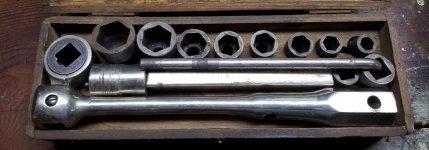
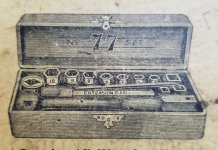
I’m going to post this Charles Miller No. 77 socket wrench set here at the end of my thread on Charles Miller crowfoot wrenches.

attachment.php


I already showed the set in post #2 upthread and it just makes sense. The crowfoot wrenches have 5/8-inch male drive tangs, just like the sockets, and they were turned with the same handles.

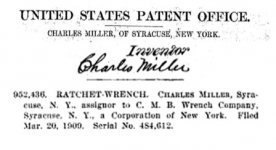
Miller was a prodigious inventor, involved in at least three other manufacturing outfits, from 1905 to 1912 or thereabouts, well before the era when he was making these crowfoot wrenches and socket wrench sets under his own name brand (1915 into early 20’s). He was a founder of the Miller Combination Tool Company, a co-founder of the C.M.B. Company, and he also collected royalties from the Syracuse Wrench Company. All three companies built tools based on his earliest patents (845,716, 845,717, 853,930, 952,435, and 952,436), which did not look anything like these tools.

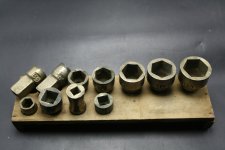
The Charles Miller No. 77 set comes in a wooden box and includes a ratchet head, a T-handle, an extension, an L-shaped tommy bar, eight (8) hex sockets, and two (2) square sockets. All the pieces are made of malleable iron. The handles are nickel-plated.

attachment.php


Knowing how to stow the pieces in a fairly compact box was made a little easier by the illustration in the center of the lid decal.

attachment.php
 

Attachments

  • Chas Miller 1.jpg
    Chas Miller 1.jpg
    153.9 KB · Views: 239
  • Chas Miller 2.jpg
    Chas Miller 2.jpg
    116.5 KB · Views: 240
  • Chas Miller 8.jpg
    Chas Miller 8.jpg
    155.4 KB · Views: 236
OP
P

Private Lugnutz

Well-known member
Joined
Mar 30, 2012
Messages
30,477
Location
The Authentic Jersey Shore
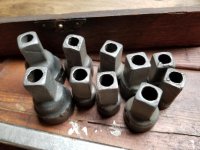
None of the sockets have size markings. All the sockets have model numbers cast into the side with “MILLER” stamped diagonally on the tangs, just like the Miller crowfoot wrenches. Measured, the hex socket service openings are 1” (No. 9), 7/8” (No. 8), 13/16” (No. 7), 11/16” (No. 6), 5/8” (No. 5), 9/16” (No. 6c), 7/16” (No. 4c) and 1/2” (No. 4). The square sockets are 5/8” (No. 5) and 1/2” (No. 4).

attachment.php


attachment.php


attachment.php


attachment.php


This set is a much different design than the Miller Combination, C.M.B., and Syracuse sets that used his earliest patents. Here are the key Charles Miller patent pieces from a Syracuse “Champion” Set No. 12 set for comparison.

attachment.php


AA has a smaller No. 99 set in their collection and they postulate that his earlier patents covered these, too, but I am not convinced of that. The ratchet works on the same principle (a simple cam-faced spring-pin), and I suppose you could interpret the connecting end of the main handle (with openings in the front and sides) as incorporating the principle he used on the earlier sets, with a separate fixture (T-Head) for turning extensions into a T or L handle. But this is all a stretch, in my opinion.

I have not been able to find any period ads for this or any other Charles Miller Company socket set.
 

Attachments

  • Chas Miller 7.jpg
    Chas Miller 7.jpg
    130.7 KB · Views: 233
  • Chas Miller 6.jpg
    Chas Miller 6.jpg
    123.7 KB · Views: 237
  • Chas Miller 5.jpg
    Chas Miller 5.jpg
    150.3 KB · Views: 234
  • Chas Miller 4.jpg
    Chas Miller 4.jpg
    147.5 KB · Views: 233
  • Syracuse Champ 3.jpg
    Syracuse Champ 3.jpg
    148 KB · Views: 233
OP
P

Private Lugnutz

Well-known member
Joined
Mar 30, 2012
Messages
30,477
Location
The Authentic Jersey Shore
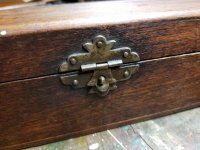
The box has an ornate clasp (identical to the clasp on the Syracuse Champion No. 12 set)...

attachment.php


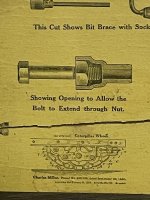
...and a marvelous paper label on the inside of the lid, reading "No. 77 Set" at the top, and "Charles Miller, Manufacturer, Syracuse N.Y.” at the bottom. Surrounding the branding and the set number are captioned illustrations of various configurations that can be accomplished with the handles and sockets.

attachment.php


Just for kicks, I duplicated the illustrations.

attachment.php


attachment.php


attachment.php


attachment.php
 

Attachments

  • Chas Miller 10.jpg
    Chas Miller 10.jpg
    149.4 KB · Views: 229
  • Chas Miller 9.jpg
    Chas Miller 9.jpg
    127.3 KB · Views: 231
  • Side Ratchet Wrench.jpg
    Side Ratchet Wrench.jpg
    81.1 KB · Views: 224
  • Spark Plug Ratchet Wrench.jpg
    Spark Plug Ratchet Wrench.jpg
    146.7 KB · Views: 225
  • Ratchet Wrench.jpg
    Ratchet Wrench.jpg
    132.2 KB · Views: 226
  • T Socket Wrench with Extension Bar.jpg
    T Socket Wrench with Extension Bar.jpg
    149 KB · Views: 223
OP
P

Private Lugnutz

Well-known member
Joined
Mar 30, 2012
Messages
30,477
Location
The Authentic Jersey Shore
A few more...

attachment.php


attachment.php


attachment.php


attachment.php


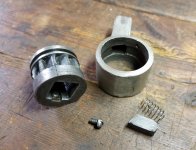
And of course I just had to disassemble the ratchet head out of curiosity, and applied some grease before re-assembling.

attachment.php
 

Attachments

  • Spring.jpg
    Spring.jpg
    92.6 KB · Views: 222
  • Ratchet Head Pieces.jpg
    Ratchet Head Pieces.jpg
    148.3 KB · Views: 223
  • Ratchet Head.jpg
    Ratchet Head.jpg
    153.1 KB · Views: 224
  • T Ratchet Wrench.jpg
    T Ratchet Wrench.jpg
    149.5 KB · Views: 223
  • T Ratchet Wrench with Extension Bar.jpg
    T Ratchet Wrench with Extension Bar.jpg
    148.5 KB · Views: 224

Man of Many Vices

Well-known member
Joined
Aug 23, 2012
Messages
366
Lugnutz,
You are a true tool historian who, with 8,451 posts, shares your expertise with the tool world. No doubt your tool collection is measured in tons. You and a few others (Outlaws, Twertsy and Shiftless come immediately to mind) have earned a place on Mount Crushmore.

I thoroughly enjoy your contributions. Keep 'em coming.
 

Szilagyi

Well-known member
Joined
Jun 9, 2019
Messages
50
Location
Florida
Just saw this thread, awesome job diving into the history of this stuff. That homemade rack for the crowsfeet is crazy cool, that kind of old school real use stuff is awesome to me.
 
OP
P

Private Lugnutz

Well-known member
Joined
Mar 30, 2012
Messages
30,477
Location
The Authentic Jersey Shore
I thoroughly enjoy your contributions. Keep 'em coming.
Thanks, MMV. The collective knowledge base by many amateur tools historians on here is what makes GJ so special.

That homemade rack for the crowsfeet is crazy cool, that kind of old school real use stuff is awesome to me.
Agreed! I would've enjoyed the crowfoot wrenches even if they had come loose, without the rack, but the rack really elevates the coolness factor for me, too.
 

y'sguy

Well-known member
Joined
May 1, 2010
Messages
1,309
Location
Tulsa, Oklahoma
This is real interesting thread, Lugs. Thanks for sharing your knowledge as always. The tombstone "holder" is really special.

:beer:
 
OP
P

Private Lugnutz

Well-known member
Joined
Mar 30, 2012
Messages
30,477
Location
The Authentic Jersey Shore
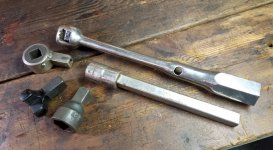
Don't really have a better place to put this early (fixed, non-detachable) crowfoot wrench, but I reference them several times in this thread and show a figure of one in post #3, so I am going to post these photos here. Appears to have been forged by Herbrand under contract (see the logo in Pic 3). It was in that large lot of early fixed socket wrenches I ran into at the flea market yesterday and I couldn't leave it behind.
 

Attachments

  • 20191228_221435.jpg
    20191228_221435.jpg
    125.3 KB · Views: 27
  • 20191228_221523.jpg
    20191228_221523.jpg
    75.9 KB · Views: 27
  • 20191228_221538.jpg
    20191228_221538.jpg
    148.1 KB · Views: 46

MR.X

Well-known member
Joined
Dec 13, 2010
Messages
1,792
Nothing to add to the crowfoot subject but while digging thru my old stuff looking for some user non sparking tools I came across these which I'm sure, at the time, I threw in with the more modern tools because I didn't know where else to put them. Some kind of brass ish alloy. Non magnetic. I vaguely remember researching these way back in the day......anyway,.....more Miller examples.
 

Attachments

  • IMG_0032.JPG
    IMG_0032.JPG
    3.3 MB · Views: 31
  • IMG_0034.JPG
    IMG_0034.JPG
    3.3 MB · Views: 29
OP
P

Private Lugnutz

Well-known member
Joined
Mar 30, 2012
Messages
30,477
Location
The Authentic Jersey Shore
Very cool, X! I have to admit, that whole Miller/Syracuse "Silverking" composition thing remains a mystery to me. I have two Miller sockets sets, the Miller crowfeet, and a Miller-made Syracuse Champion socket set and they are ALL ferrous, ALL magnetic. But according to period ads, some of them were apparently cast of "German silver" also called "silver metal", a copper-nickel alloy that is supposed to be similar to brass. The finish was silver colored though. Maybe that's what you have and the silver wore off? I don't know. Like I said, it's one of those things I haven't resolved yet.
 
To avoid these ads, REGISTER NOW!
Top Bottom