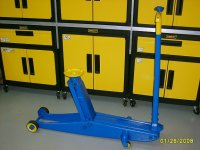
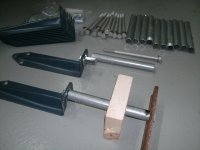
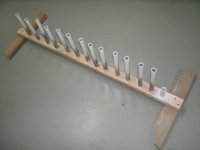
FIXING UP THE OLD MANLIFT (PART 4 OF ???))…
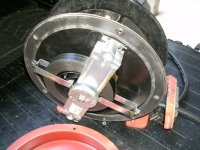
When greasing up the wheels, I found the cross member bowed slightly where the swivel casters mount on. It’s important that the caster base plate stay parallel with the ground for the swivel to spin freely - so off it came to get straightened out.

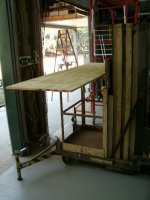
Again, the outriggers serve as a great way to service the casters. Not the wood blocks as the precautionary measure. I wasn’t going underneath it, but at 1000 pounds, it could still do some damage to limbs.
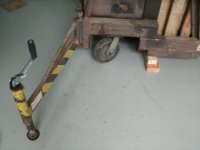

You should clearly be able to see the bow in the C-channel in this picture.
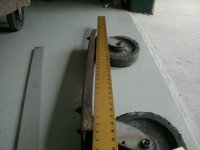
A large shop press is on my wish list, but this is what I came up with to straighten it - some 2x4 scraps appropriately placed below, and a piece on top where the ole sledge hammer would strike.

About 50 precision whacks later, it looks much better. I will keep an eye on it and reinforce it if it bends again. I have a feeling it will see a pretty easy life from now on, rolling around on my smooth, seamless floor compared to whatever torture it was subjected to before.


That made a big difference. The manlift would tend to wander a bit when rolling around due to that bent plate and the casters tending to swivel inward. It rolls so good now that I might have to rig up some type of “parking brake” to plant in when not in use (when the outriggers are stored, it’s difficult to swing the cranks).
WHAT A DIFFERENCE A NEW BATTERY CAN MAKE…
I got a chance to put the manlift through a good workout. I gathered some voltage numbers to compare to as the years go by and they are charted below. Beforehand, I charged the battery the night before and then it sat overnight and that’s where Cycle 0 starts. Average raise height was about 12’ so maybe half of its maximum lift.
The “Period Between” column indicates an approximate time that the battery sat before I hopped in the basket and rose up. "Short" would be I came down to grab a tool and went right back up. "Long" indicates maybe 10 minutes or longer when I came down to cut a piece of plywood or something. It shows that if the battery has a chance to sit for a while it recovers some voltage.
Cycle… Voltage (V)….Period Between
0…………..12.77……...………Start Point
1…………..12.74…...…………Long
2…………..12.64………...……Short
3…………..12.70………...……Long
4…………..12.53……...………Short
5…………..12.63…..…………Medium
6…………..12.57…...…………Short
7…………..12.58……...………Short
8…………..12.53……...………Short
9…………..12.61……...………Long
10…………..12.54…….………Short
11…………..12.52……….……Short
12…………..12.53……….……Short
13…………..12.56……….……Short
14…………..12.59………….…Long
15…………..12.55……….……Short
16…………..12.60……….……Long
17…………..12.52……….……Short
18…………..12.51……….……Short
19…………..12.47……….……Short
20…………..12.53……….……Medium
21…………..12.50………….…Short
22…………..12.48…….………Short
23…………..12.50….…………Medium
24…………..12.53…….………Long
25…………..12.47……….……Long
26…………..12.41……….……Short
27…………..12.40……….……Short
28…………..12.45……….……Medium
29…………..12.42……….……Short
30…………..12.46……….……Long
31…………..12.39……….……Short
32…………..12.37……….……Short
33…………..12.42……….……Long
34…………..12.43………….…Long
35…………..12.39………….…Short
Well let’s just say, it outlasted me - I ran out of gas long before the manlift did. It was still working fine and didn’t sound like it was slowing down yet. I’m simply thrilled with the performance.
Another thing worth noting is with the battery voltage down to 12.39 at the end of the day, the charger started out showing a 50% charge on it's gauge. After an hour, it was showing 75% and hung there for 2 hours. 100% occurred sometime before 8 hours (I was sleeping when it happened) and the battery returned to 12.90 volts. So that means one of my 12 hour timers will work nicely to power the charger long enough to achieve full charge, but not be on any longer than needed (Thanks for the tip,
Ompha!). It gives me piece of mind knowing there’s no chance of me forgetting something was left on when I head for home.
There were certainly times when I
could have charged the battery for a short period during the work day, like during lunch, but I didn’t for this test to work it as hard as possible. When charging opportunities present themselves, I well zap it a bit during breaks. I know from experience that batteres don’t like sitting in a deep discharge state and I think it’s better for a lead acid battery to stay at the higher end of it’s voltage range for longevity - I need to a little research to confirm.


 . it would go inot float mode and not cook the battery.
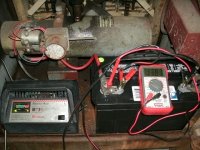

 . I have a number of 12 hour models sitting in the cabinet that would be perfect to turn off whatever charger I'm using when I'm not around. I just don't like have stuff powered up when I'm not here.