To avoid these ads, REGISTER NOW!

Above 1200 Sq/FT The ASYLUM - Happy 40th Birthday to Me! (Est. 2005)

Wokspaces above 1200 squarefeet.
OP
S

shopnut

Well-known member
Joined
Feb 22, 2006
Messages
4,237
Location
Florida
nine4gmc - Thanks - it's always good to have a plan "B" (or "C", or "D"). Initial testing is proving positive, so I'm hopeful this inexpensive version will pan out in this application. Longevity is, of course, another matter. If it does end up pulling a fair amount of moisture from the air, I may just buy another cheapie to throw on the shelf as a spare.

mdbeck1 - Thanks for reminding me to bring the thermocouples out on the next trip. I have one of those infrared probes but I haven't tried it on a known source yet to verify the accuracy. I will try to get as much data as I can (I'm curious myself!)
 
To avoid these ads, REGISTER NOW!

mdbeck1

Well-known member
Joined
Mar 7, 2010
Messages
2,297
Location
Norman, OK
nine4gmc

mdbeck1 - Thanks for reminding me to bring the thermocouples out on the next trip. I have one of those infrared probes but I haven't tried it on a known source yet to verify the accuracy. I will try to get as much data as I can (I'm curious myself!)

..and of course we'll need moisture readings from just outside the compressor and the other side of the chiller.
 
OP
S

shopnut

Well-known member
Joined
Feb 22, 2006
Messages
4,237
Location
Florida
..and of course we'll need moisture readings from just outside the compressor and the other side of the chiller.

Now you're pushing it buddy!

Hopefully water output in the separator canister will suffice (I guess I could weigh it for you :))
 

mdbeck1

Well-known member
Joined
Mar 7, 2010
Messages
2,297
Location
Norman, OK
Now you're pushing it buddy!

Hopefully water output in the separator canister will suffice (I guess I could weigh it for you :))

....but to analyze it properly don't you need to know a bunch of stuff... ...like ambient temperature, humidity, air flow across the coils, diameter of the coils, input and output temperatures, input and output humidity, and ????? Then we could go through a heat transfer book and figure out if we were getting the MAXIMUM cooling possible. Don't you WANT to know???


...okay, maybe I'm pushing it just a LITTLE bit too far....:evil:
 

E12-535iTurbo

Well-known member
Joined
Feb 27, 2014
Messages
492
Location
The Netherlands
..and of course we'll need moisture readings from just outside the compressor and the other side of the chiller.

Too bad I'm not as fast as Shopnut but I'm working on a simular setup and have the ability to measure pressure/temperature and humidity in a crazy accurate way. However it will take me quite some time to get up to that point. But then I'll be able to tell you exactly how the cooler performs. I'm guessing it will be somewhere in September/early October.
 
OP
S

shopnut

Well-known member
Joined
Feb 22, 2006
Messages
4,237
Location
Florida
mdbeck1 - Just as long as I don't have to pull out my old sling psychrometer, it will be okay.

2932-Sling-Psychrometer.JPG

(Funny you mentioned the Heat Transfer book though, I actually pulled out my old textbook - and then quick packed it away after it brought back some bad memories! ;))

E12-535iTurbo - "not as fast as Shopnut"!?! HeHeHe. You must be kidding! I've only been working on this place since 2005!

Please share your measurement methods - I'm sure I will still be working on this compressor install when Sept/Oct rolls around :sad:
 

E12-535iTurbo

Well-known member
Joined
Feb 27, 2014
Messages
492
Location
The Netherlands
mdbeck1

E12-535iTurbo - "not as fast as Shopnut"!?! HeHeHe. You must be kidding! I've only been working on this place since 2005!

Please share your measurement methods - I'm sure I will still be working on this compressor install when Sept/Oct rolls around :sad:

But you accomplished a bit more then only a cooler for compressed air. I can only dream of such a garage.

Nothing special about the measurement methods but I work at the engine development center for Paccar Trucks. I work at the department who's responsible for the engine test cells. My responsibilities are exhaust gas emission equipment and engine certification. This makes me have access (and carry all responsibilities) to all NIST traceable calibrated measurement equipment. Temperature, pressure, flow, humidity.... we have it all. So I should be able to get you a bit more accurate values than the weight of water that is being removed :). In-out pressure, temp, humidity is all you should really need.
 
OP
S

shopnut

Well-known member
Joined
Feb 22, 2006
Messages
4,237
Location
Florida
But you accomplished a bit more then only a cooler for compressed air. I can only dream of such a garage.

Nothing special about the measurement methods but I work at the engine development center for Paccar Trucks. I work at the department who's responsible for the engine test cells. My responsibilities are exhaust gas emission equipment and engine certification. This makes me have access (and carry all responsibilities) to all NIST traceable calibrated measurement equipment. Temperature, pressure, flow, humidity.... we have it all. So I should be able to get you a bit more accurate values than the weight of water that is being removed :). In-out pressure, temp, humidity is all you should really need.

Sounds like a fun job! I'm guessing the regulations are getting tighter and tighter so you probably really need to stay on top of things.

When we design a new engine package for our equipment, the diesel engine OEMs always send a field tech in for a day or two and monitor those types of things through our full range of our operations. With the electronic controls nowadays, it's amazing the amount of data they can pull right directly from the ECM. In the old days, we had to install sensors everywhere prior to their visit - now it's just a handful of them.

Now you have me wanting to borrow a few transducers from work to do some proper testing in the Asylum.

Keep working hard and stay focused on what's right so those dreams come true.
 
OP
S

shopnut

Well-known member
Joined
Feb 22, 2006
Messages
4,237
Location
Florida
INTRODUCING THE COMPRESSOR “STACK” SYSTEM…

After seeing the compressor aftercooler mounted in the cabinet, a friend of mine said it looked like a big rig exhaust stack and the stack name just stuck. So I decided to dub it:

The Asylum STACK System (STACK = Spiral Turbulating Air Compressor Kooler)

He also went on to say that it now needs some chrome on those pipes, but I’m thinking that would really blow my budget :).

228168_b72e894e5c64a5799e53cbcad46093fd_large.jpg


I had just enough room to stuff the larger 6” ductwork in the front corner of the cabinet. A louver is being used where it will draw cool air in just above the control panel. Hot air from the aftercooler will exit up above the compressor where it will be collected by a second larger exhaust fan (8”, 400 cfm) that will be cooling the entire cabinet (mostly the pump and motor). The entire after cooler system is mounted directly to the compressor and moves with it (I will demonstrate exactly how much it can move in a future video).

2933-CH-60G-Compressor-616 (STACK).jpg

Here you can see the copper line coming from the pump and the one returning the cooled air to the tank. It also shows where the aftercooler air is ducted up and out through the ceiling.

2934-CH-60G-Compressor-602.JPG

Here are those same two lines looping over the top of the motor. The one on the right is the pump line and it enters the top aftercooler in the picture. The other is the cool line returning from the water separator.

2935-CH-60G-Compressor-603.JPG

The following picture shows the inlet and outlet lines of the aftercooler. I would have preferred to not use the sharp 90 degree fittings here, but oh well. The two lines running downward out of the picture connect to the water separator.

2936-CH-60G-Compressor-607.JPG

And here are those two lines down at the foot of the compressor at the separator.

2937-CH-60G-Compressor-608.JPG

Note that the separator is mounted to the compressor foot and not the cabinet structure. I had to cope out the plywood to clear the separator and allow it to move with the compressor.

2938-CH-60G-Compressor-620.JPG

Since the water separator is only rated for 140F, I decided my first trial run would be made with this simple tee and ball valve installed. If temps prove low enough (crossing fingers), the separator would be swapped back in.

2939-CH-60G-Compressor-570.JPG
 
Last edited:
OP
S

shopnut

Well-known member
Joined
Feb 22, 2006
Messages
4,237
Location
Florida
Wingnut65 – Thanks. And yes that would agree with the budget much better. It’s amazing, but white corrosion is already starting to form on those brand new galvanized ducts after handling them with my sweaty paws during the build process.

Sonny2010 – Thanks! Glad you could stop by.

And to whomever boosted the Asylum thread rating – Thanks for your support! It had sat at 111 votes for quite some time.
 
OP
S

shopnut

Well-known member
Joined
Feb 22, 2006
Messages
4,237
Location
Florida
THE AFTERCOOLER (STACK) INTAKE LOUVER…

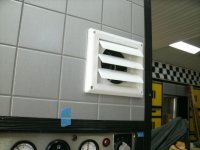
I spent most of my time in the dryer and HVAC duct aisle while buying parts for the aftercooler. I liked the way this clothes dryer exhaust louver looked, but unfortunately it was designed to blow air out and not **** it in. No problem, some little screws hold the louvers open.

2940-CH-60G-Compressor-609.JPG 2941-CH-60G-Compressor-611.JPG

The tileboard went back on temporarily and it was marked for a hole.

2942-CH-60G-Compressor-621.JPG

A holesaw made a simple job of it.

2943-CH-60G-Compressor-622.JPG

Here is the 4” inlet duct of the aftercooler peeking out the new hole.

2944-CH-60G-Compressor-626.JPG

And louver attached. I taped some of the black trim in place to get a feel for the looks.

2945-CH-60G-Compressor-624.JPG

The white colored louver just didn’t fit in, so a quick shot of black paint in my EPA-approved spray booth was a must.

2946-CH-60G-Compressor-625.JPG

Now to let the paint dry... (queue up the Jeopardy theme song)
 
Last edited:
OP
S

shopnut

Well-known member
Joined
Feb 22, 2006
Messages
4,237
Location
Florida
VENTILATION FOR THE COMPRESSOR CABINET…

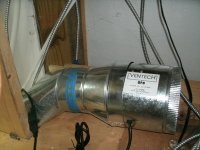
Up above the compressor, I will be using the right angle ventilation duct I showed earlier and an 8” inline fan (400 cfm) to exhaust the hot air. For now, it will just dump into the storage loft, but eventually I would like to blow it outside (don't really need any more heat in this shop!). The blue tape is just temporarily holding things together in the picture during a trial fit up.

2947-CH-60G-Compressor-599.JPG 2948-CH-60G-Compressor-600.JPG

What was really cool about this second fan was that it helps draw air up through the aftercooler even when the 6” lower fan isn’t running so I know it’s going to boost the cfm flow somewhat when both are powered up.

AND FINALLY, THE MOMENT OF TRUTH…

With all the ductwork in and copper air lines routed, it was time for the true test – lets pump some air!. It was a typical summer day here in Florida and ambient temps were in the low 90’s. Humidity level was actually pretty low for us this time of year at about 70% because it hadn’t rained for a couple of days.

The max temp I measured was 347F at the pump outlet (see the laser dot) during a full 0-125 psi pump up cycle. That seemed really high so I really need to pull out my good Omega thermocouples to double check this cheap HF infrared gun (thanks again for the reminder mdbeck1). Anyways, she was running hot, regardless what the actual temperature was, but it IS summertime I suppose.

2949-CH-60G-Compressor-593.JPG

Despite the high ambient heat, I’m very happy to report:

THE AFTERCOOLER WORKS !!!

Temperatures never exceeded 125F down at the water separator! I didn’t measure the amount of water collected on the initial full pump up cycle, but it consistently pulled this much water out of the air during any given 95-125 psi cycle or about 1.5 minutes of run time (maybe a 1/2 ounce?). I was actually quite amazed with the overall performance of the STACK cooler without any heat transfer fins on the coil.

2950-CH-60G-Compressor-597.JPG

A video will explain things much better, and that is up next.
 
Last edited:
OP
S

shopnut

Well-known member
Joined
Feb 22, 2006
Messages
4,237
Location
Florida
Any way to re-engineer the vent to turn the face of it around to **** inward?
Maybe. But it is all one big molded plastic piece. Possibly the snap-in louvers could have been flipped around, but I think that would have looked a little goofy. I just wanted something to hide the large opening a little bit without blocking airflow and the screws seem to do the job.

BTW, as purchased, the louvers lie completely flat and I never showed a picture of that. This link shows it with the louvers closed:

Imperial dryer vent

.
 
Last edited:
OP
S

shopnut

Well-known member
Joined
Feb 22, 2006
Messages
4,237
Location
Florida
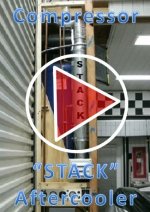
DOUBTING THE "STACK" WORKS??? - THIS VIDEO SHOULD HELP…

No, I don’t really think any of you doubt me, but I was so amazed at how well this worked that I had to capture it on film so I myself would believe it. The video is exactly 3 minutes long so it won’t blow your entire night (unless you watch it 100 times like I did :)). Sorry, it’s a bit blurry and I don’t know why my camera wasn’t auto-focusing correctly.

A little commentary on the video:
I start by showing the water separator downstream of the Asylum STACK system is totally empty. At that point, with the tank sitting with 90 psi (95 is low set point for the pressure switch), I switch the compressor on. You will then be thrilled to see my makeshift flow indicator hard at work dancing in the wind. I pan up to show the entire STACK system in all its galvanized glory (which is already starting to rust :(). Then because I thought you would get bored waiting for the compressor to hit the 125psi trip-off point, I tug on a red strap that’s attached to the compressor up by the motor. I do this to demonstrate the true cushioning effect of the soft iso-mounts under the feet of the compressor. You will see the whole thing sway back and forth, including the STACK system, which is rigidly attached to the compressor tank.

I then pan around where something amazing will be witnessed - water actually dripping down through the water separator. Yep, water is condensing at a decent rate. The next thing I do is crazy (well, maybe not since I had just done it 6 times prior to record this and knew what to expect :)) - I grab the copper lines! They are warm to the touch (maybe 110-115F), but fine for the water separator max of 140F. In fact, the highest I saw it go in this section of piping is 125F during the full 0-125psi cycle and I could still hold my hand on it.

And just to show how much water was in there after the minute and a half of running, I dump it out for all to see. End of the show.

So there you have it, the STACK works, and works pretty well if I do say so myself. I do foresee a couple drawbacks to it and I will explain that shortly in future post.

Click on the picture or this LINK to start the youtube video:
 

Attachments

  • 2951-Compressor STACK Video.JPG
    2951-Compressor STACK Video.JPG
    44.5 KB · Views: 3,299
Last edited:

E12-535iTurbo

Well-known member
Joined
Feb 27, 2014
Messages
492
Location
The Netherlands
Nice! You also have that cycling tank drain still installed right?

I'm collecting some ball valves today to be able to make a simular version. I've the air filters/separators at home already and designed a compressor box to cut down the noise.
 
Last edited:
To avoid these ads, REGISTER NOW!

akdiesel

Well-known member
Joined
Aug 8, 2008
Messages
2,617
Location
Wasilla, AK
Shotpnut

Very tight space to pack all those parts in, but you got a great system. Nice work.
Your location does have its challenges.
 
OP
S

shopnut

Well-known member
Joined
Feb 22, 2006
Messages
4,237
Location
Florida
E12-535iTurbo – Sounds like your system is starting to materialize, good for you on making progress. I like to do a temporary “dry fit” once I have all the parts on hand - sometimes it shows opportunities for improvement before everything is sealed up. With tapered pipe thread (NPT) that we often use over here however, I have to estimate the extra amount of overlap the threaded joints will have when screwed together at final assembly. I’m not sure what type of fittings you plan to use, but I am curious to hear what is normally used in you piping systems over there (BSPT? Some type of metric?).

Yes, the dual 3-way drain valve system is still in place. In fact, I think you can hear it pop (releasing its little puff of air) when I rotate the silver timer knob ON in the video. I also still have the second water separator in place downstream of the tank shutoff valve – hopefully no water makes it that far in the system anymore, but we shall see.

Next, I will be switching my efforts to the enclosure, with the cooling air path and acoustics as the primary concerns.

akdiesel – Yep, 10 pounds of stuff in a 5 pound bag - just a typical day in the Asylum. At least nothing is bulging out the sides… yet! :)

When you live in a sauna with humidity levels typically around 70 to 90%, something needs to be done. I decided I had sprayed enough water out of my air nozzle.
 

Bob Heine

ALLIANCE MEMBER
Joined
Oct 24, 2009
Messages
10,703
Location
Boca Raton, Florida
When you live in a sauna with humidity levels typically around 70 to 90%, something needs to be done. I decided I had sprayed enough water out of my air nozzle.
Shopnut,

Excellent job! Another benefit to reduced water in the air lines is avoiding frostbite! When using a die or angle grinder spinning at 20,000 rpm, the instantaneous drop in pressure means the outlet temperature drops dramatically. Before I took any steps to de-humidify the air from my compressor, frost would build up on the outlet and many times the air motor would lock up. Of course having a backup to use while waiting for the tool to thaw also works.
 
OP
S

shopnut

Well-known member
Joined
Feb 22, 2006
Messages
4,237
Location
Florida
Shopnut,

Excellent job! Another benefit to reduced water in the air lines is avoiding frostbite! When using a die or angle grinder spinning at 20,000 rpm, the instantaneous drop in pressure means the outlet temperature drops dramatically. Before I took any steps to de-humidify the air from my compressor, frost would build up on the outlet and many times the air motor would lock up. Of course having a backup to use while waiting for the tool to thaw also works.

My pneumatic tools have gotten cool to the touch, but I never thought it could be pushed to the frostbite level! Although I must say, with the temps so high in FL this time of year, it's almost a pleasant thought! :)

Thanks for stopping in Bob and sharing your experiences - it's always interesting.
 
OP
S

shopnut

Well-known member
Joined
Feb 22, 2006
Messages
4,237
Location
Florida
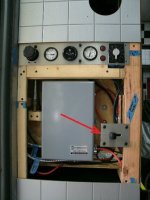
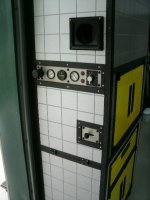
SMALL PANEL FOR THE COMPRESSOR MAIN SWITCH…

Since this little switch lever was made from a recycled push mower throttle cable, it was up to me to create a plate matching the main compressor control panel.

2952-CH-60G-Compressor-640.JPG

The two screws on the right fasten it in place while the other two serve no purpose whatsoever other than to make it look symmetrical.

2953-CH-60G-Compressor-642.JPG

I drilled two holes where I wanted the wider slot to start and stop. The narrower slot is a lead-in from the edge of the plate so it could be slid on the switch lever. The little cutout piece (temporarily taped in the place it was cut out from) was filled down to fill the lead-in. The filler piece wasn’t quite long enough to reach the edge, but some black trim around the perimeter will cover it.

2954-CH-60G-Compressor-644.JPG

A rectangular hole was cut into the tileboard, which will soon become a hinging access panel to the timer.

2955-CH-60G-Compressor-646.JPG

Note the door panel is merely taped on in the picture so hinges and trim are coming next.
 
Last edited:
OP
S

shopnut

Well-known member
Joined
Feb 22, 2006
Messages
4,237
Location
Florida
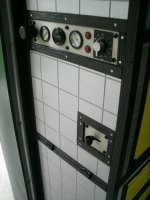
A HINGED PANEL TO ACCESS COMPRESSOR TIMER…

I was fretting building this little door because I knew it was going to be a lot of tedious work – and it was! But it is behind me now, with the exception of some quarter-turn latches to hold it shut and black screws to replace the silver ones.

2956-CH-60G-Compressor-663.JPG 2957-CH-60G-Compressor-664.JPG 2958-CH-60G-Compressor-666.JPG

Swinging the door down seemed like the best overall solution to avoid blocking anything when opened. The back of that door seems like the perfect spot for a schematic.

2959-CH-60G-Compressor-672.JPG 2960-CH-60G-Compressor-670.JPG

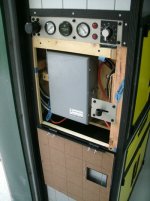
Here are a couple of views of the (nearly) finished lower section of cabinet.

2961-CH-60G-Compressor-675.JPG 2962-CH-60G-Compressor-676.JPG

The base edge of the cabinet still needs some black trim and the whole right side is still wide open.
 
Last edited:

nine4gmc

Well-known member
Joined
Mar 24, 2012
Messages
14,357
Location
Dallas
Awesome shopnut!! That really came out well, you may want to cut some fiberglass filter element and put inside that intake vent. It will cut down on dust clogging up around the copper tubing. They also make cut to fit carbon filter element that comes in a 6" or 8" wide roll like 5' long. Great job!
 
OP
S

shopnut

Well-known member
Joined
Feb 22, 2006
Messages
4,237
Location
Florida
nine4gmc - Thanks! I think I got really lucky on this one. And for a change, it was on the first attempt!

I hadn't thought about some intake filter for the STACK cooling air, but it seems like a good idea to keep performance up over time. I built an inline lint filter for our clothes dryer about twenty years ago that could be adapted easily for this application. But unfortunately, I don’t have the 4” of extra length upstream of the fan to squeeze it in there.

So I suppose something right near the louver is my best bet since I can keep an eye on it there. If the filter media is flexible material, I guess I will need to come up with some kind of retaining method to keep it from getting sucked up in the fan. I also need to be careful it doesn't slow the air down an appreciable amount.

It looks like Amazon has those rolls for about $10 delivered, which seems reasonable. Do the big box stores carry this stuff? And if so, what area of the store might I find it? Thanks in advance.

The wheels are turning!

E12-535iTurbo - It appears great minds think alike. Now I just need to figure out how to join that club! :)
 

nine4gmc

Well-known member
Joined
Mar 24, 2012
Messages
14,357
Location
Dallas
I piked up a few rolls of the carbon cut-to-fit rolls at Lowes or HD a few years back, they should still have it or standard cut to fit filter at least.
 
OP
S

shopnut

Well-known member
Joined
Feb 22, 2006
Messages
4,237
Location
Florida
I piked up a few rolls of the carbon cut-to-fit rolls at Lowes or HD a few years back, they should still have it or standard cut to fit filter at least.

I'm headed to Lowes tomorrow to get some PVC pipe for the air lines (the pump intake line, of course :) ), so I will take a look for it. Thanks.
 
OP
S

shopnut

Well-known member
Joined
Feb 22, 2006
Messages
4,237
Location
Florida
RE-THINKING THE COMPRESSOR FAN CONTROL…

Now that there are two fans cooling the compressor, I decided to revamp my control logic just a bit. Here is how it now works:

8” Duct Fan
- Used for general cabinet ventilation and also provides boost for STACK cooler.
- Runs whenever main compressor switch is ON.
- Wired directly to set of contacts in main timer box.

6” Duct Fan
- Used exclusively for STACK aftercooler air flow.
- Runs only when compressor motor is running.
- Wired to new contactor, which is triggered by the compressor motor running.

Wiring the 8” fan into the timer was easy with extra contacts available on the timer. I wanted it to run extra to rid the cabinet of residual heat in between pump cycles, but running it all the time is maybe a bit excessive. I would still like to add a delay in this circuit to allow it to run for maybe 15 minutes after the motor stops running before shutting off. The Sparky’s would call this a “delay on break” timer relay and I will watch ebay for a cheap unit to add someday.

A new contactor (which works like relay) was added to switch the 110V STACK 6” fan motor ON and OFF. Here it is mounted in a 3-gang wall box.

2963-CH-60G-Compressor-629.JPG

This particular contactor has a 240V coil that switches the contacts, but other coil voltages are available. The same wires coming down from the pressure switch to power the hourmeter also energize the coil. Any voltage can run through the high power contacts in this device because they are independent from the coil and I have the 110V fan wires being switched with them. Although I’m not using them now, there are a number of spades below the screw terminals that other wires could be connected to in the future. For around $8-12, these are pretty handy devices.

2964-240V Relay.JPG

Here is the contactor all wired up. Black and white wires with loops are for the fan line and load. Signal wires from the pressure switch telling when the motor is running attach to the coil wires on the top and bottom. This also ended up being a convenient spot to attach the wires going over to the hourmeter.

2965-CH-60G-Compressor-634.JPG

Here’s a shot zoomed out showing the new blue contactor box on the left side. Luckily, there is still room to stash my portable air tank in this area behind closed doors. :)

2966-CH-60G-Compressor-636.JPG

Wires will get organized a bit better before I wrap this project up. There’s no sense in doing this until everything is wired up and functioning properly (I'm nearly there).
 
Last edited:

Vernmotor

Well-known member
Joined
Jan 12, 2008
Messages
1,318
Location
Mt.vernon oh
I have a attic heat relay in mine. get's warm turn on the fan..cool down shut it off. Most homes that have attic fans. have this. bought it at lowes
 
OP
S

shopnut

Well-known member
Joined
Feb 22, 2006
Messages
4,237
Location
Florida
I have a attic heat relay in mine. get's warm turn on the fan..cool down shut it off. Most homes that have attic fans. have this. bought it at lowes

Good idea! Back years ago when the place was built, a thermostatic switch was installed for my 36" exhaust fan. You can see it in this picture on the very far right (black box).

attachment.php


I ended up replacing it with this spring wound timer so I could control exactly when it ran (I use it mainly for fume not heat removal) and so I wouldn't forget to turn it off.

2967-Exhaust-Fan-09.JPG

So that old dial switch is still sitting in the drawer waiting to be used. I might just rig it up and see if it works for this application. It was controlling a 110V fan so it should be compatible. I suppose it will need to be mounted somewhere near the pump and motor where most of the heat is generated.

Thanks for your input!

.
 

E12-535iTurbo

Well-known member
Joined
Feb 27, 2014
Messages
492
Location
The Netherlands
I was sketching some stuff of my own design and was working on the electronics and realized you didn't wire in a emergency stop to cut all power. I guess there is one on the original pump but that is inaccessable with the enclosure. I might have overlooked it so correct me if I'm wrong.

I'm thinking: strange noises from the pump, a seizing compressor, overheating stuff and worst case fire within the enclosure.
 
OP
S

shopnut

Well-known member
Joined
Feb 22, 2006
Messages
4,237
Location
Florida
akdiesel - Thanks. I treat my own DIY monstrosities just like the stuff I buy - there's ALWAYS room for improvement! :)

E12-535iTurbo – Sadly, I fear a fire is much more likely to originate from some of my faulty wiring :sad: :).

Considering my amateur wiring abilities, I suppose I really should have designed in a fire suppression system and/or at least one of these:

2968-Emergency-Stop-Button-Example.jpg

For the two circuits that power my system, the switch would need to be a 3-pole version to cut off the hot lines to the two 220V legs and the single 110V leg (not exactly sure how you do things in The Netherlands).

But this is what I DO have at the moment and it’s probably adequate (famous last words!):
1 - There is a main circuit breaker in the distribution panel for each circuit feeding the compressor cabinet. I know that many people simply use the breaker to switch the compressor on and off.
2 - Downstream of that is the timer switch (which I will be using on a daily basis via the remote mower throttle cable).
3 - Still further downstream is the original compressor ON/OFF switch integrated into the pressure switch assembly.

Here is the dedicated breaker for the compressor.

attachment.php


It is located in a safe spot across the room from the compressor cabinet in case a blazing fire keeps me from getting any closer :) Let's hope it doesn't come to that!
 
Last edited:
OP
S

shopnut

Well-known member
Joined
Feb 22, 2006
Messages
4,237
Location
Florida
THE COMPRESSOR AIR INTAKE FILTER…

With all the work I have done to this air compressor system, you can’t expect me to keep the stock air filter, can you? Beside noise attenuation, I want the compressor to draw cool ambient air when running.

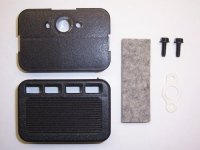
Here’s what I found when I pulled off the lid on the original little rectangular unit.

2969-CH-60G-Compressor-648.JPG

Here are the parts that make up the stock box.

2970-CH-MP333200SJ-Intake Filter.jpg

Luckily, the port is already threaded for 1/2 NPT ****** so I have some choices for adding a conventional aftermarket filter/silencer.

2971-CH-60G-Compressor-652.JPG

The plan at this point is to connect to the compressor pump with a flexible hose and run down to a low point with PVC pipe where cool air is available. PVC is okay for the intake (vacuum) piping, right? :) The pipe is just resting in place in these pictures and the final routing will be slightly different. The fresh air intake will remain inside the cabinet to keep noise down, but it will inhale some of the motor/pump cooling air before it flows upward and gets heated.

2972-CH-60G-Compressor-653.JPG 2973-CH-60G-Compressor-655.JPG

At the lower end of the PVC pipe, I will attach one of these Solberg filters (FS-10-075). It’s rated for 2.5 times the flow capacity of my compressor. With any luck, it will show up in the mail before the next work session.

I still wonder about something though – if my pump produces 10.2 cfm on the compressed side, what is the cfm on the intake side? Seems like the flow would be much higher before the compression process, right? Maybe they rate them based on compressed air flow.

2974-Air-Filter-Solberg FS-10-075 Drawing with image.jpg

More to come on this subject after I gather all the parts and put the final version together. It time to head to Lowes (my second home).
 
Last edited:

E12-535iTurbo

Well-known member
Joined
Feb 27, 2014
Messages
492
Location
The Netherlands
PVC is fine for the intake.

As for the breaker for the compressor I take it that the other electronics like the fans etc. are also wired from the same breaker circuit? You don't want the have a fan blowing fresh air into a blazing fire ;).

All this progress and those nice pictures you post really makes me want to start building too. However untill now it's only a paper exercise for me. Although I'm gathering parts. My compressors are no way near as nice as yours but the rest of the setup will be. Keep up the nice work!! In time I'll return the favor by posting my own setup.
 
To avoid these ads, REGISTER NOW!
Top Bottom