DIF:
The stuff Carla used was the 'bluing in a bottle' type affair. It gives a similar appearance, but is a completely different beast to the proper bluing process, which involves acid rusting, neutralising, cleaning, then round and round in circles until the desired result is achieved.
Yes, as I said, I used the 'bluing in a bottle' material, which isn't bluing at all, actually a variety of black copper plate.
Thats the quickest and easiest way of getting a 'reasonable' finish on steels.
The other common options are the 'Du-Lite' hot caustic process, which involves a tank of caustic soda, with a little bit of some 'additives', the various recipes for which are found in the various books on gun work, and 'Parkerising', another 'hot bath' process, but not so hot or quite so hazardous.
Both of those are industrial processes, with some very real dangers involved, cheap per item if done in quantity production, but not really practical for someone doing just a few parts at any one time.
As a generality 'industrial finish' tools are blacked with a hot caustic process, which is fast, and really cheap per part if done on a medium or high volume production basis.
'Real' or 'traditional ' gun bluing or 'browning', as it was called, is a very different operation......I'd do it where its really needed, but its a lot of work, and one must really feel 'motivated'.
There are a number of traditional recipes for the 'tiger sweat' (or less polite term) acid formula which must be applied, ever so carefully, then the parts put in a 'humidity box' for awhile, then the 'rust' carefully carded off with a very fine wire brush........and this process has to be repeated, ever so carefully, for at least six, maybe a dozen times in all......eventually, the 'real finish' appears.
One must try any new 'batch' of acid-flavoured material on 'dummy' parts (which one hopes are a sufficiently similar steel) first, to know that one's batch of stuff has some 'bite', but not too much, and the temperature/humidity in the coffin has to be kept 'just right' as well.
Winchesters and some other arms firms did this in regular high-volume production for many years, to be sure, but setting up to 'get it right' for just a few parts is seriously tedious. (Even Winchesters eventually abandoned real browning, and went to the Du-Lite (hot caustic) process by the late 1930's)
Thats the kind of work everyone should try once or twice, just for the experience, but, as a practical matter, such work is better sent to specialist firms. Its not a realistically practical finish for such as hand tools or vises, unless one's working time is of very little value, or one really wants to be some sort of 'fanatic'. (for all I know, that may well be how the tool sets originally supplied with the Bugatti cars were done....they do 'look pretty'.)
cheers
Carla




 My wife says I'm never right.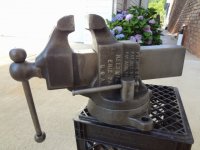


 .. has anyone any experience